In this compelling study, renowned author James D. G. Dunn provides a critique of the quest for the historical Jesus. Dunn claims that the quest has been misguided from the start in its attempt to separate the historical Jesus from the Christ of faith.
Dunn argues that Jesus scholars have consistently failed to recognize how the early disciples' pre-Easter faith and a predominantly oral culture shaped the way the stories about Jesus were told and passed on. Dunn also examines the implications of oral transmission for our understanding of Synoptic relationships.
A New Perspective on Jesus proposes a change in direction for Jesus scholarship. It will be of interest to pastors, church leaders, students, and thoughtful laypersons wanting a fresh perspective on Jesus studies.
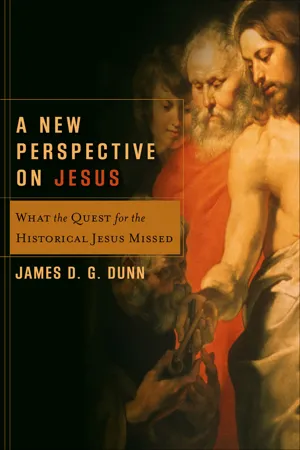
eBook - ePub
A New Perspective on Jesus (Acadia Studies in Bible and Theology)
What the Quest for the Historical Jesus Missed
- 136 pages
- English
- ePUB (mobile friendly)
- Available on iOS & Android
eBook - ePub
A New Perspective on Jesus (Acadia Studies in Bible and Theology)
What the Quest for the Historical Jesus Missed
About this book
Information
1
THE FIRST FAITH
When Did Faith Become a Factor in the Jesus Tradition?
In my recently published Jesus Remembered,[1] I attempt to engage with the long-running quest of the historical Jesus. I try to highlight what seem to me the key issues, historical, hermeneutical, theological, and the classic expositions of these issues. I note what also seem to me important advances made in the course of the quest, methodological insights that remain valid to this day. But above all I hope that my own contribution will itself constitute some advance in the quest—at three points in particular. Elaboration of these three points will be the purpose and content of the three chapters that follow. In each case it is my contention that the earlier quests have failed because they started from the wrong place, from the wrong assumptions, and viewed the relevant data from the wrong perspective. In each case they forgot what should have been more obvious than it evidently was and so lost the way almost from the beginning.
First of all, they forgot the impact made by Jesus. The disciple-making, faith-creating impact of Jesus should be a fundamental given and an indispensable starting point for any quest for the Jesus from whom Christianity originated. It is this failure to appreciate and to evaluate properly the role of faith from the very first that is the focus of my first line of criticism of earlier quests. Not all questers, of course, are equally open to this criticism; it is the main thrust and consistent emphasis of the various quests with which I find fault.
The Christ of Faith versus the Historical Jesus
If the quest of the historical Jesus is characterized by one feature above all others, it is the contrast between “the historical Jesus” and “the Christ of faith,” or probably more accurately, the antithesis between “the historical Jesus” and “the Christ of faith.”
As is well known, the quest began by way of reaction against the Christ of Christian dogma. The Christ of the Chalcedonian creed, “perfect in Godhead and perfect in manhood, truly God and truly man,” was just too unreal a human being. The Pantocrator, the world ruler, of Eastern iconography was too far removed from the man who walked the shores of the Sea of Galilee. How can we believe in such a Christ when, according to the Letter to the Hebrews, he was able “to sympathize with our weaknesses [and] . . . in every respect has been tempted as we are” (Heb. 4:15)? It is the human Jesus, the one who truly knew and experienced the reality of everyday existence in first-century Palestine, the Jesus who lived among the poor, who counted people like Martha and Mary as his close companions, who was known as “a friend of tax collectors and sinners” (Matt. 11:19), that we prefer to hear about. Is he not a more meaningful Savior than the almost mechanistic God-man or the remote Pantocrator? No wonder the cult of Mary, the mother of Christ, became so popular when her Son was so divine and so remote.[2] The heart yearning for comfort and an inspiring role model needed a mother figure to intercede with this awe-inspiring Christ, needed to rediscover the human Jesus behind the divine Christ.
The contrast between “the historical Jesus” and “the Christ of faith” initially came to prominence in the title of D. F. Strauss’s slashing critique of F. D. E. Schleiermacher’s Life of Jesus.[3] Schleiermacher’s lectures had been given in 1832 and were already seriously behind the times\ when they were published thirty-two years later. In them he had concluded that the Fourth Gospel was written by John the son of Zebedee and therefore gave the most reliable and authoritative connected presentation of the life of Jesus. In the Fourth Gospel Schleiermacher found a Jesus who was the historical actualization of his conceptualization of religion in terms of the “feeling of absolute dependence.” John’s Gospel shows a Jesus who was distinguished from the rest of men by “the constant potency of his God-consciousness, which was a veritable existence of God in him.”[4] “His consciousness of God never failed him, and apart from it he amounted to nothing.”[5] In response, Strauss’s critique was cutting. His opening words are ones of denunciation: “Schleiermacher’s Christology is a last attempt to make the churchly Christ acceptable to the modern world. . . . Schleiermacher’s Christ is as little a real man as is the Christ of the church. . . . The illusion . . . that Jesus could have been a man in the full sense and still as a single person stand above the whole of humanity, is the chain which still blocks the harbor of Christian theology against the open sea of rational science.”[6] And his concluding sentences are equally bleak: “The ideal of the dogmatic Christ on the one hand and the historical Jesus of Nazareth on the other are separated forever.”[7]
The great goal of the first phase of the quest of the historical Jesus, then, was to get behind the Christ of faith in order to recover the historical Jesus. The task was envisaged as though it was equivalent to restoring a great masterpiece: the layers of subsequent dogma were like the layers of varnish and dust obscuring the authentic brush strokes of a Michelangelo; only by stripping the layers of dogma away could the original authentic genius of Jesus himself be uncovered. So the war cry arose: back from the religion about Jesus to the religion of Jesus! Back from the gospel about Jesus to the gospel of Jesus himself! The task was to liberate the real Jesus, the historical Jesus, from the chains and obscurations of later faith.
Not altogether surprisingly, given such a goal, two of the most famous products of the liberal quest of Jesus uncovered a Jesus who was a far cry from the Christ of dogma. In Ernest Renan’s romantic reconstruction, we find a Jesus who promoted “a pure worship, a religion without priests and external observances, resting entirely on the feelings of the heart, on the imitation of God, on the direct relation of the conscience with the heavenly Father.”[8] And in Adolf Harnack’s even more influential version, we find a “historical Jesus” whose gospel centered on the fatherhood of God, the infinite value of the human soul, and the importance of love. For Harnack, “true faith in Jesus is not a matter of creedal orthodoxy but of doing as he did.”[9]
By this time it was already clear that to recover the historical Jesus was not simply a matter of stripping away the faith of creeds and later dogma. It was already the faith of the first Christians that needed to be stripped away. For Harnack, it was Paul who had begun the process of transforming the simple Jewish moralizing message of Jesus into the hellenizing religion of sacrificial cult. Jesus’ gospel focusing on the kingdom of God was transformed by Paul into the gospel focused on Jesus himself.[10] By that time, the end of the nineteenth century, Strauss’s conclusion that in the Fourth Gospel the Jesus of history had already been lost behind the Christ of faith had become the standard consensus. And William Wrede simply completed the circle by insisting that the Synoptic Gospels—not least the earliest of them, the Gospel of Mark—were also products of faith. “The messianic secret” of Mark, which holds the Gospel together, had been contrived in the process of composing Mark’s life of Jesus.[11]
Wrede’s conclusion proved to be of amazing influence and significance throughout the rest of the twentieth century; in the words of Norman Perrin, the Wredestrasse had become the Hauptstrasse.[12] It ensured that the Gospels, every one of the four canonical Gospels, would be regarded as products of faith. It ensured that the starting point for study of any Gospel passage would always be the assumption that the passage expressed the theology of that Gospel’s author. To argue that the passage may afford an insight into Jesus’ own understanding of his mission could never be assumed in the same way. The burden of proof always would lie with those who wanted to find here words that Jesus spoke or actions that Jesus took.[13]
This influence was soon reinforced by the development of form criticism. Form criticism began as an attempt to penetrate behind the written sources of the Gospels to uncover the earlier forms taken by the gospel story.[14] But the more influential aspect of form-critical method was the thesis that each unit of tradition must have had a life-setting, a Sitz im Leben, that explains and determined that form. The corollary was directly in line with the outworking of Wrede’s thesis: the unit of tradition reflects most directly the concerns and faith of its setting in life, its Sitz im Leben Kirche.[15] If the reader wants to maintain that it (also) reflects a Sitz im Leben Jesu, that has to be argued for. However, it is the Sitz im Leben Kirche that can be taken for granted and that may have created the unit, or at least have greatly modified the tradition to make it speak to that setting. Consequently, there can never be any assurance as to how much or how little may go back to the setting of Jesus’ own mission. The Christ of faith continues to obscure the historical Jesus.
Günther Bornkamm, in pleading the case for a new quest of the historical Jesus in the 1950s, well indicates how inhibiting such assumptions were. Almost immediately he observes: “We possess no single word of Jesus and no single story of Jesus, no matter how incontestably genuine they may be, which do not embody at the same time the confession of the believing congregation, or at least are embedded therein.” He continues: “In every layer, therefore, and in each individual part, the tradition is witness of the reality of his history and the reality of his resurrection. Our task, then, is to seek the history in the Kerygma of the Gospels, and in this history to seek the Kerygma.” “Nothing could be more mistaken than to trace the origin of the Gospels and the traditions collected therein to a historical interest apart from faith. . . . Rather these Gospels voice the confession: Jesus the Christ, the unity of the earthly Jesus and the Christ of faith.”[16] So the Christ of faith pervades the Gospels, and pervades them so thoroughly that the quest of the historical Jesus easily loses itself in the mist of post-Easter kerygma and faith, which seeps from every nook and cranny of the Gospel story.
It is this total lack of confidence in our ability to penetrate fully through the layers of post-Easter faith that has undoubtedly been a major factor in persuading many scholars of the past and present generation to shift their attention away from historical questions regarding Jesus to reconstructing the context to which each Gospel bears witness. Each Gospel bears more immediate witness to the situation that gave it birth than to the originating impulse of Jesus’ own mission. The debate about which traditions go back to Christ in, say, Mark’s Gospel, has become lost in confusion, and our hearing has been deafened by competing views, so let us focus rather on what Mark’s Gospel tells us about Mark’s community and its social and cultural setting.[17] Or, why torture our congregations with the grim news that we have so little confidence in our ability to hear and observe through the Gospels what Jesus himself did and said? It is more comfortable to bracket out questions of history and to focus on the closed world of the narrative itself, where discussion can be restricted within narrow and less threatening boundaries and attention can be devoted to highlighting each evangelist’s storytelling genius.[18]
The latest round in the epic contest, the historical Jesus versus the Christ of faith, appears in the work of the Jesus Seminar. Robert Funk, the doyen of the Seminar, makes no secret of his desire to rescue Jesus from Christianity; for Funk, the continuing purpose of the quest of the historical Jesus “is to set Jesus free from the scriptural . . . prisons in which we have incarcerated him. . . . The pale, anaemic, iconic Jesus suffers by comparison with the stark reality of the genuine article.”[19] The logic for this rescue effort is along predictable lines: whatever can be attributed to the communities that used this tradition is to be stripped away—any use or echo of Scripture; any saying that is not aphoristic, parabolic, or a sharp retort; any hint of baptismal practice or of the circumstances of the early Christian mission; anything that smacks of common Israelite or Judean lore or could have been said by any Christian sage; and particularly anything that is apocalyptic in character or hints at a Paul-like theology of the cross; or in a word, any sniff of faith.[20] Not altogether surprisingly, the Jesus who emerges for Funk is “a free spirit,” “a vagabond sage,” “the subverter of the everyday world around him,”[21] a historical reconstruction apparently all the more convincing because it stands at such odds with the traditional picture of Jesus drawn from the Gospels. Funk’s work and that of the Jesus Seminar are presumably intended to mark some kind of triumph of “the historical Jesus” over “the Christ of faith.”
In all this a striking feature is readily apparent: that in the quest of the historical Jesus, faith is a hindrance, faith leads the searcher down the wrong road, faith prevents the searcher from recognizing the real Jesus. Faith is bad, history is good. The Christ of faith is what we need to get behind; the perspective of faith obscures and deceives; we will only attain to the Jesus of history when all the elaborations and distortions of faith have been stripped away, and when all faith has been eliminated from the record and the resulting picture. What started as a protest against the artificialness of the creedal Christ, what began as an attempt to strip away the centuries-old layers of dogmatic and ecclesiastical contrivance, has ended up as a rejection of the Gospels themselves and their portrayal of Jesus and a deep-seated suspicion of the Jesus tradition as a whole. It is all, from start to finish, the product of faith and therefore to be discounted.
It is this whole thrust that I find it necessary to question and challenge—on two grounds: first, we must recognize that the first faith of the disciples is what makes it possible for us to gain any information about or insight into the Jesus of Galilee; and second, we must also recognize the fallacy of thinking that the real Jesus must be a nonfaith Jesus, different from the Jesus of the Gospels.
The Impact of Jesus
An inescapable starting point for any quest for Jesus should be the historical fact that Jesus made a lasting impact on his disciples. It can be regarded as one of the most secure of historical a prioris that Jesus made a deep impression during his mission. No one with any sense of history can dispute that Jesus existed and that he was active in some sort of mission in Galilee, probably in the late 20s or early 30s of the first century, prior to his execution in Jerusalem “under Pontius Pilate.” We know this because he left his mark on history. The historical fact of Christianity is impossible to explain without the historical fact of Jesus of Nazareth and of the impression he left. What he said and did evidently “got home” to many people, and the impact that he made on them has resonated down through history.
In particular, he made disciples; the effect that he had on them in due course gave us the accounts of Jesus in the Gospels. The impact was not a slight one—a memorable epigram, a good story, or an exciting event that caught their attention for a day or two and then sank below the surface of their everyday consciousness. His mission changed their lives. They became disciples. They gave up their jobs. They left their families. They committed themselves to him, to follow him. They were in his company day after day for many months. The impact of his mission turned their lives in a completely new direction; it lasted.
The point I want to make here is that this response was already a faith commitment. They believed what he said; they responded to his challenge by joining his mission and trusting their lives to him; they believed in him. At this point it is not necessary to clarify what this faith consisted of or amounted to. The point is that the way they responded to Jesus can hardly be denied description with words like “faith,” “trust,” and “commitment.” Jesus may have created many different impressions on different people, impressions that we can no longer recover. But in the case of the disciples, Jesus made a faith-creating impact, and it is from that initial disciple-making imp...
Table of contents
- Cover
- Title Page
- Copyright Page
- Endorsements
- Series Page
- Contents
- Preface
- Abbreviations
- Introduction
- 1. The First Faith: When Did Faith Become a Factor in the Jesus Tradition?
- 2. Behind the Gospels: What It Meant to Remember Jesus in the Earliest Days
- 3. The Characteristic Jesus: From Atomistic Exegesis to Consistent Emphases
- Appendix: Altering the Default Setting: Re-envisaging the Early Transmission of the Jesus Tradition
- Notes
- Scripture Index
- Subject Index
Trusted by 375,005 students
Access to over 1.5 million titles for a fair monthly price.
Study more efficiently using our study tools.
Frequently asked questions
Yes, you can cancel anytime from the Subscription tab in your account settings on the Perlego website. Your subscription will stay active until the end of your current billing period. Learn how to cancel your subscription
No, books cannot be downloaded as external files, such as PDFs, for use outside of Perlego. However, you can download books within the Perlego app for offline reading on mobile or tablet. Learn how to download books offline
Perlego offers two plans: Essential and Complete
- Essential is ideal for learners and professionals who enjoy exploring a wide range of subjects. Access the Essential Library with 800,000+ trusted titles and best-sellers across business, personal growth, and the humanities. Includes unlimited reading time and Standard Read Aloud voice.
- Complete: Perfect for advanced learners and researchers needing full, unrestricted access. Unlock 1.5M+ books across hundreds of subjects, including academic and specialized titles. The Complete Plan also includes advanced features like Premium Read Aloud and Research Assistant.
We are an online textbook subscription service, where you can get access to an entire online library for less than the price of a single book per month. With over 1.5 million books across 990+ topics, we’ve got you covered! Learn about our mission
Look out for the read-aloud symbol on your next book to see if you can listen to it. The read-aloud tool reads text aloud for you, highlighting the text as it is being read. You can pause it, speed it up and slow it down. Learn more about Read Aloud
Yes! You can use the Perlego app on both iOS and Android devices to read anytime, anywhere — even offline. Perfect for commutes or when you’re on the go.
Please note we cannot support devices running on iOS 13 and Android 7 or earlier. Learn more about using the app
Please note we cannot support devices running on iOS 13 and Android 7 or earlier. Learn more about using the app
Yes, you can access A New Perspective on Jesus (Acadia Studies in Bible and Theology) by James D. G. Dunn, Evans, Craig A., McDonald, Lee, Craig A. Evans,Lee McDonald in PDF and/or ePUB format, as well as other popular books in Teologia e religione & Critica e interpretazione biblica. We have over 1.5 million books available in our catalogue for you to explore.