French North America in the Shadows of Conquest is an interdisciplinary, postcolonial, and continental history of Francophone North America across the long twentieth century, revealing hidden histories that so deeply shaped the course of North America.
Modern French North America was born from the process of coming to terms with the idea of conquest after the fall of New France. The memory of conquest still haunts those 20 million Francophones who call North America home. The book re-examines the contours of North American history by emphasizing alliances between Acadians, Cajuns, and Québécois and French Canadians in their attempt to present a unified challenge against the threat of assimilation, linguistic extinction, and Anglophone hegemony. It explores cultural trauma narratives and the social networks Francophones constructed and shows how North American history looks radically different from their perspective.
This book presents a missing chapter in the annals of linguistic and ethnic differences on a continent defined, in part, by its histories of dispossession. It will be of interest to scholars and students of American and Canadian history, particularly those interested in French North America, as well as ethnic and cultural studies, comparative history, the American South, and migration.

- 306 pages
- English
- ePUB (mobile friendly)
- Available on iOS & Android
eBook - ePub
French North America in the Shadows of Conquest
About this book
1
THE TOCQUEVILLIAN GAZE
“[M]y mind had altways stuck the returns of 1763,” Alexis de Tocqueville wrote to a friend during his travels across North America.1 “Not six months ago I believed, with everyone else [in France], that Canada had become completely English.”2 Conquest had rendered much of French North America invisible to the Atlantic world. An astonished Tocqueville discovered that a sizable French-speaking world—now nearly ten times larger than the colony France abandoned in 1763—endured despite the collective French amnesia triggered by the fall of New France. By moving across space and geography, the Frenchman would cast new light onto life in North America.
Born into an aristocratic family on July 29, 1805, Alexis de Tocqueville emerged as one of France’s preeminent political thinkers. In 1830, the July Revolution swept through Paris and dismantled the Bourbon Monarchy. One year later, at the behest of the country’s newly installed King Louis-Philippe, Tocqueville accepted an assignment to study the U.S. prison system and left for North America with his companion Gustave de Beaumont in tow.
Tocqueville and his compatriot arrived in Newport, Rhode Island, on May 9, 1831. For nine months, the pair traversed a huge portion of the continent while assessing the U.S. criminal justice system. They visited New York, Philadelphia, and New England. But democracy in America proved more fascinating to Tocqueville than prisons. He used the remainder of his time in North America to probe the mores, cultures, and politics that defined early nineteenth-century America. Tocqueville made remarkably detailed notes about the country’s culture and politics, conducting hundreds of interviews, which he transcribed in his travelogues. Indeed, the stability and vitality of the American Republic proved fascinating to the French voyageurs, who had just witnessed yet another French revolution.3
Tocqueville’s North American excursions, however, included more than a survey of prisons and American politics. With France once again dabbling in colonialism, this time in Africa and Asia, Tocqueville also found himself chasing the memory of New France.4 “Canada piques our curiosity greatly,” he penned to his mother.5 The Frenchman set out on a grand tour of French North America that would trace the former colony’s geographic footprint. He traveled to Detroit along the Great Lakes, then eastward into Canada’s St. Lawrence Valley. When he reached Québec City on August 25, 1831, the Frenchman sought out the Plains of Abraham. Long gone were the redcoats and warships that once lay siege to the city. Instead, a cold, towering commemorative obelisk offered the only tangible indicator of Montcalm and Wolfe’s memory.6 “The population is basically French, and everywhere the French form the vast majority. But it is easy to see that the French are the vanquished people.”7 To Tocqueville’s eyes and ears, the French language was ubiquitous in the city’s streets. And yet all of the signs marking thoroughfares bore English words. Nearly all of Canada’s newspapers, with the exception of Le Canadien, were printed in English.8 If Anglophones dominated the official narrative of Canada, they also owned and operated virtually all local businesses. “English are truly the ruling class in Canada,” Tocqueville observed.9 Anglophone minority and Francophone majority lived separate, almost solitary, lives. “The English and the French are so unlikely to intermarry that only the latter are called Canadians [Canadiens], while the former continue to be called English.”10 Tocqueville later ventured into the Illinois Country and floated past former French settlements along the trunk of the Mississippi River on his way to the Gulf Coast. He visited the former French colonial outpost at Mobile and spent 24 hours in Creole New Orleans, where he hurried about the city collecting as much cultural and political data as time permitted.
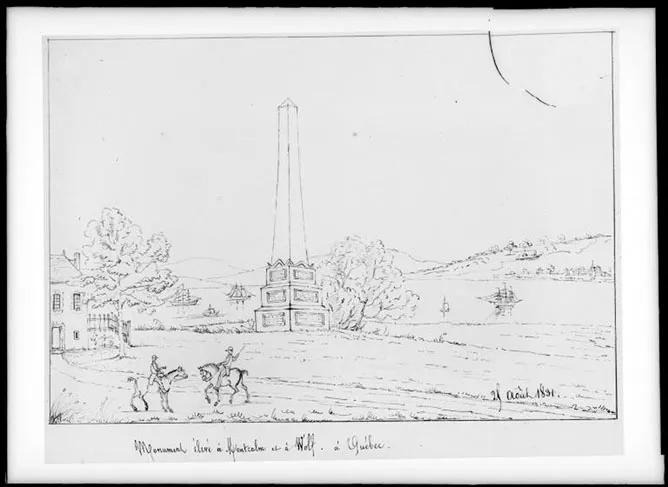
FIGURE 1.1 Gustave de Beaumont who accompanied de Tocqueville sketched the commemorative obelisk situated on the Plains of Abraham.
Source: Beinecke Rare Book and Manuscript Library. Yale University.
Source: Beinecke Rare Book and Manuscript Library. Yale University.
“The first of January 1832, the sun rising in a brilliant tropical sky revealed to us New Orleans across the mast of a thousand ships,” Tocqueville noted in his journal.11 Stepping onto Louisiana soil, Tocqueville entered a Creole world where human bondage buttressed the city’s social system and cultural institutions. President Thomas Jefferson had folded this Francophone world—one of the nation’s greatest territorial acquisitions—into the American national project in 1803, just 29 years before Tocqueville’s arrival. After Louisiana achieved statehood in 1812, French-speaking Creoles enjoyed more affluence, legal rights, and political influence than their French-Canadian counterparts. Nouvelle-Orléans further diverged from Canadien convention by maintaining commercial, cultural, and linguistic ties to the mother country. “The French here, unlike the French in Canada, are not a conquered people,” explained French consul J. N. François Guillemin, one of Tocqueville’s first contacts in the city.12 The transatlantic social network that connected New Orleans to France compelled Creoles to pay close attention to developments abroad. “This region,” Guillemin elaborated to Tocqueville, “is still mainly French in ideas, mores, opinions, customs, and fashions. We clearly model ourselves on France. I have often been struck by the influence that political passions have here and by the similarity in this respect between the population of Louisiana and that of France.”13 The consulate served as France’s literal eyes on the ground in New Orleans. The office helped maintain France’s North American gaze while simultaneously constructing and maintaining those networks tethering Louisiana Francophones to the broader French-speaking world. “In my view,” Guillemin continued, “it is of the utmost importance for France’s interests that French mores be maintained in Louisiana. This is the way to keep one of the main gateways to America open to us.”14 French culture could flourish in New Orleans so long as white Louisianians could enjoy a lifestyle and economy supported by slave labor.
Tocqueville learned more about Louisiana’s reliance on that peculiar institution when he visited French transplant and former New Orleans attorney general, Etienne Mazureau. Mazureau insisted that people of color were better suited to handle the Gulf Coast’s oppressive climate when cultivating crops. “As I was born in France, I arrived in here with the same notions that you seem to hold; but my experience pained me to refute that theory.” The expatriate continued, “I do not think that Europeans can work the land while exposed to a tropical sun. Our sun is always unhealthy, often fatal. It’s not impossible. But to escape death, whites are obliged to work with such restraint that they can only scratch out the most meager living.” However, the avocat recalled a single group of whites who dared to live off the land. “We have an example in the Attakapas district. The colonial Spain government transplanted peasants from Azores in that corner of Louisiana, where they labor without slaves. These people work the land, but so poorly, that they are the most miserable people in Louisiana.”15 Spanish immigrants joined the Attakapas district’s established peasantry—Acadian refugees—all of whom scratched out a living toiling like their Canadien counterparts along the St. Lawrence River. Unlike Acadians or French Canadians, New Orleans Francophones were not conquered representatives of a failed empire, but rather active members of a vibrant postcolonial city. Indeed, the affluent Creole world that Tocqueville inhabited for 24 hours blithely ignored the political and economic disenfranchisement rendering the majority of the peasantry, the Acadian population included, effectively invisible. Yet these North American Francophones survived beneath a dominant English-speaking caste like “the remnants of an old nation lost in the midst of a new people.”16 Louisiana’s Acadians, like their Francophone counterparts across the continent, remained in the shadows of Anglophone North America, largely forgotten and out of sight.
Tocqueville returned to France in 1832 determined to share his vision of North American with the world. “I did not go [to North America] with the idea of writing a book, the idea of a book came upon me there,” Tocqueville maintained.17 He labored for three years to make sense of the tangled cultural strata informing the political and cultural landscapes of the United States and Canada. Intended as “a plausible image of the future of France,” the study became the preeminent textbook for American politics and one of the more notable founts of American exceptionalism driving the pro-expansionist politics of Bancroft, Schoolcraft, and Turner.18 His observations filled the pages of his most famous work, two volumes entitled De la démocratie en Amérique (Democracy in America), published, respectively, in 1835 and 1840. Politically minded Americans proclaimed that “he was, in fact, the oracle in all that related to the institutions of the United States.”19 Tocqueville also proved French North America’s clairvoyant. His penetrating gaze illuminated a parallel world operating largely beyond the perception of the same Anglophones who would laud Democracy in America. He introduced a continental perspective that cast an illuminating light on Canadiens, Acadians, Creoles, and Cajuns.
“The Tocquevillian Gaze” chronicles ways of seeing and knowing l’Amérique française in the nineteenth century. In the wake of Tocqueville’s famed travels, subsequent French nationals also traveled to the former colony and initiated the slow, tectonic formation of social networks forged by transatlantic exchange between Europeans and French North Americans. Their collective ethnographic accounts expressed what political scientist Michael Shapiro identifies as the “particular economies of the Tocqevillean gaze.”20 Their direct vision, field reports, and publications effectively generated an official discourse built upon “the imposed structures of recognition/nonrecognition.”21 This binary afforded Tocqueville, and those who would follow, the power to reveal and conceal, remember and forget, aspects of the French North American experience in accordance with the observer’s own biases and predispositions. The positive effect of recognition revived the memory of New France in old France, while illuminating a world generally rendered invisible by the shadows cast by Anglophone culture on the continent. It ran counter to North American’s Anglophone gaze, which generally regarded the Francophone experience on the continent with contempt and ire, if it perceived French-speaking communities at all. The danger of nonrecognition thus threatened forgetting and erasure.
In contrast to what scholars identify as the imperial gaze, the Tocquevillian gaze had a softer focus because France no longer wielded the imperial might to control Francophones now under British and American jurisdiction.22 Instead, it projected French fantasies about empire onto North America. “I still hope that the French, despite the conquest,” Tocqueville elaborated, “will someday create a beautiful empire of their own in the New World.”23 Imperialist François-Edmé Rameau de Saint-Père and French consul Charles Fauconnet, who was stationed in New Orleans during the American Civil War, adapted the Tocquevillian gaze for their own purposes. These Frenchmen exercised soft power when they, respectively, visited the Acadian Maritimes and New Orleans. Their brand of cultural diplomacy, however, carried the unfulfilled and indeed rejected desires associated with France’s failed imperial project in North America. To be sure, the Tocquevillian gaze still functioned through imperial and gendered (decidedly male) sensibilities.24 It amounted to a kind of cultural mapping project imbued with as much curiosity as patriarchy, objecti...
Table of contents
- Cover
- Half Title
- Title Page
- Copyright Page
- Dedication
- Contents
- Prologue
- Introduction: Doomed to Suffer Long
- 1 The Tocquevillian Gaze
- 2 The Cult of Evangeline
- 3 Frenchy’s War
- 4 Nous and les Autres
- 5 French is Our Black Colour
- 6 Cultural Avengers, Cultural Fatigue
- Epilogue: Social Networks, Cultural Trauma, and Memory
- Bibliography
- Acknowledgments
- Index
Trusted by 375,005 students
Access to over 1.5 million titles for a fair monthly price.
Study more efficiently using our study tools.
Frequently asked questions
Yes, you can cancel anytime from the Subscription tab in your account settings on the Perlego website. Your subscription will stay active until the end of your current billing period. Learn how to cancel your subscription
No, books cannot be downloaded as external files, such as PDFs, for use outside of Perlego. However, you can download books within the Perlego app for offline reading on mobile or tablet. Learn how to download books offline
Perlego offers two plans: Essential and Complete
- Essential is ideal for learners and professionals who enjoy exploring a wide range of subjects. Access the Essential Library with 800,000+ trusted titles and best-sellers across business, personal growth, and the humanities. Includes unlimited reading time and Standard Read Aloud voice.
- Complete: Perfect for advanced learners and researchers needing full, unrestricted access. Unlock 1.5M+ books across hundreds of subjects, including academic and specialized titles. The Complete Plan also includes advanced features like Premium Read Aloud and Research Assistant.
We are an online textbook subscription service, where you can get access to an entire online library for less than the price of a single book per month. With over 1.5 million books across 990+ topics, we’ve got you covered! Learn about our mission
Look out for the read-aloud symbol on your next book to see if you can listen to it. The read-aloud tool reads text aloud for you, highlighting the text as it is being read. You can pause it, speed it up and slow it down. Learn more about Read Aloud
Yes! You can use the Perlego app on both iOS and Android devices to read anytime, anywhere — even offline. Perfect for commutes or when you’re on the go.
Please note we cannot support devices running on iOS 13 and Android 7 or earlier. Learn more about using the app
Please note we cannot support devices running on iOS 13 and Android 7 or earlier. Learn more about using the app
Yes, you can access French North America in the Shadows of Conquest by Ryan André Brasseaux in PDF and/or ePUB format, as well as other popular books in History & North American History. We have over 1.5 million books available in our catalogue for you to explore.