Superhero Grief
eBook - ePub

Superhero Grief

The Transformative Power of Loss

  1. 258 pages
  2. English
  3. ePUB (mobile friendly)
  4. Available on iOS & Android
eBook - ePub

Superhero Grief

The Transformative Power of Loss

About this book

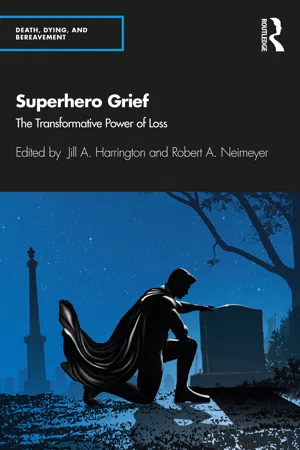
Superhero Grief uses modern superhero narratives to teach the principles of grief theories and concepts and provide practical ideas for promoting healing.

Chapters offer clinical strategies, approaches, and interventions, including strategies based in expressive arts and complementary therapies. Leading researchers, clinicians, and professionals address major topics in death, dying, and bereavement, using superhero narratives to explore loss in the context of bereavement and to promote a contextual view of issues and relationship types that can improve coping skills.

This volume provides support and psychoeducation to students, clinicians, educators, researchers, and the bereaved while contributing significantly to the literature on the intersection of death, grief, and trauma.

Trusted by 375,005 students

Access to over 1.5 million titles for a fair monthly price.

Study more efficiently using our study tools.

Information

Publisher
Routledge
Year
2020
eBook ISBN
9780429615214

Part I

Historical Backgrounds: Grief, Loss, and the Creation of Superheroes

1 The Rippling Effects of the Holocaust

The Jewish Influence on the Development of Superheroes

Howard R. Winokuer and Fred C. Fowler
Superheroes have been a significant part of the U.S. and world culture for the past 90 years. The Marvel and DC comic universes have touched the lives of millions of children and adults, filling their minds with amazing characters who brought truth and justice to an unjust world. Characters such as Superman, Batman, Spider-Man, and Captain America have captivated readers with their magnificent feats of heroism, providing hope during a period in our history where little hope existed.
What are the origins of superheroes? It seems logical to believe the influences came from U.S. history; however, strong evidence indicates the influencing origins are firmly rooted in the 1930s and 1940s Jewish experiences in Eastern Europe and the subsequent worldwide effects of anti-Semitism (Brod, 2012). It is interesting to note that many writers who created these original characters were Jewish. The characters have a strong connection to the Jewish mode of thought in that “the bad guys that superheroes fight against are, in the final analysis, those people who have oppressed the Jewish people for centuries” (Brod, 2012, p. xx).
It is important to make a distinction between Judaism and Jewishness. Judaism is a religion, whereas Jewishness is associated with a culture, which can also involve the practicing of the Jewish religion. So, an interesting question to ponder is: are the characters Jewish? If they are, it’s not in the traditional sense. It’s not as if Superman or Iron Man go to synagogue on a weekly basis. And it is important to note that the Jewish writers who created these characters were not advocating for violence as a way to combat anti-Semitism, but rather that “owning their capacity to do violence must not be misconstrued as doing violence” (Breitman, 2012, p. xxii). One could conjecture that it was the artistic response to an attempted genocide of a people – the creation of meta-humans with superpowers in a time when Jewish people were oppressed and subjected to a sense of powerlessness.
According to Brod (2012), these writers were not men who fit the traditional definition of what it meant to be manly, but rather were seen as men who were shy, introverted, and unable to live up to the expectations of how a macho man was supposed to act. They fit the stereotype of a typical Jewish man. It seems particularly interesting that people who were perceived as “less then real men created Superman” (Brod, 2012, p. xviii). This may have been a way that these writers created characters that fought for justice in a world where they had no power to do so themselves. It has been hypothesized (Brod, 2012) that the Jewish people lost much of their heritage during the Holocaust and that the creation of superheroes were the writers’ attempt to reclaim this heritage.

1.1Artist Origins

In the 1930s two young boys, Jerry Siegel and Joseph Shuster, children of Jewish parents who had fled Eastern Europe, met and created a partnership that eventually created Superman (“Jerry Siegel, Joe Shuster and Superman”, n.d.). Their first Superman character was a bald telepathic villain, and the comic book was not successful. They then morphed the character into the bespectacled Clark Kent who was patterned after the famous actors Clark Gable and Kent Taylor. The Jewish component of this character was a hidden identity and the desire to “fit” into society.
Stan Lee, an Army WWII veteran, was a Jewish writer who created many Marvel characters, such as Spider-Man, Thor, the X-Men, Iron Man, the Flash, Dr. Strange, and the Fantastic Four. Born Stanley Martin Lieber, the son of Jewish parents who immigrated to the United States from Romania, Stan became an assistant in 1939 at Timely Comics. As was common practice at the time, Jewish-sounding surnames were Westernized to be assimilated into the American and Canadian cultures. Stan changed his name to be accepted within the larger general population, stating, “for journalistic reasons” (Thomas, 2018, para. 12). Also, he was embarrassed and didn’t want anyone to associate him with comic books, as he thought one day he would write a great American novel (Thomas, 2006). There was stigma associated with writing comics, as much as being Jewish. Comics were not considered art, or great storytelling, and films based on comics still receive scrutiny for this today.
Another superhero creator was Bob Kane. Born Robert Kahn, Bob was also the son of Jewish parents who had immigrated to the United States from Eastern Europe. Bob similarly changed his name to disguise his Jewish heritage. In collaboration with Bill Finger, Bob created Batman (and Robin), the “Dark Night”, one of the most well-known and iconic superheroes in the world (Boxer, 1998). Bruce Wayne, aka “Batman”, transforms from a helpless, traumatized child who witnessed the murder of his parents into one of the world’s most brilliant detectives and crime-fighting superheroes.
William (Will) Erwin Eisner was born in Brooklyn, New York, and was the grandson of Hungarian immigrants. His family was poor and moved frequently. The family soon found themselves in the Bronx, where he attended DeWitt Clinton High School (as did Stan Lee). There, he met Bob Kane and began creating comics at Kane’s behest, who encouraged Will to submit his drawings to Wow Magazine. While serving in the U.S. Army during World War II, Will created Joe Dope, whose escapades helped soldiers fight the terrible war against the Nazis.
In addition to these writers, other comic book illustrators were also of the Jewish background. What was the commonality of these writers? All grew up in Jewish homes, all were children or grandchildren of people who had immigrated from Eastern Europe, fleeing the Nazi regime and the rippling effects of continued anti-Semitism post-World War II.
1.2The Jewish Influence on the Dawn of the Comic Book Industry

So how did the comic book industry and superheroes get started? In his article addressing the Jewish influence on the creation of superheroes, Kogan (2019) states,
The American comic-book industry started as an idea largely of Jewish artists in the 1930s and ...

Table of contents

  1. Cover
  2. Endorsement Page
  3. Half Title
  4. Series Page
  5. Title Page
  6. Copyright Page
  7. Dedication
  8. Table of Contents
  9. Series Editor’s Foreword
  10. Preface
  11. Acknowledgments
  12. List of Contributors
  13. Introduction: Finding Thanos in “Thanatology” and the Transformative Power of the Visual Arts
  14. Part I: Historical Backgrounds: Grief, Loss, and the Creation of Superheroes
  15. Part II: Understanding Superhero Grief Through Postmodern Grief Theory
  16. Part III: Types of Grief: Brief Case Studies of Superheroes
  17. Part IV: Grief and Culture: Cultural Influence in the Superhero Universes
  18. Part V: Grief and Family Systems: Superheroes and Relationship Types
  19. Part VI: Challenges in Bereavement: Facing Adversity
  20. Part VII: Posttraumatic Growth, Superheroes, and Personal Stories Addressing the Five Factors
  21. Part VIII: Superheroes, Grief Leadership, Social Justice, and Advocacy
  22. Part IX: Superhero-Based Strategies of Care: Interventions and Creative Approaches
  23. Part X: Conclusion
  24. Suggested Resources
  25. Index

Frequently asked questions

Yes, you can cancel anytime from the Subscription tab in your account settings on the Perlego website. Your subscription will stay active until the end of your current billing period. Learn how to cancel your subscription
No, books cannot be downloaded as external files, such as PDFs, for use outside of Perlego. However, you can download books within the Perlego app for offline reading on mobile or tablet. Learn how to download books offline
We are an online textbook subscription service, where you can get access to an entire online library for less than the price of a single book per month. With over 1.5 million books across 990+ topics, we’ve got you covered! Learn about our mission
Look out for the read-aloud symbol on your next book to see if you can listen to it. The read-aloud tool reads text aloud for you, highlighting the text as it is being read. You can pause it, speed it up and slow it down. Learn more about Read Aloud
Yes! You can use the Perlego app on both iOS and Android devices to read anytime, anywhere — even offline. Perfect for commutes or when you’re on the go.
Please note we cannot support devices running on iOS 13 and Android 7 or earlier. Learn more about using the app
Yes, you can access Superhero Grief by Jill A. Harrington, Robert A. Neimeyer, Jill A. Harrington,Robert A. Neimeyer in PDF and/or ePUB format, as well as other popular books in Psychology & Mental Health in Psychology. We have over 1.5 million books available in our catalogue for you to explore.