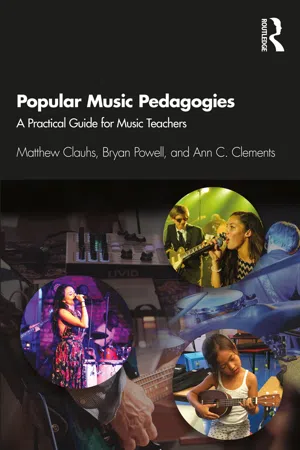
Popular Music Pedagogies: A Practical Guide for Music Teachers provides readers with a solid foundation of playing and teaching a variety of instruments and technologies, and then examines how these elements work together in a comprehensive school music program. With individual chapters designed to stand independently, instructors can adapt this guide to a range of learning abilities and teaching situations by combining the pedagogies and methodologies presented. This textbook is an ideal resource for preservice music educators enrolled in popular music education, modern band, or secondary general methods coursework and K-12 music teachers who wish to create or expand popular music programs in their schools. The website includes play-alongs, video demonstrations, printed materials, and links to useful popular music pedagogy resources.
eBook - ePub
Popular Music Pedagogies
A Practical Guide for Music Teachers
- 198 pages
- English
- ePUB (mobile friendly)
- Available on iOS & Android
eBook - ePub
Popular Music Pedagogies
A Practical Guide for Music Teachers
About this book
Information
CHAPTER 1
Foundations of Popular Music Pedagogies
While American music has clearly flourished and evolved over the last several decades, it’s difficult to say the same for American music education.– Robert Woody1
We live in a time of rapid social, cultural, technological, economic, and political change. American music education is confronted with advancements in how people experience music and the ways in which children are educated.2 While we have good reason to preserve our long-standing traditions in school music, there is a continuing concern with the apparent disconnect between school music and music as it exists within our world.3 Young people have access to a limitless number of styles, genres, and approaches to learning music through digital streaming and online content. Popular music4 remains exactly that – the most popular of all styles of music listened to, shared, emulated, and created by amateur and professional musicians. It can include music that is widely consumed by a large portion of the population or is characterized by amateur engagement, informality, a commitment to the process of making music, and a focus on pragmatic, “functional” musicianship skills that will serve students in a variety of ways.5 In K-12 contexts, this music can include currently popular music, student songwriting, folk music, and music that is not commercially popular but is interesting to students.
With unprecedented cultural and technological growth comes an increased possibility for conflict and competition. At times, it can feel as though the profession has become two distinct camps consisting of those who are concerned with the maintenance of traditional ensembles and the curricular foundations of Western music history and notation, and those who are driven to engage in curricular reform that pushes the boundaries of democratic, culturally responsive music education. Tradition and modernization, which are too often viewed as opposite ends of a continuum, serve as a point of tension within the field as we consider future directions for school music. While some music teachers feel the profession is not moving fast enough toward the new, others believe that curricular expansion puts our traditional school music culture at risk.
The combination of tradition and modern presents meaningful and unique opportunities for learners to develop a large variety of musical skills while providing school music education to a larger number of students. Music education scholar Randall Allsup writes, “school music is more creative and more open than ever before, and more teachers are coming into the profession with a larger range of skills and the disposition to teach more imaginatively.”6 From this viewpoint, tradition and modernization can move forward together in a complementary trajectory to meet the needs of all students, including those for whom traditional practices have worked successfully and those who are less interested in school music offerings. Of course, many emerging methods are untested and may not work well in some situations, and not all traditions engage the interest and spirit of our students, thus, all school music is fertile ground for reflection and critique. Some of the strongest conversations surrounding change include (1) revisiting the relevancy of curricular offerings in regard to the needs and preferences of modern students, (2) the desire to reach a broader number of students, (3) expansion of performance offerings, (4) practices fostering democratic engagement that are inclusive and culturally responsive, and (5) an increase in creativity and collaboration through music arranging and composition. In order to address these challenges of change, music educators must reexamine current practices and consider how students are prepared for lifelong and life-wide musical experiences that transcend classroom walls.
Popular Music Pedagogies
If authentic production and transmission practices are missing from the curriculum and our teaching strategies, we will be dealing with a simulacrum, or a ghost of popular music in the classroom, and not the thing itself.– Lucy Green7
The teaching practices that accompany the inclusion of popular music, hereon referred to as popular music pedagogies (PMPs), provide an opportunity for music teachers to utilize a multitude of approaches that change the dynamic of the traditional teacher–student power relationship. There is not a singular pedagogy to teaching popular music, but a range of approaches to fit a variety of popular music styles and genres. However, we believe there are enough commonalities within popular music teaching and learning to apply general principles. PMPs contain the design, practices, and approaches of learning popular music,8 centering on informal learning and nonformal teaching practices.9 Lucy Green, a well-known scholar of PMPs, defined the key tenets of informal learning as: (1) the learners choose music for themselves that they are familiar with and like; (2) the learners copy recordings by ear; (3) practice and refinement occur through self-learning, peer-directed learning, and group learning; (4) the learners focus on whole, “real-world” pieces of music; and (5) personal creativity is emphasized through the deep integration of listening, performing, improvising, and composing throughout the learning process.10 The UK-based nonprofit music organization Musical Futures defined nonformal teaching as a pedagogical approach to learner-led instruction that includes:
[a] fully inclusive approach to music making; group-based activities in performing, listening, composing and improvising; a sense of immediacy and exploration; tacit learning; music being caught not taught; music teachers/leaders often play a lot, and explain very little, utilising skills within the group through peer learning, students and teachers co-constructing content; [and] opportunities to develop non-cognitive skills, such as responsibility, empathy, support for others, creativity and improvisation to find solutions.11
The instructional activities and descriptions of instrument technique utilized in this textbook will draw from these instructional approaches, which have been field-tested, researched, and currently accepted as pedagogies in popular music education.
Popular Music in Classrooms
While a thorough examination of the history of popular music in American schools is outside the scope of this book, it is helpful to understand the context of popular music in curriculum reform.12 Current researchers and practitioners tend to cite the Tanglewood Declaration in 1967 and the directive that music education should include “currently popular teenage music”13 as a turning point for the inclusion of popular music into the music education curriculum. The Tanglewood Symposium brought together music educators, composers, performers, and publishers to discuss the role of music education in contemporary American society. Participants at the Symposium agreed that music of a variety of styles and cultures should be included within school music curricula.14 Interestingly, despite these ideas being over 50 years old, they remain sticking points in current conversations regarding the incorporation of popular music styles and practices into formal school music programs.
The Music Educators Journal, the primary journal of practicing American music teachers, devoted a section of their December 1979 issue to discuss the inclusion of popular music and rock in the music education curriculum. Topics addressed included bridging the gap between current popular music and school music practices, the issue of inappropriate lyrics, musical aspects of popular music, using popular music in the elementary classroom, and strategies for implementing popular music into the music education classroom. The Journal published additional special issues on popular music education again in 1991 and 2019.
In 2002, Music Educators National Conference (MENC) published The Guide to Teaching with Popular Music.15 The guide included lesson plans and sheet music that were in line with the National Standards for Music Education as well as tips to help teachers get started using popular music in their instruction. Two years later, MENC published Bridging the Gap: Popular Music and Music Education,16 which featured a collection of essays by well-known scholars and educators that addressed trends and issues related to the use of popular music in the classroom. PMP scholars and practitioners formed an Association for Popular Music Education (APME) in 2010 and later developed the Journal of Popular Music Education in 2017. National Association for Music Education (NAfME) established their own special research interest group (SRIG) for popular music in 2016 and authors published several popular music texts, including The Routledge Research Companion to Popular Music Education (2017) and The Bloomsbury Handbook for Popular Music Education (2019) to explore PMP-related themes. And in 2019, NAfME added an All-National Honors Modern Band as a part of their honor ensembles concerts, comprising some of the most talented high school popular musicians from across the United States.
Modern Approaches to Popular Music Pedagogies
While music educators and scholars have advocated for the inclusion of popular music styles and instrumentation for several decades, recent literature has explored the approaches and pedagogical techniques associated with these instruments and styles. Music educators cannot simply add popular music instruments and repertoire without changing the teacher-centered approach used in many music classrooms. To realize the full potential for popular music education in the classroom, music teachers need to transition from the role of director to the role of facilitator. According to music education scholar Radio Cremata, a facilitator “employs constructivist learning approaches through student-centered experiential processes.”17 In the role of a facilitator, the teacher is no longer the sole purveyor of instruction, directing all aspects of the rehearsal. In popular music ensembles, the facilitator instead responds to the needs of the students and takes cues from the group as to how and when the instructor is needed to provide direction. As a result, the music teacher must also negotiate when to inject themselves in the rehearsal process, and when to step back and allow students to collaboratively solve problems. Although directors of traditional music ensembles respond to the needs of their students as well, one difference is that the facilitator does not adhere to a set curriculum, nor do they always set out to achieve predetermined levels of progress each rehearsal. Classrooms that are teacher-facilitated may look and sound different from classrooms that are teacher-led. Facilitated classrooms may have stations for collaboration, students may be working on independent projects, there may be varied objectives and assessments depending on the learners’ goals, and the teacher may be moving around the room instead of standing in front of the class. A facilitated classroom may be uncomfortable for teachers ...
Table of contents
- Cover
- Half Title
- Title Page
- Copyright Page
- Dedication
- Contents
- List of Figures
- Preface
- Acknowledgments
- 1 Foundations of Popular Music Pedagogies
- PART I Instrument Techniques
- Part II Music Technology
- Part III Putting It All Together
- Glossary
- Bibliography
- Index
Trusted by 375,005 students
Access to over 1.5 million titles for a fair monthly price.
Study more efficiently using our study tools.
Frequently asked questions
Yes, you can cancel anytime from the Subscription tab in your account settings on the Perlego website. Your subscription will stay active until the end of your current billing period. Learn how to cancel your subscription
No, books cannot be downloaded as external files, such as PDFs, for use outside of Perlego. However, you can download books within the Perlego app for offline reading on mobile or tablet. Learn how to download books offline
Perlego offers two plans: Essential and Complete
- Essential is ideal for learners and professionals who enjoy exploring a wide range of subjects. Access the Essential Library with 800,000+ trusted titles and best-sellers across business, personal growth, and the humanities. Includes unlimited reading time and Standard Read Aloud voice.
- Complete: Perfect for advanced learners and researchers needing full, unrestricted access. Unlock 1.5M+ books across hundreds of subjects, including academic and specialized titles. The Complete Plan also includes advanced features like Premium Read Aloud and Research Assistant.
We are an online textbook subscription service, where you can get access to an entire online library for less than the price of a single book per month. With over 1.5 million books across 990+ topics, we’ve got you covered! Learn about our mission
Look out for the read-aloud symbol on your next book to see if you can listen to it. The read-aloud tool reads text aloud for you, highlighting the text as it is being read. You can pause it, speed it up and slow it down. Learn more about Read Aloud
Yes! You can use the Perlego app on both iOS and Android devices to read anytime, anywhere — even offline. Perfect for commutes or when you’re on the go.
Please note we cannot support devices running on iOS 13 and Android 7 or earlier. Learn more about using the app
Please note we cannot support devices running on iOS 13 and Android 7 or earlier. Learn more about using the app
Yes, you can access Popular Music Pedagogies by Matthew Clauhs,Bryan Powell,Ann C. Clements,Ann C Clements in PDF and/or ePUB format, as well as other popular books in Education & Digital Media. We have over 1.5 million books available in our catalogue for you to explore.