In this book, a multidisciplinary and international selection of Jungian clinicians and academics discuss some of the most compelling issues in contemporary politics.
Presented in five parts, each chapter offers an in-depth and timely discussion on themes including migration, climate change, walls and boundaries, future developments, and the psyche. Taken together, the book presents an account of current thinking in their psychotherapeutic community as well as the role of practitioners in working with the results of racism, forced relocation, colonialism, and ecological damage.
Ultimately, this book encourages analysts, scholars, psychotherapists, sociologists, and students to actively engage in shaping current and future political, socio-economic, and cultural developments in this increasingly complex and challenging time.
Where the spirit of the depths meets the spirit of the times
Thomas Singer
The purpose of this chapter is to introduce the term “extinction anxiety” as an apt clinical descriptor for a symptom that affects all of us.
Apocalyptic fantasies are as old as time but the term “extinction anxiety” which originates in such fears has not been used to describe the psychic state of individuals and groups that are either consciously or unconsciously gripped by the dread of extinction.
As we have learned from Freud, anxiety is a warning signal that danger is present and that overwhelming emotions may be felt, giving rise to unmanageable helplessness. The danger may be perceived as arising from internal or external sources and be the response to a variety of powerful fantasies in the unconscious mind.
It is my hypothesis that extinction anxiety is flooding the planet, although it frequently expresses itself in a displaced form of group or cultural anxiety rather than in the direct experience of the fear of extinction. It is timely to give a clinical name to “extinction anxiety” as a type of warning signal that danger is present whether it is originating in irrational fear and/or irrefutable objective evidence. In the recently published book The Dangerous Case of Donald Trump, Noam Chomsky writes quite simply:
There are two huge dangers that the human species face. We are in a situation where we need to decide whether the species survives in any decent form. One is the rising danger of nuclear war, which is quite serious, and the other is environmental catastrophe.
We know of the dangers, but we have not named “extinction anxiety” as a source of worldwide psychic distress.
It may seem surprising that this term has not been introduced to describe this profound disturbance in the individual and collective psyche. When I first began to consider the term, I did a search and discovered that the only use of “extinction anxiety” is to denote the extinction of a symptom in a behaviorist model. In that model, the term is used to describe the attempt to “extinguish conditioned fear.” When I use the term “extinction anxiety” I am not talking about the extinction of fear; I am talking about the fear of extinction.
Perhaps the closest we have come in the history of our profession to naming such anxiety is “existential anxiety.” Existential anxiety, born out of the disillusioning and dismembering experiences of World War I, the Great Depression, and World War II, convinced many that the universe was absurd and without meaning. “Existence precedes essence” was a way of saying that life did not come into being with a preexisting meaning but that meaning or “essence” had to be created out of one’s own being. Finding oneself in a meaningless universe is not the same as facing the extinction of life as we know it. In other words, existential anxiety and extinction anxiety emerge out of different fears, although both are profoundly disorienting in the sense that we have lost our “place” in a world that had given us meaning with a feeling of relative safety. “Extinction anxiety” as part of the “spirit of our times” is different from the “spirit of the times” that gave rise to existential anxiety.
I am not writing this chapter to prophesize the end of times. Rather, my purpose in writing this chapter is to say that the intense, contemporary anxiety about the approaching end of time is real and needs to be taken with the utmost seriousness. Although “extinction anxiety” finds direct expression in environmental groups and those concerned about nuclear war (Christensen, 2017),2 it finds less direct expression in other groups and individuals that are in fear of their own annihilation but who do not consciously link their deeply felt precarious status to the fear of the extinction of the world.
Appropriately enough, the term “extinction anxiety” literally popped into mind when I was working on a paper about Donald Trump. I was thinking about all the diverse groups around the world who fear that their unique identities and very existence are threatened. Whites, Blacks, Women, Men, Latinos, Palestinians, Jews, Muslims, Gays, 60 million refugees around the globe, are just a few of the groups in the grips of fear for their own survival. Could it be that they are all tapping into a deeper, underlying “extinction anxiety” which is the collective psyche’s equivalent of the anxiety about death in the individual?
I believe that extinction anxiety acts as a psychic radioactive background in our global society and that it fuels many of our concerns. For instance, climate change deniers on the right in the US may be seen as denying the very real possibility of the planet’s destruction as a way of defending themselves against the fear of extinction. Aligning himself with this attitude, Trump offers to staunch “extinction anxiety” by denying it is real and appointing a well-known climate change denier as his energy adviser. As we know, denial—whether at the individual or group level—is the most primitive defense in the psyche’s arsenal of defenses to protect itself.
I believe that C.G. Jung was right in suggesting that the psyche has multiple layers that go down or up or around the individual to the family, to the clan, to the nation, to larger groups such as European or Asian, and even to primate and animal ancestors, finally finding its source in what Jung called the “central fire.” We also know that there are fault lines at every level of our global society. The fault lines that demarcate divisions between groups of people and nations run deep along gender, tribal, national, religious, racial and ethnic lines. It is my hypothesis that extinction anxiety emerges from the deepest levels of the psyche through these fault lines or channels that run back and forth from the depths of the very source of life and psyche on the planet, Jung’s “central fire,” all the way up to the individual. We can imagine that extinction anxiety courses up and down along these channels as the carrier of the signal of alarm and great danger, not unlike the flow of lava that comes from deep beneath the surface of the earth until it breaks through the surface in a volcanic eruption.
We can also imagine that along these fault lines, extinction anxiety is where the spirit of the times and the spirit of the depths meet. To tease out the notion that the spirit of the depths and the spirit of the times merge with one another in the phenomenon of extinction anxiety, I want to circle around these two spirits in relation to extinction anxiety.
The spirit of the depths and extinction anxiety
“The spirit of the depths” refers to ancient and recurring themes of deepest concern to human beings: themes of death and rebirth, of meaning and meaninglessness, of suffering and joy, of loss and repair, of what is fleeting and what is eternal. From the “spirit of the depths” humankind has been experiencing apocalyptic fantasies since the dawn of human history. Zarathustra, The Book of Daniel, The Book of Revelations—all are steeped in the apocalyptic vision of the end of time.3 Perhaps the most moving modern expression of this vision from the spirit of the depths is Yeats’ “The Second Coming” written in 1919 at the end of World War I:4
The second coming
Turning and turning in the widening gyre
The falcon cannot hear the falconer;
Things fall apart; the centre cannot hold;
Mere anarchy is loosed upon the world,
The blood-dimmed tide is loosed, and everywhere
The ceremony of innocence is drowned;
The best lack all conviction, while the worst
Are full of passionate intensity.
Surely some revelation is at hand;
Surely the Second Coming is at hand.
The Second Coming! Hardly are those words out
When a vast image out of Spiritus Mundi
Troubles my sight: somewhere in sands of the desert
A shape with lion body and the head of a man,
A gaze blank and pitiless as the sun,
Is moving its slow thighs, while all about it
Reel shadows of the indignant desert birds.
The darkness drops again; but now I know
That twenty centuries of stony sleep
Were vexed to nightmare by a rocking cradle,
And what rough beast, its hour come round at last,
Slouches towards Bethlehem to be born?
Apocalyptic fantasy from the spirit of the depths is alive and well today in the longing of Christian fundamentalists for the end of times in the rapture at Armageddon. And it has been alive and well in Isis and its Islamic apocalyptic vision of the end of times in the yearning to create the Caliphate. These fantasies can be thought of as emerging from the depths of the “human psyche” that is grounded in the origins of life itself—not just human life but all plant and animal life on the planet. We can also imagine, along with the Hindus, that whatever forces give birth to life on the planet can do just the opposite and take back into itself all of life and psyche as in Vishnu’s reabsorption into himself of the whole of the created cosmos.
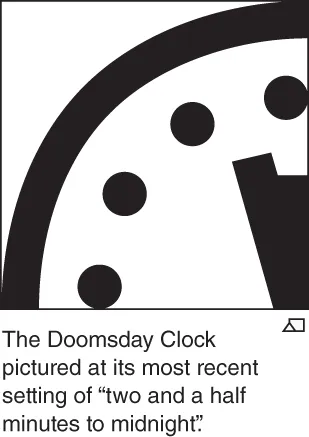
Figure 1.1 “The spirit of the times” and extinction anxiety: The Doomsday Clock.
Our “spirit of the times” remains anchored mostly in the scientific mind which has become wedded to technology and materialist consumerism. It is no accident that the Bulletin of Atomic Scientists has created and maintained a Doomsday Clock since the dawn of the nuclear age in 1947 when the clock was set at seven minutes before midnight. Midnight marks the extinction of the human race (see Figure 1.1). Since its inception, the clock has fluctuated in predicting how much time we have left. In 1953, it was moved up to two minutes before midnight when both the US and the Soviet Union exploded hydrogen bombs. It drifted back to three minutes before midnight until the election of Donald Trump and it is currently set at two minutes before midnight.5
In “the spirit of the times,” our extinction anxiety is fueled by undeniable objective evidence that life on the planet is seriously endangered. We know, for instance, that we have already entered the “sixth mass extinction event” in which it is predicted that one half of the world’s land and marine species could disappear by 2100 unless there is some other annihilating or transforming event that precedes the “natural unfolding” of the sixth mass extinction event. As human beings, we are instinctually and archetypally connected with all life. The threat of the loss of all these non-human species contributes to extinction anxiety.6
What if the human psyche carries within it the deep memory of biological and geological evolution, that our evolutionary heritage is mapped in the brain? In what scientists call “deep time” the Earth has experienced five mass extinctions. Four of these were triggered by climate change and were followed by large-scale reorganizations in the biosphere opening gateways that ultimately led to the evolution of the human species. Does the “deep psyche” have a memory of “deep time” and these previous extinctions as reflected in the Hindu religious imagination? It is interesting to contemplate how this might be manifesting in our current spirit of the times.
More immediately, on a day-to-day basis, we are flooded with news of devastating fires, massive storms, terrorist attacks and random mass killings. All of this heightens the horrifying fear that something is terribly amiss in the world. As Yeats wrote:
And what rough beast, its hour come round at last,
Slouches towards Bethlehem to be born?7
Not only are we being flooded with way too much information and the staggering explosion of the global population, but also perhaps with too much interconnectivity. Imagine for a moment that everyone you see walking down the street or sitting in a coffee house communicating on their cellphones or computers is actually sending out billions of the same daily latent message: “It hasn’t happened yet.” What if our frantic interconnectivity is a global SOS expression of extinction anxiety and that we are desperately clinging to one another in an effort to reassure ourselves we are not on a sinking or exploding ship?
Again, we might imagine extinction anxiety to be flowing like lava up and down the layers of the ancient and contemporary global psyche that includes evolutionary time, circulating in an accelerating negative feedback loop, up from the spirit of the depths to the spirit of the times, and back “down” again, in which guns, storms, droughts, and nuclear threats merge with old and new apocalyptic visions.
The obvious next question is—so what? What can we do about this? Does it help to make conscious the unconscious extinction anxiety which is fortified today by the very real scarcity that stalks much of the world’s population and that pits all sorts of groups against one another in the most intractable conflicts? I wonder if increased consciousness and political activism based on th...
Table of contents
Cover
Half Title
Title Page
Copyright Page
Table of Contents
About the authors
Introduction: why is social and political activism necessary for psychological understanding?
Section 1 Leaders, led, migration
Section 2 Ecological and other crises
Section 3 Migration, refugees, walls, bridges
Section 4 Histories and futures
Section 5 Psyche in political context
Index
Trusted by 375,005 students
Access to over 1.5 million titles for a fair monthly price.
Study more efficiently using our study tools.
Frequently asked questions
Yes, you can cancel anytime from the Subscription tab in your account settings on the Perlego website. Your subscription will stay active until the end of your current billing period. Learn how to cancel your subscription
No, books cannot be downloaded as external files, such as PDFs, for use outside of Perlego. However, you can download books within the Perlego app for offline reading on mobile or tablet. Learn how to download books offline
We are an online textbook subscription service, where you can get access to an entire online library for less than the price of a single book per month. With over 1.5 million books across 990+ topics, we’ve got you covered! Learn about our mission
Look out for the read-aloud symbol on your next book to see if you can listen to it. The read-aloud tool reads text aloud for you, highlighting the text as it is being read. You can pause it, speed it up and slow it down. Learn more about Read Aloud
Yes! You can use the Perlego app on both iOS and Android devices to read anytime, anywhere — even offline. Perfect for commutes or when you’re on the go. Please note we cannot support devices running on iOS 13 and Android 7 or earlier. Learn more about using the app
Yes, you can access Political Passions and Jungian Psychology by Stefano Carta, Emilija Kiehl, Stefano Carta,Emilija Kiehl in PDF and/or ePUB format, as well as other popular books in Psychology & Politics. We have over 1.5 million books available in our catalogue for you to explore.