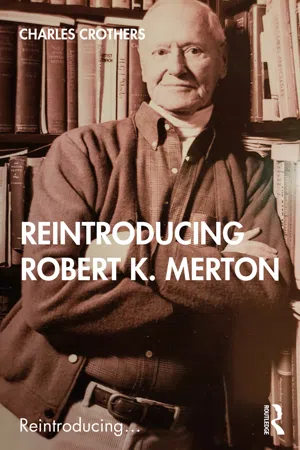
This book reintroduces the work of Robert K. Merton as a bridge between classical sociology and modern sociology. Founded in the sociological classics but developing a modern approach to the advancement of theory and research methodology, Merton's thought helped to construct modern sociology in its coverage of many of the social institutional areas of contemporary society. Recovering and analysing the system of 'structural analysis', which Merton progressively developed – a system largely overlooked due to the tendency among commentators to stereotype him as a 'functionalist' – the author considers the applications of this approach to various substantive fields, particularly science and criminal justice, and examines the effect of Merton's later 'sociological semantics' on his overall schema. A clear and accessible presentation of the array of concepts introduced by Merton to sociology, Reintroducing Robert K. Merton will appeal to scholars and students with interests in sociological theory, social research, the history of sociology and the various substantive areas covered in the work of Merton – deviance, science, and communications.
- 208 pages
- English
- ePUB (mobile friendly)
- Available on iOS & Android
eBook - ePub
Reintroducing Robert K. Merton
About this book
Information
1
The case for reintroducing Merton
The image of Merton’s work
Robert K. Merton’s death in 2003 was mourned in several newspapers – including, impressively, in The New York Times, and in a wide array of more academic obituaries (see Crothers, 2019). The newspaper coverage tended to focus on key concepts which Merton introduced into the discipline, many of which have become widespread in public usage: especially focus groups, role model, and the self-fulfilling prophecy. More academic obituaries usually covered a broader range although some were specifically tied to Merton’s contributions to the field covered by that particular journal. Reminiscences were shared by several colleagues (Calhoun et al., 2003) and later Zuckerman et al., 2011 Robert K. Merton at 100: Reflections and Recollections.
Merton’s work is varyingly covered in both introductory and more advanced sociology textbooks, and to a greater extent than most other theorists since the ‘founding fathers’. There are a few, mostly brief, chapters focused on Merton in theory texts (more recent examples of full chapter length treatments are Crothers 2011 and Sztompka 2017), encyclopedia entries, a scattering of critical articles and a large and growing literature drawing on his concepts (see Chapter 7 for detail). He is mainly known as the architect of an alternative structural-functional analysis, as collaborator with Paul Lazarsfeld and co-leader of the Columbia Sociology department, a proponent of middle-range theory, as having developed the field of the sociology of science, and especially for his account of anomie and the modes of adaptation. Zuckerman (2011: 139–140) provides a useful listing of Merton-linked concepts well entrenched in the discipline of sociology and more widely. In addition to ‘role model’ and ‘focus group’, other contributions include ‘unintended consequences’, ‘self-fulfilling prophecy’, ‘middle-range theories’, ‘role conflict’, influentials, ‘role set’ and the ‘Matthew effect’. Much commentary relates to particular areas of Merton’s expertise, while the analysis of Merton’s general approach to sociology is slight.
In these accounts, Merton is usually portrayed as a structuralfunctional loyalist, differing only in detail (not least in graciousness of writing style!) from Talcott Parsons as the grand master of structural-functional analysis, whereas on closer examination, Merton’s approach is fundamentally different. Even the more detailed of these accounts cover only highly selected portions of Merton’s work, and are more concerned to describe, than to analyse, how he constructs his analyses. Some texts explicitly deny that “he has produced a systematic theory or a system of sociology” (Bierstedt, 1981: 445). His later-developed cultural sociology or ‘sociological semantics’ is seldom mentioned, and some earlier work is overlooked. Moreover, readily available coverage largely ignores his empirical and methodological work, the range of studies spread across the many realms of contemporary society, and his underlying moral stance. Such accounts, too, seldom draw on previous exegesis established in the secondary literature on Merton.
My 1987 intellectual biography of Merton provides the foundation for this study. But much has happened since, that has been worked into the text. Most importantly, Merton continued to publish: especially his (delayed a half century) book on Serendipity (see Chapter 5). A spate of commentary volumes has appeared over the last three decades (see below) together with a range of shorter studies. The volume of material is sufficiently large that very precise tracing of sources would quickly amass a mountain of documentation, so in this book sources are often only generally indicated. And I have pursued relevant studies of my own. All these are drawn upon in updating the earlier book. This book takes a chronological approach not deployed in the earlier version.
The need for reintroducing Merton
The current standard accounts of the development of American sociology often, but not always, cover Merton, but he is seldom seen as a major proponent in contemporary theoretical debates. This partial silence is a fate shared with a slew of American mid-century theorists. The theoretical grounding of many contemporary ‘European’ social theorists lies with the `founding fathers’ (Marx, Durkheim and Weber) and the complexly intertwined threads of exegesis and extension that stretch from them. The transmission line of major theoretical ideas is seen to mainly bypass those early and mid-twentieth-century decades in which the development of sociological knowledge was largely left in American hands.
Where there is such treatment, it is often deficient. Once various early American theorists have been treated and the ‘Chicago School’ described, treatment of the sociology of the 1950s and 1960s often falters. North American sociology of the post-war period is usually characterised using one or other, or both, of two labels – ‘structural functionalism’ and ‘empiricism’. The theoretical arm of post-WW2 American sociology is often seen as a ‘grand theory’, which took a ‘structural-functionalist’ form, and which was detached from both empirical concerns and the provision of social criticism. Under the theoretical aegis of Talcott Parsons, a complex and terminologically dense conceptual framework is often seen as having developed a conservative-leaning social theory during the ‘end of ideology’ decades of the 1950s and 1960s. This approach is depicted as seeing social order as emanating from socialised conformity to cultural ideas, with a self-righting, equilibrium-seeking social system quickly restoring any departures from the status quo. But, Parsons’s direct influence on sociological theorising and research was perhaps more limited than is often held. After all, his work did not lead to the ready development of research problems or the easy formulation of theoretical explanations. The other arm of post-war American sociology is often seen to involve an ‘abstracted empiricism’ wherein micro problems about the explanations of the social distribution of attitudes and behaviour were relentlessly attacked through a myriad social survey studies, without sufficient concern for understanding the structural anchoring of these social minutiae in wider societal contexts. But a more granular account would show the more integrated theory–research combination developed at Columbia by Merton and Lazarsfeld and colleagues was a crucial seedbed of many developments over that period and since.
Especially after the upheavals of the 1960s, the picture must be immediately widened to include the ‘loyal opposition’ of symbolic interactionism, and its associated qualitative field research methodology, which throughout the period was held to be particularly cherished by the scattered remnants of the older ‘Chicago School’. To this was added a flowering of Marxisant ‘radical sociology’. Both tended to occlude functional sociology, although the research arm of positivist work continued strongly. But, the impetus for social theory then became located in Europe. That social theory tended to have a broad reach examining the social order in abstract terms and not particularly concerned to drive empirical research. Being armed with a more sophisticated account of Merton’s and other American sociology would have facilitated an active interface with more recent theory, to the benefit of both.
As a consequence, Merton’s concepts–terms continue to fuel the literatures of several fields of sociology and social science, even humanities, but to be offset to some extent from the energies of mainstream sociology. The full extent of Merton’s influence may seem to some to be fading, given that his name becomes de-coupled from his terms–concepts, a phenomenon Merton christened ‘OBI: obliteration by incorporation in the literature’ (1968: 27–28) when concepts seem ...
Table of contents
- Cover
- Half Title
- Series Information
- Title Page
- Copyright Page
- Dedication
- Contents
- Illustrations
- List of acronyms
- Biographical notes
- 1 The case for reintroducing Merton
- 2 ‘1930s: the Harvard Years’ (Jugendschriften)
- 3 Early years at Columbia
- 4 Middle years at Columbia
- 5 Later years
- 6 Reprise: Merton as discipline-builder, theorist, substantive sociologist and moralist
- 7 Merton the man, his operational code and influences
- Index
Trusted by 375,005 students
Access to over 1.5 million titles for a fair monthly price.
Study more efficiently using our study tools.
Frequently asked questions
Yes, you can cancel anytime from the Subscription tab in your account settings on the Perlego website. Your subscription will stay active until the end of your current billing period. Learn how to cancel your subscription
No, books cannot be downloaded as external files, such as PDFs, for use outside of Perlego. However, you can download books within the Perlego app for offline reading on mobile or tablet. Learn how to download books offline
Perlego offers two plans: Essential and Complete
- Essential is ideal for learners and professionals who enjoy exploring a wide range of subjects. Access the Essential Library with 800,000+ trusted titles and best-sellers across business, personal growth, and the humanities. Includes unlimited reading time and Standard Read Aloud voice.
- Complete: Perfect for advanced learners and researchers needing full, unrestricted access. Unlock 1.5M+ books across hundreds of subjects, including academic and specialized titles. The Complete Plan also includes advanced features like Premium Read Aloud and Research Assistant.
We are an online textbook subscription service, where you can get access to an entire online library for less than the price of a single book per month. With over 1.5 million books across 990+ topics, we’ve got you covered! Learn about our mission
Look out for the read-aloud symbol on your next book to see if you can listen to it. The read-aloud tool reads text aloud for you, highlighting the text as it is being read. You can pause it, speed it up and slow it down. Learn more about Read Aloud
Yes! You can use the Perlego app on both iOS and Android devices to read anytime, anywhere — even offline. Perfect for commutes or when you’re on the go.
Please note we cannot support devices running on iOS 13 and Android 7 or earlier. Learn more about using the app
Please note we cannot support devices running on iOS 13 and Android 7 or earlier. Learn more about using the app
Yes, you can access Reintroducing Robert K. Merton by Charles Crothers in PDF and/or ePUB format, as well as other popular books in Social Sciences & Criminology. We have over 1.5 million books available in our catalogue for you to explore.