What is a decent home? Does it simply provide shelter from the elements? Is it affordable enough that you can buy the other necessities of life? Does it connect you to a community with adequate social and economic resources? Noted housing expert Alan Mallach turns his decades of experience to these questions in "A Decent Home".
Mallach's nuanced analysis of housing issues critical to communities across the country will help planners evaluate the housing situation in their own communities and formulate specific plans to address a variety of housing problems. The book is both a practical step-by-step guide to developing affordable housing and a sophisticated introduction to housing policy. Chapters address design, site selection, project approval, financing, and the history of housing policy in the United States. Planners will find useful information about inclusionary and exclusionary zoning, affordable housing preservation, and the risks and rewards of affordable-home-ownership programs. Mallach also connects the dots among regional economic competitiveness, quality of life, community revitalization, and affordable housing.
Millions of households in the United States live in substandard or overcrowded housing conditions, or face excessive economic burdens in their effort to find decent housing that meets their needs. Understanding how to meet these needs and why creating affordable housing to address these needs is so important, however, takes more than simply recognizing that these needs exist. It demands an understanding of what the needs are, why they have come into being, and why they have not and will not be fully met by the private market, either by older housing filtering down to low-income families, or through regulatory reforms that will in some fashion lower the cost of housing to the point where all Americans will be able to afford a sound, livable home or apartment. While the private market plays an important role in affordable housing, that role is limited by economic forces that are inherent in the market itself, as well as by other powerful political, cultural, and social factors.
The purpose of this chapter is to put these issues in perspective, beginning with a look at the different elements that make up the need for affordable housing in the United States today. The balance of the chapter explores the extent to which those needs can be met through the private market, examining whether the need for affordable housing is a housing or an income problem and whether it is desirable to build new affordable housing or better to meet housing needs by increasing people’s income and their ability to afford housing on the private market through housing vouchers or other means of stimulating demand.
THE NEED FOR DECENT HOUSING
When Franklin Delano Roosevelt said in his second inaugural address that he saw “one-third of the nation ill-housed,” he was talking about the physical condition of their housing, about the millions of families living in homes without indoor plumbing, electricity, or the many things that 21st century Americans largely take for granted. Roosevelt’s assessment was still valid in 1950, when more than one out of every three tenants, and nearly a quarter of all home owners, lived in a home that was dilapidated or lacked a private toilet or hot running water. Much has changed since then. By 2000, the number of occupied homes without complete plumbing and bathroom facilities had dropped to less than one percent of the nation’s housing stock. Just the same, severe housing problems are still very much part of American society in the beginning of the 21st century.
Substandard housing
Although nearly all housing today contains basic plumbing and heating, substandard conditions are still widespread, as anyone who spends time in America’s inner cities or distressed rural areas can testify. Although the Census stopped measuring housing conditions in 1960,1 the American Housing Survey2 found in 2005 that six percent of the housing units in the United States had moderate or severe physical deficiencies, and nearly 13 percent of all low-income families lived in physically deficient housing. Seven percent of all rental units had open cracks or holes in walls, floors, or ceilings, while eight percent of renters had seen mice or rats in their unit during the preceding three months. The AHS also reported that one out of six homes or apartments, and one out of four rental units, had an external building deficiency, such as a sagging roof, cracking or crumbling foundation, or missing bricks or outside siding.
Six percent may be a small share of the total, but it amounts to more than six million homes and apartments. Despite code enforcement efforts and other steps taken by local government, this number seems to resist further improvement and has remained virtually unchanged for the past decade. These properties, of course, run the gamut of conditions. Some may need to be demolished or extensively rebuilt, while others could be rendered sound by only modest improvements, or in some cases simply by more conscientious maintenance and upkeep.
James Peters
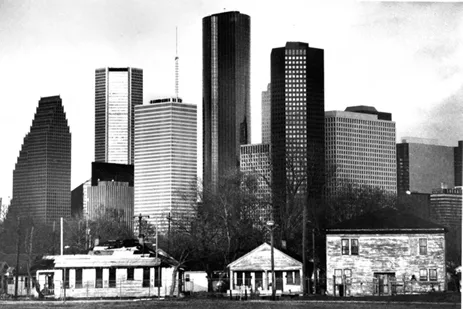
Few cities offer as dramatic a juxtaposition between wealth and poverty as Houston, Texas, where dilapidated shacks huddle in the shadow of downtown towers
Despite the persistence of deficient units, most lower income households live in homes or apartments that meet the basic requirements that American society has defined as being minimally acceptable: four solid walls and a roof that protect its residents from the elements; no hazards such as lead paint or asbestos; electricity for lighting and appliances; plumbing, including a flush toilet, a bath or shower, and hot and cold running water; a complete kitchen, including a sink, stove, and refrigerator; and adequate heat in cold weather.
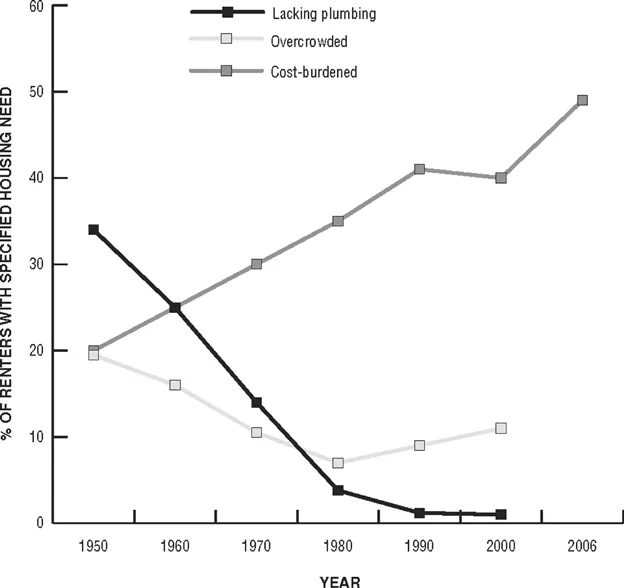
Lower income households suffer far more from problems associated with housing cost and housing occupancy—cost burden and overcrowding—than from deficiencies in their physical accommodations. In contrast to physical conditions, these problems have not diminished over time. The number of families suffering from cost burden has increased steadily since 1950, while overcrowding, after declining between 1950 and 1980, has been rising steadily at least through 2000 (Figure 1-1).3
Source: 1950–2000 data from U.S. Census; 2006 data from American Community Survey
Figure 1-1 Trends in Rental Housing Needs, 1950–2006
Cost burden
The housing problem that affects the largest number of Americans today is cost burden. Cost burden arises when families must spend so much for housing that their ability to pay for the other necessities of life is compromised. While the weight of the burden varies widely from household to household, depending on their income and the size of their nonhousing expenses such as health care, commuting, and child rearing, the federal government and other public agencies have adopted the standard that a household spending more than 30 percent of its gross income for shelter is cost-burdened, and one spending more than 50 percent is severely cost-burdened.4 For a low-income family earning $20,000 to $30,000 per year, it is easy enough to see that the amount left after taxes and annual housing costs that may be $8,000 to $10,000 will be difficult to stretch to cover the cost of putting food on the table, getting to and from work, and raising children.
Before going further, it is important to define what is meant by low income. Given the huge disparity in economic conditions and living costs from one part of the nation to another, government agencies dealing with housing, rather than setting a single national figure, have defined low-and moderate-income in relative terms, as a percentage of the median income in each region.5 This book will use the federal terminology and refer to those households earning less than 50 percent of the median income for the area in which they live, adjusted for household size, as very low-income households, and those earning between 50 percent and 80 percent of that median as low-income households.6 The sum of very low- and low-income households (all those earning 80 percent of median income or less) are referred to as lower income households. Lower income households make up roughly 40 percent of the nation’s population.
Area median incomes, which are calculated annually by the U.S. Department of Housing and Urban Development for all metropolitan areas or rural counties in the United States, vary widely from one part of the country to another. They can be as high as $111,600 (Stamford, Connecticut) or as low as $32,100 (Yazoo County, Mississippi) for a four-person family. As a result of these regional variations, a family of four earning $55,000 in Stamford would be defined as a very low-income family, but would be considered quite well-off in Yazoo County, where a family would only be defined as very low-income if their annual income was $16,050 or less.
Cost burden disproportionately affects low-income households. Nearly two-thirds of all low-income households in the United States suffer from cost burden (Table 1-1). Renters are much more likely to be cost-burdened than are owners. In 2004, 48 percent of all renters were cost-burdened, compared to 32 percent of home owners with mortgages, and only 14 percent of home owners without mortgages. During the past decade, however, the number of home owners with cost burdens has been rising much faster than the number of cost-burdened renters, as a result of the dramatic increase in house prices in much of the nation and the growth in subprime mortgages.
In 2000, more than three-quarters of all cost-burdened households were lower income households, or nearly 22 million households. Of these, half, or 11 million, were severely burdened, spending more than 50 percent of their income on housing costs. A recent study found that “working families facing a severe housing cost burden are more likely than other working families to endure material hardships.” The study found that 38 percent of those families experienced food insecurity—a euphemism for hunger—while 37 percent had a family member who lacked health insurance.7 Their situation is very different from that of affluent families, who may spend more than is necessary in order to buy a larger or higher quality home or live in a particularly desirable community. While a wealthy household might spend 30 percent of its income for housing and still have more than enough left over to live comfortably, that option is not available for struggling, hard-pressed working families.
TABLE 1-1COST BURDEN FOR LOW-AND MODERATE-INCOME HOUSEHOLDS IN 2000
INCOME RANGE
NUMBER OF HOUSEHOLDS
PERCENTAGE OF HOUSEHOLDS
Cost-burdened
Severely cost-burdened
Cost-burdened
Severely cost-burdened
Very low income
15,700,000
9,600,000
64.2%
39.2%
Low income
6,100,000
1,400,000
33.3
7.7
All lower income
21,800,000
11,000,000
51.0
25.8
Source: 2000 Census
TABLE 1-2CHANGE IN PERCENTAGE OF HOUSEHOLDS THAT ARE COST-BURDENED BY INCOME RANGE, 2000–2005
INCOME RANGE
HOME OWNERS
RENTERS
2000
2005
2000
2005
$0–19,999
60%
68%
81%
87%
$20,000–34,999
37%
44%
38%
58%
$35,000–49,999
25%
34%
11%
25%
$50,000–74,999
14%
23%
5%
11%
Source: 2000 data from 2000 Census; 2005 data from 2005 American Community Survey
Although cost burdens have been rising steadily since 1950, they took a sharp upward turn between 2000 and 2005, both for renters and—even more so—for home owners, as house prices skyrocketed to unprecedented levels. The number of renters spending 30 percent or more of their income for rent went from just over 13 million to nearly 17 million in only five years, an increase of 3.6 million or 29 percent. During the same period, however, the number of cost-burdened home owners went from 12 to 21 million, an increase of over 75 percent. Since most very low-income families were already cost-burdened in 2000, the change most dramatically affected low- and moderate-income families, as shown in Table 1-2. Many low-income families, already cost-burdened, saw their burden become even greater.8
The increase in renter cost burden since...
Table of contents
Cover
Title Page
Copyright Page
Table of Contents
Acknowledgments
Preface
Chapter 1. The Case for Affordable Housing
Chapter 2. Affordable Housing in the United States: A Short History
Chapter 3. Designing Affordable Housing
Chapter 4. Finding Sites and Gaining Approval for Affordable Housing
Chapter 5. Making the Numbers Work: Financing Affordable Housing
Chapter 7. Concentration and Opportunity: Undoing the Exclusion of Affordable Housing
Chapter 8. Affordable Housing, Community Development Corporations, and Neighborhood Revitalization
Chapter 9. The Risks and Rewards of Affordable Home Ownership
Chapter 10. Preserving Affordable Housing
Chapter 11. Homelessness and Affordable Housing
Chapter 12. Inclusionary Housing: Using the Market to Create Affordable Housing
Chapter 13. Policies, Politics, and the Future of Affordable Housing in the United States
Appendix: Resources for Further Information
Index
Trusted by 375,005 students
Access to over 1.5 million titles for a fair monthly price.
Study more efficiently using our study tools.
Frequently asked questions
Yes, you can cancel anytime from the Subscription tab in your account settings on the Perlego website. Your subscription will stay active until the end of your current billing period. Learn how to cancel your subscription
No, books cannot be downloaded as external files, such as PDFs, for use outside of Perlego. However, you can download books within the Perlego app for offline reading on mobile or tablet. Learn how to download books offline
Perlego offers two plans: Essential and Complete
Essential is ideal for learners and professionals who enjoy exploring a wide range of subjects. Access the Essential Library with 800,000+ trusted titles and best-sellers across business, personal growth, and the humanities. Includes unlimited reading time and Standard Read Aloud voice.
Complete: Perfect for advanced learners and researchers needing full, unrestricted access. Unlock 1.5M+ books across hundreds of subjects, including academic and specialized titles. The Complete Plan also includes advanced features like Premium Read Aloud and Research Assistant.
Both plans are available with monthly, semester, or annual billing cycles.
We are an online textbook subscription service, where you can get access to an entire online library for less than the price of a single book per month. With over 1.5 million books across 990+ topics, we’ve got you covered! Learn about our mission
Look out for the read-aloud symbol on your next book to see if you can listen to it. The read-aloud tool reads text aloud for you, highlighting the text as it is being read. You can pause it, speed it up and slow it down. Learn more about Read Aloud
Yes! You can use the Perlego app on both iOS and Android devices to read anytime, anywhere — even offline. Perfect for commutes or when you’re on the go. Please note we cannot support devices running on iOS 13 and Android 7 or earlier. Learn more about using the app
Yes, you can access A Decent Home by Alan Mallach in PDF and/or ePUB format, as well as other popular books in Architecture & Urban Planning & Landscaping. We have over 1.5 million books available in our catalogue for you to explore.