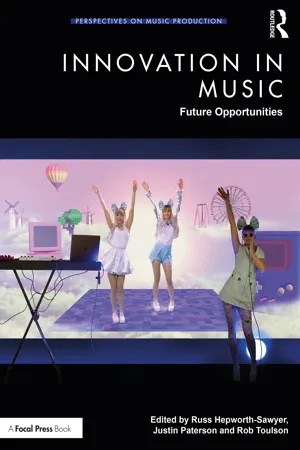
Innovation in Music: Future Opportunities brings together cutting-edge research on new innovations in the field of music production, technology, performance and business. Including contributions from a host of well-respected researchers and practitioners, this volume provides crucial coverage on a range of topics from cybersecurity, to accessible music technology, performance techniques and the role of talent shows within music business.
Innovation in Music: Future Opportunities is the perfect companion for professionals and researchers alike with an interest in the music industry.
The Innovation in Music network brings together practitioners, experts and academics in the rapidly evolving and connected disciplines of music performance, music production, audio technologies and music business. In 2019, the Innovation in Music Conference (InMusic19) was held at the University of West London and included keynote interviews, performances and panel discussions with Trevor Horn, Lula XYZ, Bruce Wooley, Rhiannon Mair, Sarah Yule, Matan Berkowitz, Rhiannon McLaren and the Radio Science Orchestra among others. The network and conference acts as a forum for industry experts and professionals to mix with researchers and academics to report on the latest advances and exchange ideas, crossing boundaries between music disciplines and bridging academia with industry. After the conference, contributors were invited to submit articles for this book, Innovation inMusic: Future Possibilities – which showcases the event. Accordingly, this book gives a broad and detailed overview of modern and cross-disciplinary innovations in the world of music.
The conference itself demonstrated a 'world first' via its performance keynote, whereby the Radio Science Orchestra ensemble played live in separate studios in London, and were joined in real time by musicians in Edinburgh, using GPS clocking via satellite to maintain data integrity over distance and keep latency within a naturalistic experience for the performers. The combined result was spatialized in 3-D, with interactive live video of all the musicians being projected onto the audience, using them as human pixels, then VJ-ed and re-projected onto the walls. Bruce Woolley interspersed his keynote dialogue over the music, and was joined by Matan Berkowitz, who improvised further musical layers using his selfbuilt gestural controllers. This event encapsulated much of the spirit of this book and technical details are offered in Chapter 6.
The book is divided into four parts, representing innovations around each of music production, technology, performance and business. In Part I, innovative examples of music production are presented, which ranges from low latency musical transmission to genre-boundary-breaking production techniques. Part II discusses innovation in music performance, discussing innovations from development of a unique ambisonic guitar system to procedural audio for theatre. Part III presents a number of new technologies for performance, from use of motion capture to aid classical piano-performance, to audience influence of live jazz-band improvisation via smart real-time electronic feedback. Finally, Part IV considers innovation in music business and artist development. Topics range from the quantum theory of musical creativity, to observation of mood-based patterns in music.
We thank all chapter authors, conference speakers, delegates and conference-sponsors for their support, and intend that the chapters of this book will be a lasting record of contemporary music innovations and a resource of research information for the future.
Russ Hepworth-Sawyer, Justin Paterson and Rob Toulson
1 Country & Eastern
Contextual and cultural mediation in the recording studio – two producers, two artists, two cultures
Richard Lightman
1.1Introduction and Background
The social and creative hierarchical positioning of the record producer in a studio context is determined by the technological and cultural dynamics within the studio and the relationship between the producer and the artist (Burgess, 2013:130-145). However, this relationship between the parties concerned seems to be weighted differently depending on cultural associations and cultural commonalities. Cultural differences appear to exacerbate incidences of insecurity and there are external, internal and stakeholder perceived pressures on the producer to meet diverse expectations. These same pressures exist within the framework of the same-culture producer/artist creative process, but there are elements of translation and interpretation removed from the transaction that are of additional concern to those outside of these parameters, (Frith and Zagorski-Thomas, 2012:149-160). There is the constant questioning as to whether either party is understood and on a creative level, the creative ideas and influences, objectives and outputs are not necessarily articulated in a fully comprehendible form (Glossop, 2014). This can be a positive contributory element to the creative process but does inject an additional dynamic into the interactions. Kerrigan (2013: 111-127) posits that cultural transference is embedded into an individual's understanding of codes and practices within a culture and that this then gets transformed into creativity. The practitioner's understanding of the process is not necessarily shared with other collaborators and unless the codes and practices are clearly defined between the parties concerned at the outset of a project, there can be a confusion of objectives and approaches to the qualitative, creative or commercial assessment of the output.
The analysis of the functions and outcomes of the mediation process within music production, within a mixed cultural context, provides further insight into the required negotiations and methodologies employed in the recording studio between artist and producer. The following outlines some of those processes through an auto-ethnographic case study of an album recording. This may help future recording artists and their producers to understand the cultural motivations and circumstances that inform the expectations of both parties within the production process, which can then be applied positively to enhance the end product.
As I had explored, experienced and researched this dynamic from both sides of the relationship as a practicing bhangra producer in the 1990s and a researcher of South Asian production techniques, it became apparent that it would be an invaluable addition to the research to experience and evaluate the relationships and dynamics from an equitable stance as both producer and artist in a modern-day context. This could then be evaluated as to how or whether the process had progressed from both an external and internal perspective.
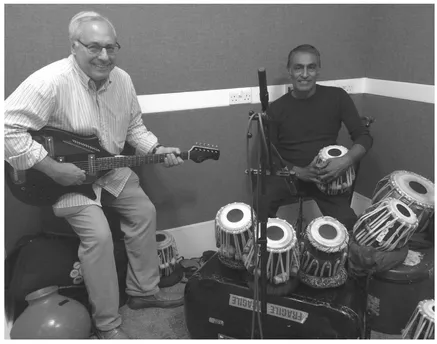
It was an accidental opportunity that allowed this further exploration. I had arranged for a concert performance of bhangra artists for students at the University of Kent. The musical director was my former associate and bhangra producer, Kuljit Bhamra, MBE, who had provided some research material via interview and with whom I had worked in the capacity of engineer and as a session musician in the early 1990s. We both worked with some of the same artists as producers in the past and this has provided an opportunity to compare styles, approaches and cultural interactions. It was during the programming of the event that Bhamra suggested that the two of us play together as an opening act to the concert. We had played on each other's productions as session musicians over the years, overdubbing parts onto existing arrangements, but had actually never played together before. The idea was that I would play a style on guitar (my first instrument) that would sit comfortably within my musical lexicon and that Bhamra would accompany me on tabla and Indian percussion. To test the concept, we met at his studio where we played together, extemporising and moving in and out of Western and Eastern styles. Being so enthused by this, we decided that after the concert, we would record an album together with the working title of 'Country & Eastern'. This would afford an additional opportunity to investigate from within, the relationships between the two cultures but with a balanced sense of production skills from the two protagonists, acting as both producers and artists. There was an awareness that this could create friction, however it could also create an intensity within the creative process that came from a position of technical and musical expertise with the possibility of creating a new genre. The success of this collaboration would depend on both an understanding of each other's cultural influences and a tolerance, or acceptance of breaches of each party's musical forms and the framework that surrounded this. The other contexts that needed to be incorporated into the equation, with a requirement for negotiation, mediation, tolerance and eventual consensus, were the technical procedures and habitual processes employed by each of the parties from a production perspective. Both of us were accustomed to different procedural methodologies when addressing our recordings and the differences could cause frustration or conversely, might be the interventions that could break both of us out of our technical comfort zones, creating new sonic vistas through non-familiar approaches to the production process.
As we sat and played together, we recorded our ideas. These recordings acted as a notepad for the musical concepts and structures that we could draw upon later when embarking on recording the album. The initial plan was to record basic backing tracks within the studio and then take the tracks away to our own studios where parts could be added on to the tracks. These additions could then be compared and adapted for the final recordings.
Figure 1.1 Richard Lightman and Kuljit Bhamra, MBE
The element of trust was rooted in the target final product and the commercial viability of the project. We were both aware that apart from the research element, the end game was also profitability. The objectives outweighed any creative misunderstandings of form and by doing so, provided the creative tension and space required to create something bigger and better than either of the parties concerned could create independently. All parties had something to gain and it is partly this dynamic that mediated any of the internal power struggles that existed between us. Even when creative differences become untenable, there is still the end goal that can bring a project back from the brink of failure. In this particular case there was the basic understanding that neither of us were going to waste our time on just creative pursuits and that ultimately, we needed to generate an equitable remuneration for our efforts. World music producer, Ben Mandelson states that although he is always in a situation where he is looking to exploit the market through his artist's creativity, he is always looking for a fair deal for all (Cottrell, 2010).
After much negotiation over time availability and diarising, I went to Bhamra's studio, taking fourteen different guitars with me. The sole purpose of this was to have a palate of sounds that could be employed if they were sonically compatible with Bhamra's extensive tabla set up. This was not done consciously to be competitive, but in retrospect it was a way of setting one's store out to show versatility. Bhamra's studio houses over 100 percussion instruments and drams and it could be argued that I did not want to be outdone. It references the observation that musicians will jostle to claim geographic possession of space when arriving in a recording studio, often placing instruments or cases in awkward positions near the console to establish territory. Once the lines have been drawn and the session settles down, these areas in some way become a safe space for the musicians who will invade or wander into the producer's 'space' in a form of territorial confrontation. This was not my intention during tins writing session, but there may have been an underlying personal agenda that even I was unaware of at the time.
Bhamra was initially unsure as to whether this project would really work and voiced his apprehension of bringing me into his world, at the ...
Table of contents
Cover
Half Title
Series Page
Title Page
Copyright Page
Contents
About the editors
Preface
Index
Trusted by 375,005 students
Access to over 1.5 million titles for a fair monthly price.
Study more efficiently using our study tools.
Frequently asked questions
Yes, you can cancel anytime from the Subscription tab in your account settings on the Perlego website. Your subscription will stay active until the end of your current billing period. Learn how to cancel your subscription
No, books cannot be downloaded as external files, such as PDFs, for use outside of Perlego. However, you can download books within the Perlego app for offline reading on mobile or tablet. Learn how to download books offline
Perlego offers two plans: Essential and Complete
Essential is ideal for learners and professionals who enjoy exploring a wide range of subjects. Access the Essential Library with 800,000+ trusted titles and best-sellers across business, personal growth, and the humanities. Includes unlimited reading time and Standard Read Aloud voice.
Complete: Perfect for advanced learners and researchers needing full, unrestricted access. Unlock 1.5M+ books across hundreds of subjects, including academic and specialized titles. The Complete Plan also includes advanced features like Premium Read Aloud and Research Assistant.
Both plans are available with monthly, semester, or annual billing cycles.
We are an online textbook subscription service, where you can get access to an entire online library for less than the price of a single book per month. With over 1.5 million books across 990+ topics, we’ve got you covered! Learn about our mission
Look out for the read-aloud symbol on your next book to see if you can listen to it. The read-aloud tool reads text aloud for you, highlighting the text as it is being read. You can pause it, speed it up and slow it down. Learn more about Read Aloud
Yes! You can use the Perlego app on both iOS and Android devices to read anytime, anywhere — even offline. Perfect for commutes or when you’re on the go. Please note we cannot support devices running on iOS 13 and Android 7 or earlier. Learn more about using the app
Yes, you can access Innovation in Music by Russ Hepworth-Sawyer, Justin Paterson, Rob Toulson, Russ Hepworth-Sawyer,Justin Paterson,Rob Toulson in PDF and/or ePUB format, as well as other popular books in Media & Performing Arts & Music. We have over 1.5 million books available in our catalogue for you to explore.