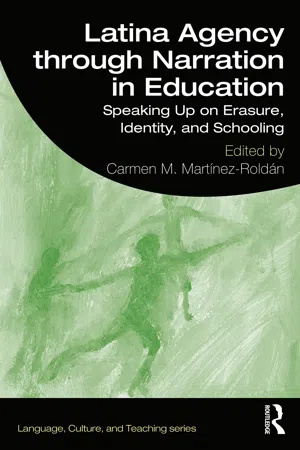
Drawing on critical and sociocultural frameworks, this volume presents narrative studies by or about Latinas in which they speak up about issues of identity and education. Using narratives, self-identification stories, and testimonios as theory, methodology, and advocacy, this volume brings together a wide range of Latinx perspectives on education identity, bilingualism, and belonging. The narratives illustrate the various ways erasure and human agency shape the lives and identities of Latinas in the United States from primary school to higher education and beyond, in their schools and communities. Contributors explore how schools and educational institutions can support student agency by adopting a transformative activist stance through curricula, learning contexts, and policies. Chapters contain implications for teaching and come together to showcase the importance of explicit activist efforts to combat erasure and engage in transformative and emancipatory education.
eBook - ePub
Latina Agency through Narration in Education
Speaking Up on Erasure, Identity, and Schooling
- 238 pages
- English
- ePUB (mobile friendly)
- Available on iOS & Android
eBook - ePub
Latina Agency through Narration in Education
Speaking Up on Erasure, Identity, and Schooling
About this book
Information
1
Narrating Erasure, Narrating Agency
Towards a Transformative Activist
This edited volume joins a line of research that uses narratives, self-identification stories, and testimonios as theory, methodology, and advocacy focusing on the lives of Latinas. Nine authors engaged in an inquiry into life experiences that have been relevant to the narrators’ processes of becoming—becoming Latinas, students, anti-racist teachers, and advocates. Their narratives highlight experiences involving what can be described as practices of erasure, but more importantly, they feature a range of agentive actions and discourses with implications for the schooling of students from minoritized1 communities, especially the schooling of Latinxs, who represent one-fourth of U.S. elementary, middle, and high-school students (IES National Center for Education Statistics, 2019).
My discussion of the narratives in this chapter is framed by an age-old question pursued by many scholars, and most recently raised by Anna Stetsenko (2017): “How can people be understood fundamentally as agentive persons choosing and making ‘their way’ and, at the same time, as constituted at the very core of their being and existence by the social forces and structures seemingly beyond themselves?” (p. 4). This question has shaped not only my own biography but also my inquiry on the interaction between educational contexts that constrain agency and those that open up spaces for teaching, learning, and agency. As Hall (1985) put it, echoing a Marxian principle: We make history and we can change history “but on the basis of anterior conditions which are not of our making” (p. 85). Working within this premise and challenging the individual/society dichotomy prevalent during his time, Vygotsky (1978, 2004) showed how individuals create, appropriate, and transform cultural tools and artifacts available to them for their own purposes. His proposal was profoundly agentive and his ideas about cultural mediation “as the main pathway for development were combined with, and embedded within, his social activism and a passionate quest for equality and justice” (Stetsenko, 2017, p. 89).
In her book, The Transformative Mind: Expanding Vygotsky’s Approach to Development and Education, Stetsenko (2017) elaborates on these proposals and puts forth a dialectical view of agency called a Transformative Activist Stance in education. Her response to the question above on individuals’ agency as enacted within social forces and structures beyond themselves resonates with my reading of the narratives presented in this volume, which center issues of identity, erasure, agency, and schooling. The central theme of Stetsenko’s critical sociocultural proposal is that human development is a collaborative project of people changing and co-creating the world together, contributing change efforts oriented by social justice and equity goals. Within this premise, every person matters because the world is evoked and created “by each and every one of us, in each and every event of our being-knowing-doing-by us as social actors” (p. 7). We are “agents of communal practices and collective history, who only come about [as humans] within the matrices of these practices through realizing and co-authoring them in joint struggles and strivings” (p. 7).
Paraphrasing the premise of her proposal, it can be said that in fighting erasure and the structures that promote it, there are no insignificant contributions. Acknowledging that we live within contexts and structures that facilitate or stifle our agentive potential with real material consequences, every effort and story of each teacher, student, and parent counts and matters. These efforts, local and little as they may be, contribute to co-creating history; each one can help change the world; through each one we realize our humanity. Narratives, then, are approached in this book as a type of activism. Storytelling has been a core strategy of Latinx2 communities’ organized and ongoing struggle for a liberatory education. Teachers have often been central to those stories or their narrators as accomplices to the struggle for change. This volume recognizes that teachers’ roles as activists are of critical importance in this struggle. Convinced of the power of stories and the power of teachers to generate change, we offer this edited volume.
As a Latina researcher and teacher educator working at a predominantly white institution of higher education that is committed to social justice through its mission and policies but that is still wrestling with how to better serve its students of color, I have been fortunate to teach a graduate methods class on ‘Latina Women Narratives’ every other year. The course has become a space where students not only engage with narrative methodologies but one in which Latinas’ experiences are brought forth and centered into the curriculum, a rare occurrence at predominantly white institutions of higher education. It has been humbling to learn about my students’ stories of struggle, survival, and self-identification processes. Their narratives raised many critical issues about the educational systems serving Latinx students, and I soon realized that these stories needed to be shared with Latinx communities and those interested in the education of students of color. The book then ...
Table of contents
- Cover
- Half Title
- Series Page
- Title Page
- Copyright Page
- Dedication
- Table of Contents
- List of Boxes
- List of Figures
- List of Tables
- Foreword
- List of Contributors
- Acknowledgements
- Chapter 1: Narrating Erasure, Narrating Agency: Towards a Transformative Activist
- Part I: Mobilizing Funds of Knowledge and Funds of Identities: Negotiating Bicultural Identities
- Part II Mobilizing Places and Voice: Authoring Linguistic and Academic Identities
- Part III Mobilizing Networks of Solidarity: Creating Spaces for Agency
- Afterword: To Defy Erasure…
- Index
Trusted by 375,005 students
Access to over 1.5 million titles for a fair monthly price.
Study more efficiently using our study tools.
Frequently asked questions
Yes, you can cancel anytime from the Subscription tab in your account settings on the Perlego website. Your subscription will stay active until the end of your current billing period. Learn how to cancel your subscription
No, books cannot be downloaded as external files, such as PDFs, for use outside of Perlego. However, you can download books within the Perlego app for offline reading on mobile or tablet. Learn how to download books offline
Perlego offers two plans: Essential and Complete
- Essential is ideal for learners and professionals who enjoy exploring a wide range of subjects. Access the Essential Library with 800,000+ trusted titles and best-sellers across business, personal growth, and the humanities. Includes unlimited reading time and Standard Read Aloud voice.
- Complete: Perfect for advanced learners and researchers needing full, unrestricted access. Unlock 1.5M+ books across hundreds of subjects, including academic and specialized titles. The Complete Plan also includes advanced features like Premium Read Aloud and Research Assistant.
We are an online textbook subscription service, where you can get access to an entire online library for less than the price of a single book per month. With over 1.5 million books across 990+ topics, we’ve got you covered! Learn about our mission
Look out for the read-aloud symbol on your next book to see if you can listen to it. The read-aloud tool reads text aloud for you, highlighting the text as it is being read. You can pause it, speed it up and slow it down. Learn more about Read Aloud
Yes! You can use the Perlego app on both iOS and Android devices to read anytime, anywhere — even offline. Perfect for commutes or when you’re on the go.
Please note we cannot support devices running on iOS 13 and Android 7 or earlier. Learn more about using the app
Please note we cannot support devices running on iOS 13 and Android 7 or earlier. Learn more about using the app
Yes, you can access Latina Agency through Narration in Education by Carmen M. Martinez-Roldan in PDF and/or ePUB format, as well as other popular books in Education & Education General. We have over 1.5 million books available in our catalogue for you to explore.