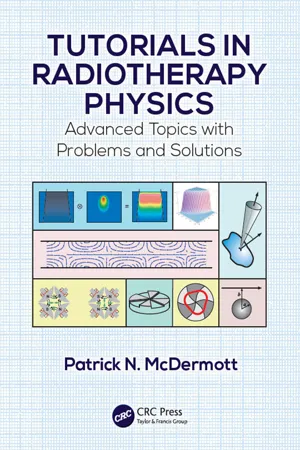
Tutorials in Radiotherapy Physics
eBook - ePub

Tutorials in Radiotherapy Physics

Advanced Topics with Problems and Solutions

  1. 302 pages
  2. English
  3. ePUB (mobile friendly)
  4. Available on iOS & Android
eBook - ePub

Tutorials in Radiotherapy Physics

Advanced Topics with Problems and Solutions

About this book

The Topics Every Medical Physicist Should Know

Tutorials in Radiotherapy Physics: Advanced Topics with Problems and Solutions covers selected advanced topics that are not thoroughly discussed in any of the standard medical physics texts. The book brings together material from a large variety of sources, avoiding the need for you to search through and digest the vast research literature. The topics are mathematically developed from first principles using consistent notation.

Clear Derivations and In-Depth Explanations

The book offers insight into the physics of electron acceleration in linear accelerators and presents an introduction to the study of proton therapy. It then describes the predominant method of clinical photon dose computation: convolution and superposition dose calculation algorithms. It also discusses the Boltzmann transport equation, a potentially fast and accurate method of dose calculation that is an alternative to the Monte Carlo method. This discussion considers Fermi–Eyges theory, which is widely used for electron dose calculations. The book concludes with a step-by-step mathematical development of tumor control and normal tissue complication probability models. Each chapter includes problems with solutions given in the back of the book.

Prepares You to Explore Cutting-Edge Research

This guide provides you with the foundation to read review articles on the topics. It can be used for self-study, in graduate medical physics and physics residency programs, or in vendor training for linacs and treatment planning systems.

Frequently asked questions

Yes, you can cancel anytime from the Subscription tab in your account settings on the Perlego website. Your subscription will stay active until the end of your current billing period. Learn how to cancel your subscription.
No, books cannot be downloaded as external files, such as PDFs, for use outside of Perlego. However, you can download books within the Perlego app for offline reading on mobile or tablet. Learn more here.
Perlego offers two plans: Essential and Complete
  • Essential is ideal for learners and professionals who enjoy exploring a wide range of subjects. Access the Essential Library with 800,000+ trusted titles and best-sellers across business, personal growth, and the humanities. Includes unlimited reading time and Standard Read Aloud voice.
  • Complete: Perfect for advanced learners and researchers needing full, unrestricted access. Unlock 1.4M+ books across hundreds of subjects, including academic and specialized titles. The Complete Plan also includes advanced features like Premium Read Aloud and Research Assistant.
Both plans are available with monthly, semester, or annual billing cycles.
We are an online textbook subscription service, where you can get access to an entire online library for less than the price of a single book per month. With over 1 million books across 1000+ topics, we’ve got you covered! Learn more here.
Look out for the read-aloud symbol on your next book to see if you can listen to it. The read-aloud tool reads text aloud for you, highlighting the text as it is being read. You can pause it, speed it up and slow it down. Learn more here.
Yes! You can use the Perlego app on both iOS or Android devices to read anytime, anywhere — even offline. Perfect for commutes or when you’re on the go.
Please note we cannot support devices running on iOS 13 and Android 7 or earlier. Learn more about using the app.
Yes, you can access Tutorials in Radiotherapy Physics by Patrick N. McDermott in PDF and/or ePUB format, as well as other popular books in Medicine & Biotechnology in Medicine. We have over one million books available in our catalogue for you to explore.

Information

Publisher
CRC Press
Year
2016
Print ISBN
9781138445680
eBook ISBN
9781498755559
1
THE PHYSICS OF ELECTRON ACCELERATION IN MEDICAL LINACS
1.1 INTRODUCTION
Let us estimate the sort of energy and beam current necessary to achieve a desirable penetration depth and dose rate. We first consider the beam energy. The deepest target in the human body is in the pelvis. Let us suppose that we need to reach a depth of 30 cm with no more than 50% beam attenuation. In this case, we need photons with energy such that the half-value layer thickness equals 30 cm in water. This corresponds to photons with an energy of approximately 5 MeV. The average energy in a bremsstrahlung spectrum is about one-third of the maximum energy. Therefore, the electron beam energy needs to be about 15 MeV. We would not want to use beam energies much larger than this because this would waste photons that would pass right through the patient and because we want the beam to be attenuated beyond the target to reduce the dose to normal tissues.
As the reader may already know, linac beams are pulsed (see Section 1.9). The beam currents quoted in this section are time averages over a timescale long compared to the individual pulses. Calculation of the necessary average beam current is most easily done for electron treatments. For photon treatments, we have the question of the efficiency of bremsstrahlung photon production in the target and the transmission of the flattening filter. Modern medical linear accelerators have a dose rate on the order of 600 cGy/min. The dose rate due to electrons is
D·[Gy s1]=1.6×10¹⁰Φ·[cm2s1](dTρdx)c[MeV/cm2g1],
(1.1)
where Φ. is the fluence rate in cm−2 s−1 and the mass collision stopping power is given in units of MeV cm2 g−1 (Attix, 1986). For 10 MeV electrons, the mass collision stopping power is 2.0 MeV cm2 g−1 in water. To obtain the desired dose rate, the fluence rate must be 3.2 × 108 cm−2 s−1. Let us suppose that the beam is 10 cm × 10 cm in cross-sectional area. In this case, we can calculate the necessary average beam current to be approximately 5 nA. In reality, the average beam current is actually considerably higher than this for the following reasons. To reduce the variation in the energy of the accelerated electrons, the beam passes through an energy slit in the bending magnet. According to Karzmark et al. (1993, p. 190), this energy slit may pass as little as 5% of the beam. This raises the necessary raw beam current for electron mode to approximately 0.1 μA. In addition, the electron gun current needs to be even higher than the beam current because only some fraction of the electrons are captured and accelerated.
For a photon treatment, the beam current needs to be between 100 and 1000 times greater than for an electron treatment. The required average beam current is up to 100 μA. Photon beam current requirements are complicated by the efficiency of x-ray production in th...

Table of contents

  1. Cover
  2. Half Title
  3. Title Page
  4. Copyright
  5. Dedication
  6. Contents
  7. Preface
  8. Acknowledgments
  9. Author
  10. 1 The Physics of Electron Acceleration in Medical Linacs
  11. 2 Proton Therapy Physics: Protons for Pedestrians
  12. 3 Convolution/Superposition Dose Computation Algorithms
  13. 4 Deterministic Radiation Transport: A Rival to Monte Carlo Methods
  14. 5 Tumor Control and Normal Tissue Complication Probability Models in Radiation Therapy
  15. Appendix: Problem Solutions
  16. Index