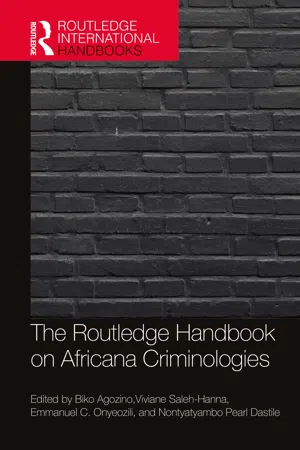
The Routledge Handbook of Africana Criminologies
  1. 270 pages
  2. English
  3. ePUB (mobile friendly)
  4. Available on iOS & Android
eBook - ePub

About this book

The Routledge Handbook on Africana Criminologies plugs a gaping hole in criminological literature, which remains dominated by work on Europe and settler-colonial locations at the expense of neocolonial locations and at a huge cost to the discipline that remains relatively underdeveloped.

It is well known that criminology is thriving in Europe and settler-colonial locations while people of African descent remain marginalized in the discipline. This handbook therefore defines and explores this field within criminology, moving away from the colonialist approach of offering administrative criminology about policing, courts, and prisons and making a case for decolonizing the wider discipline. Arranged in five parts, it outlines Africana criminologies, maps its emergence, and addresses key themes such as slavery, colonialism, and apartheid as crimes against humanity; critiques of imperialist reason; Africana cultural criminology; and theories of law enforcement and Africana people. Coalescing a diverse range of voices from Africa and the diaspora, the handbook explores outside Eurocentric canons in order to learn from the experiences, struggles, and contributions of people of African descent.

Offering innovative ways of theorizing and explaining the criminological crises that face Africa and the entire world with the view of contributing to a more humane world, this groundbreaking handbook is essential reading for criminologists and sociologists worldwide, as well as scholars of Africana studies and African studies.

Frequently asked questions

Yes, you can cancel anytime from the Subscription tab in your account settings on the Perlego website. Your subscription will stay active until the end of your current billing period. Learn how to cancel your subscription.
No, books cannot be downloaded as external files, such as PDFs, for use outside of Perlego. However, you can download books within the Perlego app for offline reading on mobile or tablet. Learn more here.
Perlego offers two plans: Essential and Complete
  • Essential is ideal for learners and professionals who enjoy exploring a wide range of subjects. Access the Essential Library with 800,000+ trusted titles and best-sellers across business, personal growth, and the humanities. Includes unlimited reading time and Standard Read Aloud voice.
  • Complete: Perfect for advanced learners and researchers needing full, unrestricted access. Unlock 1.4M+ books across hundreds of subjects, including academic and specialized titles. The Complete Plan also includes advanced features like Premium Read Aloud and Research Assistant.
Both plans are available with monthly, semester, or annual billing cycles.
We are an online textbook subscription service, where you can get access to an entire online library for less than the price of a single book per month. With over 1 million books across 1000+ topics, we’ve got you covered! Learn more here.
Look out for the read-aloud symbol on your next book to see if you can listen to it. The read-aloud tool reads text aloud for you, highlighting the text as it is being read. You can pause it, speed it up and slow it down. Learn more here.
Yes! You can use the Perlego app on both iOS or Android devices to read anytime, anywhere — even offline. Perfect for commutes or when you’re on the go.
Please note we cannot support devices running on iOS 13 and Android 7 or earlier. Learn more about using the app.
Yes, you can access The Routledge Handbook of Africana Criminologies by Biko Agozino, Emmanuel Onyeozili, Nontyatyambo Dastile, Viviane Saleh-Hanna, Biko Agozino,Emmanuel Onyeozili,Nontyatyambo Dastile,Viviane Saleh-Hanna, Biko Agozino, Viviane Saleh-Hanna, Emmanuel Onyeozili, Nontyatyambo Dastile in PDF and/or ePUB format, as well as other popular books in Social Sciences & Criminology. We have over one million books available in our catalogue for you to explore.

Information

PART I
The emergence of Africana criminologies

1
NELSON MANDELA’S CRIMINOLOGY

A decolonial intervention

Nontyatyambo Pearl Dastile and Sabelo J. Ndlovu-Gatsheni

Introduction

Nelson Mandela attained the status of global icon partly because of serving 27 years in prison and partly due to his unique approach towards the rebuilding of a post-apartheid South Africa predicated on principles of forgiveness, reconciliation, unity, nonracialism, and liberal democracy. Like many other African leaders who fought against colonialism, Mandela emerged from prison to lead South Africa into a post-apartheid era. What is of interest to us is how the apartheid colonial system criminalized African struggles for deracialization and decolonization and, indeed, for social justice – in the process, labelling such fighters for freedom as Mandela “terrorists.” Mandela was condemned as a terrorist and a communist, along with others who were threatening Christian civilization as represented by White settlers in the entire southern African region. We, therefore, use Mandela’s experience of incarceration to reveal the dynamics of criminalization of the very African struggles for liberation. Consequently, we elevate Mandela’s life of struggle to a “Mandela phenomenon”: that is, an embodiment of liberatory spirit that successfully turned the tables and led to apartheid colonialism being declared a crime against humanity. The chapter focuses on how Mandela used the Rivonia trial to put the apartheid colonial regime on the dock and how he exposed its crimes to the entire world. Building on Mandela’s speech at the Rivonia trial, the chapter opens the canvas to mount a decolonial perspective that identifies colonialism and coloniality crimes against humanity. We advance the idea of Mandela assuming the position of judge inside an apartheid colonial court so as to represent all the enslaved, colonized, and racialized peoples.
There is only one line, purpose, and reason for colonialism; it is to destroy, denigrate, and brutalize those who were deemed criminal, such as Nelson Mandela. This chapter seeks to answer the question of what it meant to be a criminal in colonial times. What do criminology and decoloniality have to unravel as disciplines that fail to acknowledge and realize colonialism as a system that created Blacks as criminals during colonial times and continued to do so under apartheid South Africa? The chapter is divided into three parts. The first part sketches Mandela’s “crimes” and offenses during the era of colonialism. The second part looks at Mandela’s representation and storytelling or narrative in court as he successfully attempted to humanize himself and others. The last part of the chapter paves the path for criminology, a discipline bedeviled by disciplinary decadence, and thus attempts to answer the question of the belonging and identity of criminology. “What would a criminology of Nelson Mandela entail?” is what the last part seeks to answer.

Framing the contours of anticolonial/liberatory criminology

There is no doubt that criminology in South Africa has features of Orientalism and Occidentalism. This is clear in the way in which colonial criminology evolved in South Africa (Dixon, 2004). Criminology in South Africa unfolded as part of Euromodernity’s claims of ushering in salvation, progress, civilization, modernization, development, and emancipation. Law and criminology were effectively used in what became known as “pacification of barbarous tribes.” Consequently, all those people who resisted colonial encroachment were labelled criminals. This takes us to a very relevant question of who/what was a criminal or a crime under colonialism.
A response to this haunting question enables the laying down of a framework of anticolonial/liberatory criminology that legitimizes African resistance to colonialism, capitalism, and patriarchy. In this framework, colonialism and coloniality emerge as crimes against humanity. Resistance in the eyes of colonialists amounted to “offending against” the system. Institutions of incarceration emerged under colonialism as part of the consolidation of conquest and domination over those who were termed “natives.” It is therefore not surprising that in former settler colonies like the United States of America and South Africa, most criminals are Black, from poor economic backgrounds, and can barely afford legal representation. Colonial criminology functioned along the lines of criminalization of Indigenous people’s ways of living and resisting.
Hence, criminology has features of Occidentalism, in which courts barely take the distinct cultural and linguistic categories into consideration when making judgements. Colonial police were law unto themselves when confronting the “natives.” Thus, colonial criminology amounted to legitimation of colonial lawlessness. The question that arises is “How does criminology, in its definition of crime and criminality, take into account the histories of colonialism and apartheid imposed on Black people in South Africa?” Colonial racism became an organizing principle of even the justice system. Justice had a color and, indeed, a gender. This is why anticolonial/liberatory criminology has to be predicated on decolonization and decoloniality for it to shift from imperialism, racism, and sexism.

Lessons from Mandela’s life of struggle and imprisonment

Mandela’s life of struggles and imprisonment are read as texts, which are revealing of how apartheid colonialism literally criminalized Black people. This is why Mandela indicated that
it was a crime to walk through a Whites Only door, a crime to ride a Whites Only bus, a crime to use a Whites Only drinking fountain, a crime to walk on Whites only beach, a crime to be on the streets after 11 p.m., a crime not to have a pass book and a crime to have the wrong signature in that book, a crime to be unemployed and a crime to be employed in the wrong place, a crime to live in certain places and a crime to have no place to live.
(Mandela, 1994:172)
According to Soudien (2015:335), “Mandela and his comrades worked through, often with great difficulty and even contradiction, the questions of their individual and collective pasts, and their subjectivities and begin to delineate alternative visions of what the new South Africa could look like.” Mandela persisted through his criminalization and wrestled with difficult questions of his humanity, criminalization, and alleged offending behaviors. Thus, one cannot look at Mandela and fail to sketch the colonial offenses through which he was, on several occasions, wrongly incarcerated for demanding social equality and justice. Mandela’s time in prison could be read as “in the beginning to construct a response to whether Mandela’s history of incarceration” can be romanticized or not is to alert to “the fact of overcoming rather than succumbing to the apartheid regime’s intent to destroy its opponents,” and this is the description that depicts the way in which Mandela served his time in prison (Soudien, 2015:355).

Accused No 1: The “crime”

From a young age, from Mandela’s involvement in student protests at the University of Fort Hare to his being suspended and expelled from the university, we see a sign and symbol of his beginning to contest the identity of being a deviant deserving criminalization. As Sitze (2014:139) argues, this was a time when Mandela
encountered the root of south African law, a specifically conceptual trouble. Mandela would have been left with the realization that the very same colonial administrative apparatus that spoke of itself, using the lexicon of the nineteenth century liberalism, as a guardian and trustee for native populations, could and did double as an occupying army – an apparatus whose normalized exceptions to law, pass laws, above all – resembled nothing so much as perpetual martial law.
Thus, for the first time, Mandela encountered a double identity: that of being Black and that of being a deviant. Indeed, one of his lecturers, Hlahlo, even believed that Mandela and other Blacks did not belong to the classroom. In his words, “law as a social science was too rigorous for women and blacks to master” (Mandela, 1994:353). The subsequent arrests of Mandela, including several bans, are highlighted to somehow prove that Hlahlo’s words came true for Mandela to be regarded as an outcast and a criminal.
In the words of Mandela, from his name, Rolihlahla, one sees the birth of someone whose identity was associated with his name. Rolihlahla, loosely translated, means troublemaker. However, he says in his autobiography,
I do not believe that names are destiny or that my father somehow divined my future, but in later years friends and relatives would ascribe to my birth name the many storms I have both caused and weathered. The years of my birth marked the end of Great War; the outbreak of an influenza epidemic that killed millions throughout the world; the visit of a delegation of the African National Congress to the Versailles peace conference to raise the grievances of the African people of South Africa.
(Mandela, 1994:3)
The first scene of the crime was his education. Having a Bantu education, Mandela soon learned how the English were assumed to be superior to any other beings. But in his interactions with Chief Joyi, he, in his own words,
railed against the white man, whom he believed had deliberately sundered the Xhosa tribe, dividing brother from brother. The white man had told the AbaThembu that their chief was a great white queen across the ocean and that they were her subjects. But the white queen brought nothing but misery and perfidy to the black people; if she was a chief, was an evil chief.
(Mandela, 1994:4)
These war stories signaled the event of colonialism through the usurpation of land, the taking over of land belonging to Blacks in order to engross its own empire. This was the beginning of Mandela’s political awareness through the narratives and storytelling of Chief Joyi. Storytelling has been part of Africa’s Black pride through generations. In colonial times, these stories served to speak the truth and disavow the education which Mandela had been taught in his schooling years which was the scene of the crime.
Another example of a storyteller was Chief Meligqili, who would further attest to the consequences of colonialism as follows:
[W]e have just circumcised them in a ritual that promises them manhood, but I am here to tell you that it is an empty, illusory promise, a promise that can never be fulfilled. For we Xhosas, and all black South Africans, are a conquered people. We are slaves in our own country. We are tenants on our own soil. We have no strength, no power, no control over our own destiny in the land of our birth. They will go to cities where they will live in shacks and drink cheap alcohol, all because we have no land to give them where they could prosper and multiply… I well know that Qamata (God) is all-seeing and never sleeps, but I have a suspicion that Qamata may in fact be dozing. If this is the case, the sooner I die the better, because I can meet him and shake him awake and tell him that the children of Ngubengcuka, the flower of the Xhosa nation, are dying.
(Mandela, 1994:35)
We argue that these two instances of storytelling were the beginning of the formation of Mandela’s political life as he says “I was beginning to realize that a black man did not have to accept the dozens of petty indignities directed at him each day” (Mandela, 1994:59). As he moved from Mqhekezweni to Alexander, he was confronted daily with police raids as well as the mass detention of scores of Black people. The mass incarceration of Black people would persist in South Africa during the apartheid years. These Black people were charged and incarcerated for, amongst other things, pass violations, possession of liquor, and failure to pay the poll tax.
His first encounter with the law was when his friend was arrested for gun possession. The gun was owned by Mandela, and he confessed this to the police. His second arrest would be when he boarded a train meant for Whites only, which was a crime in apartheid South Africa (Mandela (1994:78). This would signal his realization that “justice was not at all blind” (Mandela, 1994:105). Mandela’s coming of age would result in him saying,
I was angry at the white man not racism. While I was not prepared to hurl the white man into the sea, I would have been perfectly happy if he had climbed aboard his steamships and left the continent of his own volition.
(Mandela, 1994:129)

The beginning of his active political movement

Certain laws were introduced, such as the Suppression of Communism Act, that rendered it an offense to belong to a political party (Mandela, 1994:134). A second law was the Group Areas Act, which was the basis of residential apartheid (Mandela, 1994:143). A further encounter with the law for Mandela was an incident in which he accidentally hit a White boy with a car. Recognizing that the accident was caused by a Black man, the local White policeman said “Kaffer jy sal kak vandag” (Kaffir you will shit today) (Mandela, 1994:144). Mandela’s response was “in no uncertain terms that I would shit when I pleased, not when the policeman told me to” (Mandela, 1994:144). This resulted in a threat of his arrest, which was easily done at the time.
His first ban for political activities followed these two incidents. During a mass defiance campaign organized by the ANC, Mandela and others were arrested and imprisoned. This was not the first time he had been detained. In apartheid South Africa, arrests and detentions of this nature only served to strengthen the cause of fighting for freedom among Black people. As Mandela observed: “even on our way to prison, the vans swayed to the rich voices of Nkosi Sikelel’iAfrika, the hauntingly beautiful national anthem. Until then I had spent bit and pieces of time in prison but this was my first concentrated experience” (Mandela, 1994:137). While this was the case, and they were met with police brutality, including the killing of 18 people who were involved in silent protests, Mandela was resolute in calling for nonviolent protests, which included non-cooperation and nonviolence. Forms of nonviolent protests included
entering proscribed areas without permits, use Whites Only facilities such as toilets, Whites Only railway compartments, waiting rooms and post office entrances. They would deliberately remain in town after curfew. Each batch of defiers would have a leader who would inform the police in advance of the act of disobedience so that the arrests co...

Table of contents

  1. Cover
  2. Half Title
  3. Title Page
  4. Copyright Page
  5. Contents
  6. List of contributors
  7. Foreword
  8. Introduction
  9. Part I The emergence of Africana criminologies
  10. Part II Slavery, colonialism, and apartheid as crimes against humanity
  11. Part III The critique of imperialist reason in Africana criminology
  12. Part IV Africana cultural criminology
  13. Part V Theories of law enforcement and Africana people
  14. Conclusion
  15. Index