Integrative psychotherapy is a groundbreaking book where the authors present mindfulness- and compassion-oriented integrative psychotherapy (MCIP) as an integration of relational psychotherapy with the practice and research of mindfulness and compassion.
The book elucidates an approach which is holistic and based on evidence-based processes of change related to the main dimensions of human experience. In this approach, mindfulness and compassion are viewed as meta-processes of change that are used within an attuned therapeutic relationship to create a powerful therapeutic model that provides transformation and growth. The authors offer an exciting perspective on intersubjective physiology and the mutual connection between the client's and therapist's autonomic nervous systems.
Comprised of creatively applied research, the book will have an international appeal amongst psychotherapists/counsellors from different psychotherapy traditions and also students with advanced/postgraduate levels of experience.
1Development of mindfulness- and compassion-oriented integrative psychotherapy
When students ask us what integrative psychotherapy is, we often tell them the ancient Indian parable of the “Blind Men and the Elephant”. In this parable, some blind men wanted to know what an elephant is. Each of the blind men described the elephant in their own way, according to which part of the body they inspected. For one, who touched the trunk, the elephant was like a snake, for another whose hand touched the elephant’s leg, it was like a tree-trunk. The blind man who touched the tail described it like a rope. Others described it as a wall, a spear, and a fan. Then, the blind men started to quarrel about the reality of the “elephant”.
The field of psychotherapy is often similar to blind men who are quarrelling about the nature of truth. The history of psychotherapy is full of rivalries between psychotherapy approaches, where each approach wanted to prove that it possesses the truth and that it is better than another. Behavioural therapists criticised psychoanalysis, saying that it is unscientific. Conversely, psychoanalysts criticised behavioural therapy, saying that it produces only symptom relief. Humanistic schools were often called too optimistic, and humanistic schools thought that psychoanalysis and behavioural therapy were too deterministic.
Like a blind man, each psychotherapy approach often gives priority only to one or a few aspects of human experience. Some approaches focus on the cognitive dimension, others on emotions, some give priority to relationships, and others to values and meaning. However, as the parable suggests, all these dimensions are part of the whole and all are significant.
The parable of the “Blind Men and the Elephant” is often used to describe psychotherapy integration (Cooper, 2019; Walder, 1993). The psychotherapy integration movement emerged as an attempt to overcome the rigid boundaries and divisions of separate psychotherapy approaches, and to start an ongoing dialogue between different approaches and schools. Instead of defending and proving one’s own view, different approaches to psychotherapy can learn from each other in an attempt to understand the greater reality and the whole of the human psyche.
Psychotherapy integration as a new paradigm in psychotherapy
The psychotherapy integration movement emerged as an expression of the need to overcome the limitation of a single approach to psychotherapy. Psychotherapists who had trained in a specific approach to psychotherapy started to look outside of their primary approach and began to learn from each other. Norcross and Alexander (2019) describe that “integration is characterised by dissatisfaction with single-school approaches and a concomitant desire to look across school boundaries to see what can be learned from other ways of conducting psychotherapy” (p. 4). Since 1980, integrative psychotherapies have significantly grown in different continents and countries (Gómez et al., 2019). In the 21st century, psychotherapy integration has become a “spirit of the time” or “zeitgeist” (Castonguay et al., 2015). Norcross and Alexander (2019) state that “approximately one quarter to one-half of contemporary American clinicians disavow an affiliation with a particular school of therapy and prefer instead the label of integrative or eclectic” (p. 13). To date, there are more than 460 published books on psychotherapy integration (Goldfried et al., 2019), and leading textbooks on psychotherapy often identify their theoretical orientation as integrative (Norcross & Alexander, 2019). We think that psychotherapy integration can be rightly called a new paradigm in psychotherapy which is gaining increasing acceptance in the field.
There are different pathways to psychotherapy integration: theoretical integration, common factors, assimilative integration, and technical eclecticism (Norcross & Alexander, 2019). Theoretical integration involves the synthesis of theories and methods of two or more approaches to psychotherapy in a new therapeutic approach. A common factors approach focuses on common ingredients and principles of change across different psychotherapy approaches with an attempt to “create more parsimonious and efficacious treatments based on those communalities” (Norcross & Alexander, 2019, p. 11). Assimilative integration involves grounding in one particular psychotherapy approach and selective integration of principles, views, and methods from other psychotherapy approaches. Technical eclecticism is the use of techniques from different therapeutic approaches without an overarching theoretical framework, but it is based on research evidence and clinical observation to select the techniques which work best for a specific problem or person.
The main characteristics of the integrative paradigm can be summarised by (a) dialogue and openness, (b) coexistence of different “truths” or “realities”, (c) the importance of different dimensions of human experience, (d) the importance of tailoring the therapy to individual characteristics or needs of the client, and (e) the importance of psychotherapy research.
Dialogue and openness. The integrative paradigm is based on the spirit of open exploration of different psychotherapeutic approaches and transtheoretical dialogue. Integrative psychotherapists are open to different ideas and learning beyond any one particular approach. Fernández-Alvarez et al. (2016) describe how “in practice, psychotherapy integration characterises an ongoing rapprochement, convergence, and complementarity not only at the conceptual level, but also at the clinical and empirical level” (p. 820).
Coexistence of different “truths” or “realities”. The integrative approach is focused not on finding one absolute truth, but on being open to the coexistence of multiple truths or realities. Sometimes these truths may be contradictory. Integrative psychotherapy embraces constructivist and postmodern perspectives. The “truth” that we are proposing in this book is also one of many truths based on our knowledge and life experience.
The importance of different dimensions of human experience. Psychotherapy integration is motivated by disillusionment with a single approach to psychotherapy (Norcross & Alexander, 2019), and an awareness that each psychotherapy approach has its domain of expertise that can be enhanced if integrated with other approaches. Integrative psychotherapists focus on various dimensions such as cognitive, affective, physiological, behavioural, interpersonal, socio-cultural, ecological, and spiritual. While wholeness may be ideal, our intention is to be holistic and not to exclude any of these dimensions.
Importance of tailoring the therapy to the individual characteristics or needs of the client. This principle is based on an awareness that no single approach to psychotherapy is always the most suitable for all clients in all situations. So, instead of wanting the client to adapt to a particular psychotherapy school and method, integrative psychotherapists are flexible in their approach and focused on the needs of individual clients in their specific context.
Psychotherapy research and psychotherapy integration
Clinical science has been dominated by the medical model, which emphasises randomised controlled trials to show the effectiveness of a particular psychotherapy approach. This has led to the development of many different psychotherapy packages and therapy manuals for a specific disorder, ignoring the reality of clinical practice that demands flexibility instead of conformity to a particular manual. Fraser (2018) describes several challenges to the medical model that have arisen over the past decade. Research findings show that adherence to a treatment protocol does not lead to better outcomes, and that therapists who are more flexible in their approach achieve the best outcomes (Wampold & Imel, 2015). Therapists also find it challenging to keep up with learning every new approach for a specific disorder and often find such approaches incompatible with their viewpoint (Fraser, 2018).
Meta-analytic studies of psychotherapy outcomes also challenge the classical medical model (Fraser, 2018). Wampold and Imel (2015) in their seminal book, The Great Psychotherapy Debate, conclude that “exemplary studies and methodologically sound meta-analyses unfailingly produced evidence that demonstrated that there were small, if not zero, differences among treatments” (p. 156). This is known in psychotherapy research as the “Dodo Bird Verdict”, coming from the story of Alice in Wonderland in which the Dodo concludes: “Everyone has won and all must have prizes” (Luborsky et al., 1975). Based on research that there are few significant differences in outcomes between different psychotherapy approaches, psychotherapy researchers have focused on studying common factors and change processes that affect outcomes in different psychotherapy approaches. While there are numerous common factors, the most frequently proposed are the quality of the relationship and therapeutic alliance (Fraser, 2018), which consists of a therapeutic bond and agreement on goals and tasks of treatment. Norcross and Lambert (2018) describe how the therapeutic relationship is evidence-based and “makes substantial and consistent contributions to outcome independent of the type of treatment” (p. 303).
Whilst acknowledging the commonalities between treatments, “there are occasionally specific factors attributable to different treatments and different therapists” (Norcross & Alexander, 2019, p. 8). Both common factors and specific factors of change are important for the integrative practitioner. Norcross and Alexander (2019) write that “we integrate by combining fundamental similarities and useful differences between schools” (p. 8). In this way, we can embrace both factors that are common and also factors related to specific therapies.
In recent years, there has been an emergence of process-based therapies which are based on the transdiagnostic processes of change (Hofmann & Hayes, 2019). Instead of following specific therapy packages, the therapist encourages processes of change that have been found to be effective in psychotherapy research. Process-based therapies are congruent with the vision of the integrative paradigm. Instead of proving which therapy is more effective, they emphasise processes of change that can be found in different psychotherapy approaches and can be used with different clinical disorders. In Chapter 2, we provide a model of the processes of change that are used in our approach to psychotherapy integration.
What is integrative psychotherapy?
In line with Fernández-Alvarez et al. (2016), we think that it is important to distinguish the term integrative psychotherapy from the term psychotherapy integration. The term integrative psychotherapy refers to a specific approach based on psychotherapy integration, while the term psychotherapy integration refers to the broader framework and paradigm in psychotherapy. There are various integrative approaches such as accelerated experiential dynamic psychotherapy (Fosha, 2000b), integrative therapy (Petzold, 2002), emotion-focused therapy (Greenberg & Watson, 2006), cyclical psychodynamics (Wachtel, 2008; Wachtel & Gagnon, 2019), the transtheoretical approach (Prochaska & Diclemente, 2019), and many others.
Our approach to integrative psychotherapy is based on relationally focused integrative psychotherapy developed by Richard G. Erskine and his colleagues at the Institute for Integrative Psychotherapy (Erskine, 2015, 2019a; Erskine & Moursund, 1988; Erskine et al., 1999; Moursund & Erskine, 2004). The preliminary ideas of this approach were first presented in a series of lectures at the University of Illinois in 1972 (Erskine, 2015). Relationally focused integrative psychotherapy is based on principles of theoretical integration and the importance of common factors in psychotherapy, such as the therapeutic relationship. In this approach, the term integrative psychotherapy carries several layers of meaning. It refers to the integration: (a) of personality, (b) of psychotherapy approaches, and (c) within the psychotherapist.
Integration of personality
Relationally focused integrative psychotherapy aims at the integration of split-off parts of the personality and “making them part of the cohesive self” (Erskine, 2015, p. 1). Such integration promotes flexibility and enables people to “face each moment openly and freshly, without the protection of a preformed opinion, position, attitude, or expectation” (Erskine, 2015, p. 1). Relationally focused integrative psychotherapy also promotes the integration of the main dimensions of human experience: cognitive, affective, behavioural, and physiological “with an awareness of social and transpersonal aspects of the systems surrounding the person” (International Integrative Psychotherapy Association, 2020).
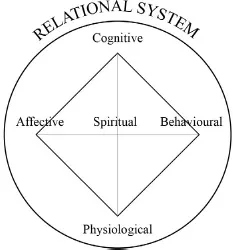
Figure 1.1 presents the model of the self-in-relationship system (Erskine & Trautmann, 1993/1997). This model presents four main dimensions of human functioning: affective, behavioural, cognitive, and physiological within a relational system (Erskine & Trautmann, 1993/1997). It also includes the spiritual dimension, which R. G. Erskine (personal communication, May 5, 2020) in his updated model puts in the centre of the diagram.
Figure 1.1 The self-in-relationship system
Note. Adapted from “The process of integrative psychotherapy” by R. G. Erskine and R. L. Trautmann, 1997, Theories and methods of an integrative transactional analysis: A volume of selected articles (p. 81), TA Press (Original work published 1993). Copyright 1993 by R. G. Erskine. Adapted with permission.
The cognitive dimension refers to thoughts, beliefs, and perceptions; the behavioural dimension refers to observed behaviour; the affective dimension to emotions; the physiological dimension to physical sensations and bodily processes; and the relational dimension to the relationship with other people and systems. The spiritual dimension refers to transcendental and existential aspects of our life and a deeper sense of purpose. All of these dimensions are viewed from a systems perspective, where the different dimensions influence and affect each other. Each dimension has an “interrelated effect on the other dimensions” (Erskine, 2015, p. 3). Based on a systems perspective, integrative psychotherapists try to understand “the function of a particular behavior, affect, belief, or body gesture on the human organism as a whole” (Erskine, 2015, p. 4). The client can be open or closed to contact in each of these dimensions. For example, some clients avoid emotions and are open to contact only on the cognitive dimension. Some clients are only open to contact on the behavioural dimension and have difficulties understanding the causes of their problems, and are also fearful of emotions. There are also clients who are overwhelmed with emotions. In integrative psychotherapy we assess in which dimension the client is open or closed to contact (Erskine, 2015). We make contact with our client first on the dimension where the client is open to contact and later on invite them to contact the dimensions where they are closed to contact. In this process, within an attuned psychotherapy relationship, we use the methods and interventions from the major psychotherapy traditions that target the phenomenological, behavioural, and relational levels of the client’s functioning. One of the goals of integrative psychotherapy is that the client is in full contact with all dimensions.
Integration of psychotherapy approaches
Relationally focused integrative psychotherapy is the theoretical integration of aspects from different psychotherapy approaches. This is illustrated in the model of the self-in-relationship (Figure 1.1) that shows the dimensions of personality that are emphasised in different psychotherapy traditions. The cognitive approach to psychotherapy focuses on the question “Why?” (Erskine & Moursund, 1988). It assumes that change takes place through the client’s understanding of their problems and conflicts – by insight. The behavioural approach to therapy focuses on the question “What?” (Erskine, 2015). It describes how our behaviour is shaped and maintained, and what changes are necessary to change dysfunctional behaviour. The goal is a reinforcement of new desired behaviour (Erskine & Moursund, 1988). “The affective approach to psychotherapy deals with the question ‘How?’ How does a person feel?” (Erskine, 2015, p. 3). The focus is on the client’s phenomenological experience. The goal in this approach is awareness and expression of repressed emotions that “will produce an emotional closure and provide for a fuller range of affective experience” (Erskine, 2015, p. 3). The fourth dimension is the physiological dimension, where the focus is on working with the body. The fifth dimension is relational and refers to the relationship of the person with other people and larger systems, such as family, school, or the socio-cultural environment. In integrative psychotherapy the therapeutic relationship is one of the major factors of change and provides a context for work on all other dimensions. The sixth dimension is spiritual, where the focus is on finding meaning and purpose in life. This dimension is emphasised in different humanistic–existential psychotherapy approaches and transpersonal psychotherapy.
Erskine (2015) describes how “integrative psychotherapy takes into account many views of human functioning: psychodynamic, c...
Table of contents
Cover
Half Title
Title
Copyright
Contents
List of figures and table
Series preface
Abbreviations
Acknowledgements
Introduction
PART I Introduction to integrative psychotherapy
PART II Concepts and theories
PART III Methods and interventions
Afterword
Appendix
References
Index
Trusted by 375,005 students
Access to over 1.5 million titles for a fair monthly price.
Study more efficiently using our study tools.
Frequently asked questions
Yes, you can cancel anytime from the Subscription tab in your account settings on the Perlego website. Your subscription will stay active until the end of your current billing period. Learn how to cancel your subscription
No, books cannot be downloaded as external files, such as PDFs, for use outside of Perlego. However, you can download books within the Perlego app for offline reading on mobile or tablet. Learn how to download books offline
Perlego offers two plans: Essential and Complete
Essential is ideal for learners and professionals who enjoy exploring a wide range of subjects. Access the Essential Library with 800,000+ trusted titles and best-sellers across business, personal growth, and the humanities. Includes unlimited reading time and Standard Read Aloud voice.
Complete: Perfect for advanced learners and researchers needing full, unrestricted access. Unlock 1.5M+ books across hundreds of subjects, including academic and specialized titles. The Complete Plan also includes advanced features like Premium Read Aloud and Research Assistant.
Both plans are available with monthly, semester, or annual billing cycles.
We are an online textbook subscription service, where you can get access to an entire online library for less than the price of a single book per month. With over 1.5 million books across 990+ topics, we’ve got you covered! Learn about our mission
Look out for the read-aloud symbol on your next book to see if you can listen to it. The read-aloud tool reads text aloud for you, highlighting the text as it is being read. You can pause it, speed it up and slow it down. Learn more about Read Aloud
Yes! You can use the Perlego app on both iOS and Android devices to read anytime, anywhere — even offline. Perfect for commutes or when you’re on the go. Please note we cannot support devices running on iOS 13 and Android 7 or earlier. Learn more about using the app
Yes, you can access Integrative Psychotherapy by Gregor Žvelc,Maša Žvelc in PDF and/or ePUB format, as well as other popular books in Psychology & Mental Health in Psychology. We have over 1.5 million books available in our catalogue for you to explore.