It can seem at times that nineteenth-century Britain was peopled entirely by stereotypes. Think of a Victorian gentleman: he wears a top hat and stiff collar, has extravagant whiskers and carries a cane. All day he sits in a vast mahogany office, where banks of shirt-sleeved clerks endlessly transcribe documents in the background. His porcelain wife is installed in their suburban villa or place in the country, her stays too tightly laced for her to move – an innocent ‘angel in the house’ of whom nothing more is required than a devotion to domestic duty.
Meanwhile the lower classes work industriously, grateful to keep their heads above water. Down in the depths, the poor struggle desperately to survive: that is their lot in life. There is a middle class of men who make their way in the world by means of art, literature, science or religion and a corresponding class of frustrated women whose only chance of prosperity is to marry well. Once married, they are safe. Impotent, but safe. This is the Dickensian, Brontë-esque world in which Josephine Butler spent most of her life. In our reductive hindsight, it is a world of caricature. Yet that is how it also appeared to many who lived through it: a society governed by clearly defined boundaries and roles, where success meant doing exactly what was expected.
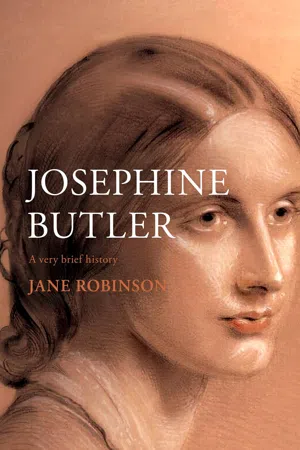
Josephine Elizabeth Grey was born on 13 April 1828 into a North Country family of minor gentry, connected across the generations by a heritage of public duty and Liberal politics. Fashionably attractive, she had pale skin, very dark hair, an elegantly long nose (the sign of good breeding) and velvety eyes. Her engaging personality was not dulled by too much education; apart from a couple of years at a Newcastle boarding school, she was educated at home and furnished with the traditional feminine accomplishments of watercolour painting and piano playing, at both of which she excelled. She loved amateur dramatics, animals, her family and God – not necessarily in that order.
So far, so conventional: a pleasant future beckoned, to be spent in sunny morning rooms, visiting the local poor, tucking up the children in their nursery and hosting her husband’s guests at dinner. She would grow up to be a good woman, a charitable and pure-minded influence on her friends and family. Hers would be a life well lived.
It was a life well lived, but not at all as one would imagine. One of the few purely personal memories in Josephine’s published reminiscences hints at what was to come. It is a winter day in Northumberland. The hilly landscape is austere, streaked with waterfalls and rocky underfoot. Two riders emerge from the mist at a gallop, heads pressed low to their horses’ manes to avoid the cutting hail. Their clothes have frozen to their bodies, soaked by sweat and the weather, so that when they reach home, they have to peel them off, cheeks glowing. They laugh, exhausted and exhilarated.
These are not rough country lads, but young ladies. Their names are Hatty and Josey Grey, famous locally for their fearlessness, brains and beauty. Hatty wants to run away to the circus when she grows up; her elder sister Josey might join her, as long as she is allowed to bring along her piano and Newfoundland dog. To modern eyes, the pair might appear like unlikely characters from a clichéd romantic novel, fictional escapees from Wuthering Heights (but more cheerful). Yet Josephine’s idiosyncrasy was real. The suffragist Maude Royden once described her as ‘designed by nature for happiness’.1 Life might have been blissfully easy for her, despite her love of adventure, had she only behaved as she should.
Later, Josephine was to be reviled as disgusting – a criminal, immoral, a procuress; she was damned in Parliament and denounced by the press. Some contemporary commentators considered her literally the devil in disguise; yet others worshipped her as a patron saint of women, ‘one of the great people of the world’.2 She was an iconoclast, a complex individual in a changing world, and about as far from a stereotype as one can imagine.
*
Josephine’s father, landowner John Grey (1785–1868), was a respected agricultural reformer, a committed abolitionist and something of a political philosopher. He inherited his family’s tendency to activism, campaigning for free trade and the repeal of the Corn Laws, and tax exemptions for his tenants. Daughter Josey continued the tradition. The women of her family were similarly outspoken. Her mother Hannah (née Annett, 1794–1860) was of Huguenot silk-weaving stock, brought up in the Moravian tradition, which stresses the importance of a personal relationship with Jesus Christ.
Josephine’s paternal aunt Margaretta Grey is said to have once disguised herself as a man in order to penetrate the strangers’ gallery at the House of Commons (where women were forbidden) because she was interested in the day’s debate and did not see why she should not be there. Aunt Margaretta was a staunch believer in educating women to lead useful lives, deploring the current fashion of hothousing them as decorative objects who could – and frequently did – bore themselves to death. It is tempting to ascribe Josephine’s idealism to her father, her spirituality to her mother and her pragmatism to Aunt Margaretta. Josephine was supremely pragmatic, and in an age when strong female role models were hard to come by, Margaretta was good value.
John and Hannah Grey had ten children, only one of whom died in infancy. Josephine was the seventh. The family moved from their small country estate in the north Cheviot village of Milfield, where Josephine was born, to a substantial house in Dilston, near Corbridge, in 1835. It was designed for John Grey on his appointment as manager of Greenwich Hospital’s extensive interests in the area, including farms, lead mines and collieries.
Even though she received scant formal education, Josephine was remarkably well informed. The family freely discussed politics and the principles of liberty and natural justice. At Dilston, the door was always open, with constant visitors arriving from Britain and abroad to discuss the practice and philosophy of agriculture with John. Josephine often accompanied him on his rounds of the Greenwich estate and enjoyed learning about the tenants’ lives. Once a year, Hexham Workhouse sent its resident children to Dilston for a party, when John Grey used to dance with them. He was a kindly man and extremely close to Josey.
Her siblings used to say that Josephine was the prettiest and sweetest-tempered of them all. ‘I wish I could send her over to you to look at for a while,’ wrote one of her sisters to another. ‘Everybody loves her so much, nearly everybody thinks she is the nicest girl in the world, next to their own wife or daughter, so you know she must be the nicest, as the aforesaid wives and daughters are only nicest to their own husbands and fathers.’3
Nice she may have been; complacent she was not. Intensely intelligent and conscientious sometimes to the point of disability, Josephine was troubled all her life by sporadic feelings of spiritual inadequacy. In her late teens, she negotiated a mental crisis, unable to reconcile the ineluctable evils of the world – slavery, poverty, sickness and misfortune – with the concept of God as love. She remembered spending hours in the woods around Dilston shrieking at God to explain Himself. Too shy to voice her doubts to her parents, or to the local vicar, she began a first-hand conversation with God that was to last until death, sustaining and challenging her in equal measure.
Josephine was in her early twenties when she met George Butler (1819-1890), a classics tutor at Durham University. He was eligible: the eldest of the Dean of Peterborough’s ten children, educated at Harrow, gifted academically and an energetic sportsman, huntsman, fisherman and shot. Possibly more attractive to Josephine than all these were his obvious humility and an unexpected sense of mischief, demonstrated by his unerring ability to knock chimney pots off their stacks with a single stone. It still took six months of poems and protestations of love to win his ‘rose of Dilstone [sic]’.
Its beauty glads the passer-by
Its fragrance fills the vale of Tyne;
No other rose, no flower would I
Were but the Rose of Dilstone mine.4
When he proposed in January 1851, Josephine fretted about his age (he was a decade older than she) and the fact that they had not spent much time in each other’s company. And those poems . . .
Records of their courtship are sparse; once George had assured her that he believed marriage to be a perfect and equal partnership of freedom and proved to her that despite the poetry and love letters, he was ‘not the least spooney’,5 she succumbed. They married at St Andrew’s Church, Corbridge, on 8 January 1852.
The Butlers settled in Oxford when George was appointed a public examiner both for the university and for the East India Company’s civil service. For years, he had resisted his father’s wish that he take Holy Orders. ‘You know that I don’t like parsons,’ he complained to Josephine.6 This was less to do with theology than an aversion to dressing up in fancy outfits and intoning things in a silly clerical voice. But in 1854, he capitulated, realising that ordination was a sensible next step in his career. At the time, many of the university’s professors were also Anglican clergymen, and George hoped for a Chair in Classics. Neither Josephine nor George considered his ordination to be in any way cynical, despite his reservations about performing in church. At the core of their Christian faith was the conviction that a personal relationship with God superseded ritual. Spiritual integrity was paramount. Josephine admired her husband for achieving this in the face of the Anglican congregation’s occasional foibles – and his own.
The couple lived in a series of rented rooms in Oxford. George’s hours during term were not onerous, with the corollary that his salary was low. (During the vacations he fulfilled his East India Company duties in London, while Josephine returned to Dilston.) Always intellectually curious, Josephine worked with him on various moneymaking ventures: editing an unexpurgated edition of Chaucer, for which – unusually for a female – she was allowed access to the university’s Bodleian library, and collating a catalogue of Renaissance drawings in Oxford. For leisure, she painted in watercolours, played her piano and rode on horseback with George to nearby Bagley Woods to listen to the nightingales.
She used to dress in white silk and lace to perform when George’s colleagues and academic friends came round of an evening, proudly noting that no one so much as coughed during her recitals, so transfixed were they by the music and, no doubt, by this amiable young woman with the raven hair and expressive eyes. Given her liberal, fresh-air upbringing, she was shocked by their reaction to her attempts to join the conversation after dinner. Offering them a flawless Beethoven sonata was fine. Expressing a personal opinion, while expecting to be taken seriously, was not. Usually she kept quiet, to avoid embarrassing George. But sometimes she could not.
In 1853, Elizabeth Gaskell’s novel Ruth was published. It was condemned by many as immoral, verging on the obscene, for suggesting that its protagonist – a young, unmarried mother – was not the author of her own downfall. The Oxford academics sitting around the Butlers’ drawing room fire harrumphed at Mrs Gaskell’s wrongheadedness, insisting that it was far safer for society that women be kept institutionally naïve. Ignorance is bliss. Everyone had tales to tell of promising undergraduates and tutors (who were all male and mostly unmarried at that time) being traduced by loose women into fatherhood. One such involved a ‘child-mother’7 who had recently been imprisoned for infanticide, after the man who got her in the family way refused to acknowledge her or his baby. No action was taken against him, naturally; she was sent to Newgate gaol.
Josephine was appalled. This sort of prejudice smacked of the injustices of slavery her father used to tell her about; it was an abuse of power and a denial of human rights. ‘Every instinct of womanhood within me was in revolt,’ she remembered later. The only reason for women being on earth at all, she decided, was to be combatants against ‘certain accepted theories in society’.8 She was ready for the fight.
*
With George’s support, Josephine marched off to tackle theologian Benjamin Jowett, arguably the most influential Oxford academic of his generation. Perhaps he did not realize the implication of this moral double standard? Though admiring of female intellect, which was uncommon for a man in his position, and generally regarded by the university as something of a sage, Jowett rejected her argument that disadvantaged women were victimized by a patriarchal society (though she did not, of course, use those words). ‘She is very excitable and emotional, of an over-sympathetic temperament,’ he wrote to his unemotional friend and confidante, Florence Nightingale. This leads her to take an interest, he continued, in ‘a class of sinners whom she had better have left to themselves.’ He warned Josephine that her agitation could only do harm. ‘It is dangerous to arouse a sleeping lion.’9
Josephine ignored him. She said of her husband that ‘the idea of justice to women, of equality between the sexes, and of equality of responsibility of all human beings top the moral law, seems to have been instinctive in him.’10 In this they were perfectly matched. To Josephine, loving one’s neighbour as oneself was a moral imperative. It informed everything she did. Together, she and George contacted the chaplain at Newgate, identified the convicted woman, and offered her sanctuary.
Though never named by the Butlers, on her release this young outcast joined their growing family as a housemaid. Josephine could not have been prouder of her husband for helping to put their beliefs into practice, in spite of the effect such wild behaviour was bound to have on his prospects. ‘I think [the Newgate girl] was the first of a world of unhappy women he welcomed into his own home,’ noted Josephine. ‘She was not the last.’11
The Butlers’ first child, George Grey (Georgie), was born in November 1852. Josephine refused attendance by a doctor, as she did for all her confinements. She tended not to trust them (though later she consulted the female medical pioneer Dr Agnes McLaren). Her health h...