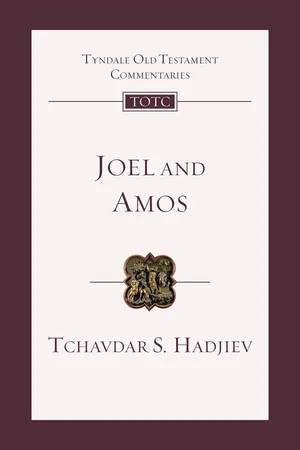
Joel's arresting imagery - blasting trumpet, darkened sun and marching hosts - has shaped the church's eschatological vision of a day of wrath. Amos's ringing indictments - callous oppression, heartless worship and self-seeking gain - have periodically awakened the conscience of God's people. Two thousand five hundred years later, those prophetic words still speak powerfully. Tchavdar Hadjiev's commentary on the books of Joel and Amos examines their literary features, historical context, theology and ethics.
- English
- ePUB (mobile friendly)
- Available on iOS & Android
eBook - ePub
About this book
COMMENTARY
1. INTRODUCTION (1:1)
The formula The word of the Lord that came to [name of prophet] is identical to the opening words of Hosea, Micah and Zephaniah. The similarity is not the result of any literary interdependence and is not an invitation to read these texts as parts of a larger literary work. The book of Joel simply uses a well-known expression to stress the divine nature and origin of the prophetic oracles. The coming of the word of the Lord may be a vision (Gen. 15:1), an auditory revelation (1 Sam. 3:1–11) or perhaps a dream (2 Sam. 7:4), but most often the way the revelation happens is not specified (1 Kgs 16:1; 17:2). Crenshaw (1995: 79–80) translates the ‘word entrusted to Joel’ and thinks the phrase has a nuance of commissioning. According to him, the revelatory event included not just the initial word or vision but also the prophet’s reflection on and proclamation of that word. The word of the Lord always comes to a specific individual. This is Joel, of whom we know nothing apart from the name of his father, Pethuel. There is no information as to the date of his ministry, which gives the text a timeless quality and invites application to different situations (Seitz 2016: 51–52).
2. GOD’S GRACE DURING PAST CRISES (1:2 – 2:27)
A. The first call to lament (1:2–20)
i. Gather all the inhabitants of the land to weep (1:2–14)
Context
The passage consists of five stanzas. The first (1:2–4), with its invitation to hear and tell future generations, introduces 1:2 – 2:27 and anticipates the deliverance in 2:18–27. The other four stanzas open with variations on the call to lament and are arranged in an alternating A-B-A-B pattern. The second (1:5–7) and the fourth (1:11–12) have a similar outline, while the third (1:8–10) and the fifth (1:13–14) explore the effects of crop failure on the cult and share a lot of common vocabulary. The literary pattern emphasizes the connection between agriculture and temple worship. The exodus tradition stands in the background of this section. The eighth Egyptian plague was an infestation of locusts (Exod. 10:1–20), and there are a number of connections between the narrative in the book of Exodus and the text of Joel: both events are described as incomparable (1:2; Exod. 10:6, 14), in both cases there is an injunction to teach the children and grandchildren (1:3; Exod. 10:2), and ultimately both plagues are said to result in knowledge of the Lord (2:27; Exod. 10:2; cf. 8:22). The plague narrative which ends with the hardening of Pharaoh’s heart (Exod. 10:20) also prepares the reader for the call to the people later in Joel to rend their hearts (2:13).
Comment
2–4. The call to Hear and give ear is often used at the start of new sections in prophetic books (Isa. 1:2; Mic. 1:2), probably because it was a standard way of beginning a speech (Judg. 5:3; Job 33:1; Ps. 49:1; Hos. 5:1). The elders were the community leaders but here the focus is on their age. As guardians of the community’s memory, they are best qualified to answer the question
Has such a thing happened in your days,
or in the days of your ancestors?
The injunction to Tell your children of it seems initially to refer to the disaster that is about to be described, and the four generations in verse 3 correspond to the four types of locusts in verse 4. However, as Jeremias (2007: 12) rightly observes, the motif of telling the future generations about the mighty deeds of the Lord is common in Old Testament literature (Pss 22:30–31; 44:1; 48:13; 78:1–4). It plays an important role in the exodus tradition (Exod. 12:26–27; 13:8, 14), especially in the narrative about the locust plague (Exod. 10:2). The point of remembering what God has done in the past is to develop an attitude of trust, obedience and adoration (Deut. 6:20–25; Pss 22:4–5; 79:13). Therefore, what is to be passed onto the children is the story of how the community turned to the Lord with weeping (2:12–17) in a time of great suffering (1:4 – 2:11) and how God delivered and blessed them (2:18–27). See further on 2:18–19a below.
The disaster is a locust infestation which has destroyed the entire vegetation of the land. It is described with the help of three tightly structured lines. In Hebrew each has exactly four words, the first of which is yeter (what . . . left) and the third ’ākal (has eaten). We are not sure what is the precise nuance of the four different terms for locusts used here (and repeated in 2:25). One possibility is that they refer to different stages of the life cycle of the desert locust (Wolff 1977: 26–28; NIDOTTE 1.492) but this is unlikely (Simkins 1991: 103–107). The translation cutting, swarming, hopping and destroying locust relies on the possible etymology of the various terms and is to be preferred. If the locusts are understood primarily as symbols, then the four different types might refer to four successive empires that dominated the people of Judah (Nogalski 2011: 218–219). It is best, however, at this point to remain on the literal level and think primarily of a natural disaster (see vv. 6–7). The piling of near synonyms combined with the skilful use of repetition creates the overall impression of the enormity of the locust plague, a disaster of breathtaking magnitude.
5–7. The structure of this oracle is the same as that of verses 11–12. (1) Calls to weep/be dismayed and to wail (hêlîlû) are followed by (2) the object of lament (sweet wine/wheat and barley), introduced by the preposition over (‘al) (vv. 5, 11). Then (3) a description of the agricultural catastrophe comes, introduced by for (kî) (Crenshaw 1995: 100). Weep and wail introduce the major theme of this chapter – lamentation caused by harvest failure. The cutting off of the sweet wine is the first representative example of the wider agricultural catastrophe that is going to occupy the attention of the reader for the rest of the chapter. The drunkards and wine-drinkers are mentioned not to criticize the ills of alcohol abuse (see Crenshaw 1995: 94); they are simply the most appropriate people to mourn the loss of wine, which is the cause of the general withering of joy in the parallel verse 12.
The catastrophe is attributed to the advance of a mighty nation against the land of Judah. In describing the powerful and innumerable army, the focus is not on the soldiers’ weapons or tactics but on their teeth, compared to the fangs of a lioness. The end result of their conquest is the laying waste of vines, the splintering of fig trees and the stripping of the trees’ bark (presumably by chewing it) so that the branches become white. This suggests the army in view is not a human enemy, but a metaphorical description of the locusts already mentioned in verse 4. The vine and the fig trees appear together as a proverbial image of security and blessing (2 Kgs 18:31; Mic. 4:4) which is here reversed. Three times the first-person singular pronoun appears (my land, my vines, my fig trees). The speaker could be God, but more likely the pronoun refers to the prophet who is identifying himself with his audience and their plight (see the first-person singular in v. 19).
8–10. The command Lament is feminine singular, in contrast to the masculine plurals of the surrounding verses, and is not followed by an addressee. This could be either the result of damage to the original text,1 or a deliberate literary technique that sets verses 8–10 apart from the surrounding context. The implied addressee must be ‘daughter Zion’, the city of Jerusalem symbolizing the community as a whole. The image of a virgin lamenting the husband of her youth is explicable against the background of ancient Israelite marriage practices. It alludes to the time of betrothal when the man has already paid the bridal price but has not yet taken his fiancée to his house. During that period the woman was still a virgin but was already considered legally the wife of her future husband (Deut. 22:23–24; Wolff 1977: 30–31). Losing a husband during the time of betrothal is an apt metaphor of a grievous tragedy, and a cause of a most intense and bitter form of lament.
The trag...
Table of contents
- GENERAL PREFACE
- AUTHOR’S PREFACE
- CHIEF ABBREVIATIONS
- SELECT BIBLIOGRAPHY
- JOEL
- ANALYSIS
- COMMENTARY
- 2. GOD’S GRACE DURING PAST CRISES (1:2 – 2:27)
- 3. GOD’S GRACE IN THE CRISIS TO COME (2:28 – 3:21 [mt 3:1 – 4:21])
- AMOS
- ANALYSIS
- COMMENTARY
- 2. ISRAEL HAS BECOME LIKE THE NATIONS (1:3 – 2:16)
- 3. A DIVINE WORD AGAINST THE PEOPLE OF ISRAEL (3:1 – 4:13)
- 4. A PROPHETIC WORD AGAINST THE HOUSE OF ISRAEL (5:1 – 6:14)
- 5. THE INEVITABLE DESTRUCTION OF ISRAEL (7:1 – 9:6)
- 6. THE RAISING OF THE FALLEN BOOTH OF DAVID (9:7–15)
- Notes
Trusted by 375,005 students
Access to over 1.5 million titles for a fair monthly price.
Study more efficiently using our study tools.