It is often recognized that the title 'servant' is applied to key figures throughout the Bible, culminating in Jesus Christ. Matthew Harmon carefully traces this theme from Genesis to Revelation, examining how earlier 'servants' point forwards to the ultimate Servant. While this theme is significant in its own right throughout redemptive history, it also plays a supporting role, enhancing and enriching other themes, such as son, prophet and king. Harmon shows how the title 'servant' not only gives us a clearer understanding of Jesus Christ but also has profound implications for our lives as Christians. When we grasp what it means to be servants of Christ, our love for him and our obedience to him deepen. Understanding that the ultimate Servant, Jesus Christ, indwells his people, to empower them to serve others in love, has the potential to transform how we interact with fellow believers and the world around us.
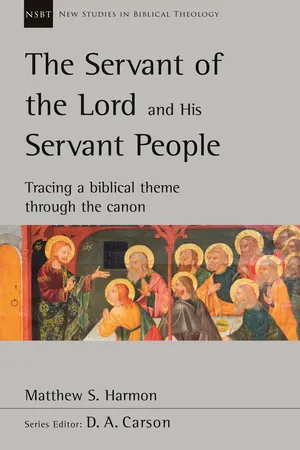
eBook - ePub
The Servant of the Lord and His Servant People
Tracing A Biblical Theme Through The Canon
- English
- ePUB (mobile friendly)
- Available on iOS & Android
eBook - ePub
The Servant of the Lord and His Servant People
Tracing A Biblical Theme Through The Canon
About this book
Information
Topic
Theology & ReligionSubtopic
Biblical Studies1
Introduction
Better to reign in Hell, than serve in Heav’n.
(Milton, Paradise Lost, Book I, line 263)
Satan’s words to his demonic forces in John Milton’s Paradise Lost capture well the lie he has told to humanity throughout the ages – rather than joyfully serve the true and living God, it is better to reject his authority and determine one’s own destiny even if that leads to an eternity in hell. Satan used a form of this lie in the Garden of Eden with Adam and Eve, persuading them to rebel against their sovereign Lord and determine for themselves good and evil. Rather than embrace their identity as servants of the Lord, our first parents chose instead to pursue the subtle but deadly slavery of perceived self-autonomy.
Identity is arguably the defining issue of our contemporary Western culture. At one level humanity has always sought to understand who we are, but developments within the past 500 years have brought the issue of identity to the forefront in fresh ways.1 The question of identity affects us as individuals, as communities and as the people of God. Yet sadly, in the contemporary quest for identity, the Bible is often neglected or ignored, even among professing Christians. But only in Scripture do we find authoritative and infallible answers to the question of who we are as human beings. In order for the church to proclaim and live out a compelling picture of what it means to be human, we must first understand what Scripture says about our identity.
Yet therein lies part of the challenge. The Bible has so much to say about our identity as human beings that it is challenging to know where to begin. But rather than paralyse us, the presence of so much material allows us to explore the question of identity from a wide variety of entry points.
In one sense this book is a contribution to understanding our identity as human beings from a biblical perspective. The specific angle will be to trace the key biblical theme of the servant of the Lord from Genesis to Revelation. I am not arguing that this is the most significant biblical theme for understanding our identity as human beings; rather, I am proposing that it is an important and sometimes overlooked theme that helps us better understand the metanarrative of Scripture as well as our identity as human beings.
But before we begin to trace our theme through the canon, we must first address some preliminary issues.
Preliminary issues
The nature of servitude in the ancient world
A significant body of literature exists on slavery in the ancient world, the New Testament, and the early church.2 The nature of these discussions is at times complex, even to the point of debates over how slavery itself should be defined!3 Further complications arise when studying slavery and servitude in the biblical world from a contemporary perspective that lives under the shadow of the history of race-based slavery in the New World and the present-day forms of slavery that continue. Such contemporary perspectives can blind the reader of Scripture to important differences in slavery in the ancient world. While such differences must not be overemphasized in an attempt to anaesthetize the evils of slavery, responsible interpretation of Scripture must take them into account.
Three differences in particular stand out. The first regards the entry point. While being taken against one’s will (e.g. kidnapping, prisoner of war, etc.) was the most common way to become a slave in the ancient world, some people chose to sell themselves into slavery because of crippling debt. Second, slavery in the ancient world was not necessarily a permanent state of affairs. The Israelites were specifically instructed to release any Hebrew slave from service in the sabbatical year (Lev. 25:35–43).4 In the Roman Empire, upon their death, masters would sometimes free their slaves; indeed, at one point the practice became so common that the emperor Augustus passed legislation establishing certain limits.5 During the first century it was also possible for some slaves to purchase their freedom, though such a process was usually lengthy and tedious.6 Finally, in the ancient world slaves served in virtually every area of society. While the experience of rural slaves was often similar to the predominantly agricultural nature of New World slavery, urban slaves served in a wide range that ran the gamut of education, government and business.7
In sharp contrast to our contemporary situation in many parts of the world, slavery and servitude were simply a given in the biblical world of both the Old and New Testaments. Regardless of how this reality strikes our contemporary sensibilities, we must allow the biblical text to speak on its own terms within its own context.
Servant, slave or none of the above?
One significant challenge in studying this theme is the vocabulary and overlapping conceptual realms of slavery and servanthood. Both the Old and New Testaments use a range of words to capture these ideas, and often do so in ways that defy precise distinctions.8 As well as the fluidity of vocabulary used, there were significant differences in how slavery and servanthood were practised and perceived in different ancient cultures. In addition to these challenges, there is also the fact that the various lxx translators use a variety of Greek terms to render Hebrew terms that refer to slavery and servanthood, even using two different Greek words to render one Hebrew word within the span of a few verses with no discernable nuance in meaning between the two.9
This challenge is multiplied when one translates from Hebrew and/or Greek into a modern language such as English. The meaning of an individual word is determined by its use in context, and words have semantic ranges. For example, the Hebrew word ‘ebed occurs over 800 times in the Old Testament, but this same word can refer to someone who is a lowly and menial slave (Lev. 26:13) or a high-ranking official in the service of a king (Gen. 41:37–38). Even an English translation such as the English Standard Version (esvuk), which strives for a ‘word-for-word’ translation that renders Hebrew words with the same English words where possible, rightly recognizes that the use of ‘ebed in 1 Kings 1:9 refers to Solomon’s high-ranking attendants and translates it as ‘officials’. Similar difficulties arise in the New Testament when attempting to translate doulos, as that term also allows for a range of meanings (e.g. slave, bondservant, servant) depending on the context and the nature of the relationship in view. According to the preface of the esvuk, where doulos refers to ‘absolute ownership by a master’ they render it ‘slave’ (e.g. Rom. 6:16), but when a ‘more limited form of servitude is in view’ they translate it ‘bondservant’ (e.g. 1 Cor. 7:21–24) or ‘servant’ (e.g. John 4:51).10 Although other English versions do not raise this issue in their preface, they regularly practise similar approaches.11
As if those difficulties are not enough, there is the further challenge of accounting for how the original audiences of the Bible would have understood the language of servitude. As we have already noted, various forms of servitude were part of the fabric of both the ancient Near East and the Greco-Roman world. Based on the various ways that the Hebrew word ʿebed (as well as other related terms) is used in the Old Testament, there is clear evidence that in certain contexts the term has an honorary sense. In other words, far from communicating a sense of bondage or oppression, it communicated a privileged position of authority and status.12 The work of scholars such as Gerhard Sass, Walter Ollrog and Dale Martin has shown that the Greek word doulos could also refer to a person in a position of honour or leadership.13 There should be little doubt that when the New Testament writers used expressions such as ‘slave of Christ/God’ or ‘servant of Christ/God’ that many of the original readers/hearers initially understood such references through the framework of their cultural experience of slavery in the Greco-Roman world. This would have been especially true of Gentile converts who had little or no exposure to the Old Testament. However, that does not mean that the New Testament authors intended such references to be exclusively or even primarily understood against this Greco-Roman cultural background.14 Indeed, there are often strong contextual indicators that expressions such as ‘slave of Christ/God’ or ‘servant of Christ/God’ have as their primary referent the Old Testament background of key individuals raised up by God to further his creational and redemptive purposes in the world. Furthermore, the New Testament writers often take language and concepts that had certain meanings and connotations in the Greco-Roman world and reframe them in the light of the truth of the gospel such that they take on fresh significance.15 As the chapters that follow will demonstrate, that is certainly the case with the use of servant language.
Approach of this study
It is important to note that this is not a word study, as Scripture uses a variety of terms and expressions to both identify and describe these key individuals. There are a variety of different terms and expressions that together express the servant of the Lord theme. Indeed, as we will see, in some instances the biblical text portrays an individual or group of people acting as a servant of the Lord without explicitly using such terminology. Thus, our interest is in the concept of the servant of the Lord, not merely the expression or terminology itself.16
Each chapter will address a specific individual who is identified as a servant of the Lord. Based on a careful reading of the biblical text (with insight from the broader historical, cultural and social contexts along the way), I will attempt to identify and summarize the nature of his role within God’s purposes for both creation and redemption. Along the way we will see the consistent pattern that God uses each individual servant to produce a servant people. Therefore, tracing this servant thread throughout Scripture sheds fresh light on (1) the role of these key figures in redemptive history; (2) how these key figures point forward to Christ; (3) the identity of God’s people; and (4) how we interact with fellow believers and the world around us.
2
Adam: the first servant
And God blessed them. And God said to them, ‘Be fruitful...
Table of contents
- Series preface
- Author’s preface
- Abbreviations
- 1
- 2
- 3
- 4
- 5
- 6
- 7
- 8
- 9
- 10
- Bibliography
- Search names for authors
- Search items for Scripture references
- Search items for ancient sources
- Titles in this series
- Notes
Trusted by 375,005 students
Access to over 1.5 million titles for a fair monthly price.
Study more efficiently using our study tools.
Frequently asked questions
Yes, you can cancel anytime from the Subscription tab in your account settings on the Perlego website. Your subscription will stay active until the end of your current billing period. Learn how to cancel your subscription
No, books cannot be downloaded as external files, such as PDFs, for use outside of Perlego. However, you can download books within the Perlego app for offline reading on mobile or tablet. Learn how to download books offline
Perlego offers two plans: Essential and Complete
- Essential is ideal for learners and professionals who enjoy exploring a wide range of subjects. Access the Essential Library with 800,000+ trusted titles and best-sellers across business, personal growth, and the humanities. Includes unlimited reading time and Standard Read Aloud voice.
- Complete: Perfect for advanced learners and researchers needing full, unrestricted access. Unlock 1.5M+ books across hundreds of subjects, including academic and specialized titles. The Complete Plan also includes advanced features like Premium Read Aloud and Research Assistant.
We are an online textbook subscription service, where you can get access to an entire online library for less than the price of a single book per month. With over 1.5 million books across 990+ topics, we’ve got you covered! Learn about our mission
Look out for the read-aloud symbol on your next book to see if you can listen to it. The read-aloud tool reads text aloud for you, highlighting the text as it is being read. You can pause it, speed it up and slow it down. Learn more about Read Aloud
Yes! You can use the Perlego app on both iOS and Android devices to read anytime, anywhere — even offline. Perfect for commutes or when you’re on the go.
Please note we cannot support devices running on iOS 13 and Android 7 or earlier. Learn more about using the app
Please note we cannot support devices running on iOS 13 and Android 7 or earlier. Learn more about using the app
Yes, you can access The Servant of the Lord and His Servant People by Matthew S. Harmon in PDF and/or ePUB format, as well as other popular books in Theology & Religion & Biblical Studies. We have over 1.5 million books available in our catalogue for you to explore.