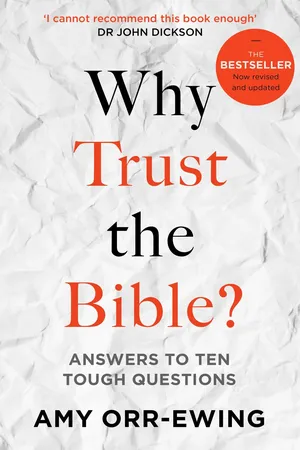
You don't honestly believe all that stuff in the Bible!
Challenged by her friends, and later as a student by theological teachers, Amy Orr-Ewing was determined to leave no stone unturned in her eagerness to prove that the Bible was unique and wholly reliable. Her passion drove her to complete an in-depth study of the answers to ten of the most frequently raised objections she encountered, including:
* Isn't it all a matter of interpretation?
* Can we know anything about history?
* Are the original manuscripts reliable?
* What about the canon?
* What about other holy books?
* Isn't the Bible sexist?
* What about all the wars?
* Isn't the Bible out of date on sex?
* How can I know?
Sensitively yet convincingly, the author addresses the issues and the arguments, showing that we have every reason to trust the Bible today.
- English
- ePUB (mobile friendly)
- Available on iOS & Android
eBook - ePub
About this book
Information
1
Isn’t it all a matter of interpretation?
You just make the Bible mean what you want it to mean! How can you expect me to take it seriously?
I was talking to a fellow traveller at an airport. She had just finished reading a book that, she explained, claimed Jesus married Mary Magdalene and ended up living happily ever after in Mesopotamia. Another friend of mine had read the same book and had come to completely different conclusions. When I mentioned this, my fellow traveller was not at all surprised. As the conversation progressed, it became clear that the historical source material was not really important to her. This new book that she had enjoyed, and the variety of conclusions drawn from it by intelligent people, just went to show that there were many interpretations of any text. This was then extended to apply to the Bible and the events it records. Meaning could not really be fixed – there was just a sea of valid opinions and no one ‘reality’ was to be found among them all.
But is this really the case? Does meaning matter? And is it possible to find it? The big issue behind the increasing numbers of questions about meaning and interpretation is the question of whether words and texts can have any inherent meaning at all. Does it all just come down to a matter of opinion? Are all interpretations really equally valid? Is perception reality? Can a text or a person actually speak to me or do I make words mean what I want them to mean?
This dilemma was powerfully communicated to my husband Francis (nicknamed Frog) many years ago. He is a vicar and had just taken a friend’s wedding. After the church service, we were sitting at a beautiful reception around a table. I was talking to the young man sitting next to me; my husband was sitting next to the young man’s girlfriend. As we began to talk, the man stopped in mid-sentence and suddenly blurted out an apology – he said he found that, for some reason, he couldn’t lie to me and explained that, before coming to the wedding, he and his girlfriend had decided to ‘swap lives’. He was a wealthy management consultant and she was an artist. They had wanted to see if people would treat them differently according to their status, so they pretended to have each other’s jobs. As we talked about why he might be uncomfortable about lying to me and other spiritual things, we looked over at our partners. He said, ‘I wonder if my girlfriend has managed to hoodwink your husband . . .’ I thought about kicking Frog under the table, but realized it would be futile.
After the wedding, Frog explained to me that the young woman had also found herself unable to lie to him. They had also begun to talk about God and, at one point, she had said, ‘The reason why I am not a Christian is that I am studying English Literature, and I don’t believe that there is a transcendental signified, so I can make the Bible mean whatever I want it to mean.’ Frog asked her to clarify. She explained that she believed that words have no actual meaning – a word on a page or a word being heard only has the meaning that a reader or a hearer gives it. It does not itself carry any ultimate meaning because there is no God (‘transcendental signified’) to give ultimate meaning to words. My husband looked at her and said, ‘If that is the case – if words have no meaning except the meaning of the listener or reader – is it OK with you if I take what you have just said to mean: “I believe in Jesus and I am a Christian”?’ At that moment, she looked a little worried. She realized that her argument failed its own test. The standards by which she was judging the Bible were standards to which her own thinking could not measure up.
All of us have a tendency to do that – we set standards that we expect opposing views to our own to meet, but quite often we forget to subject our own thinking to those same standards.
This issue of whether or not words have any meaning is incredibly important as we look at the Christian faith, and as we offer the source materials about the life of Jesus – the New Testament Gospels – to our friends who do not believe in him. If the Bible only means what we make it mean, then there is no point in reading it to discover anything about God.
Why do people believe that when it comes to the Bible, everything is a matter of interpretation? It may help us to answer this question if we can understand where these ideas about interpretation and meaning come from.
The idea that there is no ultimate meaning in any text became extremely powerful in postmodern thinking; it has continued to have enormous implications for any communication about the gospel. One literary theorist wrote:
Literature . . . by refusing to assign a ‘secret’, an ultimate meaning, to the text (and to the world as text), liberates what may be called an anti-theological activity, an activity that is truly revolutionary, since to refuse to fix meaning is, in the end, to refuse God . . .1
Of course, this echoes the strangely prophetic words of the philosopher Friedrich Nietzsche: ‘We cannot get rid of God until we get rid of grammar.’2 This idea is later echoed by the atheist Bertrand Russell: ‘Everyday language embodies the metaphysics of the Stone Age.’3 The desire to liberate the human being from the constraint of a God is powerfully linked with this issue of language and meaning.
Language as a game
There is sometimes a playfulness and whimsical quality about the approach of those who would seek to question the possibility of ultimate meaning in language. The philosopher Ludwig Wittgenstein was an important influence in this field. He asserted that each use of language occurs within a separate and apparently self-contained system with its own rules. This idea means that any use of language would be similar to playing a game. We would need awareness of the rules of the game and a sense of the significance of terms in order to use the language. ‘Each use of language constitutes a separate “language game” and various games have very little to do with one another.’4
Wittgenstein explicitly abandoned any concept of truth as corresponding with reality; instead, he characterized it as a function of language. This means that no statement or proposition can be limited to a single meaning – its meaning is completely dependent on context. So, all attempts at discovering truth or meaning are trapped by the language game in which they appear. When applied to the Bible, this means that the context of the reader is everything – context completely determines the interpretation of the text. It would therefore be impossible to posit any unifying meaning that could be received by multiple cultures, languages, situations or ‘games’.
A statement such as ‘That was relevant then, but the Bible was written thousands of years ago’ comes from the same point of view as Wittgenstein’s. Of course, all of us are in agreement that the context of any text is important for its interpretation. However, this does not mean that the same text cannot convey meaning outside its original setting. If that were the case, it would apply to Wittgenstein’s ideas themselves, which would have no relevance today.
No universal world view
Following on from this contextualization of meaning is the important subsequent idea that there are no overarching ‘myths’ or stories that give a universal framework of meaning to language. The power of a grand narrative (or ‘meta-narrative’) uniting human beings across the world, into which local stories can integrate, waned for a while. Powerful explanatory ideologies or stories were challenged as if they were dictators, inevitably restricting people’s liberty. The thinker Jean-François Lyotard argued that this outlook could demand a ‘war on totality’5 – a fight against any claim to universal meaning. This meant that any world view or framework of meaning came under fire, whether it was the modern myth of progress, the Enlightenment myth of rational beings discovering truth or the Christian ‘myth’ that God made human beings and reveals himself to them. All along, however, the exception to this denial of overarching stories was the overarching idea that there are no overarching ideas!
Language as power play
On top of the rejection of meta-narrative came the suspicion that any attempt to assign words a particular objective meaning was to use force and assert power over others. The writer Michel Foucault argued that no firm foundations for knowledge existed at all, and that there was no original or ‘transcendental signified’ (that is, God) to which all ‘signifiers’ (human beings) could ultimately refer.6 Clearly, this idea had direct consequences for the Christian seeking to advocate the possibility of encountering truth in Christ. But this was not all. Foucault went on to argue that there was an essential interplay between knowledge and power. Echoing Nietzsche’s phrase ‘the will to power’, Foucault called the pursuit of truth a ‘will to knowledge’ that arbitrarily established its own ‘truth’. This ‘truth’ could then be imposed on others, giving power into the hands of the speaker or writer. In this way, any discourse or pursuit of knowledge was written off as the pursuit of power.7
Power produces knowledge . . . There is no power relation without the correlative constitution of a field of knowledge, nor any knowledge that does not presuppose and constitute at the same time power relations . . .8
So this would mean that when we come to read the Bible, we must be suspicious of the writers, who are exercising power over us, and even more suspicious of anyone who might try to help us to interpret the Bible. Any attempt at preaching from, or explaining, the Bible is purely a sinister attempt to gain power over another. But again, we see that the reasoning fails its own test. After all, one wonders how Foucault was able to tell us about power relations and words without falling into his own trap – how could he use words to explain this to us without himself assuming power over us?
Truth
A further consequence of these ideas about power and manipulation was the denial of the idea of a disinterested knower, which meant denying any possibility that anyone can stand beyond history and human society at a vantage point that could offer certain knowledge. Truth was not seen as theoretical or objective – rather, truth was a ‘fabrication’ or ‘fiction’, a ‘system of ordered procedures for the production, regulation, distribution, circulation and operation of statements’.9 Such a system of truth was seen as standing in a reciprocal relationship with systems of power that produce and sustain it. So any attempt to assert truth about a historical event or any other kind of reality was perceived as power play. The suspicion was that any writer or speaker would be trying to manipulate and control others.
From this point of view, the Bible was seen as a tool of manipulation – used by powerful people to control others. But, again, the same question has to be asked of this approach – how can someone who really believes this communicate or use it to challenge the power intentions of others? If words are tools of oppression used by powerful people to control others, isn’t Foucault doing exactly the same thing when he writes his philosophy books to tell us so? Once again, this argument falls at the first fence – it fails its own test.
This situation reminds me very much of a friend’s mother-in-law. She constantly criticizes my friend and her husband for failing to telephone her regularly, but fairly frequently she goes travelling for a couple of months at a time without calling or letting her family know the details. Her complaint against her son is exactly what she herself does to her son. In human relationships, this is known as hypocrisy. In philosophical discussion, it is called ‘special pleading’ – the rules apply to you but not to me.
Language and meaning
Further questions about language and meaning emerge when the knock-on effect of getting rid of God is felt. If God does not exist, there is no foundation for language, and words are not able to signify or present any given reality. If no such ‘transcendental signified’ exists, then the meanings of words arise out of their relationship with an immediate context and not out of something fixed and absolute. This makes language completely self-referential.
Imagine how frustrating it would be if you had a sister or brother who insisted on interpreting your words to them as they pleased, with no reference to any fixed meaning for the given words. The simple request ‘Please do not borrow my clothes without my permission’ could be easily interpreted to mean ‘Feel free to help yourself to my clothes at any time and leave them dirty and crumpled up on your be...
Table of contents
- Acknowledgments
- Introduction
- 1
- 2
- 3
- 4
- 5
- 6
- 7
- 8
- 9
- 10
- Appendix 1
- Appendix 2
- Glossary
- Notes
- Bibliography
Trusted by 375,005 students
Access to over 1.5 million titles for a fair monthly price.
Study more efficiently using our study tools.
Frequently asked questions
Yes, you can cancel anytime from the Subscription tab in your account settings on the Perlego website. Your subscription will stay active until the end of your current billing period. Learn how to cancel your subscription
No, books cannot be downloaded as external files, such as PDFs, for use outside of Perlego. However, you can download books within the Perlego app for offline reading on mobile or tablet. Learn how to download books offline
Perlego offers two plans: Essential and Complete
- Essential is ideal for learners and professionals who enjoy exploring a wide range of subjects. Access the Essential Library with 800,000+ trusted titles and best-sellers across business, personal growth, and the humanities. Includes unlimited reading time and Standard Read Aloud voice.
- Complete: Perfect for advanced learners and researchers needing full, unrestricted access. Unlock 1.5M+ books across hundreds of subjects, including academic and specialized titles. The Complete Plan also includes advanced features like Premium Read Aloud and Research Assistant.
We are an online textbook subscription service, where you can get access to an entire online library for less than the price of a single book per month. With over 1.5 million books across 990+ topics, we’ve got you covered! Learn about our mission
Look out for the read-aloud symbol on your next book to see if you can listen to it. The read-aloud tool reads text aloud for you, highlighting the text as it is being read. You can pause it, speed it up and slow it down. Learn more about Read Aloud
Yes! You can use the Perlego app on both iOS and Android devices to read anytime, anywhere — even offline. Perfect for commutes or when you’re on the go.
Please note we cannot support devices running on iOS 13 and Android 7 or earlier. Learn more about using the app
Please note we cannot support devices running on iOS 13 and Android 7 or earlier. Learn more about using the app
Yes, you can access Why Trust the Bible? (Revised and updated) by Amy Orr-Ewing in PDF and/or ePUB format, as well as other popular books in Theology & Religion & Christian Theology. We have over 1.5 million books available in our catalogue for you to explore.