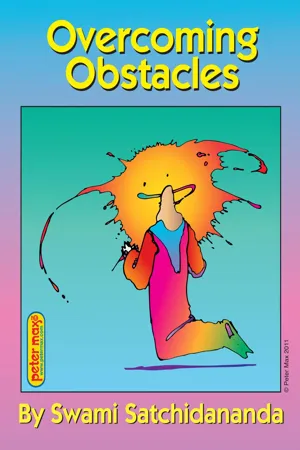
"One's whole life is an obstacle course. The more obstacles you overcome, the bigger the prize. If you avoid the obstacles, then there is no prize. Without those obstacles, you would never discover your capabilities. So instead of cursing the obstacles on your path, or the people who placed them there, try to find ways that will help you face them and overcome them. And when you do, a great joy will arise within you and you will bless the obstacles instead of cursing them." This quote from "Overcoming Obstacles" captures the flavor of total positive thinking with which Swami Satchidananda teaches us to approach life's inevitable challenges and convert all to opportunities for victory, fun, fulfillment and joy. Full of practical and priceless guidance.
- 84 pages
- English
- ePUB (mobile friendly)
- Available on iOS & Android
eBook - ePub
Overcoming Obstacles
About this book
Information
Subtopic
Sport & Exercise ScienceIndex
Biological SciencesOvercoming Obstacles
The world is a beautiful place, because this is the place where we really learn more quickly the importance of a spiritual life. You can’t learn this lesson anywhere else that soon. If you could find an educational institution where you could get a degree within the shortest time, wouldn’t you love that? All the obstacles, all the impediments on our way help us to grow in strength, to find ways and means to get over them. Obstacles are blessings in disguise.
Basically, we all want to grow. We all want to be nice. We all want to be wonderful people, divine angels. That’s why if somebody says to you, “Oh, you’re an angel, you are so happy;” but if someone says, “You devil,” you really become that devil. In reality, we all want to be thought of as fantastic people, because, essentially, that is what we are.
In truth, we are all angels, we are all divine. Haven’t we read from the scriptures that God made us in God’s own image? So if God made us in God’s own image, then we must be God; that is, we must be divine; there’s no doubt about it. But, somehow, we have forgotten that, and we seem to have gotten involved with some kind of lower animalistic tendencies that, probably, we might have been able to pass through.
Some great thinkers have said that there can be many animals hidden even in the human form, and, consciously or unconsciously, we seem to recognize that truth. Haven’t you heard people say to someone, “Oh, you! My gosh, you are a cunning fox!” This is addressed to a human being. Or, “Look at that person, howling like a dog.” “Oh, don’t go near him. He’s a snake. We use these terms, “He’s a lion.” “She’s a cougar.” These days, we hear attractive, single, middle-aged women being referred to as “cougars.”
People are proud of calling themselves lions! Don’t you know that there is a group of lions? The Lion’s Club. Once, when this group invited me to speak, I thought that I’d be meeting actual lions. But they were all human beings. This tendency to refer to particular individuals as animals means that there are these tendencies hidden inside human beings. I’m not here to tell you how or when or where we got those tendencies, because if we touch on that part, then, no doubt, certain kinds of controversial ideas will come up: “Oh, did we live before?” “Are we going to live after?” Incarnation, reincarnation, and so forth and so on. I will just leave it to you people to decide that. But what I will say is that we do seem to have all those tendencies. And we seem to recognize them.
According to Yoga philosophy, most of our sensual and lower tendencies are located in the lower half of the trunk of the body. Certainly, most of you might know about the chakras, the energy centers or seven lotuses, and the seventh—the one thousand-petaled lotus. These chakras, said to resemble lotus flowers, are psychic centers that are situated in the subtle body and parallel to the spine. The first and lowermost chakra is the muladhara at the base of the spine. Above that is the second chakra, the swadisthana. The third chakra, at the solar plexus area, is called the manipura. Then comes the heart chakra, the anahata. The fifth chakra, the vishuddha, is located at the throat. The sixth chakra, the ajna chakra, is situated in the place between the eyebrows. And finally, the seventh or crown chakra, the sahasrara, is the thousand-petaled lotus that sits at the crown of the head.
These chakras are psychic centers. In other words, you can’t perform an operation on the body and see those centers there. Sometimes, the chakras are personified as lotuses with several petals, but here are no real lotuses or petals growing in there. In actuality, the chakras are psychic centers with different faculties. Each center controls certain tendencies of the human being. Normally, it is recognized that below the anahata, or heart chakra, we have the lower tendencies. With the heart chakra and those above it, we have the higher tendencies.
So the divine is above and the devil below. In fact, when we are recommending the various positions in which to meditate or focus the awareness, we say that it’s always better to meditate either on the heart chakra or on one of the chakras above the heart. Why? Because if you direct your attention to any one place, you are going to energize that place. This means that if we put our attention on the lower chakras, we will energize those chakras, and we may have certain problems in handling that energy. On the other hand, if we always draw our attention upward, these problems, more or less, get weakened; they don’t dominate our life.
That is why, in recommending the different positions in which to meditate or focus your awareness, we say that it’s always better to meditate either on the heart chakra or on one of the chakras above the heart. Because if you direct your attention to any place, you are going to energize that place. So, by our attention, if we are going to energize the lower chakras, we may have certain problems in handling them. If we could always draw our attention upward, these problems more or less get weakened. They won’t dominate in our life. So it’s the easiest way to control the undesirable senses.
According to the different attitudes, tastes and temperaments, in meditating on the heart or on the chakras above the heart, you can visualize a light or some deities or some form that you like the most and feel that it’s presiding there. This serves only to keep your mind there. If you like some particular form or a light, whatever you like the most, that imagined object should be placed on that chakra, so that you can easily direct your attention there. Automatically, the higher potentials are developed at the cost of the lower tendencies. It’s something like if there is a dark room and if you don’t want to have the darkness there, you cannot beat the darkness out. The easiest way is just to bring a light inside. That is to say, do the opposite. If there is hatred, the easiest way is to sow a little love. That love will slowly dispel the hatred.
According to the great sage Patanjali, who formulated the Yoga Sutras, this is called pratipaksha bhavana, thinking of the opposite. If you do not...
Table of contents
- Cover
- Title
- Copyright
- Overcoming Obstacles
- Questions and Answers
- Sri Swami Satchidananda
Trusted by 375,005 students
Access to over 1.5 million titles for a fair monthly price.
Study more efficiently using our study tools.
Frequently asked questions
Yes, you can cancel anytime from the Subscription tab in your account settings on the Perlego website. Your subscription will stay active until the end of your current billing period. Learn how to cancel your subscription
No, books cannot be downloaded as external files, such as PDFs, for use outside of Perlego. However, you can download books within the Perlego app for offline reading on mobile or tablet. Learn how to download books offline
Perlego offers two plans: Essential and Complete
- Essential is ideal for learners and professionals who enjoy exploring a wide range of subjects. Access the Essential Library with 800,000+ trusted titles and best-sellers across business, personal growth, and the humanities. Includes unlimited reading time and Standard Read Aloud voice.
- Complete: Perfect for advanced learners and researchers needing full, unrestricted access. Unlock 1.5M+ books across hundreds of subjects, including academic and specialized titles. The Complete Plan also includes advanced features like Premium Read Aloud and Research Assistant.
We are an online textbook subscription service, where you can get access to an entire online library for less than the price of a single book per month. With over 1.5 million books across 990+ topics, we’ve got you covered! Learn about our mission
Look out for the read-aloud symbol on your next book to see if you can listen to it. The read-aloud tool reads text aloud for you, highlighting the text as it is being read. You can pause it, speed it up and slow it down. Learn more about Read Aloud
Yes! You can use the Perlego app on both iOS and Android devices to read anytime, anywhere — even offline. Perfect for commutes or when you’re on the go.
Please note we cannot support devices running on iOS 13 and Android 7 or earlier. Learn more about using the app
Please note we cannot support devices running on iOS 13 and Android 7 or earlier. Learn more about using the app
Yes, you can access Overcoming Obstacles by Swami Satchidananda in PDF and/or ePUB format, as well as other popular books in Biological Sciences & Sport & Exercise Science. We have over 1.5 million books available in our catalogue for you to explore.