The Bhagavad Gita tells the story of how Arjuna, the great warrior, is seated in his chariot about to engage in battle, when he sees his own kinsmen and his revered teacher arrayed in battle against him, and feels that he cannot fight. It is then that Krishna, the Cosmic Lord, comes to counsel him. Arjuna represents the human soul seated in the chariot of the body and Krishna is the inner Spirit, the God within, who is there to counsel him. Today we see humanity divided against itself and threatened with nuclear war and mutual destruction. No political means are adequate to deal with this problem, and many are driven to despair. It is then that the message of the Gita comes to teach us that it is only when we rise above human schemes and calculations and awake to the presence of the indwelling Spirit that we can hope to find the answer to our need.From the foreword by Sri P. Jayaraman, PhD (Bharatiya Bhavan, USA)Swami Satchidananda, with a life ripe in experience, gives a real commentary to the Gita. It is the calm and collected mind, far from the maddening materialism, that can enjoy the essence of the Gita to its fullest form. Sri Swamiji is the one of the authorities or adhikaris who can give us the commentary on the Gita. The Gita has enchanted great Western scholars like Thoreau, who in ecstasy remarked: "In the morning I bathe my intellect in the stupendous and cosmogonal philosophy of the Bhagavad-Gita in comparison with which our modern world and its literature seem puny and trivial." Such a great work has been taken on by Swami Satchidananda. There is a reason behind it. Whether he is aware of the great quality he possesses or not, all his listeners and readers are very much aware of that quality; that is the simplicity and clarity of his expression. The Bhagavad Gita through his pen finds a lucid expression and meaning very essential for a modern reader. His words reach the very depth of the heart of the reader. What else should the expression need? Rhetoric, rhythm and rhyme are not that essential as the simplicity and sincerity of thought. Sri Swamiji is the foremost in that art. His listeners would certainly agree with this remark of mine. I am honored to write these words in this book of great significance.
eBook - ePub
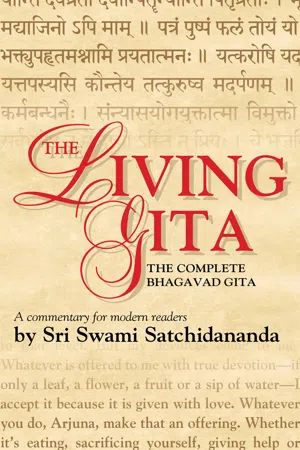
The Living Gita
The Complete Bhagavad Gita: a Commentary for Modern Readers
- 356 pages
- English
- ePUB (mobile friendly)
- Available on iOS & Android
eBook - ePub
About this book
Information
Topic
PhilosophySubtopic
Eastern PhilosophyTable of contents
- Cover
- Title
- Copyright
- Contents
- Foreword
- Foreword
- Preface
- Acknowledgements
- Introduction
- The Story Behind the Bhagavad Gita
- Chapter One: The Despondency of Arjuna
- Chapter Two: The Yoga of Wisdom
- Chapter Three: Karma Yoga: The Yoga of Action
- Chapter Four: The Wisdom Yoga of Action and Renunciation
- Chapter Five: The Yoga of Renunciation
- Chapter Six: The Yoga of Meditation
- Chapter Seven: The Yoga of Knowledge and Realization
- Chapter Eight: The Yoga of the Absolute Truth
- Chapter Nine: Yoga of the Regal Science and the Royal Secret
- Chapter Ten: Yoga of the Divine Manifestations
- Chapter Eleven: The Yoga Vision of the Cosmic Form
- Chapter Twelve: The Yoga of Devotion
- Chapter Thirteen: Yoga of the Field and Its Knower
- Chapter Fourteen: Yoga of the Three Qualities of Nature
- Chapter Fifteen: Yoga of the Supreme Self
- Chapter Sixteen: The Yoga of the Divine and the Demonic
- Chapter Seventeen: Yoga of the Three-fold Faith
- Chapter Eighteen: Yoga of Freedom Through Renunciation
- Epilogue
- Note on Sanskrit Transliteration
- Glossary
- Index
- Index of Stories
- About the Author
Trusted by 375,005 students
Access to over 1.5 million titles for a fair monthly price.
Study more efficiently using our study tools.
Frequently asked questions
Yes, you can cancel anytime from the Subscription tab in your account settings on the Perlego website. Your subscription will stay active until the end of your current billing period. Learn how to cancel your subscription
No, books cannot be downloaded as external files, such as PDFs, for use outside of Perlego. However, you can download books within the Perlego app for offline reading on mobile or tablet. Learn how to download books offline
Perlego offers two plans: Essential and Complete
- Essential is ideal for learners and professionals who enjoy exploring a wide range of subjects. Access the Essential Library with 800,000+ trusted titles and best-sellers across business, personal growth, and the humanities. Includes unlimited reading time and Standard Read Aloud voice.
- Complete: Perfect for advanced learners and researchers needing full, unrestricted access. Unlock 1.5M+ books across hundreds of subjects, including academic and specialized titles. The Complete Plan also includes advanced features like Premium Read Aloud and Research Assistant.
We are an online textbook subscription service, where you can get access to an entire online library for less than the price of a single book per month. With over 1.5 million books across 990+ topics, we’ve got you covered! Learn about our mission
Look out for the read-aloud symbol on your next book to see if you can listen to it. The read-aloud tool reads text aloud for you, highlighting the text as it is being read. You can pause it, speed it up and slow it down. Learn more about Read Aloud
Yes! You can use the Perlego app on both iOS and Android devices to read anytime, anywhere — even offline. Perfect for commutes or when you’re on the go.
Please note we cannot support devices running on iOS 13 and Android 7 or earlier. Learn more about using the app
Please note we cannot support devices running on iOS 13 and Android 7 or earlier. Learn more about using the app
Yes, you can access The Living Gita by Swami Satchidananda in PDF and/or ePUB format, as well as other popular books in Philosophy & Eastern Philosophy. We have over 1.5 million books available in our catalogue for you to explore.