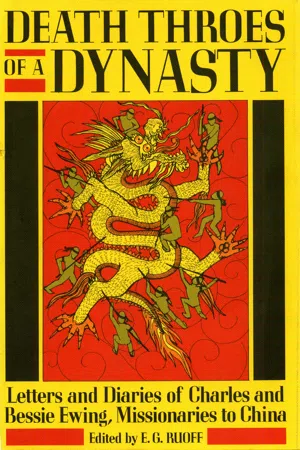
The letters of Charles and Bessie Ewing provide eyewitness accounts of the social upheaval and warfare that shook turn-of-the-century China. In addition to discussing their missionary activities in the villages of North China and their struggle to master the Chinese Mandarin dialect, the Ewings describe the impact of Western culture upon the social structure of Imperial China as they lived it. Ruoff sets the larger scene about which the Ewings wrote: The Sino-Japanese war, the extraterritorial treaties, the Boxer Uprising, the foreign military interventions, the belated effort to modernize by the Manchu dynasty, the struggle against opium addiction, the student political movement, and the beginning of the Chinese Revolution. We also learn about the last great empress of China, Tzu His, and the last emperor, the child Pu Yi. Through the Ewing correspondence and his own narrative, Ruoff shows the parallel between the attitude toward the Chinese held by the foreign community in the 1890s and the equally restricted outlook the Chinese held of their land and themselves. But just as the views held by the young Congregationalist minister Ewing change during his nearly two decades of service in China, so also the views of the Chinese themselves undergo vast changes. This book then is both a compelling history of a period in modern China and the story of an American family living that history.
eBook - ePub
Death Throes of a Dynasty
Letters and Diaries of Charles and Bessie Ewing, Missionaries to China
- 286 pages
- English
- ePUB (mobile friendly)
- Available on iOS & Android
eBook - ePub
Death Throes of a Dynasty
Letters and Diaries of Charles and Bessie Ewing, Missionaries to China
About this book
Information
Topic
HistoireSubtopic
Biographies de sciences sociales1
The Encroachment
1892–1898
THE war between the aggressive and recently modernized Japanese military and the mistake-prone and traditional Chinese armed forces began on August 1, 1894. The conflict, which was to cost China dearly, was primarily fought over the issue of which of the two countries would dominate Korea. The fighting on land took place in China’s eastern provinces of Manchuria, the homeland of the reigning dynasty, the Manchu or Ching. By early 1895 Japan had occupied Korea, the Manchurian port cities of Dairen and Port Arthur, Weihaiwei on the Shantung peninsula, and the islands of Formosa (Taiwan) and the Pescadores (Peng-hu). What these humiliating occupations had fully revealed was the weakness of China at a time when the powers of Europe were in the throes of their most aggressive imperialism.
Since China had been defeated, it was the empire’s chief modernizer, Viceroy Li Hung-chang, whom the throne called upon to negotiate the humbling settlement. Viceroy Li, who had his viceregal headquarters at Tientsin, had been ordered to Japan by the emperor, a twenty-three-year-old Manchu who ruled under the reign name of Kuang Hsu. He had come of age under the tutelage and domination of his aunt, the Dowager Empress Tzu Hsi. Kuang Hsu was neither politically astute nor, because of his upbringing largely at the hands of the eunuchs of Peking’s Forbidden City, did he have any understanding of international affairs. Furthermore, he lacked physical strength and emotional maturity.
Although the Dowager Empress had officially ended her regency in 1889, when Kuang Hsu reached maturity, she had in fact never completely given up control of the throne. In 1895 she was in her sixty-first year; she had first learned to enjoy the exercise of power thirty-four years earlier during the infancy of her son, the Emperor Tung Chih. Tzu Hsi had maintained her influence not only through such appointments as Prince Jung Lu, her cousin and longtime “special friend,” but through her contact with and use of the palace eunuchs. The eunuchs had originally been placed into the Imperial Court more than 2,000 years before as a staff of servants and as neutralized protectors of the women of the court. Over a period of many years, though, these Chinese men had become the controllers of court intrigue and a power unto themselves. It was Tzu Hsi who had learned to manipulate the eunuchs and who used their power as her own. They not only provided her with information about the empire’s administration and court intrigue but arranged substantial loans and became executioners when called upon.
At the Peking level, the Manchu dynasty employed the Grand Council and Grand Secretariat to supervise a massive bureaucracy. Below that were such powerful viceroys as Li Hung-chang in North China, Chang Chih-tung in Central China, and the eighteen provincial governors. Below them were hundreds of district officers and thousands of lower-level officials, all appointed from Peking. This vast bureaucratic machine was designed primarily to keep the peace, collect the taxes, and maintain such public works as canals, roads, and dikes.
Following the peace settlement of 1895, Russia, France, and Germany intervened by forcing Japan to give up the Manchurian territory it had won in battle. Japan continued its protectorate over Korea and retained Formosa and the Pescadores outright. Extraterritorial privileges and a huge indemnity of $185 million were to be given to Japan by China. Although other foreign powers were encroaching on China, Great Britain remained the paramount foreign power in the last decade of the nineteenth century. British businesses reigned supreme in the field of China’s foreign commerce. British interests dominated most of the treaty ports. Those ports were primarily protected by British gunboats. Through Sir Robert Hart and the Imperial Maritime Customs, the British dominated China’s treaty port tax collection. Hart, an Irish-born Englishman, had been Inspector General of customs since 1867. British banks such as the Hong Kong and Shanghai were foremost in the field of trade and loans. Altogether some 360 British banks and business firms had offices in China, although Britain’s position was threatened by China’s defeat in 1895.
By the mid-1890s the primary concern of the Western powers’ commercial penetration of China was railway construction and mining enterprises. The treaty port of Tientsin was not only the primary entry point for such European activities in North China but the gateway to Peking. By the treaty of Tientsin in 1860, China had granted Great Britain, France, and other foreign nations the right to utilize small portions of land bordering the Pei Ho River. It did not take long for the foreign powers to establish extraterritorial privileges on those enclaves. In time the Tientsin “concessions” became small bits of Europe in China, with restaurants, churches, hotels, clubs, schools, and even a racetrack. In 1895 it became possible to entrain at Tientsin and travel the 85 miles northwest to Peking’s Machiapu Station, or the more than 200 miles northeast to Shanhaikwan in southern Manchuria.
In addition to commerce, another kind of Western penetration was making deep inroads into China. The Christian missionary movement was beginning to have an impact upon the Chinese way of life. Two very distinct and mutually antagonistic Christian communities, the Roman Catholic and the Protestant, existed in China. The Roman Catholic was dominated by the French but also had significant German and Italian elements. Catholic missionaries, who numbered over 750, had made about 500,000 converts by 1897. The man who ministered to the Catholic flock, at least in North China, was Monsignor Alphonse Favier, a French Lazarist priest who was vicar apostolic of Peking. Father Favier spoke fluent Chinese, had assumed Chinese dress, wore his hair in a queue, was a friend of Prince jung Lu, and was considered by many to be the best informed European on Chinese affairs.
The second group of Christian missionaries in China, the Protestants, were dominated by British and American congregations. A substantial increase in the number of Protestant missionaries took place during the last decade of the nineteenth century. Although the exact number is difficult to determine, one student of Western activities in China has estimated that 2,800 Protestant missionaries were in China toward the end of the century.1 More than half of these were of British or British Empire nationality. About one thousand were Americans. Among the most active of the congregations or societies were the American Board of Commissioners for Foreign Missions, American Presbyterian (North) Society, China Inland Mission, Christian and Missionary Alliance, Church Missionary Society, English Baptist Missionary Society, London Missionary Society, Methodist Episcopal Missionary Society, and the Church of England’s Society for the Propagation of the Gospel.
The reason for the great increase of Protestant missionaries in China and the subsequent upsurge of evangelistic activity, was the previously explained belief in America and Great Britain that a great opportunity, indeed heavenly call, for the expansion of Christianity was at hand. The missionaries and their supporters “back home” believed that spiritual salvation of the “heathen” Chinese was essential to the modernization and revitalization of China. In the belief that the Chinese people were doomed to perdition and damnation unless the word of God reached them, missionaries journeyed deep into China’s interior, preachers went from village to village, street chapels were established, and tracts and Bibles were distributed. Another kind of response came from the missionaries when late in the nineteenth century China experienced a series of catastrophic natural disasters. At that time many missionary societies organized to undertake widespread programs of health, education, and social assistance to the blind, deaf, addicted, orphaned, and to women (destitute widows and girls or women who might be helped by anti-foot-binding campaigns were of particular concern). However, many missionaries continued to feel that such activities took away from their “true calling” of simply spreading the gospel message.
All of the above activities, including evangelism, were organized and carried out from mission stations or compounds. Although there were some variations, most of the mission compounds throughout China consisted of a chapel, a hall, a school, a clinic or dispensary, a warehouse or godown, and the residences of the missionaries. The compound was usually surrounded by a high, solidly built wall. These centers became a kind of small tache d’huile, or oil spot, from which the Christian message was spread into the vast sea of Chinese tradition and customs. They also were enclaves of “foreign territory,” protected by the extraterritorial clauses of the various treaties imposed upon China. Even though the government of China had reservations about the extraterritorial privileges assumed by the missionaries, the Western diplomats in the treaty ports did not, and the Westerners acted accordingly.
Although the issue concerning the extraterritorial privileges granted many mission compounds was a bone of contention between the Manchu dynasty and the Westerners, it proved to be less important than the question of the protection of Chinese Christian converts by the foreigners. As conversions increased in number and converts began to appear in the interior, serious incidents occurred in which the missionaries and their flocks were pitted against Chinese who were determined to retain their traditional ways and religious customs. In time, the Chinese gentry and provincial administrations were involved in the quarrels, which often had to do with the purchase of property by the missionaries for chapels and schools; injuries done to converts by zealots who guarded the traditions; the payment of taxes to support festivals and quasi-religious activities that the Christians found, or were encouraged to find, objectionable; and the problems associated with acquiring and caring for Chinese orphans.
The Chinese gentry class was particularly threatened by the missionary activities away from the treaty ports. The gentry, around whom societal customs revolved, were pitted against literate foreigners who, among other things, questioned the divinity of the emperor and the customs accorded him. The missionaries went so far as to argue that only God was divine. To the gentry and local officialdom it appeared that in many instances the poorest and least-educated elements in a village had become Christian converts in order to obtain material benefits or escape punishment. The gentry viewed these so-called rice Christians with contempt and considered those who had converted them a dangerous threat to the time-tested Chinese ways. Because of their education and position, the Chinese gentry had a strong social class snobbery. Both their position and their attitude directly affected converts and missionaries.
Many missionaries considered the gentry and officialdom directly responsible for the antiforeign outbreaks that had periodically occurred. Since corruption was rampant in Chinese officialdom, the missionaries viewed, from a Christian and Victorian perspective, the entire class as beyond redemption. Reform seemed possible only from converted Christians or by outside force. Many of the conflicts between gentry and officialdom on one side and Christian converts and missionaries on the other were sent to consulates and legations for resolution. Such conflicts were often legalistic and subject to a variety of interpretations, realities that made them difficult to resolve. A number of missionaries realized that certain converts took advantage of their church affiliation and pressed for legal support that should not have been requested. A number of more farsighted missionaries believed with conviction that they should never have been granted or assumed the legal right of defending the convert.
By the late 1890s the American legation at Peking and its consulates in the treaty ports estimated that fully half of their time was spent on conflicts between the Chinese government and the converts of the missionaries. Diplomats were more and more of the view that they had been drawn into an area outside their traditional field of work. As it has been aptly put, “The encounter of missionary and diplomat pitted men of burning ardor against men of slow deliberation. It was a contest of enthusiasm against sophistication, of dedication against detachment.”2
It was not until 1898 that the impact of the Japanese victory over the Chinese in 1895 fully hit China. In that year the European powers grabbed for additional concessions of land at an unprecedented rate. What set the land grab in motion was a minor incident involving the death of two German priests in Shantung in November 1897. The incident provided the pretext for Germany to seize the port of Tsingtao on Kiaochow Bay. On the following March 6, China conceded to Germany all of Kiaochow Bay, encompassing some 200 square miles. In a separate agreement China gave to Germany the right to build railways and work mines in Shantung province.
Not wishing to miss an opportunity to stake out some desirable Chinese territory, the Russians soon followed Germany’s move. The czar’s government demanded Port Arthur and by the end of March 1898, the Chinese had agreed to lease it and the surrounding territory. Russia now had the ice-free port that it had “saved” for China from Japan only three years earlier. All that had to be done was to connect it by rail with the Trans-Manchurian Railway to form a link with European Russia.
Fearing that the Russian fleet at Port Arthur would control the strategic Gulf of Chihli and therefore the entrance to Tientsin and Peking, British diplomats were hurriedly instructed by Queen Victoria’s government in London to have the Manchu court cede the port of Weihaiwei in Shantung to Britain. In addition, the British demanded, and were eventually able to obtain, additional territory at Kowloon in order to expand the Hong Kong colony. Not to be outdone by Germany, Russia, and Great Britain, the French moved naval units into the Bay of Kwangchowan in southern China. By April 1898, the Manchu dynasty had granted a long-term lease for the bay in Kwantung province for use by the French navy as a coaling station.
The defeat of China by Japan and the subsequent payment of an indemnity and loss of territory to...
Table of contents
- Cover Page
- Halftitle Page
- Title Page
- Copyright Page
- Dedication
- Contents
- Preface
- Introduction
- 1. The Encroachment: 1892–1898
- 2. The Boxer Uprising and Subsequent Reform Efforts: 1899–1904
- 3. The Rising Storm: 1905–1908
- 4. The End of a Dynasty: 1909–1913
- Epilogue
- Conversion, Wade-Giles to Pinyin
- Index
Trusted by 375,005 students
Access to over 1.5 million titles for a fair monthly price.
Study more efficiently using our study tools.
Frequently asked questions
Yes, you can cancel anytime from the Subscription tab in your account settings on the Perlego website. Your subscription will stay active until the end of your current billing period. Learn how to cancel your subscription
No, books cannot be downloaded as external files, such as PDFs, for use outside of Perlego. However, you can download books within the Perlego app for offline reading on mobile or tablet. Learn how to download books offline
Perlego offers two plans: Essential and Complete
- Essential is ideal for learners and professionals who enjoy exploring a wide range of subjects. Access the Essential Library with 800,000+ trusted titles and best-sellers across business, personal growth, and the humanities. Includes unlimited reading time and Standard Read Aloud voice.
- Complete: Perfect for advanced learners and researchers needing full, unrestricted access. Unlock 1.5M+ books across hundreds of subjects, including academic and specialized titles. The Complete Plan also includes advanced features like Premium Read Aloud and Research Assistant.
We are an online textbook subscription service, where you can get access to an entire online library for less than the price of a single book per month. With over 1.5 million books across 990+ topics, we’ve got you covered! Learn about our mission
Look out for the read-aloud symbol on your next book to see if you can listen to it. The read-aloud tool reads text aloud for you, highlighting the text as it is being read. You can pause it, speed it up and slow it down. Learn more about Read Aloud
Yes! You can use the Perlego app on both iOS and Android devices to read anytime, anywhere — even offline. Perfect for commutes or when you’re on the go.
Please note we cannot support devices running on iOS 13 and Android 7 or earlier. Learn more about using the app
Please note we cannot support devices running on iOS 13 and Android 7 or earlier. Learn more about using the app
Yes, you can access Death Throes of a Dynasty by E. G. (Jay) Ruoff, Ed., E. G. (Jay) Ruoff in PDF and/or ePUB format, as well as other popular books in Histoire & Biographies de sciences sociales. We have over 1.5 million books available in our catalogue for you to explore.