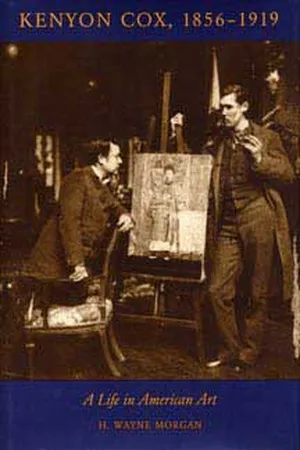
Kenyon Cox was among the best-know cultural figures in the United States during the first two decades of this century, thanks to his reputation as a mural painter and especially as a critic. In this first biography, H. Wayne Morgan focuses on Cox's development and personality, treating his art as an expression of his idealism. Cox was born in Warren, Ohio grew up in the Cincinnati area, and attended the McMicken School of Design there. His art training continued in Paris, where he studied for five years in the academic setting of the Ecole des Beaux-Arts as well as in private ateliers, such as those of Emile Carolus-Duran, Rodolphe Julian, and Jean-Leon Gerome. An academic, Cox was committed to learning traditional drawing and composition before establishing his own artistic identity. Cox became well known as a muralist during the prosperous years from 1897 to the 1920s, providing works for the new state capitols of Wisconsin, Iowa, and Minnesota, the Library of Congress, and several public buildings in New York City. His large allegorical decorations rested on a thorough knowledge of Italian renaissance masters, many of whose works he had seen as an impressionable student. In addition, Cox's gift for pithy phrases and his obvious knowledge gained him considerable prominence as a critic and reviewer. Throughout his career, he emphasized the values of craftsmanship and of attachments to ongoing traditional ideals that emphasized harmony, order, and unity of artist and public. He became famous, or notorious, and an outspoken opponent of the trend toward modernism, which he believed glorified individual expression at the expense of communicating with an audience. Cox saw this as culturally divisive, destroying the power of art to expand the viewer's imagination and consciousness. Eventually, however, modernism overcame the traditional ideals and styles that Cox and many of his contemporaries had represented. Morgan's sources include the Cox papers at the Avery Library of Columbia University as well as his voluminous published writings on criticism and art history—Old Masters and New: Essays in Art Criticism (1905), Painters and Sculptors (1907), The Classic Point of View (1911), Artist and Public (1914), and Concerning Painting: Considerations Theoretical and Historical (1917). His re-evaluation of Kenyon Cox and his classical/idealistic style contributes to the growing body of scholarship on the non-modern art of the late 19th and early 20th centuries.
- 304 pages
- English
- ePUB (mobile friendly)
- Available on iOS & Android
eBook - ePub
About this book
Information
Topic
ArtSubtopic
History of Art
INDEX
Italicized page references indicate illustrations.
Abbey, Edwin Austen, 144
Aderante, Vincent, 166
Albany State Capitol, 138
Albright Art Gallery (Buffalo), 97, 163
Alexander, John White, 163, 171
Allegorical paintings, 97–99, 139, 141
Allen, Rosa Dale, 70
Allen Museum (Oberlin), 234
Alvarez Espino, Gonzalo, 18–19
American Academy (Rome), 97, 182, 227
American Academy of Arts and Letters, 200, 216, 241, 242
American art, 81, 92, 208, 210, 211, 214–15, 219
American Art Galleries (New York), 81, 82
American Artists’ Committee of One Hundred, 225
American Institute of Arts and Letters, 200
American Red Cross, 227
Andrea del Verrocchio, 42
Antwerp (Belgium), 122–23
Apollonius the Athenian, 252n21
Architectural League of New York, 145, 151, 162, 201, 234
Architecture, 27, 38, 43, 139, 140, 144, 148, 167
Armory Show (1913), x, 217–20, 222
Arnold, Matthew, 81
Arquebusier (Fortuny), 14–15, 25
Art Institute of Chicago, 97, 206–10, 212–13
Art students, 29, 30, 83
Art Students League (New York): A. Cox and, 182; The Girl With the Red Hair and, 95, 97; KC and, 18, 24, 62, 83–86, 112, 124, 166, 183, 201, 205; L. King and, 124–26; nude life classes at, 260n31
Ashcan school, 211
Association of American Painters and Sculptors, 217
Bacher, Otto, 72
Bacon, Henry, 29
Barbizon school, 15, 52, 82, 103
Barnes, Grace Edith, 168, 170
Baroque architecture, 43
Barrymore, Ethel, 158–61, 240
Barye, Antoine-Louis, 75
Bashkirtseff, Marie, 33
Bastien-Lepage, Jules, 34, 51–52, 53, 67, 255n55
Becker, Georges, 65, 66, 72
Beckwith, J. Carroll, 119, 121, 252n14, 266n34
Belgium, 122
Bellini, Giovanni, 42
Bellows, George, 208
Berlin...
Table of contents
- Cover Page
- Halftitle Page
- Title Page
- Copyright Page
- Dedication
- Contents
- Preface
- I. An Unusual Young Man
- II. Paris
- III. An Artist in New York
- IV. Art Life and New Relationships
- V. Mural Painter
- VI. An Established Artist
- VII. Classics and Moderns
- VIII. Last Years
- Notes
- Bibliographic Essay
- Index
Trusted by 375,005 students
Access to over 1.5 million titles for a fair monthly price.
Study more efficiently using our study tools.
Frequently asked questions
Yes, you can cancel anytime from the Subscription tab in your account settings on the Perlego website. Your subscription will stay active until the end of your current billing period. Learn how to cancel your subscription
No, books cannot be downloaded as external files, such as PDFs, for use outside of Perlego. However, you can download books within the Perlego app for offline reading on mobile or tablet. Learn how to download books offline
Perlego offers two plans: Essential and Complete
- Essential is ideal for learners and professionals who enjoy exploring a wide range of subjects. Access the Essential Library with 800,000+ trusted titles and best-sellers across business, personal growth, and the humanities. Includes unlimited reading time and Standard Read Aloud voice.
- Complete: Perfect for advanced learners and researchers needing full, unrestricted access. Unlock 1.5M+ books across hundreds of subjects, including academic and specialized titles. The Complete Plan also includes advanced features like Premium Read Aloud and Research Assistant.
We are an online textbook subscription service, where you can get access to an entire online library for less than the price of a single book per month. With over 1.5 million books across 990+ topics, we’ve got you covered! Learn about our mission
Look out for the read-aloud symbol on your next book to see if you can listen to it. The read-aloud tool reads text aloud for you, highlighting the text as it is being read. You can pause it, speed it up and slow it down. Learn more about Read Aloud
Yes! You can use the Perlego app on both iOS and Android devices to read anytime, anywhere — even offline. Perfect for commutes or when you’re on the go.
Please note we cannot support devices running on iOS 13 and Android 7 or earlier. Learn more about using the app
Please note we cannot support devices running on iOS 13 and Android 7 or earlier. Learn more about using the app
Yes, you can access Kenyon Cox, 1856-1919 by H. Wayne Morgan in PDF and/or ePUB format, as well as other popular books in Art & History of Art. We have over 1.5 million books available in our catalogue for you to explore.