![]()
“A Step All-Important
and Essential to Victory”
Henry W. Slocum and the Twelfth Corps
on July 1–2, 1863
A. WILSON GREENE
Every Civil War battle produced a gallery of heroes and rogues—commanders whose conspicuous valor, bold gambles, or fatal errors pursue them through history to their everlasting glory or shame. At the Battle of Gettysburg, the Army of the Potomac certainly conformed to this pattern. On one side proudly stand the likes of Brigadier General John Buford, Major General Winfield Scott Hancock, and Colonel Joshua L. Chamberlain, whereas on the other lurk the blemished visages of Major General Oliver Otis Howard, Major General Daniel E. Sickles, and Brigadier General Alexander Schimmelfennig.1
Usually absent from either list are the ranking officers of the Twelfth Corps. Major General Henry W. Slocum and his eight subordinate commanders have attracted less attention from Gettysburg scholars than the leaders of any other Union corps. Despite this neglect, some observers have credited Slocum’s corps with crafting the Union victory, none more eloquently than Oliver Otis Howard: “The most impressive incident of the great battle of Gettysburg,” wrote the Eleventh Corps commander in 1894, “was Slocum’s own battle… . Slocum’s resolute insistence the afternoon of July 2nd and his organized work and battle the ensuing morning, in my judgment prevented Meade’s losing the battle of Gettysburg. It was a grand judgment and action; a step all-important and essential to victory.”2
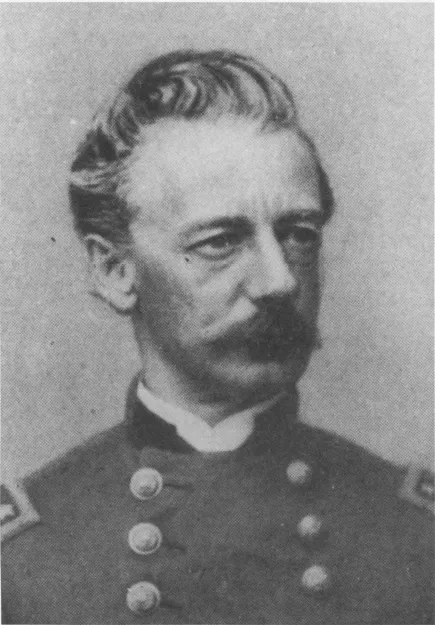
Major General Henry Warner Slocum
(Photographic History 10:177)
Was Howard correct in ascribing a critical role to the Twelfth Corps at Gettysburg? If so, what part did Slocum and the rest of the relatively anonymous hierarchy of his corps play on July 1–2? Did they render service that altered the outcome of North America’s most famous battle?
The Twelfth Corps embarked on the Gettysburg campaign after suffering nearly three thousand casualties in the Battle of Chancellorsville.3 Henry Warner Slocum, thirty-five years old and from Onondaga County, New York, led the corps at Chancellorsville as he had since October of the previous year. Slocum graduated seventh in the class of 1852 at West Point, having roomed part of the time with Philip H. Sheridan. After a brief career in the Old Army, Slocum resigned to practice law but maintained connections with the New York state militia. Shortly after the fall of Fort Sumter, he offered his sword to the Union, reentering the service as colonel of the 27th New York Infantry.4
Admirers praised Slocum’s manner, which “inspire[d] faith and confidence,” and noted that his sparkling brown eyes contributed to a “magnetic power over his troops.”5 A less-impassioned assessment might mention that the beardless Slocum lacked dash, loved discipline and order, and gained the respect, if not the devotion, of his men. Nothing in Slocum’s record prior to the Gettysburg campaign either cast doubt on his military skills or marked him for higher responsibility.
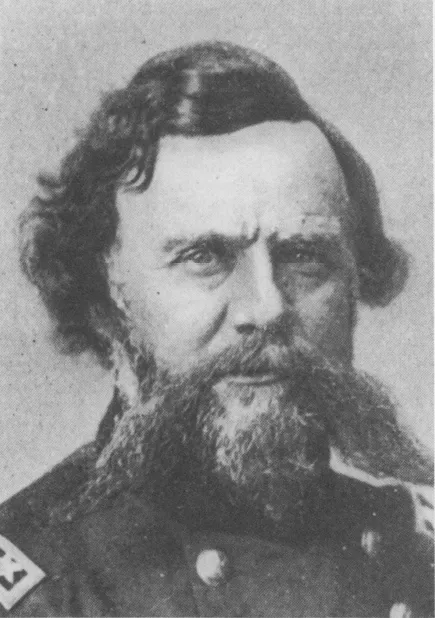
Slocum’s command consisted of only two divisions. The First Division belonged to Brigadier General Alpheus S. Williams, whose published letters make him familiar to modern students. “Old Pap” hailed from Connecticut and earned a degree from Yale, but after extensive travel abroad he settled in Michigan and established a Detroit law practice. Williams served in the Mexican War and presided over the state military board in the spring of 1861. A temporary replacement for the mortally wounded Major General J. K. F. Mansfield as Twelfth Corps commander at Antietam, he returned to his division after the battle. Fifty-two years old in early summer 1863, Williams sported a luxuriant beard embellished by extravagant mustachios rivalling the hirsute splendor of fellow brigadier John C. Robinson.6
Brigadier General Alpheus Starkey Williams
(Photographic History 10:85)
The three brigades of Williams’s division experienced considerable reorganization following Chancellorsville. The 28th New York and 128th Pennsylvania mustered out of the First Brigade in May, and the brigade commander, Brigadier General Joseph F. Knipe, temporarily left the field nursing a bothersome wound sustained the previous August at Cedar Mountain. The army consolidated the Second Brigade with the First’s remaining two regiments and named Colonel Archibald L. McDougall of the 123d New York as commander of this new First Brigade. Gettysburg would be the only battle at which McDougall exercised so high an authority.7 The Third Brigade remained intact under the able direction of Brigadier General Thomas H. Ruger of New York. Like Slocum, the thirty-year-old Ruger was a high-ranking graduate of West Point who resigned his commission to practice law. Ruger settled in Janesville, Wisconsin, and reentered the army as lieutenant colonel of the 3d Wisconsin, one of six western regiments in the corps at Gettysburg.8
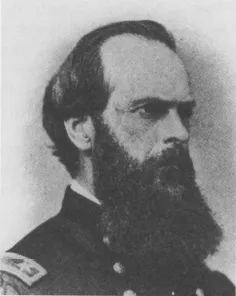
The other division of the Twelfth Corps, known as the White Stars, served under Brigadier General John White Geary. This Pennsylvanian, in keeping with the coincidental character of the corps, also possessed a legal background. His law career, however, would be eclipsed by politics. After volunteer duty with Winfield Scott in Mexico, Geary moved to California where he became the first mayor of San Francisco. In 1856, at age thirty-seven, he received an unenviable appointment as territorial governor of turbulent Kansas; the strains of this office led him to an early retirement at his Pennsylvania farm. Geary raised a regiment in 1861 and advanced steadily through the ranks to divisional command.9
Brigadier General John White Geary
(Courtesy of the National Archives)
The Second Division experienced little organizational change between Chancellorsville and Gettysburg. Colonel Charles Candy led the First Brigade, a unit comprised entirely of Ohioans and Pennsylvanians. Twenty-nine years old and a native of Lexington, Kentucky, Candy had served a decade as an enlisted man in the regular army when the war commenced. Commissioned an officer in the volunteers, he would eventually receive a brevet promotion to brigadier general, making him one of the few soldiers to rise from private to general during the course of the war.10
Colorful Thomas L. Kane held the official command of the Second Brigade. Yet another lawyer, Kane had earned a reputation before the war as an ardent abolitionist and principal in the Underground Railroad. Following an eventful period with the Mormons in Utah, Kane returned to his native Pennsylvania, founded a village he named after himself, and recruited the famous Pennsylvania Bucktails. A bout with pneumonia after Chancellorsville forced Kane to leave the field temporarily and entrust his brigade to Colonel George A. Cobham of the 111th Pennsylvania. The thirty-seven-year-old Cobham, perhaps because he was an Englishman, did not practice law but earned his living as a bridge builder and contractor.11
The Third Brigade consisted of five New York regiments led by Brigadier General George Sears Greene of Rhode Island. One observer described this unit as “the best brigade of the biggest state led by the best general of the smallest state.” Sixty-two years old, Greene had graduated second in the West Point class of 1823 and lost his wife and three children during one seven-month period at Fort Sullivan, South Carolina. He resigned his commission in 1836 to pursue civil engineering in New York. Greene’s troops called their commander “Pop” and deeply respected him as a stern authority figure.12
The Twelfth Corps, smallest in the army at only nine thousand soldiers and officers present for duty,13 marched north on June 29 from Frederick, Maryland. Entering Pennsylvania the next day, the troops arrived hot and dusty at Littlestown about 2:00 P.M. Although Pennsylvanians generously dispensed refreshments and encouraging words to the tired troops, General Williams most vividly remembered the provincialism of the locals: “The inhabitants are Dutch descendants and quite Dutch in language…. The people are rich, but ignorant of everybody and [every] thing beyond their small spheres. They have immense barns, looking like great arsenals or public institutions, full of small windows and painted showily. Altogether, they are a people of barns, not brains.”14
As some soldiers mustered for pay, word came that Rebel cavalry had attacked Union horsemen to the north. The Twelfth Corps quickly prepared to go to their cavalry’s assistance, but by the time the men hurried through Littlestown the alarm had been cancelled. The corps made a comfortable camp about one mile northeast of town on the road to Hanover. From army headquarters, Major General George G. Meade then instructed Slocum to become familiar with the roads between Littlestown, Gettysburg, and Major General John F. Reynolds’s position farther west, and informed Slocum of Confederate movements toward Gettysburg.15
July 1 dawned, according to one soldier, “wet and lowery.” Following “a hasty breakfast of coffee, crackers and pork,” elements of Williams’s division left their bivouacs about 5:00 A.M. The corps retraced its route to Littlestown then gained the Baltimore Pike leading northwest toward Gettysburg about ten miles distant. By 9:00 A.M. the last units of Geary’s division had commenced what everyone described as a leisurely march.16
The pace proved so casual, in fact, that members of the 66th Ohio of Candy’s brigade found an opportunity for a little spontaneous recreation. William Henry Harrison Tallman remembered stopping at a farm house along the road where he and his comrades “squandered our shin plasters for soft bread, butter, apple butter, and a cheese the like of which I never smelled before. This cheese was made up in round balls about the size of a regulation baseball and [when] broken open perfumed the air for rods around us. Then commenced a lively pelting of each other with the cheese balls and the odor in and around our company was dense enough to cut with a knife.”17
Slocum’s immediate goal, as specified in orders communicated by Meade the previous day, was the hamlet of Two Taverns, a six-mile march and more than halfway to Gettysburg. The only event that disturbed the tranquility of this movement, cheese-ball battles notwithstanding, came from the north in the form of “the dull booming of cannon” heard by some of the troops. Slocum later described the sounds as cavalry carbines occasionally accompanied by artillery rather than the racket caused by a general engagement.18 Williams’s vanguard reached Two Taverns in midmorning and Geary’s leading units arrived about 11:00 A.M., filing to the west of the road and encamping on a small hill.19
The day had grown uncomfortably muggy, and some of the pickets posted around the camp collapsed from heatstroke. The men sought solace from the weather in their rations and by gossiping, “the air… full of the rumors which circulate so freely when a battle becomes imminent.” The air also resounded with the unmistakable echo of combat. “Heavy and continuous firing in the direction of Gettysburg” gradually grew more rapid. “The cannonading became more and more furious as the minutes passed,” according to a Wisconsin soldier, “until in the distance it sounded like one continual roll of thunder.”20 Some listeners climbed to the tops of nearby barns where the bursting of shells could be plainly detected; others witnessed “smoke from the cannon and the little puffs in the air” from high points at the bivouac itself.21
The men completed their meal and some had begun the regular monthly inspection when a civilian dashed up to Slocum’s headquarters with word of “a great battle” in progress at Gettysburg. The general dispatched Major Eugene W. Guindon of his staff to ride north and investigate this report. Guindon soon observed what other witnesses had seen from their lofty vantage points at Two Taverns, returning to Slocum with confirmation of the citizen’s veracity.22
Meanwhile, Edmund R. Brown of the 27th Indiana saw no fewer than three couriers arrive at Two Taverns, “their horses in a lather and jaded, prov[ing] that they had come a distance and ridden fast.” Brown identified them as emissaries from Major General Oliver O. Howard, in command of Union forces at Gettysburg. In fact, Howard had sent a message to Slocum at 1:00 P.M.: “Ewell’s corps is advancing from York. The left wing of the Army of the Potomac is engaged with A. P. Hill’s corps.”23
In response to this corroborated intelligence, the Twelfth Corps resumed its northward march on the Baltimore Pike but arrived too late to participate in the desperate defense mounted by Howard north and west of Gettysburg. Howard’s strategy on the afternoon of July 1 depended in large part on the timely arrival of the Twelfth Corps, which he knew to be located only five miles to the southeast. Did Howard have reason to expect help from Slocum, and if so, why did it not materialize?
The most apposite document in this inquiry is Meade’s famous Pipe Creek Circular, which was sent to Slocum on July 1.24 The circular clearly stated Meade’s intention to assume a defensive position along northern Maryland’s Pipe Creek in the event of certain contingencies. First, the enemy would have to attack. Thanks to the civilian’s report and Howard’s messengers, Slocum knew early in the a...