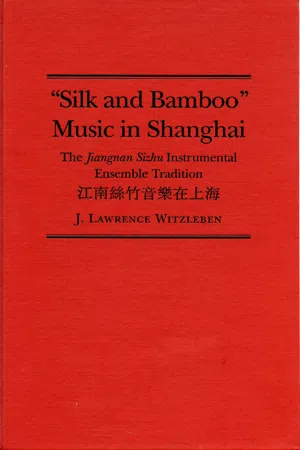
"Of all the world's major musical cultures, that of China may well be the least thoroughly understood and most often misunderstood by Western scholars and music lovers, "writes J. Lawrence Witzleben. Witzleben adds to the understanding of this musical culture with the first book-length study of one of China's most influential regional musical traditions. The first Western ethnomusicologist admitted to a Chinese conservatory, Witzleben presents a multifaceted study, based on more than two years of fieldwork in the early 1900s, of "silk and bamboo" string and wind music (Jiangnan sizhu) in Shanghai. Although Jiangnan sizhu is a regional tradition, enjoyed by only a small part of the population, an indepth look at it reveals much about Chinese musical culture. Jiangnan sizhu is deeply rooted in everyday life, and those who perform and enjoy it represent a broad spectrum of Chinese society. It is cultivated as an amateur art, but many of its performers are closely tied to the professional musical community. And although it is a regional genre, it has been highly influential in the development of contemporary solo and ensemble music for Chinese instruments. Through his varied experiences as student, performer, and participant-observer, Witzleben is able to present and discuss the perspectives of musicians in Shanghai and of Chinese scholars and teachers, as well as those of a Western-trained ethnomusicologist. The result is a comprehensive understanding of Jiangnan sizhu its musical sounds and concepts; the people who play, teach, and learn the music; and the environment in which it is and has been played, heard, and discussed.
eBook - ePub
Silk and Bamboo Music in Shanghai
The Jiangnan Sizhu Instrumental Ensemble Tradition
- 224 pages
- English
- ePUB (mobile friendly)
- Available on iOS & Android
eBook - ePub
Silk and Bamboo Music in Shanghai
The Jiangnan Sizhu Instrumental Ensemble Tradition
About this book
Information
Subtopic
EthnomusicologyONE
Historical Background &
Intergenre Relationships
Intergenre Relationships
Jiangnan sizhu is a young tradition by Chinese standards, but string and wind ensembles have played an important role in Chinese music for over two millennia. Moreover, Jiangnan sizhu music is closely linked to other instrumental and vocal genres in the Jiangnan region.
ANTECEDENTS
Silk and bamboo are two of the materials among the “eight sounds” (bayin) used to classify musical instruments in the ancient Chinese organological system first outlined in the Zhou Dynasty (1122–255 B.C.) in the Zhouli [Rituals of Zhou] (Li Minxiong 1982:35). The best-documented ancient Chinese ensembles were comprised of a variety of instrumental types, including bronze bells, stone chimes, and other loud percussion instruments. String and wind instruments may have been emphasized in certain pieces or passages (since no musical notation from this period survives, we can only speculate), but they were certainly not the dominant instruments—in volume, at least—in these ensembles.
At some point in China’s early musical history, the idea of a small ensemble featuring strings and relatively soft wind instruments became valued as an aesthetically desirable musical combination. Archaeological evidence from the Zenghouyi tomb, which was sealed in 433 B.C.(DeWoskin 1982:25), indicates that such ensembles were already in existence at that time. In addition to the set of bronze bells for which this tomb has become famous, many other instruments were also unearthed: “The coffin of the Marquis was found in the eastern cell which is thought to be the bed room. In this room, a silk and bamboo chamber orchestra was found. It contains ten pieces [sic] of wind, plucked string and percussion instruments” (Lee 1980:3). Thus, in addition to the large orchestras that played for ceremonial and ritual events, string and wind instruments were combined for music making on a smaller scale and of a more intimate nature.
One ancient tradition often cited as a precedent for later sizhu developments is that of xianghe ge, “harmonious songs.” These were songs with sizhu accompaniment and were developed from folk songs of northern China as early as 200 B.C. (Yang Yinliu 1981:114); instrumental preludes to the singing became an important part of this tradition (Yeh 1985:65). Although little is known about the actual music of these songs or their accompaniment, they represent the earliest specifically named genre known to have featured a sizhu ensemble.
In the Sui-Tang period (A.D. 581–907), the genre known as qingshang yue, which the Japanese scholar Shigeo Kishibe has described as “popular songs of the Han dynasty” (1960–61:14), prospered. Nora Yeh has summarized the findings of Chinese music historians concerning this music: “During the fifth and sixth centuries … the folk music in both northern and southern China came to be known as “qingshang yue.” … [it] came to be regarded as one of the music departments (known as jiubu ji or shibu ji) in the imperial court. It used mainly the silk-bamboo instruments” (1985:66). Jiubu ji were the “nine kinds of music” established in the reign of Emperor Yang (605–17), which included not only Chinese traditions but also musics from Korea, India, and various parts of the regions that later came to be known as Chinese and Russian Turkestan, and were used for “various feasts and festivals in the court” (Kishibe 1960–61:15, 16). Shibu ji were the “ten kinds of music” established in A.D. 640–42. In both of these genres, fixed sequences were established for performing the nine or ten musical types (ibid.: 17).
He Changlin (1985) suggests that another form of music dating from the Tang Dynasty, chashan douyue (“dou music from the tea hills”), was at least in part an early type of sizhu ensemble music.1 A special grade of tea was grown in the area to the west of Lake Tai, near the border between present-day Zhejiang and Jiangsu provinces. A tradition was established of presenting tea to the emperor, and a festival was held each year when the tea was picked, tasted, and graded. The festival lasted about twenty days, with both court specialists and amateur folk musicians taking part in performing various types of music and dance. In describing the festivities, the late-Tang poet Cao Song refers to a “tea hills sizhu festival,” and, according to He’s interpretation, Cao’s poem suggests that music making would already be in progress while participants were still on board the boats bringing them to the event (ibid.:43).
The predecessors of the bowed and plucked lutes so prominent in contemporary sizhu musics came to China from central Asia at relatively late dates. Based on the visual evidence from frescos in the Mugao caves at Dunhuang in Gansu province, the pipa was included in entertainment orchestras as early as A.D. 642 (Han 1979:3, 5), while the bowed lutes became assimilated by the fourteenth century during the Yuan Dynasty, 1279–1368, whose Mongol rulers were accustomed to hearing similar instruments and looked with favor upon their use in court circles.
“Sizhu,” in addition to its literal organological meaning, came to be used as a euphemism for music in general, usually implying a music played indoors. The term has been in use at least since the Han Dynasty (206 B.C.—A.D. 220), where it is found in the Jinshu [Book of the Jin (dynasty)] (Li Minxiong 1982:35). The term “sizhu” was later used by writers of poetry and prose for affective purposes. A famous example is found in the Tang poet Bai Juyi’s “Changhen Ge” (Lament everlasting), which refers to “slow songs, leisurely dances, crystallizing string and reed” (Levy 1971:1, 137) played in the emperor’s chambers.
Another common term related to sizhu (also found in the Jinshu) is guanxian, “winds and strings.” While this expression refers to the manner of sound production rather than materials used to make the sounds, the connotations of guanxian may be considered to be essentially the same as those of sizhu.2
During the Ming Dynasty (1368–1644), Chinese opera underwent considerable development, culminating in the genre that came to be known as Kunqu, “songs of Kun,” which originated in the Kunshan region of Jiangsu province. Kunqu is a genre in which elements of the northern zaju, “miscellaneous plays,” and the southern nanxi (“southern plays,” later called chuanji, meaning “marvel tales”) were integrated. The rise of Kunqu is associated with Wei Liangfu and a small circle of associates, who “devised” the new tradition “during the years 1540–66” (Dolby 1976:91). It is widely assumed that the northern style emphasized string instruments while the southern style favored winds; however, Yang Yinliu (1981:902) believes that such distinctions were rarely rigid and, by the fourteenth century, southern repertory came to be accompanied by the pipa and zheng, and the dizi could be used to accompany northern repertory. By the late Yuan period, northern and southern dramatic music were combined in “song-sets” (Dolby 1976:74); eventually, the standard accompanying ensemble included both string and wind instruments. Although documentation on Kunqu is extensive, specific information on the instruments used and style of accompaniment is relatively scarce, and the detailed accounts that are available may be highly idiosyncratic rather than typical (Yang Yinliu 1981:901). According to one source from 1559, the accompaniment featured dizi, pipa, and guan (a double-reed wind instrument) at that time (Xu 1959:3, 242).3 Another source (Mackerras 1972:7) also mentions the xiao and yueqin (“moon stringed-instrument,” a plucked lute with a round body and a short neck), and other scholars have added sanxian and sheng. Yang Yinliu believes that the essential accompanying instruments are percussion, dizi, and sanxian, with the most common auxiliary instruments including sheng, xiao, pipa, yueqin, and huqin, the generic term for two-stringed bowed lutes (1981:905).
The 1814 collection of musical notation Xiansuo Beikao [A reference appendix for strings], now more often referred to as Xiansuo Shisantao [Thirteen pieces for strings], is intended for a string ensemble supplemented by winds (Yang Yinliu and Cao 1979 is an annotated edition of this collection). The notation contains parts for up to six instruments and may either document existing ensemble style or be arrangements by the compiler, Rong Zhai. Four of the musical lines are specified for pipa, sanxian, zheng, and huqin. The other two lines may be played by any combination of xiao, dizi, sheng, and tiqin, a low-pitched two-stringed bowed lute (Han 1979:7). Thus, the complete ensemble was one very similar to that of contemporary Jiangnan sizhu. This manuscript is also significant in that several of the pieces contained in it are still played by Jiangnan sizhu music clubs.
Two closely related traditions from the Wuxi area of Jiangsu province that include both a sizhu ensemble and a percussion ensemble are probably the most direct antecedents of Jiangnan sizhu. These string-wind-percussion genres are shifan gu and shifan luogu and will hereafter be referred to collectively as shifan music.4 Although various explanations exist for the meaning of the names, shifan can best be thought of as meaning “ten times,” with the sense of “many changes” (Yang Yinliu 1981:992). Shifan gu, “shifan drums,” music is played by a string and wind ensemble plus a drum, a clapper, and a gong chime; shifan luogu, “shifan gongs and drums,” music adds a large percussion ensemble of various gongs and cymbals to this basic instrumentation (Li Minxiong 1982:76). Yang Yinliu believes that despite the apparent similarities, shifan gu and shifan luogu should be treated as two distinct genres and that they are “two kinds of music which are obviously different and not interrelated. Not only are the types and playing techniques of the percussion instruments considerably different, but the tunes [qupai] used in the wind and string music are also different” (1981:993).
In the 1950s the Central Conservatory of Music undertook a large-scale research and collection project that resulted in annotated collections of notation of shifan luogu (Yang Yinliu 1980) and shifan gu (Yang Yinliu and Cao 1982). Shifan musical activity in Wuxi dates from at least the late eighteenth century, when it was documented in the 1795 book Yangzhou Huafang Lu [Yangzhou painted pleasure-boat record] (Yang Yinliu and Cao 1982:1). The instruments used in shifan music’s sizhu section (dizi, xiao, sheng, huqin, pipa, and sanxian) are among those found in the contemporary Jiangnan sizhu ensemble. The only significant difference in instrumentation is the occasional presence of a small suona, a double-reed wind instrument, and the absence of a yangqin in shifan music; Jiangnan sizhu almost always includes a yangqin, but never a suona. None of the shifan repertory included in Yang’s books is identical to that of Jiangnan sizhu, but the musical styles of Jiangnan sizhu and the sizhu portions of shifan music are similar, although the texture of the former tends to be more heterophonic.5
Outside of Jiangnan, other regional sizhu traditions have developed, especially along the southeastern coast of China. The most influential of these are nanguan (“Southern pipes”), also called nanyin (“Southern sounds”), from Fujian and Taiwan, and Chaozhou xianshi (“Chaozhou string poetry”) and Guangdong Yinyue (“Cantonese Music”) from Guangdong province. Other traditions sometimes classified as sizhu are errentai paiziqu from inner Mongolia and baisha xiyue from Yunnan province.6 In addition to these genres which have become widely recognized as sizhu musics, many types of dramatic music, narrative singing, and dance music include instr...
Table of contents
- Cover Page
- Halftitle Page
- Title Page
- Copyright Page
- Contents
- Preface
- Acknowledgments
- Romanization, Pronunciation, and Translation
- Prologue
- 1. Historical Background and Intergenre Relationships
- 2. Jiangnan Sizhu in Shanghai, 1981–1985
- 3. Instruments
- 4. Repertory
- 5. Form
- 6. Variation
- 7. Texture
- 8. Aesthetics
- Epilogue
- Appendix A: Translation of the Regulations of the China National Music Ensemble
- Appendix B: An Introduction to Cipher Notation
- Notes
- Character List and Glossary
- References Cited
- Selected Discography
- Index
Trusted by 375,005 students
Access to over 1.5 million titles for a fair monthly price.
Study more efficiently using our study tools.
Frequently asked questions
Yes, you can cancel anytime from the Subscription tab in your account settings on the Perlego website. Your subscription will stay active until the end of your current billing period. Learn how to cancel your subscription
No, books cannot be downloaded as external files, such as PDFs, for use outside of Perlego. However, you can download books within the Perlego app for offline reading on mobile or tablet. Learn how to download books offline
Perlego offers two plans: Essential and Complete
- Essential is ideal for learners and professionals who enjoy exploring a wide range of subjects. Access the Essential Library with 800,000+ trusted titles and best-sellers across business, personal growth, and the humanities. Includes unlimited reading time and Standard Read Aloud voice.
- Complete: Perfect for advanced learners and researchers needing full, unrestricted access. Unlock 1.5M+ books across hundreds of subjects, including academic and specialized titles. The Complete Plan also includes advanced features like Premium Read Aloud and Research Assistant.
We are an online textbook subscription service, where you can get access to an entire online library for less than the price of a single book per month. With over 1.5 million books across 990+ topics, we’ve got you covered! Learn about our mission
Look out for the read-aloud symbol on your next book to see if you can listen to it. The read-aloud tool reads text aloud for you, highlighting the text as it is being read. You can pause it, speed it up and slow it down. Learn more about Read Aloud
Yes! You can use the Perlego app on both iOS and Android devices to read anytime, anywhere — even offline. Perfect for commutes or when you’re on the go.
Please note we cannot support devices running on iOS 13 and Android 7 or earlier. Learn more about using the app
Please note we cannot support devices running on iOS 13 and Android 7 or earlier. Learn more about using the app
Yes, you can access Silk and Bamboo Music in Shanghai by J. Lawrence Witzleben in PDF and/or ePUB format, as well as other popular books in Media & Performing Arts & Ethnomusicology. We have over 1.5 million books available in our catalogue for you to explore.