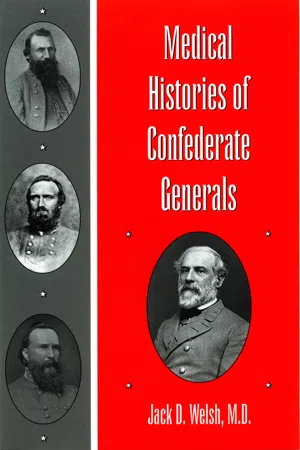
From official records, personal letters, and postwar memoirs, Jack D. Welsh, M.D., has compiled the medical histories of 425 Confederate generals. The generals' early military experience, at West Point and in Florida, Mexico, or on the western frontier, meant that hundreds of them were exposed to and immunized against the diseases that killed so many soldiers in the Civil War, while many also were wounded or lost limbs. In addition, several survived street fights, duels, and shooting accidents-all before the war. Throughout the Civil War, most officers fought in spite' of illness or wounds and spent little time in hospitals. Welsh mentions this fact not to point out bravery, but rather to illustrate the prevailing attitudes toward disease and injuries. Ninety-six Confederate generals died during the war; half of those who survived lived to age 70 or older. Welsh does not attempt to analyze the effects of an individual's medical problems on a battle or the war, but whenever possible provides information about factors that may have contributed to the wound, injury, or illness, and the outcome. He also details the immediate care, logistics of transportation, timing of operations, and the remedies used or recommended by the physicians, when such data is available. This insight into the lives of men who often paid a high price for the Confederacy will prove fascinating for physicians, historians of medicine, and students of the Civil War.
- 316 pages
- English
- ePUB (mobile friendly)
- Available on iOS & Android
eBook - ePub
Medical Histories of Confederate Generals
About this book
Information
A
DANIEL WEISIGER ADAMS • Born May 1, 1821, in Frankfort, Kentucky. In a duel in 1843, Adams killed a writer who had been critical of his father. The man had thrown him to the ground and was on top of him when Adams pulled a derringer from his pocket and shot him in the head. Adams later became a practicing lawyer and eventually entered Confederate service as a lieutenant colonel of the 1st Louisiana Regulars. On April 6, 1862, while at Shiloh, a rifle ball hit him in the head. The projectile penetrated the skull above the left eye and came out just behind the left ear, resulting in the loss of the eye. Taken from the field in a helpless condition, Adams was thrown into a wagon with the other wounded soldiers. Progress was almost impossible because the muddy road had been torn up by the wagons and artillery. Because Adams was senseless and covered with mud, the driver thought he was dead and threw his body along the road to lighten the load. Men of the 10th Mississippi noticed signs of life and attended to him. He had nearly regained both his physical and mental capacities by the middle of May and was promoted to brigadier general on May 23. He was ordered to report for duty on August 13, 1862, and participated in the Battle of Perryville on October 8. In command of the Louisiana Brigade at Murfreesborough on December 31, 1862, he received a slight wound of the left arm from a piece of shell. Not able to go back to the field the next day, he turned over his command. In May 1863, he felt well and wanted to return to duty. Participating in a charge at Chickamauga on September 20, 1863, Adams was wounded in the left arm again. He remained in command until he became so exhausted that he was left on the field and captured by Federal troops. He was taken to the hospital at Murfreesborough without having received any medical aid. A ball had fractured the middle third of the left humerus and produced considerable tumefaction and pain. He was administered chloroform on September 23 so that doctors could determine the extent of the injury and whether amputation was required. The ball was embedded among the bone fragments, all of which were removed, together with the pointed end of the upper fragment. The specimens consisted of six pieces of bone, which represented two inches in length, and a battered conical ball. Although shortening of the limb would result, conservative treatment was selected, because any deformity was considered tolerable if the functions of the hand could be preserved. About four weeks after the operation, the arm was put up in splints of coaptation, and Adams was sent through the Confederate line under a flag of truce at the solicitation of Gen. Braxton Bragg. He went to La Grange, Georgia, to recuperate; after his recovery he was given command of the cavalry brigade in northern Alabama and Mississippi. He was assigned to command of the District of Central Alabama in September 1864. On February 6, 1865, he was told to report to Gen. E. K. Smith, commander of the Trans-Mississippi Department, for assignment to an appropriate post duty or to any administrative department. Following his parole at the end of the war, he again took up the practice of law in New Orleans. Adams had complained of not feeling well for a few days before his death. On June 13, 1872, he was writing a legal brief at his office when his head suddenly fell forward. A physician was called immediately; he prescribed some medicine, which revived Adams rapidly. The physician left after telling Adams to go home and to continue to take the medicine. Within a short time, Adams said he felt very sick. He expired within a few minutes, before the doctor could be found again. He was buried in Jackson, Mississippi, in an unmarked grave in Greenwood Cemetery.1
DEATH CERTIFICATE: NAD
1. Combined Service Record, National Archives (hereafter cited as CSR); U.S. War Department, The War of the Rebellion: A Compilation of the Official Records of the Union and Confederate Armies, vol.10, pt. 1:537, pt. 2:533; vol. 16, pt. 1:1122, pt. 2:756; vol. 20, pt. 1:670, 792–94; vol. 30, pt. 1:200, 379, pt. 2:222; vol. 39, pt. 2:869; vol. 48, pt. 1:1368 (hereafter cited as OR; unless otherwise indicated, all references are to Series 1); John Francis Hamtramck Claiborne Papers, Library of the University of North Carolina, Southern Historical Collection (hereafter cited as SHC); St. John Richardson Liddell, Liddell’s Record, ed. Nathaniel C. Hughes, 82; Medical and Surgical History of the War of the Rebellion, vol. 2, pt. 2:669, Case no. 1615, incorrectly identified as Wirth Adams (hereafter cited as MSHW); Southern Historical Society Papers 10:20 (hereafter cited as SHSP); Glenn Tucker, Chickamauga: Bloody Battle of the West, 236; Confederate Veteran Magazine 3:278 (hereafter cited as CV); Gen. Clement A. Evans, ed., Confederate Military History 10:291, La. (hereafter cited as CMH); New Orleans Daily Picayune, June 14, 1872.
JOHN ADAMS • Born July 1, 1825, in Nashville, Tennessee. He graduated from USMA in 1846. Served in the Mexican War. He arrived at Fort Leavenworth in August 1846 but because of a severe attack of fever was advised not to continue his travels. He reported at Santa Fe on October 10 and was temporarily attached to Company G at Albuquerque, remaining at that post sick for the balance of the year. In November 1850 he was ordered to go to Las Vegas; though on the sick list, he had no choice but to go. In March 1851, Adams’s arm was injured when one of his company’s wagons fell into the Arkansas River. He applied for a twenty-day leave of absence but was refused. Although he was able to ride a horse by June, it took almost four months for his injury to heal. While in Baltimore on general recruiting duties in March 1857, he had an attack of “National Hotel disease,” which he acquired in Washington, D.C. Profuse watery diarrhea, nausea, and thirst characterized this disease, which tended to relapse over a number of weeks or months. Adams was to be transferred to the Pacific, but the surgeon did not think he could tolerate it, as it would be hazardous for him to pass the Isthmus of Panama or contiguous regions. Adams’s initial request for a leave was not granted. It was not until August that he received a leave, but not enough time was allowed for him to recover completely. After he resigned from the United States Army in May 1861, he received a captaincy of cavalry in the regular Confederate Army and was commissioned brigadier general to rank from December 1862. On November 30, 1864, early in the Battle of Franklin, Adams was wounded severely in the right arm near the shoulder but would not leave the field. Later, on horseback, he attempted to jump the Federal breastworks and was mortally wounded. There are two reports as to what happened. In the first, he fell, hit by nine bullets fired by the Federal color guard, and his horse, which was also hit, fell on top of him. When they could, the Federal troops lifted the horse, while others dragged the general from under it. Adams was conscious, realized his condition, and asked for water. One of the Federal soldiers gave him his canteen, and another brought cotton for a pillow. Adams died shortly afterward. According to the other report, made by a member of the 15th Mississippi who knew Adams, after he was wounded he crawled back toward the Confederate lines and died thirty or forty yards from the Federal works. The next morning his body was recovered, placed in an ambulance, and taken to the residence of Col. John McGavock. He was buried at Pulaski, Tennessee, in Maplewood Cemetery.1
1. CSR; OR, vol. 45, pt. 1:353, 425; Rita Grace Adams, “Brigadier-General John Adams” (diss.), 30–31, 55, 59–60, 86–88; Adjutant General’s Office, Letters Received, 125a/201a, May 24, 1857; ibid., 201.A/125.A, July 1857; James Wynne, “On the Disease Affecting the Inmates of the National Hotel,” American Medical Monthly 8:347–58; CMH 8:285; CV 1:208, 264.
WILLIAM WIRT ADAMS • Born March 22, 1819, at Frankfort, Kentucky. After service in 1839 with the army of the Republic of Texas, he was a planter, banker, and legislator in Mississippi. He raised the 1st Mississippi Cavalry and was its colonel until his promotion to brigadier general in September 1863. Returning to Mississippi after the war, he held various positions, including postmaster of Jackson. He was killed May 1, 1888, in a street encounter by a newspaper editor from Jackson with whom he had argued. Adams was buried in the Greenwood Cemetery in Jackson.
DEATH CERTIFICATE: NAD
EDWARD PORTER ALEXANDER • Born May 26, 1835, in Washington, Georgia. He graduated from USMA in 1857. He left the old army in May 1861 and was appointed a Confederate captain. In mid-May 1862, Alexander had measles and remained in bed for two weeks. On May 30, when he learned that an attack was planned, he left his bed and, although still weak, rejoined the army. At Gettysburg on July 2, 1863, a spent ball ripped through his pants and bounced off of his leg. Alexander’s next wound occurred in the Petersburg trenches on June 30, five months after his appointment as brigidier general. He had been walking down a path in full view of the Federal lines when a minié ball ricocheted from the hard ground in front of him and hit him under the left armpit. He walked back with help, and although the wound bled freely, he was able to ride his horse to the camp. The ball, which had just missed the artery and the shoulder joint, was removed under chloroform anesthesia. Alexander’s health was already poor as he had been having fever and chills for a week. He was jaundiced and his gums were bleeding. He went home on a leave of absence as a result of his wound. On July 26, 1864, his doctor said that Alexander was suffering from intermittent fever and pain from the unhealed wound and was incapacitated. He also thought that it was not advisable for Alexander to travel to Augusta to appear before the medical examining board. The jaundice slowly disappeared, and Alexander returned to duty in mid-August, although he continued to have chills and fever. In the fall of 1864, besides having occasional aches from his wound, he was still taking medication for the recurring fever and chills that were probably due to malaria. A bout of dysentery during this period was treated by his own concoction of chloroform, brandy, peppermint, and laudanum. He was paroled at Appomattox Court-House. After the war, he held a number of governmental posts and was also a professor of engineering, a businessman, and an author. He had an unspecified illness in 1900. In September 1902, Alexander had a cerebral vascular accident and a convulsion. His convalescence was complicated by aphasia and dizziness. Throughout the remainder of his life he continued to have similar attacks. After a severe stroke in January 1910, he was diagnosed with arteriosclerosis by doctors at Johns Hopkins Hospital. He went into a coma on April 27 and died the next day in Savannah, Georgia. Alexander was buried in the City Cemetery (Magnolia Cemetery) at Augusta.1
DEATH CERTIFICATE: Cause of death, cerebral apoplexy, duration of about a week.
1. CSR; OR, vol. 40, pt. 1:759; vol. 46, pt. 1:1279; Maury Klein, Edward Porter Alexander, 41, 79, 124–27, 213, 221, 224, 227–29; Douglas S. Freeman, R. E. Lee: A Biography 3:464.
HENRY WATKINS ALLEN • Born April 29, 1820, in Prince Edward County, Virginia. During a duel of July 6, 1844, a pistol ball passed through Allen’s upper thighs. A further description of this wound was provided in Latin: “In abdominis partibus inferioribus vulnaratus fuit Allen; ictu transcidente et lacerante prorsus membra vitalia.” Apparently, the ball, after passing through the soft tissue of his thigh, went across his lower abdomen and injured a vital part. It was stated that there was no conclusive evidence that his manhood was affected. His health was poor in January 1851, and he tried the waters of Cooper’s Well near Jackson. In 1859, while visiting London, he almost died from an attack of “Roman fever”; although he lay in a hotel room without friends or medical care, he recovered sufficiently to return home. Poor health in 1860 prevented him from seeking the office of speaker of the Louisiana State legislature. Enlisting as a private in the Confederate Army, he was soon elected lieutenant colonel of the 4th Louisiana Infantry. On April 6, 1862, at the Battle of Shiloh, Allen was shot through both cheeks. Although blood streamed from his mouth, he continued in battle, stopping the bleeding by first placing a handful of cotton lint in the wound and then tying a handkerchief around his face. The next day, because of blood loss and intense pain, he relinquished his command and went to the hospital. After his wound was dressed, he started to lie down when a general retreat took place; he mounted his horse and tried to rally the troops. In May 1862, with his face only partially healed, Allen proceeded to Vicksburg with a detachment. On August 5, 1862, during the battle at Baton Rouge, he was severely wounded when a canister shot fired from a Federal cannon located within fifty yards hit him in both legs. The loss of blood and extreme pain rendered him almost senseless, and he was carried off the field to a private home outside of Baton Rouge. The left leg had only flesh wounds, but the bones of the right leg were shattered; although amputation was recommended, he refused. He remained at a private home for about four months, and by the end of the year he could move around on crutches. Allen left there early in December but by Christmas was again confined to bed in great agony and with little hope of recovery. In early June 1863, while escaping from a hotel fire in Jackson, Mississippi, he was injured. Later in the month he was at Bladon’s Springs, Alabama, apparently for his health. Appointed brigadier general in August 1863, he was nominated for governor of Louisiana the same month and conducted his campaign and business on crutches. Allen left for exile in Mexico in June 1865 but could only travel by carriage. In Mexico h...
Table of contents
- Cover Page
- Halftitle Page
- Title Page
- Copyright Page
- Dedication
- Contents
- Acknowledgments
- Introduction
- Abbreviations
- Confederate Generals: Medical Histories
- Appendix: A Sequence of Medical Incidents during the Civil War
- Glossary
- Bibliography
Trusted by 375,005 students
Access to over 1.5 million titles for a fair monthly price.
Study more efficiently using our study tools.
Frequently asked questions
Yes, you can cancel anytime from the Subscription tab in your account settings on the Perlego website. Your subscription will stay active until the end of your current billing period. Learn how to cancel your subscription
No, books cannot be downloaded as external files, such as PDFs, for use outside of Perlego. However, you can download books within the Perlego app for offline reading on mobile or tablet. Learn how to download books offline
Perlego offers two plans: Essential and Complete
- Essential is ideal for learners and professionals who enjoy exploring a wide range of subjects. Access the Essential Library with 800,000+ trusted titles and best-sellers across business, personal growth, and the humanities. Includes unlimited reading time and Standard Read Aloud voice.
- Complete: Perfect for advanced learners and researchers needing full, unrestricted access. Unlock 1.5M+ books across hundreds of subjects, including academic and specialized titles. The Complete Plan also includes advanced features like Premium Read Aloud and Research Assistant.
We are an online textbook subscription service, where you can get access to an entire online library for less than the price of a single book per month. With over 1.5 million books across 990+ topics, we’ve got you covered! Learn about our mission
Look out for the read-aloud symbol on your next book to see if you can listen to it. The read-aloud tool reads text aloud for you, highlighting the text as it is being read. You can pause it, speed it up and slow it down. Learn more about Read Aloud
Yes! You can use the Perlego app on both iOS and Android devices to read anytime, anywhere — even offline. Perfect for commutes or when you’re on the go.
Please note we cannot support devices running on iOS 13 and Android 7 or earlier. Learn more about using the app
Please note we cannot support devices running on iOS 13 and Android 7 or earlier. Learn more about using the app
Yes, you can access Medical Histories of Confederate Generals by Jack D. Welsh, M.D.,Jack D. Welsh in PDF and/or ePUB format, as well as other popular books in History & American Civil War History. We have over 1.5 million books available in our catalogue for you to explore.