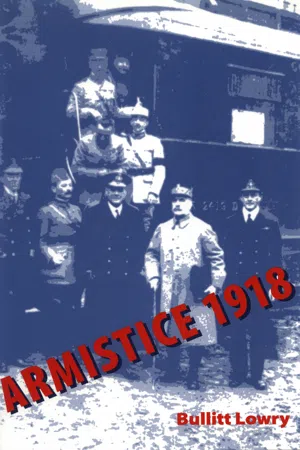
The five armistices arranged in the fall of 1918 determined the course of diplomatic events for many years. The armistice with Germany, the most important of the five, was really a peace treaty in miniature. Bullitt Lowry, basing his account on a close study of newly available archives in Great Britain, France, and the United States, offers a detailed examination of the process by which what might have been only simple orders to cease fire instead became extensive diplomatic and military instructions to armies and governments. He also assesses the work of the leading figures in the profess, as well as supporting casts of generals, admirals, and diplomatic advisors.
- 262 pages
- English
- ePUB (mobile friendly)
- Available on iOS & Android
eBook - ePub
Armistice 1918
About this book
Information
1
The Conference of Prime Ministers and the First German Note
On September 25, the Bulgarians decided to ask for an armistice. They lacked German aid, their front was crumbling, and they faced the Army of the East’s renewed offensive as well as mutiny in their own forces. With no hope of victory left, Bulgarian representatives met with the commander of the Allied army facing them.1 The French general who commanded that army, Louis Franchet d’Esperey, drew up the armistice conditions he wanted to impose on Bulgaria and sent them to the French prime minister, Georges Clemenceau, for approval.2 Clemenceau endorsed them and cabled a copy to London, which the British approved, too.3
The Bulgarians accepted those terms, the Salonika Armistice, without objections on September 29.4 The Salonika Armistice required the Bulgarians to evacuate the Greek and Serbian territory they still held. The Army of the East would stay on in the Bulgarian territory it already occupied, and Allied soldiers would have the right of transit through the rest of Bulgaria. The Bulgarians had to demobilize all but three divisions and surrender the equipment of the demobilized divisions to Allied supervision. Finally, the Salonika Armistice gave Bulgaria’s allies, Germany and Austria-Hungary, only four weeks to withdraw their military units from Bulgaria.
Not only did the Bulgarians accept those terms readily, but they had something more in mind. A Bulgarian delegate told Franchet d’Esperey that Bulgaria might reenter the war, this time on the Allied side. That is, if the Allies gave Bulgaria peace terms, not just armistice terms, Bulgaria would become an Allied nation. The abdication of the wartime tsar of Bulgaria on October 3 made that change more feasible.5
In the meantime, American actions were disturbing the Balkan situation. The United States, a nation “associated” with the Allies in the war against Germany and Austria-Hungary, had never declared war on the other two Central Powers, Bulgaria and the Ottoman Empire. The Bulgarians, at the same time that they sent representatives to the Army of the East, had also asked President Woodrow Wilson to “use his influence” with the Allies to end the bloodshed.6
Wilson eagerly agreed to help the Bulgarians get an armistice “if the Bulgarian Government will authorize him to say that the conditions of the armistice are left to him for decision.”7 To cap it off, the American State Department on October 2 sent a circular letter to all Allied capitals stating that any peace with Bulgaria must form part of a general settlement of the war.8 That is, the United States was insisting on taking a hand in Balkan affairs although it had not joined the Allies in making war there.
French reaction against American interference was sharp. Even before the United States’ circular letter arrived, the French prime minister ordered the commander-in-chief of the Army of the East to have nothing to do with any Americans. Clemenceau told the British ambassador in Paris, “We must make it clear that the Allies have a free hand in a war which is ours and not America’s.”9 He stayed angry. Days later, Clemenceau said he could reduce the official response he planned to give the United States to “This has nothing to do with you. Go to the devil.”10
Yet, perhaps because of Wilson’s pressure, Clemenceau backed away from drafting immediate peace terms for Bulgaria. To the British prime minister, he claimed that the difficulty in reaching a Bulgarian settlement came from greed in the Balkan nations.11 The defeat of Bulgaria had “overexcited hungers that it will not be easy to satisfy.” He added that ultimately there should be “one single and large peace.” The British agreed with him that Bulgaria could not become an Anglo-French ally immediately.12
Behind all this talk was the fact that adding Bulgaria to Allied ranks would require a peace treaty. The British and French could not possibly exclude the Americans from participating in formal discussions over that settlement, and neither Clemenceau nor the British were ready yet to accept American involvement in Balkan affairs. The result was that Bulgaria would get no quick peace treaty. Whatever promises Allied representatives had held out to the Bulgarians—and there seem to have been some—evaporated in the months that followed. In the end, the Bulgarians could expect treatment no more generous than the other Central Powers got.13
Bulgaria’s surrender changed the strategic situation dramatically. First, it isolated Turkey geographically and freed the Army of the East to attack Turkey-in-Europe. Second, with the Salonika Armistice, the British and French gained access to their former ally, Rumania. Out of the war since the Peace of Bucharest the previous spring, the Rumanians now could reenter the conflict and possibly attack the Hungarian provinces of Austria-Hungary in concert with Franchet d’Esperey’s Army of the East. Third, the Army of the East might join the Italian army in an assault on southern Austria.
The Allied leaders thus had to decide among three courses of action: to attack Turkey-in-Europe, to attack Hungary, or to attack southern Austria. The British were the first to suggest that the leaders meet, to which Clemenceau answered that he wanted no formal conference on Balkan matters.14 He never gave any explicit explanation for opposing a formal meeting, but it was probably because a formal meeting had to have representatives from the United States. He did tell the British ambassador in Paris that he was ready to meet informally with only the Italian and British prime ministers.
British Prime Minister David Lloyd George concluded that a meeting was essential, informal or not, and he went to Paris late on October 4.15 The next morning, he began his day with a pile of French memoranda about the Balkans.16 About noon, he went to the Ministry of War, where he met with Clemenceau and the Italian prime minister, who had just arrived from Rome.17
No official record of that first conversation exists, but discussions over the next three days reflect its substance. In this first meeting, the Allied prime ministers argued over command in the Balkans. Lloyd George wanted to pull the British general commanding the east wing of the Army of the East, General Sir George Milne, from under the command of General Franchet d’Esperey and have him attack Constantinople independently. Although the British had pride of place in the Army of the East, because that force was the lineal descendant of the soldiers who had stormed ashore at Gallipoli in 1915, the French recently had shouldered the heavier Allied burden in the region, eight French divisions against four British ones. For that reason, it was difficult for the British to sustain their wish that they alone should carry out the attack on Constantinople, the part of a Balkan campaign likeliest to yield lasting, concrete gains. Reaching no decisions at their first meeting, the Allied leaders met again late that afternoon and began to discuss the Army of the East, this time with a secretary present.18
They were not meeting as the Supreme War Council, the directing body set up late the previous year, but informally as a “Conference of Prime Ministers,” with some other cabinet members present. The United States’ diplomatic liaison officer to the Supreme War Council had already gone to the French Foreign Office to ask what was happening. In the past, he had attended meetings of the Supreme War Council and reported the discussions to Washington. Now, “he was all agog to know what we were discussing at the Conferences and why we did not have a Supreme War Council,” the secretary of the British cabinet noted in his diary.19 “We could hardly tell him that we were holding Conferences, instead of the S[upreme] W[ar] C[ouncil], because President Wilson would not declare war on Turkey and Bulgaria.”
At their noon meeting, the Allied leaders had agreed they wanted to hear Marshal Ferdinand Foch, commander-in-chief of the Allied armies on the Western Front, assess the changed Balkan situation.20 When Foch came to the afternoon meeting, Lloyd George summed up British aims for his benefit. The main British intention at that moment, the prime minister stressed, was to get the Ottoman Empire out of the war as soon as possible. He wanted to attack Turkey immediately and not wait for the outcome of any drawn-out Danubian campaign. If the Allies could force the Ottoman Empire out of the war, he said, the British could redeploy their soldiers from the Near East to the Western Front—a plan that is, incidentally, a clear sign that Lloyd George did not expect a speedy end to the war.
To Clemenceau’s intense irritation, Foch supported a tentative British proposal to take sixty thousand men from Egypt and land them in Thrace, where they would constitute an independent British command.21 At this meeting, however, the Allied leaders reached no conclusions concerning the Ottoman Empire, deferring discussion of military operations against Turkey to some later session.
As the Allied leaders began their late afternoon talks, they suddenly learned about a potentially far more important matter. Clemenceau announced interception of a message from the German government to Woodrow Wilson. In it, the Germans asked President Wilson to arrange an armistice that would allow preparation of a peace treaty based on his peace program, the Fourteen Points.22
Between September 26 and September 28, the German military leaders had concluded it was no longer possible to win the war, a judgment precipitated by the Bulgarian request for an armistice.23 Here, late in September, the Germans were prepared to admit lack of success in the war, but not defeat. What they hoped for in a peace settlement was a Wilsonian arrangement on their west, with Alsace remaining German, in exchange for a free hand to the east.
The emperor reorganized the German cabinet, and on October 3, the Germans sent their request for an armistice to President Wilson.24 In an independent move, the Austro-Hungarians, too, sent Wilson a note asking him to arrange an armistice.25 Thus, the two principal enemy nations were each appealing for an armistice through the offices of the American president. From the Allied point of view, the problem was that these notes had gone directly to Wilson, not to the Allies. If the Allied leaders sent the president any comments or suggestions, he might resent their interference.
It was the afternoon of October 6 before the prime ministers officially discussed the subject they had certainly been mulling over for the past twenty-four hours: this German request for an armistice.26 To put the subject into perspective, it is necessary to remember that the First German Note, as it came to be known, was not the first peace initiative of the war. The First German Note did finally lead to an armistice, so it has gained a historical status that makes it seem a critically important document. On October 6, 1918, there was no more reason for the Allied leaders to assume that this overture would lead directly to peace than, for example, the Prince Sixtus letter or the other peace proposals of 1917 had.27 To assess the work of the Allied leaders early in October, it is necessary to recognize that they saw the First German Note as a good sign, indeed an excellent one, but in their eyes, it by no means assured an early German surrender.28
The First German Note was brief.29 In its entirety, it read:
The German Government requests the President of the United States of America to take steps for the restoration of peace, to notify all belligerents of this request, and to invite them to delegate plenipotentiaries for the purpose of taking up negotiations. The German Government accepts, as a basis for the peace negotiations, the program laid down by the President of the United States in his message to Congress of January 8, 1918, and in his subsequent pronouncements, particularly in his address of September 27, 1918. In order to avoid further bloodshed the German Government requests to bring about the immediate conclusion of a general armistice on land, on water, and in the air.
At first, none of the Allied prime ministers seems to have put much concentrated thought on armistice terms for Germany. As the secretary of the conference phrased it laconically in his later recollections, “It was decided that work should be started on the German armistice terms in case anything came of it.”30 Underlining the surprise the German note created is the dearth of civilian or military staff studies on the problems of an armistice.31
Now, Lloyd George suggested that the prime ministers draw up general principles for an armistice and then refer the matter to their military leaders. For the first condition, he proposed requiring the German army to retreat behind the Rhine, leaving Alsace and Lorraine as a neutral barrier. The Italians added that, like the line of the Rhine, the Allies should require the German and Austro-Hungarian forces facing Italy to fall back beyond Istria. Lloyd George said he doubted the Austrians would accept such a provision, but he was quite willing to insert it in the draft armistice. His easy acceptance of the Italian proposal, despite his belief that the Austrians would reject it, is a sign that he did not take the First German Note as a promise that the war was coming to an immediate end.
Other proposals for items to include in an armistice with Germany followed, and the prime ministers eventually created a brief guide of eight points. The Central Powers must evacuate their soldiers from France, Belgium, Italy, and Luxembourg.32 The Germans must retire behind the line of the Rhine and evacuate their troops from Alsace and Lorraine, although the Allies would not occupy those provinces. The “same condition” would apply on the Italian Front, and the Central Powers must withdraw their soldiers from Serbia and Montenegro. The Central Powers must take immediate steps to evacuate their forces from Russian and Rumanian territory, and all enemy soldiers had to leave the Caucasus. Finally, submarine warfare would cease.
This eight-point guide was a military document, not a political one. The prime ministers had overlooked some important items, but they could add them to the document without changing its essentially military character. For example, the eight-point guide established no time limits within which...
Table of contents
- Cover Page
- Halftitle Page
- Title Page
- Copyright Page
- Contents
- Maps
- Preface
- Introduction
- 1. The Conference of Prime Ministers and the First German Note
- 2. Woodrow Wilson, the Fourteen Points, and the German Notes
- 3. Great Britain and the Armistice
- 4. France, Clemenceau, and Foch
- 5. The Fourteen Points, House, and the Allied Prime Ministers
- 6. The Austro-Hungarian Armistice
- 7. The Allies, House, and the Terms for Germany
- 8. The Germans Sign
- 9. Conclusions
- Abbreviations in Notes
- Notes
- Selected Bibliography
- Index
Trusted by 375,005 students
Access to over 1.5 million titles for a fair monthly price.
Study more efficiently using our study tools.
Frequently asked questions
Yes, you can cancel anytime from the Subscription tab in your account settings on the Perlego website. Your subscription will stay active until the end of your current billing period. Learn how to cancel your subscription
No, books cannot be downloaded as external files, such as PDFs, for use outside of Perlego. However, you can download books within the Perlego app for offline reading on mobile or tablet. Learn how to download books offline
Perlego offers two plans: Essential and Complete
- Essential is ideal for learners and professionals who enjoy exploring a wide range of subjects. Access the Essential Library with 800,000+ trusted titles and best-sellers across business, personal growth, and the humanities. Includes unlimited reading time and Standard Read Aloud voice.
- Complete: Perfect for advanced learners and researchers needing full, unrestricted access. Unlock 1.5M+ books across hundreds of subjects, including academic and specialized titles. The Complete Plan also includes advanced features like Premium Read Aloud and Research Assistant.
We are an online textbook subscription service, where you can get access to an entire online library for less than the price of a single book per month. With over 1.5 million books across 990+ topics, we’ve got you covered! Learn about our mission
Look out for the read-aloud symbol on your next book to see if you can listen to it. The read-aloud tool reads text aloud for you, highlighting the text as it is being read. You can pause it, speed it up and slow it down. Learn more about Read Aloud
Yes! You can use the Perlego app on both iOS and Android devices to read anytime, anywhere — even offline. Perfect for commutes or when you’re on the go.
Please note we cannot support devices running on iOS 13 and Android 7 or earlier. Learn more about using the app
Please note we cannot support devices running on iOS 13 and Android 7 or earlier. Learn more about using the app
Yes, you can access Armistice 1918 by Bullitt Lowry in PDF and/or ePUB format, as well as other popular books in History & British History. We have over 1.5 million books available in our catalogue for you to explore.