The U.S. Company of Sappers, Miners, and Pontooniers, which Congress authorized on May 13, 1846, quickly became one of the army's elite units. During the Mexico City campaign, Company 'A' played a significant role in scouting, building fortifications, and setting artillery batteries. Gustavus Woodson Smith, the unit commander and author of the text, describes the training and discipline of the enlisted soldiers. His commentary also provides interesting insights into the early careers of future Civil War generals - Lee, Beauregard, Pemberton, and McClellan. The narrative is also a striking testament to the impact of West Point-trained officers on the course of the war and to the effectiveness of Winfield Scott's army.
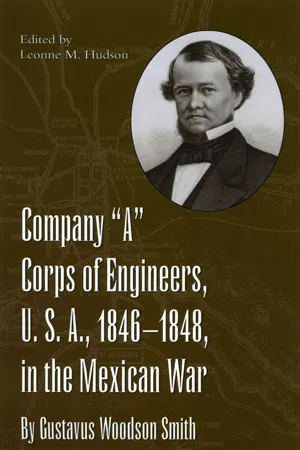
eBook - ePub
Company "A" Corps of Engineers, U.S.A., 1846-1848, in the Mexican War, by Gustavus Woodson Smith
- 120 pages
- English
- ePUB (mobile friendly)
- Available on iOS & Android
eBook - ePub
Company "A" Corps of Engineers, U.S.A., 1846-1848, in the Mexican War, by Gustavus Woodson Smith
About this book
Information

1
Enlistment, Instruction, Detention on the Rio Grande, March to Victoria and Tampico, Landing at Vera Cruz, Death of Captain Swift

In the meantime he had, however, succeeded in persuading the Government at Washington to send—by permission of the Government of France—a selected Captain of the U.S. Engineer Corps to the French School of engineer officers at Metz; for the purpose of having in the U.S. Army, an officer qualified to instruct and command a company of engineer soldiers in case Congress could be induced to authorize the enlistment of such a company.
Captain Alexander J. Swift was the officer selected to be sent to Metz. On his return to the United States, he was assigned to temporary duty at West Point awaiting the long delayed passage of an act authorizing the enlistment of a company of U.S. Engineer soldiers.
That act was passed soon after the commencement of hostilities with Mexico. It provided for the enlistment of an engineer company of 100 men, in the regular army. The company to be composed of 10 sergeants, 10 corporals, 39 artificers, 39 second class privates, and 2 musicians; all with higher pay than that of enlisted men in the line of the army.
Captain Swift was assigned to the command; and, at his request, I was ordered to report to him as next officer in rank to himself. At my suggestion, Brevet Second Lieutenant George B. McClellan, who had just been graduated from the Military Academy, was assigned as junior officer of the company.
At that time I had been an officer of engineers for four years; my rank was that of second lieutenant. All the first lieutenants, and some of the second lieutenants, of that corps were then in sole charge of the construction of separate fortifications, or were engaged in other important duties. Captain Swift was not disposed to apply for the assignment of any of those officers to be subalterns under him in a company of soldiers.
I had taught McClellan during his last year in the Academy, and felt assured that he would be in full harmony with me in the duties we would be called upon to perform under Captain Swift. It is safe to say that no three officers of a company of soldiers ever worked together with less friction. The understanding between them was complete. There were no jars—no doubts or cross purposes—and no conflict of opinion or of action.
In the beginning I was charged with the instruction of the company as an infantry command, whilst the Captain took control of the recruiting, the collection of engineer implements—including an India Rubber Ponton {pontoon} Bridge—and he privately instructed McClellan and myself, at his own house, in the rudiments of practical military engineering which he had acquired at Metz. In the meantime we taught him, at the same place, the manual of arms and Infantry tactics which had been introduced into the army after he was graduated at the Military Academy. In practical engineer drills the Captain was always in control.
After the men were passably well drilled in the “Infantry School of the Company,” the time had come for him to take executive command on the infantry drill ground. He did this on the first occasion, like a veteran Captain of Infantry until “at rest” was ordered.
Whilst the men were “at rest,” McClellan and myself quietly, but earnestly, congratulated him upon his successful debut as drill officer of an Infantry Company. He kindly attributed to our instruction in his house whatever proficiency he had acquired in the new tactics which had then been recently introduced.
But, after the company was again called to “Attention” and the drill was progressing, whilst marching with full company front across the plain, the men all well in line, to my surprise the Captain ordered “faster,” and added “the step is much too slow.” Of course we went “faster.” In a short time the Captain ordered “faster still, the step is very much too slow.” This order was several times repeated, and before the drill ended we were virtually “at a run.”
After the drill was over and the Company dismissed from the parade ground, I asked the Captain why he had not given the commands “quick time” and “double quick,” instead of saying “faster” and “still faster.” He said he did not intend the step should be “quick time”—much less “double quick.” He only wanted the rate to be in “common time—90 steps a minute”; and added: “you had not reached that rate when the drill ended.”
I insisted that he must be mistaken, and told him we were marching in “common time” or very near it, when he first gave the order, “faster.” He persisted that he was right in regard to the rate of the step—said “that he had carefully counted it, watch in hand”; and added: “You were, at the last, not making more than 85 steps to the minute.” I was satisfied that he was mistaken; but he relied implicitly upon the correctness of his count and the accuracy of his watch.
McClellan and I proceeded to the company quarters, of which I still had charge. On the way we referred to the matter of the step, and both of us were at a loss to account for the misapprehension we were sure the Captain labored under in regard to it.
I asked McClellan to take out his watch and count whilst I marched in “common time.” I made 90 steps per minute—and repeated it more than once. It presently dawned upon us that our Captain, whilst consulting his watch, had counted only one foot in getting at the number of steps: and that we were really making 170 steps to the minute when he counted 85. The mystery was solved, the Captain had counted “the left foot” only.
When we next went to his house for instruction in details of the school of the engineer soldier, I asked him how many steps we were making a minute when he first ordered “faster.” He said “about 45.” I replied: “That’s it. We have found out what was the matter. You counted only the left foot. We were marching in ‘common time’ when you ordered us to move ‘faster’; and you pushed us to nearly twice that rate.”
“The cat was out of the bag.” The Captain saw it at once and laughed heartily over the error he had fallen into in the latter part of his “first appearance” as captain, in drilling the company as infantry. He made no such mistake thereafter; and the men never knew of his “count,” watch in hand.
On the 26th of September, 1846, we sailed from New York, 71 rank and file, for Brazos Santiago, under orders to report to General Taylor,2 commanding the U.S. army in Mexico. We landed at Brazos on the 12th of October, remained at that point for several days, proceeded thence to the mouth of the Rio Grande and arrived at Camargo3 on the 2nd of November. There the company was delayed for several weeks because transportation for the engineer train to the headquarters of the Army at Monterey was not then available.
The Company left Camargo for Brazos on the 29th of November, under orders to proceed to Tampico4 by sea, but was ordered to return to Matamoros with a portion of its tools, and march, via Victoria,5 to Tampico—the bulk of its train to be transported to the latter place by water.
Whilst detained at Camargo, instruction in the school of the engineer soldier was kept up, and infantry drills were constantly practiced. During that time several thousand troops were in camp near Camargo, and the men of the engineer company learned that they were, by the line of the army, styled: “the pick and shovel brigade.” Their officers advised them not to care for {object to} this epithet but “take it easy, continue to endeavor to become model infantry, and engraft on that a fair knowledge of the duties of the engineer soldier.” They were assured that “for heavy work,” details {teams} would have to be made from the line of the army; and these details would, for the time, constitute the real “pick and shovel brigade” under the control of engineer officers, assisted by trained engineer soldiers. When the time came for close fighting the engineer company would be at the front.
The troops stationed on the Rio Grande during the fall of 1846 suffered greatly from Mexican diarrhea, fevers and other diseases. Several men of the engineer company died, and Captain Swift and twenty of the men were left in hospital at Matamoros, when the company finally left the latter place.
Before giving an account of our first march in the enemy’s country, it may be well to state here that with two exceptions, the enlisted men of the engineer company were native born, and all but four of them were raw recruits. Each of these four had served, with credit, during one or more terms of enlistment in the regular army. Three of them were promptly made sergeants, and the fourth was a musician (bugler).
All of the recruits but one were very carefully selected material out of which to form, as soon as practicable, skilled engineer soldiers. The one exception was a short, fat, dumpy, Long Island Dutchman—a good cook especially enlisted by Captain Swift to cook for the men. He was given the pay and rank of artificer of engineers. The men looked upon him more as a servant of theirs than as a fellow soldier. He was well satisfied with his position, prided himself on his special duties, rather looked down upon “soldiers”—and was impudent by nature.
All went well enough with the “cook” until he was required to take his place in the ranks, at regular bi-monthly “muster, and inspection” for pay. His performance on that occasion was so grotesquely awkward that I directed he should be put through the “squad-drill” by one of the sergeants, who was a thoroughly competent, but rather severe, drill-master.
The “cook” felt that his rights were invaded, in requiring him to submit to be drilled. The sergeant made no progress in teaching him. After three days’ trial, he reported to me that he was mortified, and ashamed, to have to admit he could do nothing with “that cook”; and he asked to be relieved from the duty of drilling him. In reply to my question: “Can’t you make him obey you?” He replied: “No—the only thing I can do is to kill him”; and added: “When that kind of thing has to be done, in this company, my understanding is, the lieutenant in command is the only one who has the right to kill.”
I relieved the sergeant, and told him I would take the “cook” in hand at the next drill. On the following day, I marched him off into the dense chaparral, on the bottom lands near Matamoros. After following obscure paths, about three miles in their windings through the jungle, I halted him in a small open space a few hundred yards from the company camp. He thought, no doubt, we were five miles from camp—in boundless wilderness—whilst, in fact, we were at no time five hundred yards away.
I told him of the report that had been made to me of his disobedience, informed him that I had brought him into the chaparral for the purpose of compelling him to obey me; called his attention to the fact that we were in the enemy’s country in time of war; all of our lives were in peril, and that persistent disobedience on the part of any officer or soldier to the legal authority of those over him was punishable with death; that I did not propose to place him before a Court Martial but would kill him, if he did not implicitly obey an order I proposed then and there to give him.
I measured 15 paces in front of him and placed a small white chip on the ground, called him to “attention,” ordered him to place his eyes on that chip, and told him if he removed them from it before I gave the command “rest,” I would run him through with my rapier.
I then drilled him at the manual of arms for about 20 minutes. Large beads of perspiration rolled down his face—he began to totter on his feet—and I gave the command “rest.” He had not taken his eyes from the chip.
At the command “rest,” he drew a long sigh of relief and uttered a subdued but prolonged “Oh.” I asked him if he now thought he could obey the sergeant. He replied: “yes, I will obey anybody.”
I told him I would temporarily withdraw what I had said about killing him, and would put him on his good behavior. I drilled him about two hours longer; and then took him, by a circuitous route, through the jungle, back to camp. He was obedient enough thereafter.
When the war had ended and I was relieved from duty with the company, one of the men told me that “the cook,” on his return from the drill I had given him said: “The Lieutenant took me way off, ever so far, in the chapparal, and told me he took me there to kill me if I didn’t mind him. The little devil meant it, and would have done it too, if I had fooled with him like I had done with the sergeant.”
Except this case, of “the cook,” there had been no difficulty in bringing the men of the company to a high standard of drill and discipline as an infantry company, and a reasonable degree of proficiency in the school of the engineer soldier. But, on their first march into the enemy’s country, they were called upon to do an immense amount of hard work not specially referred to in their preliminary instruction.
The March from Matamoros to Victoria and Tampico
By special orders from General Taylor, brought by Major George A. McCall6 to Captain Swift, the latter was charged with the duty of repairing the road from Matamoros to Victoria, and making it practicable for artillery and the baggage train; and to do this, if possible, so that the whole command might make its prescribed daily marches and arrive at Victoria on a named day. Captain Swift was authorized to call upon the commander of the forces, on this march, for such assistance as might be needed to perform the work; and was directed to do no more to the road than was barely sufficient to enable the trains to pass over it. It was not expected that we would ever have occasion to pass through that region again; and it was not proposed to make a permanent road for the benefit of Mexicans.
Captain Swift being sick in hospital, the foregoing instructions were given to me, as Commander of the company, by Major McCall, who, in the capacity of Adjutant-General of the forces under General Patterson,7 accompanied him on this march.
Under orders from General Taylor, the company of engineers, reduced to two officers and forty-five enlisted men for service, marched from Matamoros on the 21st of December, 1846, with a column of volunteers under General Patterson, to join General Taylor’s army at Victoria. We arrived at the latter place on the 4th of January, 1847. A great deal of work had been done by details of volunteers and the engineer company in making the road practicable for artillery and baggage wagons. Without dwelling upon daily operations, the following statement of the manner in which we made our way across a difficult stream may be of interest.
About noon one day I was informed by Major McCall, who had ridden ahead of the working party, that there was an exceedingly difficult “river-crossing”...
Table of contents
- Cover Page
- Halftitle Page
- Title Page
- Copyright Page
- Dedication
- Contents
- Maps
- Introduction
- 1. Enlistment, Instruction, Detention on the Rio Grande, March to Victoria and Tampico, Landing at Vera Cruz, Death of Captain Swift
- 2. Engaged in Operations against Vera Cruz
- 3. After the Surrender of Vera Cruz to the Occupation of Puebla
- 4. From Puebla to Churubusco
- 5. Capture of the City of Mexico
- 6. In the City of Mexico, Return to West Point
- Appendix A: Brief Extracts from Wilcox’s History of the Mexican War (1892)
- Appendix B: Promotions of Enlisted Men of the Company
- Notes
- Bibliography
- Index
Trusted by 375,005 students
Access to over 1.5 million titles for a fair monthly price.
Study more efficiently using our study tools.
Frequently asked questions
Yes, you can cancel anytime from the Subscription tab in your account settings on the Perlego website. Your subscription will stay active until the end of your current billing period. Learn how to cancel your subscription
No, books cannot be downloaded as external files, such as PDFs, for use outside of Perlego. However, you can download books within the Perlego app for offline reading on mobile or tablet. Learn how to download books offline
Perlego offers two plans: Essential and Complete
- Essential is ideal for learners and professionals who enjoy exploring a wide range of subjects. Access the Essential Library with 800,000+ trusted titles and best-sellers across business, personal growth, and the humanities. Includes unlimited reading time and Standard Read Aloud voice.
- Complete: Perfect for advanced learners and researchers needing full, unrestricted access. Unlock 1.5M+ books across hundreds of subjects, including academic and specialized titles. The Complete Plan also includes advanced features like Premium Read Aloud and Research Assistant.
We are an online textbook subscription service, where you can get access to an entire online library for less than the price of a single book per month. With over 1.5 million books across 990+ topics, we’ve got you covered! Learn about our mission
Look out for the read-aloud symbol on your next book to see if you can listen to it. The read-aloud tool reads text aloud for you, highlighting the text as it is being read. You can pause it, speed it up and slow it down. Learn more about Read Aloud
Yes! You can use the Perlego app on both iOS and Android devices to read anytime, anywhere — even offline. Perfect for commutes or when you’re on the go.
Please note we cannot support devices running on iOS 13 and Android 7 or earlier. Learn more about using the app
Please note we cannot support devices running on iOS 13 and Android 7 or earlier. Learn more about using the app
Yes, you can access Company "A" Corps of Engineers, U.S.A., 1846-1848, in the Mexican War, by Gustavus Woodson Smith by Leonne Hudson in PDF and/or ePUB format, as well as other popular books in History & American Civil War History. We have over 1.5 million books available in our catalogue for you to explore.