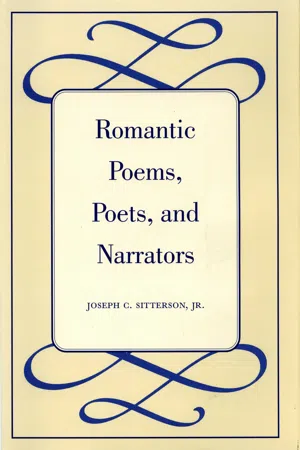
Romantic Poems, Poets, and Narrators will be valuable to specialists not only in romantic period studies but in literary theory and poetics as well. Students of Blake, Coleridge, Wordsworth, and Keats will appreciate these refreshingly subtle, tactful, and convincing new readings of the major romantic poems. The book is a scholarly and engaging guide to the various and complex discourses—formalist, psychoanalytic, deconstructive, new historicist—that have provided the terms in which these poems have been and currently are received.
- 203 pages
- English
- ePUB (mobile friendly)
- Available on iOS & Android
eBook - ePub
Romantic Poems, Poets, and Narrators
About this book
Information

1“Introduction” to the
Songs of Experience
The Infection of Time
Modern criticism of Blake’s “Introduction” to the Songs of Experience reveals in miniature the persistent tendency to simplify, in different ways, the complex subjectivity of Romantic speakers. Some readers set apart the speaker from the author in the name of formalism; others subsume the one in the other in the name of authorial intention. (Still others conceive of a poststructuralist subject so dispersed in and by its contexts that for them the problem of author and speaker seems to disappear. I discuss such a conception later in this chapter, excluding it here in order to clarify the issue of subjectivity in relation to Blake’s poem.) The former simplification retains the poet as omniscient, ironizing the Bard as a deluded prophet to the extent that he is not omniscient. The latter collapses all distinctions between poet and speaker, assuming either a unitary, systematic intention shared by the poet and the Bard, or a divided, confused intention in which the poet is as deluded as his speaker. (We can understand such simplification as the result of our need to master another’s subjectivity; that, however, does not make it any more adequate to such subjectivity than the oversimplifying acts we perform in daily life on others and even ourselves.) Such simplification is not necessarily simple; interpretations on both sides of the “ironic narrator” problem can be subtle and learned. But they tend to be on one or the other side: the Bard is either right or wrong, prophetic or deluded; in Mary Lynn Johnson’s otherwise useful review of interpretations of the Songs of Innocence and of Experience, “the speaker of the ‘Introduction’ is” either “a reliable witness of Experience—prophetic, visionary, and imaginative,” or “authoritarian, error-prone, hypocritical, or worse.”1 Here I do not intend a transcendent third position, whatever that might be. Instead, I shall argue that finally it does make sense to see the Bard in both ways rather than in only one, to say that the Bard can be at the same time right and wrong, about the same things.
To understand the problem, let us look in some detail at how the poem has been read, adhering to Blake’s own well-known principle that “Ideas cannot be Given but in their minutely Appropriate Words.”2 Northrop Frye’s has remained the most important of these readings for several decades.3 It accounts for much more of the poem’s detail than any other reading—seeing it, in accord with Blake’s own apparent aesthetics, as “a Vision; a perfect Whole … in its Minute Particulars; Organized”; it also contextualizes the poem and its speaker persuasively in relation to other Blake poems, and in relation to Frye’s influential Blakean system.4
For Frye the Bard is “in the tradition of the Hebrew prophets, who derive their inspiration from Christ as Word of God, and whose life is a listening for and speaking with that Word” (25).
Hear the voice of the Bard!Who Present, Past, & Future seesWhose ears have heard,The Holy Word,That walk’d among the ancient trees.(E 18)
The first stanza for Frye establishes unequivocally the speaker’s identity as a rightly confident prophet “Who Present, Past, & Future sees” and who therefore transcends “our ordinary experience of time” (24). This transcendence enables the Bard to describe what he hears not as “the voice of the Lord God walking in the garden in the cool of the day” (Genesis 3.8) but, building on John’s identification of Word, God, and Jesus (John 1.1,14), as “The Holy Word, / That walk’d among the ancient trees … in the evening dew.” Like Blake the Bard knows, implies Frye, that “the worst theological error we can make [is] putting God at the beginning of a temporal sequence”; instead, knowing like Blake that “there is no God but Jesus,” he replaces God the Father with Jesus, who “in Paradise Lost,” says Frye, “created the unfallen world, placed man in Eden, and discovered man’s fall” (24–25). It is, then, not just the Bard’s confidence in his own vision (“Hear the voice of the Bard!”) but his typologically transformed allusion that serves as evidence for his prophetic identity.
If the Bard really does understand all this as clearly as Frye his reader, we might ask why he nevertheless addresses Earth not with the Good News of the Gospel (“Jesus supposes every Thing to be Evident to the Child & to the Poor & Unlearned Such is the Gospel” [E 664]) but with this complex—even in Frye’s account—typological reformulation of the Genesis beginning. We might indeed ask why he begins with any version of that biblical book, since God’s words and actions from this point on in Genesis condemn man.
There are additional disquieting details or implications in the Bard’s account, matters that have led other readers to question the degree of his understanding.5
Calling the lapsed SoulAnd weeping in the evening dew;That might controll,The starry pole;And fallen fallen light renew!
The most obvious problem here is syntactical complexity or confusion: who is “Calling the lapsed Soul”? Frye minimizes the problem, with some covert adverbial uncertainty: “‘Calling’ refers primarily to Christ, the Holy Word calling Adam in the garden, and the ‘lapsed soul’ is presumably Adam.” If Christ is “calling,” it must be he who is “weeping”—“the Jesus of the Gospels who wept over the death of man as typified in Lazarus [John 11.35].” While he admits the initial syntactic ambiguity, then, Frye resolves it by merging the speaker and the Holy Word on the basis of Blake’s belief that “there is no God but Jesus, who is also Man”: “calling” can thus refer syntactically both to “the Holy Word” and to “the voice of the Bard” at the same time. “Both the calling and the weeping, of course, are repeated by the Bard; the denunciations of the prophet and the elegiac vision of the poet of experience derive from God’s concern over fallen man” (25).
The stanza raises a second syntactic question: who “might controll, / The starry pole” and “renew” the “fallen light”? Frye is unequivocal: “In the last three lines the grammatical antecedent of ‘That’ is ‘Soul,’” and this “lapsed Soul” he identifies with fallen man, capable of responding to the prophet’s words although not himselfprophetic (25–26). But syntactic ambiguity remains: “That might controll” also parallels “That walk’d among the ancient trees” only three lines earlier; thus it might be the “Holy Word,” not fallen man, “That might controll” and “renew.” Frye avoids the ambiguity, as indeed he must, having conflated Christ and his prophet. It would not make sense, in his argument’s terms, that Christ and his prophet “might controll, / The starry pole,” additionally because accepting this ambiguity would also conflate prophet and fallen man—in which case, how would the two differ, and what grounds would we have for believing the one to be authentically prophetic and the other wrong, or at least mired in Experience? If this poem is “an introduction to some of the main principles of Blake’s thought” (23), then this last question’s implied skepticism has radical implications not only for how Blake’s speaker understands Blake’s system but for how we and Blake understand it.6
Here is one way of putting the problem. If the Bard is alluding only to the Old Testament (as overtly he seems to be doing, since the clear allusion is to Genesis 3), the Bard seems to be asserting Blake’s negative father-priest-king concept of divinity, and we should be careful about believing what he claims and says, since his vision is at least partly mistaken, whatever its truth to experience. To the extent that the Bard is alluding to the New Testament Christ who weeps for man’s sin, the Bard is asserting Blake’s vision as Frye describes it and is not being ironized. If both allusive contexts come into play, the function of allusion here becomes complex, irreducibly so in terms of the text alone, in fact reducible only by choices for which we as readers are responsible. In the typological terms that most readers of the poem assume Blake to have adopted, to what extent can we gain a New Testament perspective on an Old Testament story of generation?
But the question needs to be rephrased. Typology for Blake does not provide a stable basis for interpretation. Frye’s “tradition of the Hebrew prophets, who derive their inspiration from Christ as the Word of God,” may have become paradigmatic for how we understand the narrators in Blake’s longer poems, but this “tradition” is a problem: “prophet” is not necessarily a fixed state of self, inevitably reliable in its understanding of self or world, in Blake or in the Bible. That is, “prophecy” may be as much of a human problem as it is a generic solution for reading both texts—indeed it is already a problem in Frye’s conflation of Old and New Testament prophecy. Zachary Leader argues that “bard” poses a similar problem: its link with both prophecy and Druids “associate[s it] not only with antiquity, poetic high-seriousness, and prophecy, but with a Dark Age of religious and military barbarism” (Reading Blake’s “Songs” 139). Blake sometimes distinguishes between the two testaments—“Wherefore did Christ come was it not to abolish the Jewish Imposture … [he was] in opposition to the Jewish Scriptures which are only an Example of the wickedness & deceit of the Jews” (E 614). But he does not consistently oppose them to one another: “The Jewish & Christian Testaments are An original derivation from the Poetic Genius”; “The Old & New Testaments are the Great Code of Art” (E 1, 274; emphasis added). Instead, he distinguishes between reading the Bible, and presumably other texts, as art and reading it as something else. His aphorism “Prayer is the Study of Art” (E 274) suggests his belief in the first kind of reading; his comment on Homer might cause us to rethink our relation to reading for (and his relation to writing for) a unitary system of any kind: “As Unity is the cloke of folly so Goodness is the cloke of knavery Those who will have Unity exclusively in Homer come out with a Moral like a sting in the tail. … It is the same with the Moral of a whole Poem as with the Moral Goodness of its parts Unity & Morality, are secondary considerations & belong to Philosophy & not to Poetry” (E 269–70).
Let the question formerly phrased in terms of New and Old Testament perspectives then be rephrased: To what extent can we gain a different perspective on Experience than that of an ironized Bard, with whom we are mired in Experience? We shall need eventually to apply this question to Blake as well as to his speaker and to ourselves. For now, I am arguing that it is inadequate to the poem’s complexity of viewpoint and understanding to reduce it, and our role as readers of it, to one of the following situations: either the Bard possesses fully and securely a prophetic vision, and our responsibility as readers is to attain his level of understanding; or the Bard is radically mistaken, a limited prophet deluded into taking Experience (and the father-priest-king God of the Old Testament) as the limits of reality, and our responsibility as readers is to understand the ways in which he is ironized and his partial vision undermined by Blake, whose superior understanding we come to share. Instead, we might see a Bard who is striving for prophetic insight, who is claiming it with a rhetoric that may or may not match the depth of that insight, but whose vision is complex and uncertain enough to call into question the adequacy of—not invalidate—that insight.
Harold Bloom was the first (and until Leader the only) reader to characterize the Bard in this way. “This Bard of Experience has considerable capacity for vision, and has much in common with Blake, but he is not Blake, and his songs are limited by his perspective”; he is “capable of imaginative redemption [but] still stand[s] in need of it.” (Despite his momentary insight, Bloom both distances Blake in his omniscience from the Bard and identifies himself with that omniscience as reader, able to know which songs have as their speaker the Bard, which have “various other Redeemed speakers,” and which have Blake himself, where “he allows himself a full Reprobate awareness.”)7 We must see the Bard as someone striving for prophetic understanding, partly caught within his culture and therefore partly caught between two readings of the human condition, that is, two cultural conceptions of humanity’s relation to divinity: child-worshipper-subject to father-priest-king, and adult to Christ, or adult to oneself, understanding and taking responsibility for the universality of one’s own image of deity that does not impinge on another’s subjectivity.

If Blake is right that his readers stand in the same need of imaginative redemption as his Bard, then we must apply Bloom’s insight more rigorously than does Bloom himself to the Bard and to Blake—and to ourselves, unless we are to assume that omniscience we so quickly grant the poet. This does not mean that we give up trying to understand Blake’s poems on the grounds that, after all, we too are mired in Experience and might as well live with our confusion. It does mean that we try to become more self-aware as readers—specifically, that we recognize truths or readings that do not fit our masterful interpretive structures, while at the same time recognizing that we must create or at least work within such structures if we are to know anything at all.8
Blake recommends as much, when he writes, “The wisest of the Ancients consider’d what is not too Explicit as the fittest for Instruction, because it rouzes the faculties to act,” and adds, “What is it sets Homer Virgil & Milton in so high a rank of Art. Why is the Bible more Entertaining & Instructive than any other book. Is it not because they are addressed to the Imagination which is Spiritual Sensation & but mediately to the Understanding or Reason” (E 702–3. Because Blake is writing here to John Trusler—“falln out with the Spiritual World” [E 702] and, says Blake to George Cumberland, in that “Class of Men” that Blake “despair[s] of Ever pleasing” [E 703]—he may be modifying his real opinions. But the rest of his letter evidences no such compromise.) In this context I take Understanding or Reason to be what produces masterful interpretive structures, Urizen’s “solid without fluctuation” (U 4.11; E 71), and I emphasize that Blake does not deny that the greatest art appeals to reason. He wants to awaken human faculties, of which reason is one. It may take another faculty than reason to recognize reason’s limits, but without reason’s attempts to master the world and its texts, we cannot articulate the very structures whose limitations we must discover.
My emphasis on how we read the “Introduction” thus is not just an attempt at hermeneutical accommodation. It also reflects Blake’s educative poetics and his likely sense of his audience. This reflection can be corroborated if we extrapolate from Heather Glen’s contextualizing of Blake’s Songs in its time.9 Glen shows that Blake chose his genre because it was popular, “aim[ing the Songs] at a known (and growing) market of parents from the polite classes” (9), and at the same time because in that genre “real imaginative life (albeit of an ephemeral, sensationalistic kind) was consistently being subordinated to ‘instructive’ purposes” (14)—purposes that Blake continually “worked to frustrate” (17). “Blake is using the form of the late eighteenth-century child’s song not as a vehicle for ‘ideas’ counter to those which it usually expresses, but in order to expose and subvert that whole mode of making sense of the world which it characteristically embodied” (18). By doing so, Blake “celebrates indiv...
Table of contents
- Cover Page
- Halftitle Page
- Title Page
- Copyright Page
- Dedication
- Contents
- Acknowledgments
- Introduction
- 1. “Introduction” to the Songs of Experience: The Infection of Time
- 2. The Rime of the Ancient Mariner: Distinguishing the Certain from the Uncertain
- 3. The Prelude: Still Something to Pursue
- 4. The Intimations Ode: An Infinite Complexity
- 5. Lamia: Attitude Is Every Thing
- Conclusion
- Notes
- Works Cited
- Index
Trusted by 375,005 students
Access to over 1.5 million titles for a fair monthly price.
Study more efficiently using our study tools.
Frequently asked questions
Yes, you can cancel anytime from the Subscription tab in your account settings on the Perlego website. Your subscription will stay active until the end of your current billing period. Learn how to cancel your subscription
No, books cannot be downloaded as external files, such as PDFs, for use outside of Perlego. However, you can download books within the Perlego app for offline reading on mobile or tablet. Learn how to download books offline
Perlego offers two plans: Essential and Complete
- Essential is ideal for learners and professionals who enjoy exploring a wide range of subjects. Access the Essential Library with 800,000+ trusted titles and best-sellers across business, personal growth, and the humanities. Includes unlimited reading time and Standard Read Aloud voice.
- Complete: Perfect for advanced learners and researchers needing full, unrestricted access. Unlock 1.5M+ books across hundreds of subjects, including academic and specialized titles. The Complete Plan also includes advanced features like Premium Read Aloud and Research Assistant.
We are an online textbook subscription service, where you can get access to an entire online library for less than the price of a single book per month. With over 1.5 million books across 990+ topics, we’ve got you covered! Learn about our mission
Look out for the read-aloud symbol on your next book to see if you can listen to it. The read-aloud tool reads text aloud for you, highlighting the text as it is being read. You can pause it, speed it up and slow it down. Learn more about Read Aloud
Yes! You can use the Perlego app on both iOS and Android devices to read anytime, anywhere — even offline. Perfect for commutes or when you’re on the go.
Please note we cannot support devices running on iOS 13 and Android 7 or earlier. Learn more about using the app
Please note we cannot support devices running on iOS 13 and Android 7 or earlier. Learn more about using the app
Yes, you can access Romantic Poems, Poets, and Narrators by Joesph C. Sitterson, Jr.,Joesph C. Sitterson in PDF and/or ePUB format, as well as other popular books in Literature & English Literary Criticism. We have over 1.5 million books available in our catalogue for you to explore.