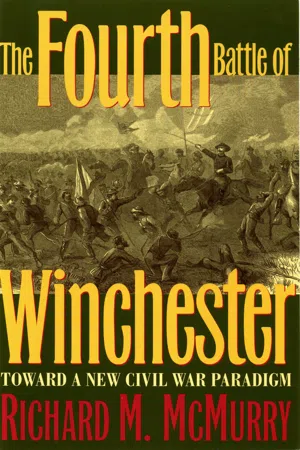
"Counterfactual questions, if kept within the parameters of what was possible at the time and place, can often help us better understand events of the past. In so doing, they can sometimes bring about a 'paradigm shift'—a new way of thinking about history and hence of grasping its meaning... While the events described in the opening sections are fanciful, the underlying points, I believe are valid. The counterfactual events, I hope, can help us see the points with greater clarity."—From the Preface
In the spring of 1864, at the beginning of the fourth year of the American Civil War, Lt. Gen. Ulysses S. Grant, recently promoted and placed in command of all Federal armies, planned to launch a five-pronged assault against the Confederacy. Grant hoped that by engaging the Rebels simultaneously on so many fronts and maintaining constant, unrelenting pressure against the secessionists on all of them, he would stretch Confederate manpower and resources to the breaking point; achieve success somewhere; and, by converting that success into a great victory, bring about the collapse of the rebellion.
Two of Grant’s proposed assaults on Rebeldom could be described as major operations; three as relatively minor undertakings. Since any one of the five that achieved success could be exploited to bring about final victory, it really did not matter where the success came. Each of the five campaigns had the potential to become the decisive operation that snuffed out the South’s bid for independence. Conversely, the Confederacy had to win—or at least to avoid defeat—everywhere to preserve its hope for nationhood. For the Rebels, to lose anywhere in 1864 would be to lose all.
One of the minor Union operations, commanded by Maj. Gen. Benjamin F. Butler, was to be launched up the James River in southeastern Virginia against the Richmond-Petersburg area. A second, under Maj. Gen. Franz Sigel, involved a thrust into the northern Shenandoah Valley in western Virginia. Maj. Gen. Nathaniel P. Banks was to lead the third minor operation, moving eastward from New Orleans (occupied by Northern forces in April 1862) against Mobile, Alabama, the Confederacy’s last important port on the Gulf of Mexico.
The major efforts were to take place in east-central Virginia and in North Georgia. In the former operation, Grant himself would direct the Army of the Potomac as it moved against the Army of Northern Virginia commanded by Gen. Robert E. Lee. (Technically, Maj. Gen. George G. Meade commanded the Army of the Potomac, but Grant would be present with it, control its operations, and issue—through Meade—the orders for its movements.) Grant entrusted the Federal forces invading North Georgia to his good friend and favorite subordinate Maj. Gen. William T. Sherman.
Each of the three lesser campaigns quickly met with failure as the Southerners won convincing victories over Banks along the Red River in Louisiana, over Butler at Bermuda Hundred along the James River below Richmond, and over Sigel at New Market in the Shenandoah Valley. By mid-May, Grant’s great five-pronged offensive had been reduced to the operations directed by himself and Sherman.
After a long, bloody summer, Sherman finally won the major victory that the Federal cause needed when he forced the Rebels to evacuate Atlanta, Georgia, during the night of September 1–2. Sherman’s triumph touched off massive rejoicing by unionists everywhere and appeared to be the great success that would soon result in the reelection of President Abraham Lincoln, a complete national triumph, an end to the war, the abolition of slavery, and the restoration of the Union.
While Sherman and his troops maneuvered and fought their way across North Georgia to capture Atlanta, Grant and the Yankees in Virginia experienced a quite different fate in their great struggle against Lee. Through May and June the two armies clashed in a series of titanic battles in the Wilderness, at Spotsylvania Court House, on the North Anna River, at Cold Harbor, and along the lines of massive fortifications that quickly sprouted from the ground in front of Richmond and Petersburg.
Through mid-June, when Grant reeled back in defeat from his first assaults on the Petersburg trenches, he had lost a total of about 65,000 men. His army—its offensive capability greatly weakened, if not destroyed—found itself bogged down before the very strong Confederate earthworks protecting the Rebel capital and Petersburg. Lee, in fact, felt so secure in his great fortifications that in mid-June he detached a large part of his army under his most capable subordinate, Lt. Gen. Jubal A. Early, and sent it west to defend Lynchburg, where a new Union force had appeared.
Lee hoped that Early and his troops could drive away the unionists who menaced Lynchburg. They could then clear the area of all remaining Yankee forces, enter the Shenandoah Valley, secure the region’s rich summer crops for the Southerners, alarm and demoralize the people of the North, and perhaps even compel Grant to detach troops from his army before Richmond and Petersburg and send them off to the Valley after Early. Such detachments would weaken the Union forces facing Lee. It was the old strategy that the Rebels had used to such good effect in 1862 in similar circumstances.
At first, Early’s success exceeded all of Lee’s expectations. Early and his troops quickly disposed of the Federal forces still in the Valley, marched north, swept across the Potomac River into Maryland, defeated a hastily gathered Northern army on July 9 in the Battle of the Monocacy, and for a few days menaced Washington, D.C. Even President Abraham Lincoln himself briefly came under fire from a few of Early’s men when he paid a visit to some of the capital’s fortifications.
Finding the works that protected the Federal capital too strong to assault, Early soon withdrew to the northern Shenandoah Valley. There he and his army remained—an annoying threat to the North and an embarrassing and irritating thorn in the Yankees’ side. On July 24 Early routed a pursuing Union force in the Second Battle of Kernstown. A week later, to add insult to injury, some of his cavalry burned Chambers-burg, Pennsylvania.
During August, in a belated effort to deal with the enormous military and political problems stemming from Early’s presence in the lower Shenandoah Valley, Grant and Federal authorities created the “Middle Military Division” and placed it under the command of Maj. Gen. Philip H. Sheridan, formerly head of the cavalry forces in the army with Grant.1
Sheridan’s force totaled about 48,000 troops. His most important units were the Sixth Corps, under Maj. Gen. Horatio G. Wright, sent from Grant’s lines in front of Richmond; two divisions of the Nineteenth Corps commanded by Maj. Gen. William H. Emory that had been in Louisiana until brought east and sent to the Shenandoah Valley; and some of the Union forces that had been operating in the western Virginia—West Virginia area (the Army of West Virginia, sometimes designated the Eighth Corps) under Brig. Gen. George Crook. Sheridan’s field command—the Army of the Shenandoah—also included a three-division cavalry corps, commanded by Brig. Gen. Alfred T. A. Torbert.
As the strength of Sheridan’s army increased, Lee raised the stakes in the Shenandoah Valley, dispatching reinforcements to Early from the Rebel lines at Richmond and Petersburg. These additions to Early’s Army of the Valley brought Confederate strength in the area up to about 18,000 men.
Sheridan and Federal authorities, however, believed that Early commanded perhaps twice that number of troops. For that reason, and also because Northern officials did not want to chance a large-scale defeat with the crucial fall elections looming in October and November, Sheridan received instructions not to risk another setback. For five weeks, therefore, no serious fighting took place in the Valley. Sheridan and Early limited themselves to cautious actions, sparring occasionally with each other, but neither general willing to bring on a major engagement.2
In mid-September, Lee called some of Early’s men back to the lines at Richmond. When Rebecca Wright, a Quaker schoolteacher in Winchester who doubled as a Union agent, sent word to Sheridan that troops had left Early’s army, the Federal commander concluded that the time had come to strike.
Early—perhaps lulled into overconfidence by his foe’s recent inactivity—had foolishly scattered his army. On September 19, in the Third Battle of Winchester, Sheridan pounced upon, overpowered, and routed the outnumbered Confederates. Three days later Sheridan’s troops caught up with Early’s men at Fisher’s Hill some twenty miles south of Winchester and administered a second sound drubbing to the Rebels. Indeed, only some very bad generalship on the part of Sheridan’s cavalry commander allowed the Southerners to escape from Fisher’s Hill and continue their flight southward.3
After this great victory Sheridan pushed south up the Valley to Harrisonburg. Then, concluding that he had finally disposed of the pesky Early, the Yankee commander began to shift his troops back toward Winchester in the lower Valley, laying waste to the countryside as he went so that, he hoped, the area could not again provide sustenance for a Confederate army. Because he reasoned that no more serious fighting would occur in the Shenandoah Valley, Sheridan thought the time had come to return most of the Army of the Shenandoah to Grant’s main force for the continuing operations against Richmond and Petersburg.4
Early and the Army of the Valley, however, were far from finished. After the debacle at Fisher’s Hill, Lee returned to Early the troops whose departure had triggered Sheridan’s September offensive. As Sheridan pulled his force back to the north, the crafty Rebel commander followed at a distance with his reinforced army.
On October 9 Early’s cavalry, which had gotten too far ahead of its infantry support, ran into a large force of Federal horsemen at Tom’s Brook near Fisher’s Hill. The Yankees chased the Rebel cavalrymen back up the Valley for more than twenty miles (an episode known as the “Woodstock Races” in the annals of Sheridan’s mounted force). The bulk of the Union army, however, continued its slow march northward. Early followed.
By October 13 Sheridan had his unionists in camp north of Cedar Creek and south of Middletown. Early’s Confederates—infantry included now—lurked only a mile or so to the south. Skirmishing over the next several days revealed to the Yankees the presence of a fairly large Southern force. Soon, however, Early pulled back southward to the Fisher’s Hill area. Sheridan still thought that the Rebels in the Valley constituted no serious threat to his command.
Meanwhile, a disagreement had arisen between Sheridan and his superiors over the future employment of the Army of the Shenandoah. The Federal authorities summoned “Little Phil” to Washington to confer about the matter. Firmly convinced that the soundly whipped Early would remain passive, Sheridan departed for the national capital late on October 15. Maj. Gen. Horatio G. Wright assumed acting command of the army; Brig. Gen. James B. Ricketts ascended temporarily to the head of the Sixth Corps.5
When Sheridan departed for Washington, he left his army camped in the wide angle formed by the North Fork of the Shenandoah River on the east and Cedar Creek to the south and west. The creek flows generally from northwest to southeast and joins the river, which along that stretch flows from southwest to northeast.
The macadamized Valley Pike ran west of the river from Fisher’s Hill north through Strasburg and then crossed Cedar Creek a mile or so above (west of) that stream’s junction with the river. At the point where it crossed the creek, the pike ran from southwest to northeast, but a short distance north of the creek, the road bent to the north and ran on to Middletown, whence it continued northward down the Valley.
Along its lower stretches, Cedar Creek was about thirty yards wide and flowed between steep banks. Several fords on the lower section of the creek and others along the river near the creek’s mouth offered points at which to cross those streams; Middletown lay about two miles from the point where the pike crossed the creek. Meadow Brook ran from north to south to the west of and parallel to the pike to join Cedar Creek about three-fourths of a mile above the point where the pike crossed the creek.
Sheridan had posted most of his cavalry on the far right (west) of his position, and he stationed the Sixth Corps between the cavalry and Meadow Brook. In the highly unlikely event that Early dared initiate aggressive action, Sheridan assumed that the Rebel effort would come from the more open area to the west. For that reason, he posted the Sixth Corps, his best and most experienced unit, where it could most easily meet such an assault. The Nineteenth Corps and the Army of West Virginia held the ground from Meadow Brook eastward toward the river. Ridges that ran across the whole area separated the Federal camps and would make it difficult for the various units to support each other in the event of battle.6
On the afternoon of October 17, some of Early’s subordinate commanders along with his topographical engineer Jedediah Hotchkiss climbed to the northern end of Three Top (or Massanutten) Mountain, from which they could examine Sheridan’s position north of Cedar Creek. (Arthritis kept Early himself from making the trek.) From their lofty observatory, Maj. Gen. John B. Gordon, Hotchkiss, and the others studied the Yankee camps spread out on the far side of the river. The Rebel observers soon saw that the left (eastern) flank of the Union position was vulnerable to attack and realized that Sheridan had presented the Confederates with a golden opportunity to strike a blow that might reverse the tide that had been running against them in the Valley since mid-September. The Southern officers could scarcely contain their glee as they made their way back down the mountain.7
Early, an often gruff man who sometimes had great difficulty listening to his subordinates and accepting suggestions from them, proved surprisingly receptive to the proposal brought to him by Gordon, Hotchkiss, and the others. At a long conference on the following day, he and his chief lieutenants hammered out the details of their plan. Gordon, with the bulk of Early’s little army, would make a night march, cross the river, follow a “pig’s path” along the northern nose of the mountain, cross back to the left bank of the river below (north of) its junction with Cedar Creek, deploy, and at 5:00 A.M. on the nineteenth launch an assault against the weak eastern side of the Yankee position.
At the same time, most of the remaining units of the small Confederate army, the most important of which was the infantry division of Maj. Gen. Joseph B. Kershaw, would cross Cedar Creek near the Valley Pike and assail the Federals from the south. Rebel cavalry would be on either flank of the attacking force.
Early entrusted what turned out to be the key part of his battle plan to the small infantry division (three Virginia brigades) of Brig. Gen. Gabriel C. Wharton. While Gordon and Kershaw attacked the Yankees from the east and south, Wharton’s three brigades, followed by a battalion of artillery, were to march northward along the Valley Pike, passing behind the attacking units as they pushed the enemy off to the west, and seize the road at and north of Middletown. Since the pike there commanded the ground to the west and south, control of the road at M...
Table of contents
Cover Page
Halftitle Page
Title Page
Copyright Page
Dedication
Contents
Acknowledgments
Preface
Part One: The Fourth Battle of Winchester
Part Two: Other Inconsequential Engagements
Part Three: Meanwhile
Part Four: The Big Picture
Part Five: Implications
Part Six: Robert E. Lee and the Confederacy’s Conduct of the War
Part Seven: Conclusions
Index
Trusted by 375,005 students
Access to over 1.5 million titles for a fair monthly price.
Study more efficiently using our study tools.
Frequently asked questions
Yes, you can cancel anytime from the Subscription tab in your account settings on the Perlego website. Your subscription will stay active until the end of your current billing period. Learn how to cancel your subscription
No, books cannot be downloaded as external files, such as PDFs, for use outside of Perlego. However, you can download books within the Perlego app for offline reading on mobile or tablet. Learn how to download books offline
Perlego offers two plans: Essential and Complete
Essential is ideal for learners and professionals who enjoy exploring a wide range of subjects. Access the Essential Library with 800,000+ trusted titles and best-sellers across business, personal growth, and the humanities. Includes unlimited reading time and Standard Read Aloud voice.
Complete: Perfect for advanced learners and researchers needing full, unrestricted access. Unlock 1.5M+ books across hundreds of subjects, including academic and specialized titles. The Complete Plan also includes advanced features like Premium Read Aloud and Research Assistant.
Both plans are available with monthly, semester, or annual billing cycles.
We are an online textbook subscription service, where you can get access to an entire online library for less than the price of a single book per month. With over 1.5 million books across 990+ topics, we’ve got you covered! Learn about our mission
Look out for the read-aloud symbol on your next book to see if you can listen to it. The read-aloud tool reads text aloud for you, highlighting the text as it is being read. You can pause it, speed it up and slow it down. Learn more about Read Aloud
Yes! You can use the Perlego app on both iOS and Android devices to read anytime, anywhere — even offline. Perfect for commutes or when you’re on the go. Please note we cannot support devices running on iOS 13 and Android 7 or earlier. Learn more about using the app
Yes, you can access The Fourth Battle of Winchester by Richard McMurry in PDF and/or ePUB format, as well as other popular books in History & American Civil War History. We have over 1.5 million books available in our catalogue for you to explore.