- 72 pages
- English
- ePUB (mobile friendly)
- Available on iOS & Android
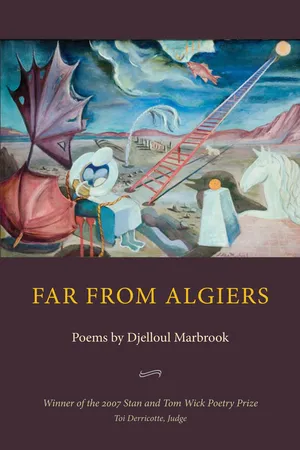
Far From Algiers
About this book
"How honored I amâhow luckyâto have been able to choose this superb first book by Djelloul Marbrook that honors a lifetime of hidden achievement.... Sometimes the poems seem utterly symbolic, surreal; they are philosophical, historical, psychological, political, and spiritual. The genius is in the many ways these poems can be read. I kept being rewarded by new awarenesses of the poet's intentions, by the breadth and scope of the manuscript. As I read, I felt more and more that it was impossible that this was a first book. It seemed the writer knew exactly what to say, and, more importantly, exactly what to leave out."
âToi Derricotte, judge
"In a dizzying and divisive time, it's beautiful to see how Djelloul Marbrook's wise and flinty poems outfox the Furies of exile, prejudice, and longing. Succinct, aphoristic, rich with the poet's resilient clarity in the face of a knockabout world, Far from Algiers is a remarkable and distinctive debut."
âCyrus Cassells
"Djelloul Marbrook, 'a highly skilled outsider, ' bursts into poetry with this splendid first book, which brings together the energy of a young poet with the wisdom of long experience."
âEdward Hirsch
Djelloul Marbrook started writing poems in Manhattan when he was fourteen. In his thirties he abandoned poetry after publishing a few poems in small journals, but he never stopped reading and studying poetry. Then at age sixty-seven, appalled by the 9/11 terrorist attacks, the poet within awakened. Stuffing sky-blue notebooks in his pockets, Marbrook began walking around Manhattan determined to affirm his beloved home in the wake of the nihilistic attacks. Far from Algiers emerged from hundreds of poems he has composed in the years since.
Marbrook's voice speaks to anyone who has ever had doubts about belonging. Born in Algiers to an American artist and a Bedouin father and arriving in America as a gravely ill infant, Marbrook has contemplated this issue throughout his life. Far from Algiers explores "belonging" in a society that is in denial about its own nativist sentiments. It speaks of the struggle to belong in a culture that pays lip service to assimilation but does not fully accept anyone perceived as "foreign." Marbrook examines this issue with unflinching honesty. Anyone rejected by a family member or neighbor or coworker will relate to these well-crafted and moving poems.
Frequently asked questions
- Essential is ideal for learners and professionals who enjoy exploring a wide range of subjects. Access the Essential Library with 800,000+ trusted titles and best-sellers across business, personal growth, and the humanities. Includes unlimited reading time and Standard Read Aloud voice.
- Complete: Perfect for advanced learners and researchers needing full, unrestricted access. Unlock 1.4M+ books across hundreds of subjects, including academic and specialized titles. The Complete Plan also includes advanced features like Premium Read Aloud and Research Assistant.
Please note we cannot support devices running on iOS 13 and Android 7 or earlier. Learn more about using the app.
Information
CLIMATE CONTROL
against my attempts to insert
flat evidence of my belonging here.
as I am of wanting to be heard.
I was born with one of those faces that say
Bad enough listening to myself,
who needs you to confirm the news?
the fruit expected of your tree
and I see you have no patience for experiment.
in the natural course of an alien life,
so why would I quarrel with locked doors?
BITCHY NURSE
(Algiers, August 12, 1934)
if this isnât how I talk to me,
that leaves the little bastard
who started tagging along
after my cold welcome in Algiers.
the kid needed milk and a name.
A little welcome would be nice,
but she kept that to herself
because they were distracted
the cliché the three of them
had painted on the world,
red and squawking graffiti
never meant to be foreground.
is an understudy bound
by the uninspired script.
I donât encourage them because
Iâve heard what they have to say.
listening as if someone
has something to say.
DJELLOUL
I invite you to notice that
is the sound of deportation.
Is quarantine necessary?
Wouldnât exile be better?
but a spurt in thoughtless dark:
youâve nowhere to send me.
the difference? The difference is that
itâs Arabic with French panache.
Terrorists bear the name, scientists
and singers, and a few cashiers
because theyâve turned their battlements
into condominia of hope.
The name of a Saracen lancer
ghosting in the dusk of Provence
and the name of a citizen deported
a thousand times a year.
FAR FROM ALGIERS
ethnographer and xenophobe,
roiling bowels and hackles,
electrifying space.
about our overlords;
we know weâre an underclass
to these corsairs and otherlings.
take our wives and children,
foul our consensus with ideas
and scat full sail on glassy seas.
theyâre unwelcome in our churches;
they profane our certainties
and stir up gifts renounced.
is a Barbary where our rules
stand on their heads and dance
to tunes of turbans and scimitars.
itâs far too late and weâre engaged
in the kind of bloodiness youth
prays for to spite the social good.
guards against kidnappers,
every complacency has its dey
fat on ransom in some Algiers.
to haunt our dreams and genes
weâd eat potatoes, bed our cousins
and be as...
Table of contents
- Cover
- Title
- Copyright
- Dedication
- Contents
- Acknowledgments
- Foreword
- 1
- 2
- 3