- 340 pages
- English
- ePUB (mobile friendly)
- Available on iOS & Android
eBook - ePub
About this book
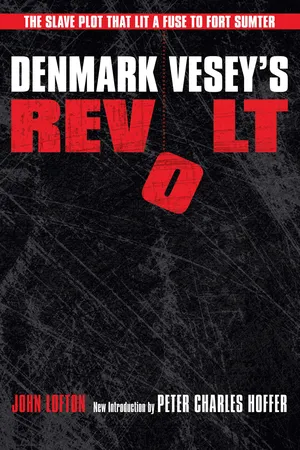
In 1822, Denmark Vesey was found guilty of plotting an insurrection—what would have been the biggest slave uprising in U.S. history. A free man of color, he was hanged along with 34 other African Americans in Charleston, South Carolina, in what historians agree was probably the largest civil execution in U.S. history. At the time of Vesey's conviction, Charleston was America's chief slave port and one of its most racially tense cities. Whites were outnumbered by slaves three to one, and they were haunted by memories of the 1791 slave rebellion in Haiti. In Denmark Vesey's Revolt, John Lofton draws upon primary sources to examine the trial and provide, as Peter Hoffer says in his new introduction, "one of the most sensible and measured" accounts of the subject. This classic book was originally published in 1964 as Insurrection in South Carolina: The Turbulent World of Denmark Vesey, and then reissued by the Kent State University Press in 1983 as Denmark Vesey's Revolt: The Slave Plot That Lit a Fuse to Fort Sumter.
Information
1
A KEY PORT

• The sloop Warwick was an insignificant vessel even by eighteenth century maritime standards. And her commander was hardly a man who in that day would have attracted much attention. But when the Warwick sailed into the harbor of Charleston, South Carolina, on a mid-summer day in 1770, the little ship was helping to link that city to a fortuitous destiny. She was taking her master, Captain Joseph Vesey, on the first leg of a trading route which, through his instrumentality, would have a portentous bearing on the history of the South Carolina port and indirectly on the history of the nation.
In the early days of the American nation port cities located at points where rivers met the sea were naturally key centers of cultural and mercantile commerce. Linked to the interior by the most convenient mode of transportation and to the transoceanic world by the only means of contact, ports were much more vital conduits in the exchange of commodities and ideas than are trading centers in an age of multiple methods of movement and communication. There were only a few such cities in eighteenth century America. Charleston was one of them. As late as 1774 an English visitor said, after a tour of the United States, that in all the southern states Charleston was the only town worthy of notice.1
Captain Vesey was not then a Carolinian. He was a Bermuda islander. But in the period 1770-1775 his real home was the sea, as he commanded a series of no less than five vessels and conducted a lively shipping business between trading points ranging from Carolina to Barbados, a distance of some 1,900 miles. Charleston during these years was one of his regular ports of call.2
As a Bermuda islander, Captain Vesey had chosen the calling which attracted most of the inhabitants of that British colony during his day. The Bermudians in this period built sloops and brigs—as many as sixty in one year—and sold them in the West Indies or North America. Along with the occupation of ship-building went that of navigation. From eighty to a hundred Bermuda vessels were constantly at sea, each manned by a skeleton crew of two whites and four Negroes. In this way fully half of the able-bodied men of the islands became expert mariners. Though some of the ships were owned by their captains, a good many were the property of the better-off Bermudians, who employed the crews. In the case of the Vesey family, several members were masters of vessels which had been acquired as prizes.3
During the early months of the year Bermuda’s maritime traders often repaired to the Tortugas and to Turks Island. (The latter especially was one of Joseph Vesey’s rendezvous.) Here the Bermudians raked salt for sale to passing American vessels or for use as cargo. And from these points they would proceed to South Carolina or Virginia in search of corn, or to Philadelphia or New York in order to exchange their salt or money for such necessities as salt pork, beef, flour, peas, lumber, and candles. Some of the islanders sailed directly home from the continent, while others proceeded to the sugar islands and disposed of their American merchandise there for cash. They reserved part of their receipts for new cargoes to the mainland and put the rest into bills of exchange to be used for purchases in England. By these means Bermudian mariners made a living, and some of them became wealthy.
It may have been on one of his early visits to Charleston that Captain Vesey first considered how he would settle down from the rigorous life of a mariner. A month’s visit in port in 1770 gave him ample time in which to view the town as a place to secure permanent moorings.4
Charleston in 1770 was the fourth largest city of British America, being exceeded in size only by New York, Boston, and Philadelphia. Shipping, of course, was a major business activity in colonial Charleston, since the city was the commercial capital of the South and the port for a vast territory with few other trading outlets. The volume of trade in 1770 was below average, however, because of the colonists’ non-importation policy instituted as a protest against the various tax laws imposed on them by Parliament.
While an embargo on slaves from both Africa and the West Indies was complete during much of the non-importation period, intercolonial commerce between Charleston and the West Indies (except in slaves) continued. Imports from the West Indies included rum, sugar, and molasses. Exports from Charleston to the islands consisted of pine and cypress lumber, cattle, slave provisions, salt meat, and rice. Slave muscles supplied the energy to move these commodities between wharf and ship’s hold.
Lumber or slave provisions probably made up the Warwick’s cargo as she weighed anchor for Turks Island and the Barbados on August 25, 1770. During those intervals before the Revolution when the non-importation policy against slaves was not in effect, Captain Vesey’s cargoes may well have consisted partially or wholly of African slaves picked up at relay points in the West Indies. It is not likely that he hauled West Indian slaves, since the Carolinians were prejudiced against Negroes from places other than the coast of Africa. They believed that slaves from the Spanish colonies incited others to escape, and that slaves from the English colonies were of questionable value because they might have been sent away by the courts for crimes or by their owners for their bad qualities.5
When the slave trade was resumed in full force in 1772, the figures indicate that the number imported from the West Indies was small in comparison to the number coming from Africa. Whatever the source of Captain Vesey’s “merchandise” was, the market in the pre-war years was bringing inflated prices. In May and June of 1773 Captain Vesey could have gotten 350 pounds each for “prime men” in the South Carolina market, and 290 pounds each for “prime women.”6
As the showdown between the American colonies and Great Britain approached, times became more troublous for maritime traders like the Bermuda captain. In the latter part of 1773 and during 1774 protests against Parliament’s tax on tea took the form of dumping tea in the harbor or storing it unused in warehouses. In September 1774 the Continental Congress in Philadelphia adopted an “Association” pledging the colonies to commercial non-intercourse with Great Britain, Ireland, and the West Indies. By this agreement, nonimportation was to take effect after December 1, 1774, and unless grievances were redressed, non-exportation on September 10, 1775. Such strictures would obviously threaten the livelihood of the trading Bermudians.
Captain Vesey could perceive during a visit to Charleston in January, 1775, that serious trouble with Britain was brewing. On January 11 South Carolina’s First Provincial Congress met to hear a report from the colony’s delegates to the Continental Congress at which the non-importation policy had been formulated. After much debate, members of the South Carolina body approved without a dissenting vote the proceedings of the Continental Congress, which included a call for another ban against the slave trade.
When the captain arrived in Charleston in June, 1775, news of the battle of Lexington had reached the city. On August 24, 1775, as Captain Vesey brought the brigantine Rebecca into the South Carolina port, the revolutionary storm was too plain to ignore.7
By early 1775 South Carolina’s accession to the Non-Importation Association had cut off practically all slave imports. The same agreement reduced the value of the total volume of imports from 378,116 pounds sterling in 1774 to a mere 6,246 pounds in 1775. Thus the prospect for West Indies trade could hardly have been encouraging to the Bermuda captain when he sailed into Charleston in the late summer of 1775. In fact, the sickly character of this commerce was attested to by a petition to the House of Commons by the sugar planters of the West Indies, who complained about the American Association and begged for relief because their prosperity depended on free and reciprocal intercourse with the North American provinces.
On September 15, 1775, while the Rebecca was reported windbound in Charleston Harbor, the situation in the colony reached such an explosive point that the royal governor, Lord William Campbell, fled to H.M.S. Tamar lying in Rebellion Road. Though no newspaper took note of her departure,8 the Rebecca presumably sailed when the weather permitted. That was the last sign Charleston had of Captain Vesey until the Revolutionary War was over. He was occupied during the war in supplying the French of St. Domingue with slaves.9
While the uncertain conditions of Carolina trade on the eve of the Revolution led Captain Vesey to transfer his operations farther south, the Bermuda mariner as early as April 15, 1774, had incurred business obligations which called upon him to maintain contact with Charleston. On that date he had signed a bond in which he acknowledged his indebtedness in the sum of 2,400 pounds to Joseph Darell, a Charleston merchant.10 In addition to being the captain’s creditor, Joseph Darell was the owner of his vessel, the Rebecca, a square-sterned, fifteen-ton craft that had been built in Bermuda in 1767. Before what seems to have been a remodeling operation in Charleston during the summer of 1773, the Rebecca had been the sloop Robert.11
The captain’s signature on the bond, whether he intended it or not, symbolized the tying of his destiny to that of the Carolina port. He would be absent for several years of maritime activity before settling in Charleston. But the signature was a public act, presaging other public acts that he would take as a more solid citizen in the years to come. As a man who assumed responsibility, Captain Vesey would become known in the community, and his influence would be exerted in several fields. Through a former slave, his influence was later to be given expression in a way he could hardly have anticipated.
2
SLAVERY
IN THE ISLANDS
• The spotlight of history, in playing back over the personal world of a child slave, cannot focus on details of character and event. By design of its rulers, the captive society in which the child lived offered no outlets for personal expression, no medium for a personal record to be inscribed on. Though the slave might be kindly treated, he was expected to display more of the responsive nature of a draft animal than the individuality of a human being. If the slave was capable of mental creativity, he had less opportunity to register it than even the most lowly members of non-slave society.
Yet in the almost animal environment of slavery, there were cultural forces and accidents of timing that shaped individual characters. Despite the difficulties of narrowing retrospective vision to a well deliniated scene at St. Thomas (Virgin Islands) in 1781, the historian can note that that place and that time were influential in producing a significant individual career. On this West Indian island in this year lived an unknown slave boy whose personality, while it was being ignored by his masters, was inevitably being molded by an impersonal and uncaring world. For want of any record of an earlier name, call the boy “Denmark,” the name he later acquired.
That part of the slave boy’s life story which preceded 1781 remains curtained in mystery. He may have been born of slave parents on the West Indian island of St. Thomas, or he may have been born in Africa and have been brought to St. Thomas as a child.1
In the years immediately preceding 1781 the Danes were bringing about 1,200 Negroes annually to their island colony of St. Thomas.2 Since most of the slave cargoes came from Guinea, it is likely that if the character of Denmark himself was not shaped by the culture of Guinea, his antecedents were a product of this society. The Guinea coast at this time had highly organized kingdoms with well recognized social strata signified by forms of deference and prestige differentials. These were all part of the African native’s experience before he reached the New World. Most of the slaves in the Danish colony in 1767 (the year of Denmark’s birth, according to a later estimate) had been captured in inter-tribal warfare or through some form of treachery. A few had been sold by relatives to satisfy debts. A very few had been sold as punishment for some crime. They came from all levels of the highly stratified African society.3
Upon their arrival in St. Thomas, the Africans were received by the island slaves with an initiation ceremony in which the neophytes were baptized and prayed over in the Congo tongue. They were given several lashes across the back to atone for their sins in Guinea. This ceremony had no relation to religion but was a part of the introduction of the new arrival to a pair of foster-parents or god-parents who would take some responsibility for his adjustment to his new life.
Conditions of life among the slaves of St. Thomas varied according to the nature of their work. Laborers on the plantations lived in crude slave houses which were lined up in rows, with as many as fifty or sixty to the row. These dwellings were primitive huts, their roofs thatched with cane stalks and their walls plastered with mud and cow manure. Each family was allotted a house and a piece of land, which it was expected to till and from which it was supposed to obtain most of its food.
Slaves who were skilled craftsmen—masons, carpenters, coopers, tailors, barbers—and the warehouse workers lived for the most part in the town of Charlotte Amalia. Their quarters gradually grew in the savannahs between the hills on which the town was built. The skilled craftsmen, warehouse workers, and house servants enjoyed much more comfortable circumstances and worked shorter hours than did the field laborers, who were at the bottom of the social ladder in slave society.
In addition to the stratification according to occupation, another division which emerged as the colony grew older was that between slaves born in the West Indies and those newly arrived from Africa. A contemporary St. Thomas observer reported that the West Indian Negro looked with scorn on the African-born, referring to the African by the insulting name of “salt head” and classing him with oxen so far as intelligence went. Because the West Indian Negro was born in the land of the whites, he considered himself, according to the white observer, not only much higher socially than the other but also much cleverer.
There was also a social distinction between the slaves and the free Negroes in the colony. In 1773 “336 free negroes and colored persons”4 were counted in the island’s census. They in all likelihood provided for Denmark’s first contact with free persons of his own race.
To learn the cost of a fight for freedom, young Denmark had only to observe the Danes’ methods of discouraging slave rebels. Their laws for those who aspired to freedom...
Table of contents
- Cover Page
- Copyright Page
- Contents
- New Introduction
- Preface to the Paperback Edition
- Preface
- Introduction
- 1. A Key Port
- 2. Slavery in the Islands
- 3. Slave Life at Sea
- 4. Slave City in a Free Republic
- 5. Burden Bearers in South Carolina
- 6. Seeds of Insurrection
- 7. The Half-Free Community
- 8. Mainstream of Reaction
- 9. Eddies of Revolution
- 10. Preparing the Ground
- 11. The Hour for Revolt
- 12. Rebels On Trial
- 13. The Harvest of Fears
- 14. A Fuse to Fort Sumter
- Notes
- Bibliography
- Index
Trusted by 375,005 students
Access to over 1.5 million titles for a fair monthly price.
Study more efficiently using our study tools.
Frequently asked questions
Yes, you can cancel anytime from the Subscription tab in your account settings on the Perlego website. Your subscription will stay active until the end of your current billing period. Learn how to cancel your subscription
No, books cannot be downloaded as external files, such as PDFs, for use outside of Perlego. However, you can download books within the Perlego app for offline reading on mobile or tablet. Learn how to download books offline
Perlego offers two plans: Essential and Complete
- Essential is ideal for learners and professionals who enjoy exploring a wide range of subjects. Access the Essential Library with 800,000+ trusted titles and best-sellers across business, personal growth, and the humanities. Includes unlimited reading time and Standard Read Aloud voice.
- Complete: Perfect for advanced learners and researchers needing full, unrestricted access. Unlock 1.5M+ books across hundreds of subjects, including academic and specialized titles. The Complete Plan also includes advanced features like Premium Read Aloud and Research Assistant.
We are an online textbook subscription service, where you can get access to an entire online library for less than the price of a single book per month. With over 1.5 million books across 990+ topics, we’ve got you covered! Learn about our mission
Look out for the read-aloud symbol on your next book to see if you can listen to it. The read-aloud tool reads text aloud for you, highlighting the text as it is being read. You can pause it, speed it up and slow it down. Learn more about Read Aloud
Yes! You can use the Perlego app on both iOS and Android devices to read anytime, anywhere — even offline. Perfect for commutes or when you’re on the go.
Please note we cannot support devices running on iOS 13 and Android 7 or earlier. Learn more about using the app
Please note we cannot support devices running on iOS 13 and Android 7 or earlier. Learn more about using the app
Yes, you can access Denmark Vesey's Revolt by John Lofton in PDF and/or ePUB format, as well as other popular books in History & 19th Century History. We have over 1.5 million books available in our catalogue for you to explore.