- 288 pages
- English
- ePUB (mobile friendly)
- Available on iOS & Android
eBook - ePub
About this book
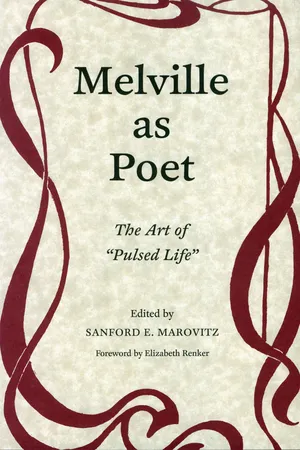
Herman Melville's literary reputation is based chiefly on his fiction, especially Moby-Dick and Billy Budd. Yet he was a gifted poet, as evidenced by his collection of Civil War poems, Battle-Pieces and Aspects of the War (1866), and by his epic-length poem, Clarel (1876), a symbolic rendering of his pilgrimage of 1856–57 to the Holy Land, as well as the two small volumes of poems he published before his death in 1891. Melville as Poet: The Art of "Pulsed Life" opens with an introduction by Sanford E. Marovitz and the late Douglas Robillard on Melville's conception of poetry as a literary form. The essays begin with Dennis Berthold's study of how Melville's observations of art at New York's National Academy of Design in 1865 are reflected in Battle-Pieces, and Mary K. Bercaw Edwards follows, describing how the nautical combat of the ironclads Monitor and Merrimack became a subject of wide contemporary interest in popular culture. The next three essays focus on Clarel. Peter Riley explains how Melville's familiarity with the congestion of Lower Manhattan as a customs inspector influenced his descriptions of Jerusalem. Gordon M. Poole then discusses notable subtleties in Ruggero Bianchi's Italian translation of the poem, and Robert R. Wallace reveals how selected Biblical prints and other graphics familiar to Melville affected the poet's descriptions in Clarel. Melville's John Marr and Other Sailors (1888) is then examined by A. Robert Lee, who emphasizes the themes of memory and death in that small volume, and Sanford E. Marovitz illuminates Melville's method of unifying Timoleon, Etc. by using contrast to bind, not separate. Vernon Shetley compares Melville's "Pausilippo" thematically with Shelley's "Julian and Maddalo," and Michael Jonik explores "The Archipelago" for insights into Melville's experimentation with imagery and form. Finally, Wyn Kelley, Clark Davis, and Robert Sandberg imaginatively examine and reassess poems Melville left unpublished at his death. Melville as Poet is a valuable collection of new and critical scholarship that aims to encourage more and deeper study of Melville's art of poetry.
Information

Index
“Admiral of the White, The” (Melville), 115
“Aeolian Harp, The” (Melville), 104–9
“Afternoon in Naples in the Time of Bomba, An” (Melville): Italian translation of, 88; prose-and-verse writing style, 228, 229–30, 244–46; unpublished status of, 153, 154; voice of, 208–9, 210–13, 215, 218–21, 224
“After the Pleasure Party” (Melville), 130–32, 162, 176, 181
Allom, Thomas, 39, 42
American Risorgimento (Berthold), 93
Anatomy of Melancholy (Burton), 133
“Apparition, The” (Melville), 139–40
“Archipelago, The” (Melville): archipelago as form of writing, 165–68; “art” of, 139; ekphrasis and, 178–81; as “isles of absentees,” 168–73; relation and, 173–77
Aristarchus of Samothrace, 254n38
“Art” (Melville), 126–27, 192
Arvin, Newton, 74
Atlantic Monthly, 29
“At the Hostelry” (Melville): prose-and-verse writing style, 228, 229–30, 244–46; relation and, 178; unpublished status of, 10, 153; voice of, 208–9, 215, 217
“Attic Landscape, The” (Melville), 137, 138, 172–73, 176
Attridge, Derek, 71
“Avant-Garde and Kitsch” (Greenberg), 149–50, 161–62
“Banker, The” (Melville), 43, 45, 59
“Bartleby; or, The Formula” (Deleuze), 166–67
Bartlett, W. H., 40–42, 41
Battle-Pieces (Melville), 9–24; “Archipelago, The” (Melville) compared to, 174; Clarel inspiration and, 36; “Coming Storm, The,” 13–17, 36; “Commemorative of a Naval Victory,” 10, 13, 21; “Formerly a Slave,” 13–14, 17–19, 36; inspiration of, 19–22 (see also National Academy of Design [1865]); “In the Turret,” 22; “Malvern Hill,” 22; “Misgivings,” 21; Monitor and, 29; New Path paintings and, 11–13; non-narrative poems of, 21; “On a Natural Monument in a Field of Georgia,” 21; publication of, 105; “Shiloh,” 11, 22, 199; “Supplement” to, 159, 231; “Swamp Angel, The” 22; title of, 9; “uncollected poems” compared to, 199; voice of, 213–14, 223–24
Bayle, Pierre, 129
Beach, Alfred Ely, 67
“Bell and Cairn” (Melville), 59
“Bench of Boors, The” (Melville), 132
Bench of Boors, The (Tenier), 131
“Berg, The” (Maldive), 105, 120–21
Bergson...
Table of contents
- Cover Page
- Halftitle Page
- Title Page
- Copyright Page
- Dedication
- Contents
- Foreword
- Acknowledgments
- Introduction
- Pictorial Intertexts for Battle-Pieces: Melville at the National Academy of Design, 1865
- Recontextualizing Melville’s: Monitor Poems
- Melville’s Biblical Prints and Clarel
- Urban and Metrical Forms in Clarel
- Clarel in Italy, Italy in Clarel: From Poem to Poema
- A Picture Stamped in Memory’s Mint: John Marr and Other Sailors
- Connecting by Contrast: The “Art” of Timoleon, Etc.
- A Failure to Communicate: Shelley’s “Julian and Maddalo” and Melville’s “Pausilippo”
- “Isles of Absentees”: The Form of the Archipelago in Melville’s Writing
- “Free Robe and Vest”: Melville’s Uncollected Verse
- Melville and the Poetics of Ventriloquism: Giving Voice “At the Hostelry”
- Literary Reprises: Rhetorical Staging and Dramatic Performance in Melville’s Prose-and-Verse Writings
- Contributors
- Index
Trusted by 375,005 students
Access to over 1.5 million titles for a fair monthly price.
Study more efficiently using our study tools.
Frequently asked questions
Yes, you can cancel anytime from the Subscription tab in your account settings on the Perlego website. Your subscription will stay active until the end of your current billing period. Learn how to cancel your subscription
No, books cannot be downloaded as external files, such as PDFs, for use outside of Perlego. However, you can download books within the Perlego app for offline reading on mobile or tablet. Learn how to download books offline
Perlego offers two plans: Essential and Complete
- Essential is ideal for learners and professionals who enjoy exploring a wide range of subjects. Access the Essential Library with 800,000+ trusted titles and best-sellers across business, personal growth, and the humanities. Includes unlimited reading time and Standard Read Aloud voice.
- Complete: Perfect for advanced learners and researchers needing full, unrestricted access. Unlock 1.5M+ books across hundreds of subjects, including academic and specialized titles. The Complete Plan also includes advanced features like Premium Read Aloud and Research Assistant.
We are an online textbook subscription service, where you can get access to an entire online library for less than the price of a single book per month. With over 1.5 million books across 990+ topics, we’ve got you covered! Learn about our mission
Look out for the read-aloud symbol on your next book to see if you can listen to it. The read-aloud tool reads text aloud for you, highlighting the text as it is being read. You can pause it, speed it up and slow it down. Learn more about Read Aloud
Yes! You can use the Perlego app on both iOS and Android devices to read anytime, anywhere — even offline. Perfect for commutes or when you’re on the go.
Please note we cannot support devices running on iOS 13 and Android 7 or earlier. Learn more about using the app
Please note we cannot support devices running on iOS 13 and Android 7 or earlier. Learn more about using the app
Yes, you can access Melville as Poet by Sanford E. Marovitz in PDF and/or ePUB format, as well as other popular books in Literature & Literary Criticism in Poetry. We have over 1.5 million books available in our catalogue for you to explore.