eBook - ePub
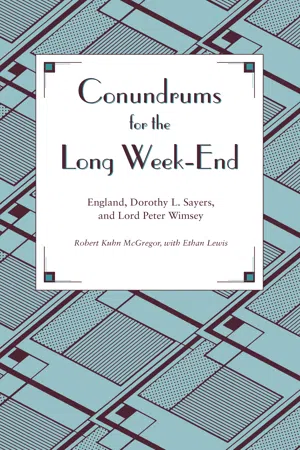
Conundrums for the Long Week-End
England, Dorothy L. Sayers, and Lord Peter Wimsey
- 258 pages
- English
- ePUB (mobile friendly)
- Available on iOS & Android
eBook - ePub
Conundrums for the Long Week-End
England, Dorothy L. Sayers, and Lord Peter Wimsey
About this book
Lord Peter Wimsey-amateur detective, man of fashion, talented musician, and wealthy intellectual-is known to legions of readers. His enduring presence and popularity is a tribute to his creator, Dorothy L. Sayers, who brought Lord Peter to life during "the long week-end" between the First and Second World Wars, as British aristocracy began to change, making way for a modern world. In Conundrums for the Long Week-End, Robert McGregor and Ethan Lewis explore how Sayers used her fictional hero to comment on, and come to terms with, the social upheaval of the time: world wars, the crumbling of the privileged aristocracy, the rise of democracy, and the expanding struggle of women for equality.
Information
Topic
LittératureSubtopic
Critique littéraire1
Lord Peter Begins a Career
LIFE WAS NOT EASY IN 1922. AS AUTUMN DREW TO A DREARY close that November, the British nation clung to a kind of wary optimism, a somber hope of the soul. The Great War was truly over, the troops demobilized. Those who would ever return home had done so. Government efforts to ease the transition to peacetime economy met with some success, though a recent slump threatened troubled times ahead. The political situation remained unclear. Lloyd George had resigned as prime minister, and Bonar Law presided for the moment. The next year would bring still another general election. Abroad, a tolerable postwar climate took shape as Germany and Russia stabilized and the Fascists seized control in Italy. It was not an ideal world by any stretch but one in which Britons could only mend their lives and try to go on.
For Dorothy L. Sayers, life experience reflected the national mood. She was young, talented, cautiously confident of the future, yet beset with all kinds of immediate disappointments. She had just ended a tempestuous and unconsummated love affair with writer John Cournos, a memory that would haunt her for years to come. Six months before, she had taken a new job at S. H. Benson’s, an advertising firm. Not exactly a soul-satisfying position for a woman with an Oxford University education, but more palatable than the teaching and publishing posts she had tried before. Popular writing had now become an outlet. One detective novel, completed and typed twelve months before, made the rounds of publishing houses while she worked steadily at a second. There was no pretension to higher literature here, but the writing was great fun and it might someday pay the bills.
The fictional hero whom Dorothy L. Sayers fervently hoped to present to the public was the product of both the mystery writer’s convention and her own eccentric imagination: Peter Wimsey, an ingenious amateur detective with an unfortunate penchant for blither. More than two years before, Sayers had invented him, a minor character in a Sexton Blake story she never finished. She began to experiment seriously with the detective genre the following year, and by November 1921 she produced the first Wimsey novel, Whose Body? The book finally saw publication in May 1923.
Sayers set the novel in the bleak London of November, presumably in 1922. Although this was to be the first actual public glimpse of Lord Peter, she presented him as a man with a complicated (if largely unwritten) past. The “Battersea Park Mystery” detailed in Whose Body? is far from being Wimsey’s first case. He has already undertaken enough major investigations to acquire close friends and bitter enemies among the official police. He is also brittle and impenetrably defensive in manner, the consequence of a love affair only barely suggested in the text. One more component is enmeshed in the Wimsey character: his experience as a frontline officer in the Great War. Lord Peter, the reader eventually learns, is a victim of shell shock.
To arrive at this first incarnation of Wimsey, the blithering young ass of November 1922, we must pursue elements of two separate but related natures: the recent history of England and the history of Dorothy L. Sayers herself. Any fictional character is a product of his creator’s life and beliefs; this is perhaps more true of Peter Wimsey than most. Wimsey is also a product of the world his creator inhabited, a world haunted by memories and bloodstains.
Sayers was born in Oxford on June 13, 1893. She was an only child, much loved and sheltered by parents who indulged her creative whims from a very young age. Her father was a High Church cleric, headmaster and chaplain at Oxford’s Christ Church Choir School. When Dorothy was four, he accepted a parish appointment at Bluntisham-cum-Earith, a remote country town in the fenlands of East Anglia. Educated there by her parents and tutors, Sayers remained at home until the unusually advanced age of fifteen, when she enrolled at the Godolphin Boarding School, Wiltshire. Here she quickly demonstrated her formidable scholastic aptitude, and here also she had her first unhappy encounter with medical practice. Ill with measles, pneumonia, and other ailments through much of 1911, she underwent therapies that caused her hair to fall out.1
Despite leaving Godolphin early with illness, she successfully competed for a scholarship to Somerville College, Oxford. Sayers was admitted for the Trinity term in 1912. Somerville, the first Oxford University college for women, was still not allowed to bestow university degrees, but it did offer a thorough grounding in the humanities. Dorothy L. Sayers flourished, becoming one of the leaders of her class and achieving a first in modern languages in 1915. When the university finally relented in 1920, granting women the right to receive the degrees they had earned, Sayers was among the first women’s graduating class. The days at Oxford were perhaps the most treasured of her life. The heady intellectual atmosphere steeped her very essence. No matter her subsequent occupation or situation, she firmly remained an Oxford scholar.2
The Great War touched the life of Dorothy L. Sayers very lightly. Like many young Britishers in 1914, she did not take the threat of war at all seriously, actually going on holiday in France that malignant August. She escaped to England only after the British Expeditionary Force had assumed positions in northern France; the French army was in full retreat westward. Returning to Oxford for her final year, she found the university in disarray. Most of the male students had enlisted; buildings were given over to Belgian refugees and wounded soldiers. Somerville was moved to new headquarters for the duration of the war, the buildings converted to a hospital. Sayers devoted some time to nursing the sick and wounded but never fully committed herself to this task. She was young, with much of a purely intellectual nature to accomplish. For her at least, the horrors of the Great War were very far away.3
Would that such had been true for more of England. While Sayers grew up, attended university, and began the search for a career, the British nation absorbed shock after brutalizing shock as the great conflagration redefined the meaning of warfare. For the vast majority of Britons, the war came to define the routine of existence. Most people were either on the frontline or agonizing for loved ones in danger. The fear was well placed. By November 1918 more than nine hundred thousand English soldiers had died in Europe and Asia Minor. Sayers was one of the very few who did not lose a close friend or relative. It was the tragic end to a century of comparative peace.
As much as anything, the Great War was a consequence of misplaced faith in European cultural superiority. Cultural arrogance led European nations to carve much of the world into exploited colonies, touching off a competition for resources that left them at each other’s throats. Unforgivable smugness and cultural nearsightedness allowed them to believe that they had progressed too far along the path of civilization to descend into general conflagration.
There had been no general European war since the final defeat of Napoleon in 1815. In the ensuing century, Britain leapt ahead of its neighbors, exploiting newfound industrial capacity and establishing a vast overseas empire. The nation’s supreme position in world affairs remained essentially unchallenged until the 1890s, when the new German Empire embarked on a military and formidable naval buildup intended to match British strengths. The British felt obliged to respond to this challenge, and the arms race was on.4
At this same time Britain went to war against the Boers in South Africa and discovered it had no friends. No continental power supported the effort to extend British imperial authority; several nations openly sympathized with the Boers. Though Britain eventually crushed all resistance, the lesson of the Boer War was not lost. Continued existence of the empire would depend on finding allies among the European powers.
Traditionally, Britain had remained aloof from all alliances, instead practicing “balance of power” diplomacy, ensuring that no one continental nation became powerful enough to dominate all others. Generally this had meant siding with Prussia against the French and probably against the Russians or the Austrians. Now the aggressive rise of Germany had rewritten the diplomatic map. Germany dominated its weaker ally, Austria, and seemed to have attracted Italy to its orbit. France, fearful of this powerful neighbor and recalling past humiliations, had come to an understanding with Russia. Leery of Russia but still more apprehensive of Germany, the British now swallowed hard and came to an understanding with their old enemy of several centuries’ standing: the French. Europe had resolved itself into two overarmed camps, waiting for someone to toss a grenade.5
The powder keg almost went off any number of times; it finally did so, in June 1914, when a Serbian operative of the “Black Hand” murdered Archduke Ferdinand, heir to the throne of Austria-Hungary, in the streets of Sarajevo. Austria demanded an impossibly grovelling apology from Serbia and attacked when the Serbians did not quite measure up. Russia came to Serbia’s defense, which obligated Germany to support Austria. The French had to come to Russia’s defense. Europe was at war.6
Most thinking people believed that Europe was too civilized to hurl itself into a full-blown conflagration, but they also believed that if war did come, it would be over very quickly. Technology would see to that. The vast network of railroads would allow rapid movement of masses of men, ordnance was louder and far more deadly, and the submarine would destroy overseas supply. Above all, the machine gun would be the irresistible weapon of attack, mowing down resistance as invaders moved across the battlefields. All that mattered was who got the most men, equipment, and supplies to the important points quickest.7
Germany had a plan. Rightly assuming that the ponderous Russian military would mobilize slowly, a rapidly moving German army would sucker punch the French, knocking them out of the war before Britain could mount effective aid. With the western front secure, the Germans could then turn to face Russia. Given that Germany faced enemies on two long, separate fronts, this was, on balance, a realistic set of calculations. But the risks were high. This was a gambler’s plan, and it required a gambler’s nerve to carry it through.
Architect of the German strategy was Count Alfred von Schlieffen, German chief of staff for fifteen years through 1906. Von Schlieffen looked into the souls of his French adversaries and saw character shaped by unthinking aggressiveness and the desire for revenge. The French still smarted from the humiliating defeat in the Franco-Prussian War in 1870. As soon as hostilities broke out, the French would march westward to reclaim the provinces of Alsace and Lorraine, lost to Germany in the war settlement of 1870. This was exactly what von Schlieffen needed to execute his plan. He would place a small residual defense in those provinces, men who would beat an orderly retreat before the French onslaught, drawing the enemy ever eastward. All the while, the main body of German forces would drive through Belgium and wheel southward, falling on the French rear. The vise would close; victory would be achieved.
By the time war finally came, von Schlieffen was long in retirement, his place taken by Helmuthe von Moltke, a good soldier but not one to roll the dice. Von Schlieffen’s plan called for an audacity that von Moltke simply could not muster.8
The war began early in August 1914. As Dorothy L. Sayers and hundreds of equally foolish tourists struggled to flee from panicked France, the French army acted as anticipated. Wearing glorious red uniforms, they rushed eastward, completely misreading Germany’s disposition of forces and its underlying intent. The result was unparalleled slaughter, a German victory so complete as to ruin von Schlieffen’s carefully constructed strategy. By August 20, the French were in full retreat westward.
The main German thrust, passing north of the French invasion, crushed “poor little Belgium” in thirteen days. The invasion of neutral Belgium forced Britain to declare war on August 4, but it would be another seventeen days before the British Expeditionary Force could reach the fighting. It was up to the retreating French to rescue the situation.
Retreat was exactly what von Schlieffen had not wanted the French to do. The force on the German frontier was intended to engage the enemy and hold them in place, not bloody them so badly that they moved westward. When the French did that, they encountered the main German invasion coming down from Belgium. The French were in disorder, but they offered enough opposition to bog down the German advance. As the British fell into line, allied resistance stiffened; the German invasion stalled. By September 5 any German hope for quick victory was gone. The two sides spent more than a month trying to outflank each other, a desperate business ending in cold rain with both lines firmly anchored to the North Sea. The troops dug in to escape the constant and brutal hail of enemy ordnance. In mid-October, three hundred miles of trenches stretched from the North Sea to Switzerland. Neither side would move very much over the next four years. The price for that stalemate would be horribly high.9
Two months of massive warfare should have been instructive, but many lessons were lost on those in command. They did give up on cavalry charges rather quickly, but the massed infantry assault remained a staple of war for the next three years. “Always attack” was the French mantra; the British accepted this, though no one had an answer for the ugliest fact of the war: the machine gun was the ultimate defensive weapon. Time after time, troops were sent over the top in well-organized, open assaults, target practice for a handful of defenders wielding a well-placed machine gun. Death tolls were unforgivable.
The Somme, Vimy Ridge, Caudry, the Marne—lessons in French geography written in blood. Sayers mentions these and other battles of the Great War in her eleven Wimsey novels; contemporary readers recognized the names instantly. These were the places where illusions of advanced civilization dispersed, where men exchanged their faith in progress and glory for the dubious advantages wrought by technological butchery. In the autumn of 1916, while Sayers assumed her first job at the Hull High School for Girls, teaching modern languages and trying to keep her head during zeppelin raids, more than one million men fell in France. By then, dreams of rapid victory had long given way to the harsh realities of a war of attrition. Nobody could win, but everyone had to empty their country of the able-bodied, sending them to the nightmare in the trenches. Too much was already spent; no one dared to lose.10
If the French and English lines were hell on earth, the German experience proved worse in the end. A British naval blockade strangled the country, and food became critically scarce. Although the allies did not know it, by 1917 the Germans had to win the war soon or starve. Again Germany decided on a desperate gamble.
The only answer to British naval superiority was unrestricted use of submarines to prevent supplies reaching Britain—an attempt to starve that island first. Whenever the Germans sought to play this card, sabers rattled in the United States. America was the leading “neutral” supplier, England the chief beneficiary. Facing internal collapse, the German high command resumed unrestricted submarine attacks on February 1, 1917, calculating that Britain would surrender before the Americans could mobilize to intervene.
It was a huge mistake. German submarines were unable to make much of a dent in British supply lines, and the United States entered the war on a massive scale. Had the Germans simply held out, they probably would have won. Russia began to collapse early in 1917; by year’s end their leadership, elevated by the Bolshevik Revolution, was happy to end the war on the eastern front. The Germans would have faced only France and Britain, both nearing exhaustion.
By spring 1918 the Germans were completely desperate. ...
Table of contents
- Cover
- Title Page
- Copyright
- Contents
- Acknowledgments
- Introduction: England, Sayers, and Lord Peter
- 1. Lord Peter Begins a Career
- 2. Lord Peter Discovers the Possibilities
- 3. Lord Peter Acquires a Soul
- 4. Lord Peter Displays His Range
- 5. Lord Peter Achieves a Balance
- 6. Lord Peter and the Long Week-End
- Appendix A: Coordinated Timeline
- Appendix B: On Sayers and the Sonnet
- Notes
- Bibliography
- Index
Trusted by 375,005 students
Access to over 1.5 million titles for a fair monthly price.
Study more efficiently using our study tools.
Frequently asked questions
Yes, you can cancel anytime from the Subscription tab in your account settings on the Perlego website. Your subscription will stay active until the end of your current billing period. Learn how to cancel your subscription
No, books cannot be downloaded as external files, such as PDFs, for use outside of Perlego. However, you can download books within the Perlego app for offline reading on mobile or tablet. Learn how to download books offline
Perlego offers two plans: Essential and Complete
- Essential is ideal for learners and professionals who enjoy exploring a wide range of subjects. Access the Essential Library with 800,000+ trusted titles and best-sellers across business, personal growth, and the humanities. Includes unlimited reading time and Standard Read Aloud voice.
- Complete: Perfect for advanced learners and researchers needing full, unrestricted access. Unlock 1.5M+ books across hundreds of subjects, including academic and specialized titles. The Complete Plan also includes advanced features like Premium Read Aloud and Research Assistant.
We are an online textbook subscription service, where you can get access to an entire online library for less than the price of a single book per month. With over 1.5 million books across 990+ topics, we’ve got you covered! Learn about our mission
Look out for the read-aloud symbol on your next book to see if you can listen to it. The read-aloud tool reads text aloud for you, highlighting the text as it is being read. You can pause it, speed it up and slow it down. Learn more about Read Aloud
Yes! You can use the Perlego app on both iOS and Android devices to read anytime, anywhere — even offline. Perfect for commutes or when you’re on the go.
Please note we cannot support devices running on iOS 13 and Android 7 or earlier. Learn more about using the app
Please note we cannot support devices running on iOS 13 and Android 7 or earlier. Learn more about using the app
Yes, you can access Conundrums for the Long Week-End by Ethan Lewis,Robert Kuhn McGregor in PDF and/or ePUB format, as well as other popular books in Littérature & Critique littéraire. We have over 1.5 million books available in our catalogue for you to explore.