eBook - ePub
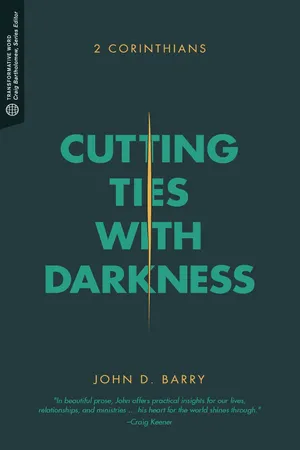
Cutting Ties with Darkness (Transformative Word)
2 Corinthians
- 160 pages
- English
- ePUB (mobile friendly)
- Available on iOS & Android
eBook - ePub
About this book
Paul wrote 2 Corinthians with a heavy heart, wrestling to maintain his relationship with the young church that he established. The way that Paul handled this painful situation provides an example for us today. When should we reconcile, and when should we walk away? How do we cut ties with darkness--whether in ourselves or in others? In this volume from the Transformative Word series, edited by Craig Bartholomew, John D. Barry explores how we deal with such scars in light of Jesus' example.
Information
Topic
Theology & ReligionSubtopic
Biblical Studies1. Introduction: The Threads of Life
“How do you pick up the threads of an old life? How do you go on, when in your heart, you begin to understand, there is no going back? There are some things that time cannot mend. Some hurts that go too deep.” When Frodo Baggins says these words at the end of the movie The Return of the King, they carry the full weight of someone who is grieving deeply.1 These words echo some of my relationships. I often wonder: “With all the damage that has been done, how can we ever return to how things used to be?” And, “Was there ever really anything to our friendship at all?” This is how Paul must have felt when he wrote 2 Corinthians. In this deeply personal letter, Paul offers profound insights into relationships. He writes out of both love and pain. He writes about severing relationships and mending them. He writes in a way that is decidedly centered on God, as seen in the person of Christ. Paul is humble and meek; he is bold and adamant.2 But I don’t want to give away the punchline here; I’ll let Paul do that as we journey together through past hurts and intelligent solutions—as we learn what darkness is and how to cut ties with it.
Overview
Second Corinthians is a letter laced with pain. Paul has suffered greatly for the good news of Jesus, and now he is struggling to maintain a relationship with the church he founded in Corinth (1 Cor 3:6; 2 Cor 1:8–2:4). Paul planted the church at Corinth while there as a tentmaker for at least a year and a half (Acts 18:1–18).3 By Christ’s strength, Paul built the church at Corinth from nothing into a lively church, proclaiming the gospel of God to them “without payment” (2 Cor 11:7–9).
But sometime after departing Corinth, Paul learned that the Corinthian church was allowing Christians to openly practice sexual immorality (1 Cor 5:9–11). To put a stop to this, Paul writes a letter demanding that the believers not associate with people who claim to believe in Jesus but openly live in sin (1 Cor 5:9). There is no preserved copy of this initial letter to Corinth; all we can know about it we learn from 1 Corinthians (which actually is his second letter to Corinth).
After sending his initial letter, Paul received a report from a church member that factions were emerging in the church (1 Cor 1:1). Around the same time as this report, the Corinthians apparently sent him a letter full of pragmatic questions.4 To address these issues, Paul wrote his second letter to them—1 Corinthians.
In 1 Corinthians, Paul explains that he does not want the Corinthian church to separate from all people who live in sin because that would mean separating from the world entirely; instead, they should separate from those who claim to believe in Jesus but condone sin (1 Cor 5:10–11).5 Paul considers this issue to be so detrimental to the church that he tells the Corinthians to “remove the evil person from among yourselves” (1 Cor 5:13; compare 2 Cor 6:14–7:1).6
Sometime after he sent 1 Corinthians, Paul had a “sorrowful visit” to Corinth, during which people had argued with Paul about the changes he felt they should make (2 Cor 13:2). This resulted in Paul writing a “sorrowful letter” to the Corinthians—another letter that has not been preserved for us today (see 2 Cor 2:3–4; 7:8, 12). Following this letter, Paul wrote a fourth letter,7 which we know as 2 Corinthians.
In 2 Corinthians, we see that Paul’s correspondence with the Corinthians has done little to change their ways. They have repented by dismissing at least one problematic believer and now have found a way toward reconciliation with that person, but not much else has changed (2 Cor 2:5–11). Tragically, at least some members of the Corinthian church still have problems with Paul and his authority and are now following false apostles (2 Cor 11:1–15). They also seem to be openly living in sin and welcoming other so-called believers who are living in sin (2 Cor 12:20–21). But the stakes are even higher than just the well-being of the Corinthian church: The lives of impoverished people in Jerusalem hang in the balance as they wait for an offering from the Corinthian believers (2 Cor 9:1–3). The work of the gospel reaching the ends of the earth is also in view, since Paul intends to use the church at Corinth as a launching point for bringing the good news of Jesus to unreached regions (2 Cor 10:16). Without the Corinthians cutting ties with darkness, only pain will come to them and others. Jesus has a better way, if only they can see it and embrace it.
This context explains all of 2 Corinthians. When Paul says, “Do not be unequally yoked,” he means first, that we should not associate with believers who don’t actually live for Jesus, and second, that engaging in any sort of intimate relationship or partnership with someone who does not let Jesus be the center of their lives will ultimately lead to our demise (2 Cor 6:14). We must cut ties with whatever or whomever leads us to darkness.
Paul intends for believers to engage with people who don’t share their beliefs; he just doesn’t want to see their relationships lead them into darkness. The Corinthians believers are supposed to be changing the world, not to be changed by it. Paul wants to see the Corinthian believers separate from their old way of living and fully embrace the ways of Jesus.
In 2 Corinthians we see that Paul feels responsible for the Corinthians, both as an apostle and as a brother in Christ (2 Cor 1:1; 11:2).8 Paul cannot simply let the Corinthian believers go their own way; he reaches out to resolve the conflicts that have arisen, and he hopes the Corinthians will work with him. Paul might be unable to pick up his old life with the Corinthians, but he still wants to move forward with them. He has ideas about what it means to live under Jesus’ new covenant—ideas that he believes will change the Corinthians’ lives and ultimately bring them back into relationship with him.
But this is complicated: There are false leaders, and old friends turned enemies, and broken relationships. There are questions about Paul’s motives and ministry. He is essentially standing on trial before a body of believers that he planted himself, and he knows that they are the ones unable to stand the test of authenticity (2 Cor 10:7–8; 12:19–21; 13:5–8). And nothing with the Corinthians is clear; it’s opaque and in the shadows. Paul has to wade through the gray areas of life to find answers. And isn’t that exactly how life is for all of us?
A heretic never says, “I’m a heretic.” A deceiver never alerts you to his true intentions, and a friend can turn on you at any moment. A family member, or even a spouse, can betray your trust. Authenticity and reliability are hard to find, and so are real friends. Giving each other the benefit of the doubt is far from the norm. And correctly asserting truth, without standing in judgment of someone else, is decidedly difficult.
Some of the Corinthian believers seem to be struggling within themselves. They can’t rightly see the difference between darkness and light because they have allowed darkness to take hold. Paul has so much to teach them, but most of them are blind to it.9
Paul’s response teaches us much about how to work through troubled relationships. He shows us that we cannot truly know another person without first knowing ourselves. And we cannot overcome our demons without first separating ourselves from the work of Satan. In order to be set free, we have to cut ties with the darkness—and Paul tells us how.
For Paul, all of these difficulties are clarified when we renew our perspective in Christ: We were made to be empowered by God’s Spirit so that everything we do is influenced by his holiness and love. As hard as it may be to admit, we are either acting for Jesus or against him; we are either centered on Christ or camping out with evil (2 Cor 5:1–10; 6:15). For some people, this is an intentional choice, or a choice made by default when they don’t make a decision at all; for others, the choice comes by way of deception. Those yet to know Jesus are called to make a decision for him. Those who already know Jesus are called to choose him each day instead of choosing the influences of culture. Even those of us who know Jesus, like the Corinthian believers, risk being so influenced by evil that we can end up doing Satan’s work without realizing it. This is why it’s so critical that we center ourselves fully on Christ (2 Cor 1:1).
To combat the darkness, Paul ultimately shows us a better way: We are not meant to pick up the threads of our old sinful lives at all; instead, we’re called to rebuild our lives on the redemption we find in Jesus.10
Outline of 2 Corinthians
1.Introduction and blessing (2 Cor 1:1–11)
2.Paul’s defense of his ministry and call to discernment (2 Cor 1:12–6:13)
3.The tough decisions Christians must make (2 Cor 6:14–7:1)
4.Peace and generosity toward Paul and others (2 Cor 7:2–9:15)
5.Paul’s visit to Corinth, super-apostles, and the gospel (2 Cor 10:1–13:13)11
The Center of 2 Corinthians
The strength of Paul’s words could prompt us to say that, for him, the world is black and white. But when you get down to the gritty details of 2 Corinthians, it’s apparent that the world is much more complicated than many of the “religious” people would like to believe...
Table of contents
- Cover
- Title Page
- Copyright
- Table of Contents
- Chapter 1: Introduction: The Threads of Life
- Chapter 2: The Tough Decisions Christians Must Make (2 Corinthians 6:14–7:1)
- Chapter 3: A God Who Comforts Us in All Affliction (2 Corinthians 1:3–11)
- Chapter 4: Defending Ourselves like Paul Would (2 Corinthians 1:12–3:18)
- Chapter 5: Zebras, Lions, and Theology (2 Corinthians 2:9–11)
- Chapter 6: Who Do You Work for—Really? (2 Corinthians 4:1–6:13)
- Chapter 7: Joy, Grief, and Making Peace (2 Corinthians 7:2–16)
- Chapter 8: How to Love the Impoverished (2 Corinthians 8:1–9:15)
- Chapter 9: Fighting the Spiritual War against Darkness (2 Corinthians 10:1–11:6)
- Chapter 10: Super-Apostles and Boasting in Jesus (2 Corinthians 11:7–13:10)
- Chapter 11: Conclusion
- Appendix: Flesh and Law in Paul’s Theology
- Bibliography of Academic Works
- Bibliography of Other Sources
Trusted by 375,005 students
Access to over 1.5 million titles for a fair monthly price.
Study more efficiently using our study tools.
Frequently asked questions
Yes, you can cancel anytime from the Subscription tab in your account settings on the Perlego website. Your subscription will stay active until the end of your current billing period. Learn how to cancel your subscription
No, books cannot be downloaded as external files, such as PDFs, for use outside of Perlego. However, you can download books within the Perlego app for offline reading on mobile or tablet. Learn how to download books offline
Perlego offers two plans: Essential and Complete
- Essential is ideal for learners and professionals who enjoy exploring a wide range of subjects. Access the Essential Library with 800,000+ trusted titles and best-sellers across business, personal growth, and the humanities. Includes unlimited reading time and Standard Read Aloud voice.
- Complete: Perfect for advanced learners and researchers needing full, unrestricted access. Unlock 1.5M+ books across hundreds of subjects, including academic and specialized titles. The Complete Plan also includes advanced features like Premium Read Aloud and Research Assistant.
We are an online textbook subscription service, where you can get access to an entire online library for less than the price of a single book per month. With over 1.5 million books across 990+ topics, we’ve got you covered! Learn about our mission
Look out for the read-aloud symbol on your next book to see if you can listen to it. The read-aloud tool reads text aloud for you, highlighting the text as it is being read. You can pause it, speed it up and slow it down. Learn more about Read Aloud
Yes! You can use the Perlego app on both iOS and Android devices to read anytime, anywhere — even offline. Perfect for commutes or when you’re on the go.
Please note we cannot support devices running on iOS 13 and Android 7 or earlier. Learn more about using the app
Please note we cannot support devices running on iOS 13 and Android 7 or earlier. Learn more about using the app
Yes, you can access Cutting Ties with Darkness (Transformative Word) by John D. Barry, Craig G. Bartholomew in PDF and/or ePUB format, as well as other popular books in Theology & Religion & Biblical Studies. We have over 1.5 million books available in our catalogue for you to explore.