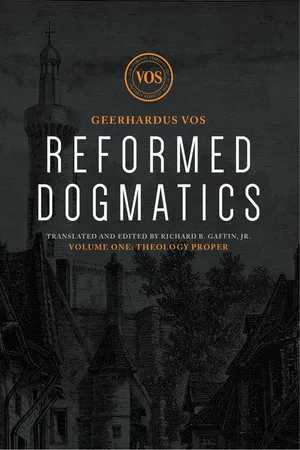
A Foundational Work of Reformed Theology
Geerhardus Vos's Reformed Dogmatics represents the early theological thought of one of the premier Reformed thinkers of the nineteenth and twentieth centuries. Originally self-published in 1896 in five volumes as Gereformeerde Dogmatiek, this monumental work of systematic theology wasn't available in English until more than a century after its initial publication.
Translated and edited by biblical theologian and Vos expert Richard B. Gaffin Jr., Reformed Dogmatics offers valuable insight into the formative thought of this influential theologian. This book includes all five volumes: Theology Proper; Anthropology; Christology; Soteriology; and Ecclesiology, The Means of Grace, Eschatology. Although this work is systematic in nature, Vos brings the skills and acumen of a biblical theologian to the task.
eBook - ePub
Reformed Dogmatics
Theology Proper
- 256 pages
- English
- ePUB (mobile friendly)
- Available on iOS & Android
eBook - ePub
Reformed Dogmatics
Theology Proper
About this book
Information
Topic
Theology & ReligionSubtopic
Christian Theology1. The Knowability of God
1. Is God knowable?
Yes, Scripture teaches this: “that we may know the One who is true” (1 John 5:20), although it also reminds us of the limited character of our knowledge (Matt 11:25).
2. In what sense do Reformed theologians maintain that God cannot be known?
a)Insofar as we can have only an incomplete understanding of an infinite being.
b)Insofar as we cannot give a definition of God but only a description.
3. On what ground do others deny God’s knowability?
On the ground that God is All-Being. They have a pantheistic view of God. Now, knowing presumes that the object known is not all there is, since it always remains distinct from the subject doing the knowing. Making God the object of knowledge, one reasons, is equivalent to saying that He is not all there is, that He is limited.
4. What response is to be made against this view?
a)The objection that this view presents stems entirely from a philosophical view of God, as if He were All-Being. This view is wrong. God is certainly infinite, but God is not the All. There are things that exist, whose existence is not identical with God.
b)It is certainly true that we cannot make a visible representation of God because He is a purely spiritual being. But we also cannot do that of our own soul. Yet we believe that we know it.
c)It is also true that we do not have an in-depth and comprehensive knowledge of God. All our knowledge, even with regard to created things, is in part. This is even truer of God. We only know Him insofar as He reveals Himself, that is, has turned His being outwardly for us. God alone possesses ideal knowledge of Himself and of the whole world, since He pervades everything with His omniscience.
d)That we are able to know God truly rests on the fact that God has made us in His own image, thus an impression of Himself, albeit from the greatest distance. Because we ourselves are spirit, possess a mind, will, etc., we know what it means when in His Word God ascribes these things to Himself.
2. Names, Being, and Attributes of God
1. In what does the importance of the names of God lie?
In this, that God through them draws our attention to the most important attributes of His being. This being is so rich and comprehensive that we need to have some benchmarks in order to understand the rest. God’s names are not empty sounds (like the names of people), but they have meaning and contribute to our knowledge of God.
2. What is the meaning of the name Elohim?10
“He who is to be feared,” “the One who is full of majesty.” The ending im11 is a plural ending. The singular is Eloah and appears first in the later books of the Bible as a poetical form. The plural ending does not point to an earlier polytheistic conception, but signifies the plenitude of power and majesty there is in God.
3. What are the meanings of the names El and Adonai?
El means “the Strong One,” “the Mighty One.” Adonai means “Ruler,” “Lord”; originally, “my Ruler,” “my Lord.”
4. Give the meaning of the name Eljon.
It means “the Exalted One,” namely “above all other so-called gods”; cf. Gen 14:18.
5. What is the meaning of the name El Shaddai?
“The Mighty One,” “the Sovereign One.”
6. What is the derivation and what is the meaning of the name Jehovah?
Very early the Jews thought that Leviticus 24:11, 16 forbade them to pronounce the holy name of God. They always replaced it with Adonai. Later, when vowels were added to the Hebrew text, the vowels of Adonai were used. Thus, the pronunciation “Jehovah” came into existence. We cannot ascertain with certainty what the original pronunciation was, but most probably the pronunciation was Jahweh. However, we are already so used to the sound of Jehovah that it would almost be irreverent to change it at this stage. According to Exodus 3:14, Jehovah is a covenant name and signifies: (a) self-existence; and (b) God’s immutability and faithfulness.
Elohej12
7. What does the name Jehovah Zebahoth affirm?
It means “the God [or the Lord] of Hosts.” This name was first used in the time of Samuel. In that connection, one has thought that it indicates Jehovah as Captain of Israel’s battle array (Psa 44:10).13 However, in Scripture, two other things are also called “hosts,” namely the stars and the angels (Deut 4:19; Job 38:7). Thus along with the meaning mentioned above, included also in the name is this: God all-powerfully rules over angels and stars, and Israel should not fear them as the heathen do.
8. Has God made Himself known to us only through His names?
No, also through His attributes. God’s attributes are the revealed being of God Himself insofar as it is made known to us under certain circumstances.
9. What two questions arise for us in connection with God’s attributes?
a)In what relation do they stand to His being?
b)In what relation do they stand to each other?
10. What do the ancients teach concerning God’s being?
a)As has been noted above, we cannot give a definition of God’s being. After all, every definition presupposes a higher concept of genus and a distinction between a concept of genus and a concept of species, as well as a composition of the two. Now there is nothing higher than God, and God is simple, without composition.
b)There is no distinction in God between essence and existing, between essence and being, between essence and substance, between substance and its attributes. God is most pure and most simple act.
11. May we make a distinction in God between His being and His attributes?
No, because even with us, being and attributes are most closely connected. Even more so in God. If His attributes were something other than His revealed being, it would follow that also essential deity must be ascribed to His being, and thus a distinction would be established in God between what is essentially divine and what is derivatively divine. That cannot be.
12. May we also say that God’s attributes are not distinguished from one another?
This is extremely risky. We may be content to say that all God’s attributes are related most closely to each other and penetrate each other in the most intimate unity. However, this is in no way to say that they are to be identified with each other. Also in God, for example, love and righteousness are not the same, although they function together perfectly in complete harmony. We may not let everything intermingle in a pantheistic way because that would be the end of our objective knowledge of God.
13. From what other matters in God must we clearly distinguish His attributes?
a)From God’s names, derived from the relation in which He stands to what is created. Thus, He is called Creator, Sustainer, Ruler (we call these predicates or descriptions).
b)From the personal qualities that are unique to each person of the Holy Trinity and whereby they are distinguished from one another, e.g., begetting, being begotten, and being breathed (these are called properties, “particularities”).
14. In how many ways have theologians attempted to make a classification of God’s attributes?
a)They have been classified in three ways according to which, it is thought, one must arrive at knowledge of the attributes:
1.The way of causality
2.The way of negation
3.The way of eminence
However, this is not so much a classification of attributes as of ways in which natural theology has attempted to establish God’s attributes.
b)Another classification is affirming and negating attributes. Pure negations only tell us what God is not and are therefore not attributes in the fullest sense of the word. When we consider this more closely, these so-called negative attributes mostly include something affirming, so the distinction disappears. For example, God’s eternity says more than that He has no beginning and no end. It also says that for Him everything is an indivisible present, etc.
c)A third classification divides into absolute and relative attributes, or what comes down to the same thing, inherent and transitive attributes. However, strictly speaking, all God’s attributes are absolute. In other words, the ground for them resides in His being, apart from the existence of the world, although we must admit that we could not conceive of some of them in action (e.g., grace and mercy) if the world did not exist. On the other hand, there is no attribute in God that is not in a certain sense ...
Table of contents
- Cover
- Title Page
- Copyright
- Contents
- Preface
- Chapter 1: The Knowability of God
- Chapter 2: Names, Being, and Attributes of God
- Chapter 3: The Trinity
- Chapter 4: Of God’s Decrees in General
- Chapter 5: The Doctrine of Predestination
- Chapter 6: Creation
- Chapter 7: Providence
- Acknowledgments
- Question Index
- Subject and Author Index
- Scripture Index
Trusted by 375,005 students
Access to over 1.5 million titles for a fair monthly price.
Study more efficiently using our study tools.
Frequently asked questions
Yes, you can cancel anytime from the Subscription tab in your account settings on the Perlego website. Your subscription will stay active until the end of your current billing period. Learn how to cancel your subscription
No, books cannot be downloaded as external files, such as PDFs, for use outside of Perlego. However, you can download books within the Perlego app for offline reading on mobile or tablet. Learn how to download books offline
Perlego offers two plans: Essential and Complete
- Essential is ideal for learners and professionals who enjoy exploring a wide range of subjects. Access the Essential Library with 800,000+ trusted titles and best-sellers across business, personal growth, and the humanities. Includes unlimited reading time and Standard Read Aloud voice.
- Complete: Perfect for advanced learners and researchers needing full, unrestricted access. Unlock 1.5M+ books across hundreds of subjects, including academic and specialized titles. The Complete Plan also includes advanced features like Premium Read Aloud and Research Assistant.
We are an online textbook subscription service, where you can get access to an entire online library for less than the price of a single book per month. With over 1.5 million books across 990+ topics, we’ve got you covered! Learn about our mission
Look out for the read-aloud symbol on your next book to see if you can listen to it. The read-aloud tool reads text aloud for you, highlighting the text as it is being read. You can pause it, speed it up and slow it down. Learn more about Read Aloud
Yes! You can use the Perlego app on both iOS and Android devices to read anytime, anywhere — even offline. Perfect for commutes or when you’re on the go.
Please note we cannot support devices running on iOS 13 and Android 7 or earlier. Learn more about using the app
Please note we cannot support devices running on iOS 13 and Android 7 or earlier. Learn more about using the app
Yes, you can access Reformed Dogmatics by Geerhardus J. Vos,Geerhardus Vos, Richard B. Gaffin, Richard B. Gaffin,Richard B. Gaffin, Jr. in PDF and/or ePUB format, as well as other popular books in Theology & Religion & Christian Theology. We have over 1.5 million books available in our catalogue for you to explore.