The King James Version has shaped the church, our worship, and our mother tongue for over 400 years. But what should we do with it today?
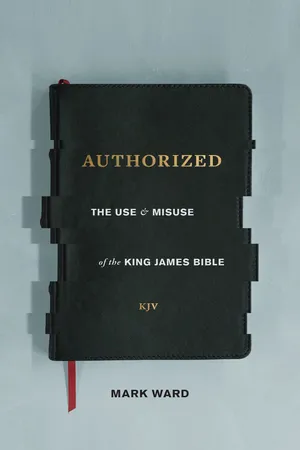
The KJV beautifully rendered the Scriptures into the language of turn-of-the-seventeenth-century England. Even today the King James is the most widely read Bible in the United States. The rich cadence of its Elizabethan English is recognized even by non-Christians. But English has changed a great deal over the last 400 years, and in subtle ways that very few modern readers will recognize. In Authorized Mark L. Ward, Jr. shows what exclusive readers of the KJV are missing as they read God's word.
In their introduction to the King James Bible, the translators tell us that Christians must "heare CHRIST speaking unto them in their mother tongue." In Authorized Mark Ward builds a case for the KJV translators' view that English Bible translations should be readable by what they called "the very vulgar," and what we would call "the man on the street."
- 112 pages
- English
- ePUB (mobile friendly)
- Available on iOS & Android
eBook - ePub
About this book
Information
Topic
Theology & ReligionSubtopic
Biblical ReferenceCHAPTER 1
What We Lose as the Church Stops Using the KJV
Who reads the Matthew Bible of 1537? Nobody I know of. And who misses it? Again, nobody I know of.
The same pretty much goes for other classic English translations of the Scriptures: the Geneva Bible, the Coverdale Bible, the Bishop’s Bible, and—stretching back a few more centuries—Wycliffe’s translation.
Much of English-speaking Christianity has sent the King James Version, too, to that part of the forest where trees fall with no one there to hear them. That’s what we do with old Bible translations.
But I don’t think many people have carefully considered what will happen if we all decide to let the KJV die and another take its office.
There are at least five valuable things we will lose—things that in many places we are losing and have already lost—if we give up the KJV, this common standard English Bible translation that has served us all since before the oldest family ancestor most of us know of.
1. WE LOSE INTERGENERATIONAL TIES IN THE BODY OF CHRIST
I spent an inordinate amount of time before marriage considering which Bible translations I would hand to my children (inordinate because I didn’t even have a girlfriend at the time). I dithered so long in this decision, even after marriage and the birth of my three children, that Grandma ended up deciding for me by buying the kids Bibles. And one of the reasons I struggled so hard was that I knew that if I didn’t hand my kids KJVs I would be severing some rich connections between them and their heritage.
The KJV includes countless little phrases that have made it not just into English but into the stock lexicon of Christian biblical and theological conversation. For example, I was reading along in one theology book and the author said of the Parable of the Wicked Tenants: “What do we learn about the story by this means? Much in every way.”1
I can’t prove it, because he added the word “in” (the KJV just says “much every way”), but I think this was a casual allusion to Romans 3:2 in the KJV. It was not placed in quotation marks. It wasn’t footnoted. Was this author plagiarizing? No, he was showcasing his wit and erudition—and signaling his connection with the English-speaking Christian past. He was sending a message to readers: “I know the Bible so well—the same Bible you grew up on—that its words leak out of my pen as if by accident.” I don’t want my kids to miss such casual KJV allusions.2
I don’t want my kids missing more artful and complicated allusions, either—like the comment, attributed to Walker Percy among others, that someone “sold his birthright for a pot of message.”3 You don’t have to read the KJV to get this one—plenty of people who have never read the KJV understand what’s going on here because it’s based on a stock phrase, namely “selling one’s birthright for a mess of pottage,” which in turn is based on the Jacob and Esau story. But having read the KJV sure helps someone understand Percy’s witticism. No recent Bible translation uses the word “pottage.”
I want my kids to be skilled readers who get all the meaning an author has to give. I want them to feel connected to all the valuable traditions of the Christian church, and that means passing on the store of knowledge upon which Christian authors rely for their allusions and verbal echoes.
Christian leader and theologian Russell Moore was standing at the bedside of his grandmother as she lay recovering from a life-threatening stroke. He said, “I thought she was about to die; she didn’t. But I was thinking, I can sing hymns to her here at the bedside that she will know and that I will know. And I don’t think that will be the case with my children when I am lying on my deathbed, because the way that we sing the hymnody is all so generationally divided up.”4
Traditional hymns—and traditional Bible translations—bind the generations together. Evangelical suspicion of tradition can be healthy, because the danger is ever present that we will “set at nought the word of God” by our traditions. But traditions develop to protect things our forebears valued. Discovering why they did so will strengthen our ties with them.
Moore misses the KJV for this very reason:
There’s something about the beauty, the majesty, and the continuity between generations about the KJV that is sorely missed when it is gone. I suppose that’s why I preach and teach from any number of translations, but when I am sorrowful or grieving or comforting a hopeless friend I turn to the same King James Version I memorized verses from in childhood Sword Drills at Woolmarket Baptist Church. I know that I’m reading the same words my grandfather preached from fifty years ago, the same words my great-grandparents would have read through the Depression, and my great-great-great grandparents would have read in the aftermath of Reconstruction.5
Churches and families that no longer use the KJV might consider having their children memorize key King James passages like Psalm 23; John 3:16, and the Lord’s Prayer. When I lay dying, it will be undeniably meaningful to me to pray with my family to a Father “which art” in heaven, not one merely “who is” there. Parents who teach their kids the KJV rendition of the Lord’s Prayer are tying one little string between them and our rich English Christian history—a history that has much to teach us. We can’t keep all the strings. Some of them must or even should be cut. But let’s at least be aware of what we’re doing.
2. WE LOSE SCRIPTURE MEMORY BY OSMOSIS
When an entire church, or group of churches, or even an entire nation of Christians, uses basically one Bible translation, genuinely wonderful things happen. An individual Christian’s knowledge of the Bible increases almost by accident, because certain phrases become woven into the language of the community. If even non-Christians today who have never read the KJV know many of its phrases because they’ve passed into the lexicon, surely a people who lives by the Book will learn even more Bible through the normal course of everyday life within a Christian community.
Christians in my growing-up years were constantly reinforcing each other’s knowledge of the KJV every time they mentioned it in conversation. We were teaching each other Bible phrases when we read Scripture out loud together in church. (Corporate reading from five different translations just doesn’t work. I’ve heard it done—no, attempted.)
People can memorize any Bible translation on their own, but the community value of learning by osmosis is eroded when people aren’t reinforcing precisely the same wording. It helps to have a common standard. That standard doesn’t have to be the KJV, of course. But no other translation seems likely to serve in the role. If indeed the King is dying, it is just as sure that none of his sons or cousins have managed to become the heir apparent.
3. WE LOSE A CULTURAL TOUCHSTONE
And it’s not just Christians who stand to lose things of value if KJV readership goes from 55 percent to where the Coverdale Bible is right now—at 0 percent. All English speakers will lose a literary benchmark, a source of common phrases, and a key pillar supporting the form of English universally recognized as elevated and religious. And these cultural values are not to be sniffed at. There is a grandeur to the wording of the KJV, and it isn’t just Christians who feel it. If KJV wording fades entirely out of cultural memory, its language may no longer call up any instinctual cultural respect from non-Christian people.
I was listening recently to the Festival of Nine Lessons and Carols on BBC Radio 4, broadcasted live every year from the soaring medieval Chapel of King’s College Cambridge, and featuring perhaps the most famous choir in the world, a choir founded in 1411 by King Henry VI. This is a church service, yes, but it’s also a cultural event enjoyed by countless people who are not Christians.
Interspersed throughout the beautiful carols, sung impeccably by the boy choristers and young choral scholars, there are Scripture readings. And somehow the KJV befits the occasion and the physical setting. I heard through my speakers, in the clear tones of British RP (received pronunciation), “Dust thou art, and unto dust thou shalt return” (Gen 3:19). Culturally speaking—and I do love high culture—this is preferable in a cathedral ceremony to the hapless, “You’re made from dust and you’ll return to dust” (International Standard Version).
David Norton, the premier scholar in the world on the history of the KJV, writes in his Textual History of the King James Version that by the mid-century, “the language of the KJB had become what [lexicographer Samuel] Johnson calls ‘solemn language’: it was the accepted language of the Bible and religion, distinguished from ordinary language.”6 As we’ll see later, this distinction creates problems. But here’s one positive: when you quote the KJV, you don’t have to tell people you’re quoting the Bible. They just know. What educated English speaker doesn’t have some attraction to the KJV’s elevated diction, punctuated with spots that are more earthy (“every male that pisseth against the wall”) and even wry (“grace is no more grace”)?
The late Christopher Hitchens, the kind of crusading atheist whose own wit and erudition helped win him several personal friends among orthodox Christians,7 was nothing if not cultured. I don’t think I’ve ever heard anyone speak so eloquently ex tempore, and his own high-class British accent completes an effect that makes American audiences swoon. (How could someone who sounds so smart possibly be wrong?) One of the reasons many Christians found him likable despite his atheism was that he saw good in religion in a way his fellow atheist Richard Dawkins never quite could. But both see good in the KJV. Dawkins wrote,
A native speaker of English who has never read a word of the King James Bible is verging on the barbarian.8
And Hitchens:
A culture that does not possess [the KJV’s] common store of image and allegory will be a perilously thin one. To seek restlessly to update [the Bible] or make it “relevant” is to miss the point, like yearning for a hip-hop Shakespeare.9
Hitchens is confusing “the Bible” and translations of the Bible—but his cultural point is well taken, and Christians should not miss this chance to agree with the world’s most prominent atheists. Anyone who cares about English and the culture(s) it nourishes has to understand the value they are trying to protect.
4. WE LOSE SOME OF THE IMPLICIT TRUST CHRISTIANS HAVE IN THE BIBLES IN THEIR LAPS
There’s another thing we’ll lose—and are already losing as the KJV loses its place as a common standard. It follows on from the second point: as the KJV fades, so does at least some of the trust Christians have in their Bible translations. I don’t think this fading trust is necessary; it doesn’t always happen. But I have definitely seen it.
I was dimly aware as a child of the growing displacement of the KJV in American Christianity, and I knew that that displacement was contested. But my first introduction as an adult to the “politics” of Bible translation was on March 29, 1997, when a WORLD Magazine cover charged the NIVI—New International Version Inclusive language edition—with being a “Stealth Bible” because of its use of allegedly “gender-neutral” language.10 Though previous large-scale fights over English Bible translations have occurred (the RSV, for example, raised ire among many evangelicals for its translation of Isaiah 7:14), this was the first one I saw up close. Representatives from Zondervan met with evangelical leaders at Focus on the Family (somewhat awkwardly, they wound up riding the elevator together to their tense meeting), and Zondervan agreed to cease publication of the NIVI.11
The successor to the NIVI was the TNIV, Today’s New International Version. Enough financial resources went into the TNIV that its backers sent me a free copy while I was in seminary: they wanted to win over future pastors in what quickly became an uphill battle. Major evangelical scholars put out impassioned web-based pleas for their fellow Christians to view the TNIV as “gender-accurate,” not “gender-neutral.” But the tie between the “Stealth” NIVI and the TNIV had been cemented in too many Christian minds—and a Bible translation that fails to win sufficient trust will die. That’s what happened to both the NIVI and the TNIV.
Bible translations succeed or fail based on Chri...
Table of contents
- Cover
- Title Page
- Copyright
- Contents
- Introduction
- Chapter 1: What We Lose as the Church Stops Using the KJV
- Chapter 2: The Man in the Hotel and the Emperor of English Bibles
- Chapter 3: Dead Words and “False Friends”
- Chapter 4: What Is the Reading Level of the KJV?
- Chapter 5: The Value of the Vernacular
- Chapter 6: Ten Objections to Reading Vernacular Bible Translations
- Chapter 7: Which Bible Translation Is Best?
- Epilogue
- Acknowledgments
Trusted by 375,005 students
Access to over 1.5 million titles for a fair monthly price.
Study more efficiently using our study tools.
Frequently asked questions
Yes, you can cancel anytime from the Subscription tab in your account settings on the Perlego website. Your subscription will stay active until the end of your current billing period. Learn how to cancel your subscription
No, books cannot be downloaded as external files, such as PDFs, for use outside of Perlego. However, you can download books within the Perlego app for offline reading on mobile or tablet. Learn how to download books offline
Perlego offers two plans: Essential and Complete
- Essential is ideal for learners and professionals who enjoy exploring a wide range of subjects. Access the Essential Library with 800,000+ trusted titles and best-sellers across business, personal growth, and the humanities. Includes unlimited reading time and Standard Read Aloud voice.
- Complete: Perfect for advanced learners and researchers needing full, unrestricted access. Unlock 1.5M+ books across hundreds of subjects, including academic and specialized titles. The Complete Plan also includes advanced features like Premium Read Aloud and Research Assistant.
We are an online textbook subscription service, where you can get access to an entire online library for less than the price of a single book per month. With over 1.5 million books across 990+ topics, we’ve got you covered! Learn about our mission
Look out for the read-aloud symbol on your next book to see if you can listen to it. The read-aloud tool reads text aloud for you, highlighting the text as it is being read. You can pause it, speed it up and slow it down. Learn more about Read Aloud
Yes! You can use the Perlego app on both iOS and Android devices to read anytime, anywhere — even offline. Perfect for commutes or when you’re on the go.
Please note we cannot support devices running on iOS 13 and Android 7 or earlier. Learn more about using the app
Please note we cannot support devices running on iOS 13 and Android 7 or earlier. Learn more about using the app
Yes, you can access Authorized by Mark Ward in PDF and/or ePUB format, as well as other popular books in Theology & Religion & Biblical Reference. We have over 1.5 million books available in our catalogue for you to explore.