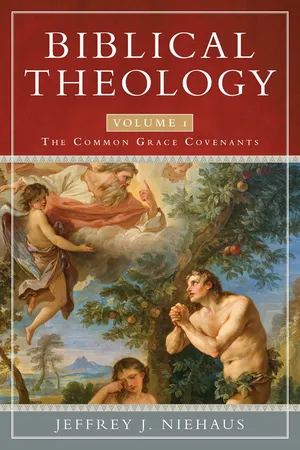
- 364 pages
- English
- ePUB (mobile friendly)
- Available on iOS & Android
eBook - ePub
About this book
The first of three volumes, this study explores the two common grace covenants: the Adamic and Noahic. The second volume examines the special grace covenants: the Abrahamic, Mosaic, and Davidic. The third volume explores the final and culminating special grace covenant: the new covenant. These volumes present covenant as an expression of the nature of God, and show a paradigm of activity by which God works in covenantal relations first to create the world and then, through a redemptive program after the fall, to redeem what was lost.
Information
Topic
Theology & ReligionSubtopic
Biblical StudiesChapter One
The Creation Covenant
“mi parve pinta de la nostra effige”
—Dante1
The Idea of Covenant
As my own thinking on covenant has evolved, I have taken a—to the best of my knowledge—somewhat different road from the ones followed by other scholars who have written on the topic. This evolutionary process began as a result of reading and disagreeing with two scholars, and led to my composing several articles, including the article, “Covenant: An Idea in the Mind of God.” In that article, I proposed that the second millennium B.C. covenant idea and form as we find them in the ancient Near East did not simply arise in a process by which family relations were taken as a model for treaties between states, as has sometimes been argued. The use of familial terms in ancient near eastern treaties makes it seem rather obvious that some such development of the treaty concept took place over time (say, over a millennium or so). But there is, I believe, a deeper root explanation for the covenant concept, and that is that both authority and kinship within the family, and authority and legal “kinship” between partners in a covenant, arose out of human nature as a reflection of God’s nature.2
I would now put the matter in the following way: A suzerain–vassal covenant is an expression of the elements of a power relationship, and the original of this pattern resides with God, who instituted a power relationship with creation and its inhabitants when he created it and them. This idea applies to both the invisible and the visible “registers” (to use Meredith Kline’s term) of the created order.
Any power relationship, then, will contain the most important elements of a covenant.3 For example, if one has a job, the following “covenantal” elements are in place: one has a suzerain (a boss or employer), who promised to provide certain good things for the vassal-to-be (the employee-to-be) and to expect certain things from the vassal-to-be (again, the employee-to-be) before the contract was signed, and such is the historical background, and also the stuff of the classic “historical prologue,” of the covenant or treaty; one has certain tasks to perform on the job and certain rules that must be obeyed and not broken, and these correspond to the “stipulations” of the covenant; the employee will be blessed if he or she does the work assigned as assigned and obeys whatever rules are in place, or the employee will be cursed (e.g., be demoted, suffer a pay cut, or be fired) if he or she fails to do so. Although, then, scholars distinguish between treaties and contracts in the ancient Near East because of the presence or absence of certain recorded elements, it remains true that a contract between a boss and a worker in any age and culture will contain the essential elements of a covenant, as indicated earlier. The covenant idea is the idea of a power relationship, and this idea is rooted in the very nature of God and finds expression in any relationship between God and his creatures, and in any power relationship between humans, because humans are made in the image of God, and thus will, out of their own natural constitution, form and formulate power relationships that echo the covenantal nature of God.
Put another way, covenant is an expression of God’s nature as a great suzerain who provides good things for his vassals, who imparts standards for their way of life, who will bless them for obedience and curse them for disobedience, and who is the eternal witness to these facts. Form critically speaking, these are the relational elements that appear in second millennium BC Hittite suzerain–vassal treaties. They also appear in the creation account, Genesis 1:1–2:3. The creation account that contains all of these elements is thus an expression of God’s nature and also has formally the constituent parts of a covenant and thus shows us that God’s nature is what people would later call covenantal. Since God also has ideas of his own nature and of the legal forms that nature’s expression will take as he makes covenants with people in human history, covenant is also, as I have called it, “an idea in the mind of God.” God’s nature is covenantal, and as he is supremely self-aware, he has an accurate idea of his own nature.
It follows from our observations on the nature of a divine–human covenant as a power relationship that, when a covenant is reported in a biblical narrative, the report need not include certain technical elements, such as a recorded oath or a ratification ceremony—or even the very term covenant—in order for the narrative of the institution of the relationship to be a narrative of a covenant’s first appearance.4 So, Genesis 1:1–2:3 can portray the institution of relations between God and humans as he creates the world and them in it, and the pericope can be the narrative account of a relationship that is covenantal between God and humans without using the term covenant and without recording any oath or ceremony of institution.
The Creation Covenant and Its Forms of Revelation
On such an understanding we affirm that, from the beginning, God has been in covenant with all creation. Moreover, both Old and New Testaments attest to this fact.5 The Old Testament in particular makes it clear that God had, from the beginning, a Creation covenant that he renewed in his covenant with Noah. God caused both covenants to be composed as narratives that have the form of second millennium BC international treaties. His purpose in doing so was to communicate to humanity that he was indeed in covenant with them, and to communicate that fact even through a narrative such as Genesis 1:1–2:3, which does not contain the actual term covenant. The church has long understood, and some modern scholars have affirmed, the reality of a Creation covenant, and also recognized that the Noahic covenant was a re-Creation covenant—that is, a covenant that reinstated humanity as vassal rulers over the created order on earth after the Flood.6
I will review some evidences for a Creation covenant later in this chapter. Before that is done, however, it is worthwhile to understand and to display the fact that the Genesis creation account (Gen. 1:1–2:3) also partakes of two other literary forms: the form of an ancient near eastern list (e.g., the Sumerian King List) and a structurally balanced form of domains and dominators sometimes referred to as the “Framework Hypothesis,” after its articulation as such by Meredith Kline. Both of these forms are important and not incidental. If all scripture is “God–breathed,” then the literary and/or legal forms into which the Spirit has cast items of revelation must of themselves be important and communicate things of value. Form criticism on this understanding contributes to the content o...
Table of contents
- Title Page
- Copyright Page
- Dedication
- Contents
- Preface
- Acknowledgments
- Abbreviations
- Prolegomena
- 1. The Creation Covenant
- 2. The Creation Covenant Unfolds
- 3. The Creation Covenant Is Threatened
- 4. The Sin and Heritage of Cain
- 5. Noah and the Reason for the Flood
- 6. The Flood and the Noahic Covenant
- 7. Life under Two Covenants
- Appendix A: God’s Imagination and Creativity
- Appendix B: Kline on Time
- Appendix C: Between Genesis 1:27b and 1:27c
- Appendix D: The Term “Glory” in the Gospels
- Bibliography
- Scripture Index
- Subject Index
Trusted by 375,005 students
Access to over 1.5 million titles for a fair monthly price.
Study more efficiently using our study tools.
Frequently asked questions
Yes, you can cancel anytime from the Subscription tab in your account settings on the Perlego website. Your subscription will stay active until the end of your current billing period. Learn how to cancel your subscription
No, books cannot be downloaded as external files, such as PDFs, for use outside of Perlego. However, you can download books within the Perlego app for offline reading on mobile or tablet. Learn how to download books offline
Perlego offers two plans: Essential and Complete
- Essential is ideal for learners and professionals who enjoy exploring a wide range of subjects. Access the Essential Library with 800,000+ trusted titles and best-sellers across business, personal growth, and the humanities. Includes unlimited reading time and Standard Read Aloud voice.
- Complete: Perfect for advanced learners and researchers needing full, unrestricted access. Unlock 1.5M+ books across hundreds of subjects, including academic and specialized titles. The Complete Plan also includes advanced features like Premium Read Aloud and Research Assistant.
We are an online textbook subscription service, where you can get access to an entire online library for less than the price of a single book per month. With over 1.5 million books across 990+ topics, we’ve got you covered! Learn about our mission
Look out for the read-aloud symbol on your next book to see if you can listen to it. The read-aloud tool reads text aloud for you, highlighting the text as it is being read. You can pause it, speed it up and slow it down. Learn more about Read Aloud
Yes! You can use the Perlego app on both iOS and Android devices to read anytime, anywhere — even offline. Perfect for commutes or when you’re on the go.
Please note we cannot support devices running on iOS 13 and Android 7 or earlier. Learn more about using the app
Please note we cannot support devices running on iOS 13 and Android 7 or earlier. Learn more about using the app
Yes, you can access Biblical Theology by Jeffrey J. Niehaus in PDF and/or ePUB format, as well as other popular books in Theology & Religion & Biblical Studies. We have over 1.5 million books available in our catalogue for you to explore.