eBook - ePub
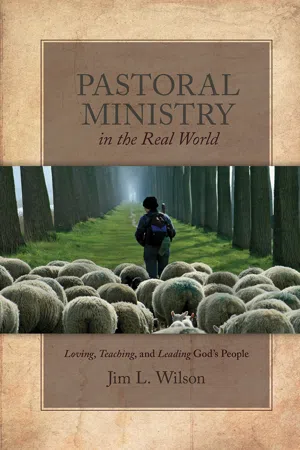
Pastoral Ministry in the Real World
Loving, Teaching, and Leading God's People
- 256 pages
- English
- ePUB (mobile friendly)
- Available on iOS & Android
eBook - ePub
About this book
Pastoral Ministry in the Real World not only explores the character of a worthy minister, but also his three primary functions: loving, teaching, and leading God's people. The book applies the timeless biblical instructions for pastors to the ever-changing realities of today's ministry environment.
Information
Topic
Theology & ReligionSubtopic
Christian MinistryPART ONE
INVITATION TO PASTORAL MINISTRY
Chapter 1Who Is a Pastor?
God gave pastors to the first century church to love, teach, and lead His people. The New Testament writers used three words to refer to pastors: poimén (shepherd), presbuteros (elder), and episkopos (overseer). Some may see these as three separate offices, but there is evidence they are synonymous1 and refer to the single office of pastor.2
Poimén (shepherd) and its subsequent forms appear eighteen times in the New Testament, referring usually to the literal vocation of tending sheep (Luke 2:18) or, metaphorically, to Jesus’ care of His people (John 10:11). In Ephesians 4:11, Paul uses poimén to refer to a church leader, “And He personally gave some to be apostles, some prophets, some evangelists, some pastors3 and teachers.” In this passage, Paul was not introducing a new concept by referring to a spiritual leader as shepherd. Jeremiah referred to spiritual leaders as shepherds, “I will give you shepherds who are loyal to Me, and they will shepherd you with knowledge and skill” (3:15); and in John 21:15–17, Jesus asked Peter to shepherd His sheep.
By using a word that most commonly referred to those who had responsibility for sheep in a pasture to denote one who cares for people in a congregation, the biblical writers drew an analogy between the two professions that speaks to the devotion and character of congregational leaders and the nature of their work. While shepherds were not always respected (Gen. 46:34), they were responsible for protecting and caring for their sheep at all costs and without regard to their own safety or comfort (1 Sam. 17:34–35). Pastors have a similar duty. They are to love the people they serve (1 Tim. 4:11–12) and keep watch over their souls (Heb. 13:17).
Jesus drew on the shepherd analogy to reveal a bit about his core identity:4 “I am the good shepherd. The good shepherd lays down his life for the sheep” (John 10:11). Pastors, like shepherds, are to devote themselves to the well-being of those under their care, without regard for personal benefit or enrichment (John 10:12). Pastors are to love their people.
Presbuteros (elder) in its various forms appears sixty-six times in the New Testament and is used to refer to an older person (Acts 2:17), or more commonly a Jewish official (Matt. 16:21). The biblical authors also use the term to refer to heavenly elders (Rev. 4:4), a governing body (Acts 21:17–26), and on a few occasions, church leaders (Titus 1:5–7).
Their use of elder for the role of congregational leader communicates two important concepts: (1) pastors have leadership responsibilities, and (2) they require personal gravitas5 to fulfill their responsibilities. Furthermore, in 1 Timothy 3:6, Paul warns against allowing a novice to serve and requires those selected be “above reproach” (1 Tim. 3:2). Pastors are to be respected leaders.
Episkopos (overseer) is the only term New Testament writers used exclusively to refer to church leaders.6 In the five times it appears in the New Testament,7 it has the meaning of a person who is keeping watch over a congregation. On three of the five occasions, it is paired with elder or shepherd. Of those three times, overseer is paired with elder once in Titus 1:5–7: “The reason I left you in Crete was to set right what was left undone and, as I directed you, to appoint elders8 in every town: someone who is blameless, the husband of one wife, having faithful children not accused of wildness or rebellion. For an overseer,9 as God’s administrator, must be blameless, not arrogant, not hot-tempered, not addicted to wine, not a bully, not greedy for money. Notice that the same leader referred to as an elder in verse 5 is called an overseer in verse 7.
Biblical writers also paired overseer with shepherd on two occasions. The first is found in Acts 20:28: “Be on guard for yourselves and for all the flock that the Holy Spirit has appointed you to as overseers,10 to shepherd11 the church of God, which He purchased with His own blood.” This pairing is not contrasting the work, showing the roles to be unique and distinct, but demonstrating the overseer functioning as a shepherd.
The second pairing is found in 1 Peter 5:2: “Shepherd12 God’s flock among you, not overseeing13 out of compulsion but freely, according to God’s [will]; not for the money but eagerly.” Again, the terms likely refer to the same person, making them interchangeable.14 Therefore, using overseer to refer to the office of pastor reinforces the expectation that pastors are leaders. Clearly, the Ephesians 4:11 listing are different offices — an evangelist and a prophet are different. Bishop and elder are notably absent from the list. This absence is likely due to these terms referencing the same pastoral office and leadership role, rather than separate roles.15
Poimén (shepherd), presbuteros (elder), and episkopos (overseer) therefore all refer to a single leadership role in a congregation, but the nuance of each word provides a depth and richness in understanding the person and work of the pastor. Poimén emphasizes the loving and caring for the people, and Paul uses it alongside teacher in Ephesians 4:11 to underscore that teaching is that one of the ways shepherds show love to their people. Presbuteros adds a sense of gravitas to the pastoral role. And episkopos identifies pastors as serving in a leadership role. Therefore, pastors are influential and respected leaders who watch over God’s people by loving, teaching, and leading them — without regard for personal enrichment.
Paul provides two almost identical lists16 describing qualifications of episkopoi (overseers, 1 Tim. 3:2–7) and presbuteroi (elders, Titus 1:6–9). These lists lend credence to the argument that Paul is writing to those occupying the same pastoral office.17 According to these passages, pastors must have a stable lifestyle, character that is above reproach, and necessary skills to do their work.
BIBLICAL QUALIFICATIONS FOR PASTOR: STABLE LIFESTYLE
Paul describes a solid family man in 1 Timothy 3:2–7 and Titus 1:6–9. He has only one wife,18 is able to control his children, and is not addicted to wine. Most would agree that these passages prohibit a polygamous person from serving. After that clear prohibition, it gets complicated. Can a single man serve?19 If God calls a man to be a pastor and his wife dies, is he disqualified and must he then resign?20 What about those who were divorced before becoming Christians, and then convert, grow in their faith, and are called by God to pastoral ministry — can they become pastors?21 What about a woman?22 These are all fair questions, but likely are not Paul’s point in this passage. This is not a “pilot’s checklist”23 to go through prior to takeoff, it is a general description of the Pastor’s lifestyle. It is descriptive language.
The pastor must have control over his children. Though not a pastor, Eli was an Old Testament priest who was criticized for the wickedness of his sons (1 Sam. 2:12–36). That example stands as an extreme end of a spectrum, and perhaps a pastor with a teenager struggling with depression, who attempts suicide, is on the other. The truth is, no father has complete control over the choices his children make, but he still has responsibility to supervise his children and guide them into adulthood. What is clear from this text is that while they are in his household, the pastor must have control over his children.24
The pastor should not be under the control of an intoxicant. Of course, Paul allows for the use of medicine (1 Tim. 5:23), but he also underscores the need for sobriety among the pastorate. The Spirit of God, not alcohol, should control all believers (Eph. 5:18), including pastors. No credible interpretation would argue that a pastor could be a substance abuser, but where to draw the line on the other end is open to debate. Some pastors see responsible drinking as a reasonable response to this passage,25 while others, including myself, 26 make a personal choice to be teetotalers.27
BIBLICAL QUALIFICATIONS FOR PASTORS: ABOVE REPROACH
While many are ready to draw disqualifying red lines over lifestyle issues like divorce or drinking,28 fewer are ready to disqualify a pastor from serving who is quarrelsome or a bully. Ironically, those who draw the former lifestyle lines with the boldest strokes often display the later traits in the way they express their views on a pastor’s lifestyle. Paul, however, requires a pastor to be “above reproach.”29
The lists of virtues that Paul provides in table 1 illustrate what it means to be above reproach.30 Many of these virtues align with the fruit of the Spirit (Gal. 5:22–23), while some others align with Paul’s listings of things that should occupy a believer’s mind (Phil. 4:8). Still others, like hospitable, sensible, not greedy, and not arrogant have particular significance for those in pastoral ministry.
Table 1: Above Reproach Virtues
| 1 Timothy 3:2–7 | Titus 1:6–9 | ||
| respectable | righteous | ||
| good reputation among | holy | ||
| outsiders | self-controlled | ||
| self-controlled | not hot-tempered | ||
| sensible | sensible | ||
| hospitabl... |
Table of contents
- Cover Page
- Title Page
- Copyright Page
- Dedication
- Contents
- Foreword
- Preface
- Acknowledgements
- Part One: Invitation to Pastoral Ministry
- Part Two: Loving God’s People
- Part Three: Teaching God’s People
- Part Four: Leading God’s People
- Appendix: One-Point Sermons
- Bibliography
- General Index
- Scripture Index
Trusted by 375,005 students
Access to over 1.5 million titles for a fair monthly price.
Study more efficiently using our study tools.
Frequently asked questions
Yes, you can cancel anytime from the Subscription tab in your account settings on the Perlego website. Your subscription will stay active until the end of your current billing period. Learn how to cancel your subscription
No, books cannot be downloaded as external files, such as PDFs, for use outside of Perlego. However, you can download books within the Perlego app for offline reading on mobile or tablet. Learn how to download books offline
Perlego offers two plans: Essential and Complete
- Essential is ideal for learners and professionals who enjoy exploring a wide range of subjects. Access the Essential Library with 800,000+ trusted titles and best-sellers across business, personal growth, and the humanities. Includes unlimited reading time and Standard Read Aloud voice.
- Complete: Perfect for advanced learners and researchers needing full, unrestricted access. Unlock 1.5M+ books across hundreds of subjects, including academic and specialized titles. The Complete Plan also includes advanced features like Premium Read Aloud and Research Assistant.
We are an online textbook subscription service, where you can get access to an entire online library for less than the price of a single book per month. With over 1.5 million books across 990+ topics, we’ve got you covered! Learn about our mission
Look out for the read-aloud symbol on your next book to see if you can listen to it. The read-aloud tool reads text aloud for you, highlighting the text as it is being read. You can pause it, speed it up and slow it down. Learn more about Read Aloud
Yes! You can use the Perlego app on both iOS and Android devices to read anytime, anywhere — even offline. Perfect for commutes or when you’re on the go.
Please note we cannot support devices running on iOS 13 and Android 7 or earlier. Learn more about using the app
Please note we cannot support devices running on iOS 13 and Android 7 or earlier. Learn more about using the app
Yes, you can access Pastoral Ministry in the Real World by Jim L. Wilson in PDF and/or ePUB format, as well as other popular books in Theology & Religion & Christian Ministry. We have over 1.5 million books available in our catalogue for you to explore.