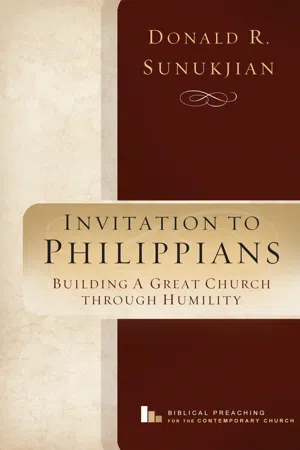
eBook - ePub
Invitation to Philippians (Biblical Preaching for the Contemporary Church)
Building a Great Church Through Humility
- 125 pages
- English
- ePUB (mobile friendly)
- Available on iOS & Android
eBook - ePub
Invitation to Philippians (Biblical Preaching for the Contemporary Church)
Building a Great Church Through Humility
About this book
These sample sermons show a combination of solid scholarly study, fidelity to the meaning and intent of the biblical author, oral clarity, contemporary relevance, humor, and creativity. Pastors who plan on preaching through any of these biblical books could be drawn to these sermons as models or as stimulating prompters for their own messages.
Information
Topic
Theologie & ReligionSubtopic
Biblischer Kommentar
Invitation to Philippians:
Building a Great Church through Humility
Building a Great Church through Humility
Invitation to James:
Persevering through Trials to Win the Crown
Persevering through Trials to Win the Crown
Invitation to the Life of Jacob:
Winning through Losing
Winning through Losing
Invitation to Galatians
(forthcoming)
(forthcoming)
Invitation to Mark
(forthcoming)
(forthcoming)
Invitation to Joshua
(forthcoming)
(forthcoming)

Invitation to Philippians: Building a Great Church through Humility
© 2014 by Donald R. Sunukjian
Lexham Press, 1313 Commercial St., Bellingham, WA 98225
LexhamPress.com
First edition by Weaver Book Company.
All rights reserved. You may use brief quotations from this resource in presentations, articles, and books. For all other uses, please write Lexham Press for permission. Email us at [email protected].
All Scripture quotations, unless otherwise indicated, are from the Holy Bible, New International Version®, NIV®. Copyright© 1973, 1978, 1984, 2011 by Biblica, Inc.TM Used by permission of Zondervan. All rights reserved worldwide. www.zondervan.com
Print ISBN 9781683592228
Digital ISBN 9781683592235
Cover design: LUCAS Art & Design
Editorial, design, and production:
{ In a Word } www.inawordbooks.com
/edited by Daphne Parsekian/
To the wonderful folks at
The Armenian Christian Fellowship
of Orange County;
no pastor was ever more loved.
Contents
Series Preface
Introduction
The Blazing Fastball That Gives Us Confidence
Philippians 1:1–8
Choosing What Is Best
Philippians 1:9–11
It’s All about You, Lord
Philippians 1:12–18
A Win–Win Situation
Philippians 1:19–26
Where’s the Gift Receipt?
Philippians 1:27–30
It’s Not Thinking Less of Yourself; It’s Thinking of Yourself Less
Philippians 2:1–4
Down the Ladder to the Highest Place
Philippians 2:5–11
Working Out the Working In
Philippians 2:12–18
“We Don’t Have Men Like That”
Philippians 2:19–30
The Christian Subculture: Righteous Or Rubbish?
Philippians 3:1–9
All I Really Need to Know I Learned by Suffering Triumphantly until I Died
Philippians 3:10–11
Straining for the Prize
Philippians 3:12–21
Peace in the Church
Philippians 4:1–9
How Should a Pastor Think about His People’s Giving?
Philippians 4:10–23
Series Preface
Some years ago I wrote a textbook—Invitation to Biblical Preaching—which has been translated into several languages and is being used rather widely to develop biblical preachers. This current series of volumes is being published as an Invitation to sermons on specific biblical books, individuals, or themes. The purpose of this series is to offer models of the principles presented in the textbook.
A sermon comes alive when it is true to the biblical author’s flow of thought, clear in its unfolding, interesting to listen to, and connected to contemporary life. Hopefully that’s true of the messages in this book.
These messages were originally preached before a congregation of God’s people, and then slightly edited to their present form in order to adjust from the hearing ear to the reading eye. But I’ve tried my best to retain their oral flavor—I’ve wanted them to still sound close to the way we talk. This means there will be incomplete sentences, colloquial and idiomatic language, and other features of the spoken word.
I’ve also occasionally included some stage directions, so that the reader can visualize any props or large physical movements that were part of a message.
May God speak to your heart through his Word.
Introduction
The church at Philippi was probably the one Paul loved the most. Every time he remembered them, he thanked God for them (1:3). They were dear to his heart, and he longed for them with all the affection of Christ (1:7–8).
They were the only church that supported him financially. At the end of his first visit to them, they sent him on his further missionary travels with a parting gift (4:15) and then repeatedly followed that up with additional financial aid (4:16). One of the reasons he wrote this letter was because Epaphroditus, one of their members, had just brought him yet another sizeable gift (1:3–5; 4:10–18).
The money Epaphroditus had brought enabled Paul to pay his living expenses. When he wrote, he was under house arrest in Rome, chained to a guard, though with freedom of movement through the house. He was financially responsible, however, for the rent on the house and for his food. If his funds dried up, the alternative would be a damp dungeon with little food and unhealthy conditions. In part, therefore, this is a thank-you letter to the Philippians for their generous and helpful gift.
Paul also had other reasons for writing. He had heard that the Philippian Christians were suffering for the faith, and he wanted to encourage them (1:27–30; 3:17–4:1). He had also heard of dissension in the church. Instead of humbly deferring to one another, some were insisting on having their own way (2:1–4; 4:2–5). He spent much of his letter pointing them to the examples set by Christ (2:1–11) and himself (3:3–16). In addition, he held up Timothy and Epaphroditus, two men well known to them, as models of self-sacrificing love (2:19–30).
It’s understandable that the Philippian church would struggle with issues of pride and self-importance. The city of Philippi had a unique, special status—it was a colony of Rome. This meant that even though it was located eight hundred miles from Rome, it was as though its citizens lived in Rome itself, with all the rights and privileges of Roman citizenship. Their pride in their Roman citizenship influenced their behavior in the church. Paul reminded the believers that they were most of all citizens of heaven (1:27; 3:17–4:1) and that they needed to live worthy of this higher allegiance.
Paul structured his letter to the Philippians in a chiastic pattern (see below), which means that his sequential top and bottom sections have matching themes and that his dominant section is the point of the wedge (>). In other words, Timothy and Epaphroditus, on a human level, model the exact spirit of humility and self-sacrifice that Paul wanted to see in the Philippians (2:19–30).
A Opening greetings (1:1–2)
B Thanks for your gift; my prayer for you (1:3–11)
C Rising above disunity and difficulty by rejoicing in Christ (1:12–26)
D Standing firm as citizens; contending together (1:27–30)
E In humility, living like Christ (2:1–11)
F Becoming blameless and pure (2:12–18)
G Timothy and Epaphroditus (2:19–30)
F' Guarding against evil men (3:1–4)
E' In humility, living for Christ (3:5–16)
D' Standing firm as citizens; waiting for the Lord (3:17–4:1)
C' Rising above disunity and difficulty by rejoicing in the Lord (4:2–7)
B' Thanks for your gift; my desire for you (4:8–20)
A' Final greetings (4:21–23)
The benefit of a chiastic structure is that it helps the reader to anticipate the flow of thought and to more accurately understand the matching sections in light of each other.
1
The Blazing Fastball That Gives Us Confidence
Philippians 1:1–8
July 15, 1986, Roger Clemens went to bat in his first all-star game. Roger was the sizzling right-hander for the Boston Red Sox who had been named starting pitcher for the American League All-Star team. In the second inning, it was his turn to bat. But batting was something Roger Clemens was not used to doing. He never batted, because in his league, the American League, they had the designated-hitter rule—someone else batted in place of the pitcher. Roger Clemens never batted; he just pitched. But the All-Star games between the American League and the National League alternated each year between the rules of the two leagues, and this year it was the National League’s rule—pitchers would bat for themselves. So Roger Clemens found himself coming to bat for the first time.
He took a few uncertain practice swings in the on-deck circle, and then he stepped into the batter’s box. On the mound was Dwight Gooden, the best pitcher in the National League. The year before, Dwight had won the Cy Young Award for being the best pitcher in all of baseball. So a pitcher who never batted was facing the best pitcher in all of baseball.
Dwight Gooden wound up and threw a white-hot, streaking fastball that blew by Roger Clemens. Roger stepped out of the box and blinked his eyes a few times. Then he turned to the catcher behind him, Gary Carter. “Gary, is that what my pitches look like?”
“You bet it is!” Gary said.
Roger Clemens stepped back into the box and quickly struck out. But when he went back on the pitcher’s mound to pitch for his team, he threw three perfect innings—nobody on the other team got a hit. He was voted the game’s Most Valuable Player. And he told people that from that day on, he had a greater confidence in his own pitching. When he saw how powerful his own fastball was and when he saw how it was working, he then pitched with all the confidence in the world.
What could give a church that same confidence—that God was powerfully working in it? What streaking “fastball” could we see that would tell us that God was making our church a place of joy and spiritual growth?
That’s not just a question for a church. It’s also a question for individuals. What would give you confidence that God was genuinely working in you? What “fastball” would give you confidence that he’s p...
Table of contents
- Series Preface
Trusted by 375,005 students
Access to over 1.5 million titles for a fair monthly price.
Study more efficiently using our study tools.
Frequently asked questions
Yes, you can cancel anytime from the Subscription tab in your account settings on the Perlego website. Your subscription will stay active until the end of your current billing period. Learn how to cancel your subscription
No, books cannot be downloaded as external files, such as PDFs, for use outside of Perlego. However, you can download books within the Perlego app for offline reading on mobile or tablet. Learn how to download books offline
Perlego offers two plans: Essential and Complete
- Essential is ideal for learners and professionals who enjoy exploring a wide range of subjects. Access the Essential Library with 800,000+ trusted titles and best-sellers across business, personal growth, and the humanities. Includes unlimited reading time and Standard Read Aloud voice.
- Complete: Perfect for advanced learners and researchers needing full, unrestricted access. Unlock 1.5M+ books across hundreds of subjects, including academic and specialized titles. The Complete Plan also includes advanced features like Premium Read Aloud and Research Assistant.
We are an online textbook subscription service, where you can get access to an entire online library for less than the price of a single book per month. With over 1.5 million books across 990+ topics, we’ve got you covered! Learn about our mission
Look out for the read-aloud symbol on your next book to see if you can listen to it. The read-aloud tool reads text aloud for you, highlighting the text as it is being read. You can pause it, speed it up and slow it down. Learn more about Read Aloud
Yes! You can use the Perlego app on both iOS and Android devices to read anytime, anywhere — even offline. Perfect for commutes or when you’re on the go.
Please note we cannot support devices running on iOS 13 and Android 7 or earlier. Learn more about using the app
Please note we cannot support devices running on iOS 13 and Android 7 or earlier. Learn more about using the app
Yes, you can access Invitation to Philippians (Biblical Preaching for the Contemporary Church) by Donald R. Sunukjian in PDF and/or ePUB format, as well as other popular books in Theologie & Religion & Biblischer Kommentar. We have over 1.5 million books available in our catalogue for you to explore.