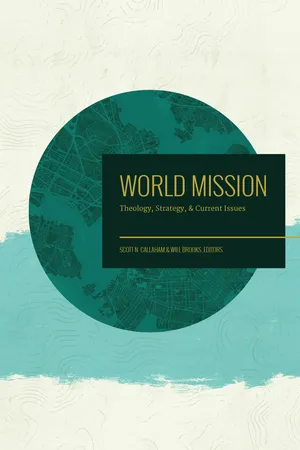
World mission needs a fully biblical ethos.
This is the contention of the editors of and contributors to World Mission, a series of essays aimed at reforming popular approaches to missions.
In the first set of essays, contributors develop a biblical theology of world mission from both the Old and New Testaments, arguing that the theology of each must stand in the foreground of missions, not recede into the background. In the second, they unfold the Great Commission in sequence, detailing how it determines the biblical strategy of all mission enterprises. Finally, they treat current issues in world mission from the perspective of the sufficiency of Scripture.
Altogether, this book aims to reform missions to be thoroughly--not just foundationally--biblical, a needed correction even among the sincerest missionaries.
- 376 pages
- English
- ePUB (mobile friendly)
- Available on iOS & Android
eBook - ePub
About this book
Information
Topic
Theology & ReligionSubtopic
Biblical Studies1
OLD TESTAMENT THEOLOGY AND WORLD MISSION
Scott N. Callaham
INTRODUCTION
“What does Old Testament theology have to do with world mission?” Anyone who considers Old Testament theology and world mission to be worthwhile enterprises should be prepared to answer this question. That said, one could possibly cast world mission in solely New Testament terms, treating Old Testament Scripture as irrelevant to mission-related theological reflection. One could also theoretically study Old Testament theology at great breadth and depth without once contemplating the issue of world mission. Both of these stances are flawed, and neither because they lack some elusive sense of balance nor simply because they fail to connect the two fields. After all, if Old Testament theology and world mission truly have little to do with each other, coercing them into contact through brute force or novel flights of ingenuity would hold meager value.
Against the backdrop of weighty issues such as this, the present study takes the first steps in shouldering the burden of this book: to call the church to return to a thoroughly biblical ethos for all aspects of world mission. This biblical ethos stems from biblical theology, such that the content, themes, and story line of the Bible determine everything else. Therefore, after setting its foundation on biblical authority, this chapter specifically asserts that if the first three-quarters of the Christian canon has something to say about world mission, then the church must listen and respond.
WORLD MISSION WITHOUT OLD TESTAMENT THEOLOGY: A CHALLENGE TO BIBLICAL AUTHORITY
World mission is a derivative idea, which is to say that it should derive from theological reflection on the Bible and take place in obedience to scriptural teaching. World mission shares this derivative nature with systematic theology, which also theoretically springs from but is not identical to Scripture.1 While established systems of doctrine have matured through the centuries within venerable complexes of theological thought, in the end even the most deeply rooted theological convictions must defer to Scripture at any point of dissonance. A necessary overarching implication of the concept of biblical authority is that Scripture as the word of God holds priority over all theological systems and philosophical worldviews.2 Similarly, all programs of world mission are subordinate to biblical teaching in every respect.
While a thoroughgoing presuppositional commitment to biblical authority might lead to ready acceptance of the concepts sketched out above, at the risk of repetition it is necessary to draw out at least three more specific implications of a robust view of biblical authority for world mission. For the purposes of the present study, the first implication of biblical authority is that the context-laden meaning of Scripture must exercise a controlling influence over theology. Therefore, at least in theory, present-day theologians reject the prooftexting practices of the past in favor of contextual biblical interpretation.3 “Rightly handling the word of truth” (2 Tim 2:15) unleashes the voice of the Bible to speak afresh into the theology and practice of the church. Thus in the specific case of world mission, assuming a certain theory or shape for world mission and then seeking scriptural teaching to shore it up is fundamentally at odds with the concept of biblical authority.4 Sound biblical teaching must instead give birth to theology of mission.
A second implication of biblical authority is that God and his word stand at the center of the Christian life. Now if God and his word occupy the center, there is no room for anything else there. In fact, this center overflows into the whole of life. Faithfully following Jesus through the empowerment of the Holy Spirit in obedience to the teachings of God’s word—for his glory alone—is the hallmark of being a Christian. Discrete elements of this full-orbed image of discipleship do not by themselves embody the whole; or to restate in another way, one’s degree of involvement in certain Christian activities is not a measure of faithfulness.5 Thus, for example, personal participation in missions is neither the purpose nor the essence of being a Christian. Additionally, in terms of preparation for Christian ministry, mission can never be the integrating center of theological education.6 On the broader scale of the Christian community, vibrant mission efforts do not necessarily imply healthy churches. Despite noble intentions, proposals such as these are critically imbalanced, for they unduly maximize the missional aspect of following Jesus at the expense of others. Instead the proper focal point of a Christian’s whole-life devotion must be God himself; otherwise one risks stealing the glory that belongs to God alone.
A third implication of biblical authority is acceptance of the entire canon of Scripture as authoritative. While rehearsing the critical questions surrounding the definition of the Christian canon is well beyond the scope of this chapter, it is necessary to raise the issue of canon in order to underscore that the canonicity of the Old Testament is a settled matter.7 If the Old Testament is inspired Scripture, then it cannot be Scripture in any kind of honorary sense, perhaps tolerated as a rather bulky historical prelude to “Christian Scripture”: in this case meaning the New Testament. Furthermore, if the Old Testament is inspired Scripture then there can also be no question of pitting the New Testament (or even portions of the New Testament) against it in an unreflective manner, as if the way of Jesus constitutes a repudiation of all that came before.8 Instead, merely observing the New Testament’s host of direct quotations of, allusions to, and verbal parallels with the Old Testament should refute crudely supersessionist thinking about God’s interactions with humanity leading up to the time of Jesus.9 Yet the Old Testament not only serves New Testament authors as an authoritative literary reference but also preemptively lays out the guiding principles of New Testament faith and thus is nothing less than, as C. H. Dodd puts it, “the substructure of all Christian theology.”10 Indeed, recognition of the Old Testament as canon requires that the entirety of the Old Testament be relevant to theological thinking. There can be no separating out of some parts as more authoritative than others.11 In the words of Bruce Waltke, “Every sentence of the Bible is fraught with theology, worthy of reflection.”12
To review, submission to biblical authority requires first listening to the voice of God through Scripture and then forming theology. In the process of constructing theology, interpreters must resist the urge to seize on and maximize certain theological themes (such as world mission) in a way that Scripture itself does not. Finally, respect for biblical authority requires that the Old Testament feature prominently in discussion of issues across the theological spectrum, including world mission. Taken together, these principles require a different approach to world mission from the panoply of alternatives commonly seen in contemporary missions practice. Simply put, it is time to return the word of God—including the Old Testament—to its rightful place at the center.
WORLD MISSION WITHIN OLD TESTAMENT THEOLOGY
In order to commence this recentering project, the present study turns its attention primarily toward Old Testament theologies. Therefore works specifically written to advance biblical foundations for mission or a missional understanding of the grand narrative of the Bible only appear in a minor, supporting role rather than a leading role. One expects these specialized works to discourse on missional undertones within broader theological themes in the Old Testament and thus exemplify a bottom-up approach to an Old Testament theology of mission. The bottom-up method is valuable for its concentration on mission, though in the background must always loom the potentially unfair suspicion of imbalanced issue advocacy.
In marked contrast, the Old Testament theology field as a whole is virtually invulnerable to the charge that it maintains an outsized interest in world mission. Accordingly, at first one might not expect a top-down approach, starting with Old Testament theologies, to deliver substantive theological reflection to missiologists. After all, mining the entire Old Testament in order to refine its theology requires treatment of a vast array of themes. Yet the following sections demonstrate the potential enrichment of missional theory and practice that await those who are willing to allow this first and largest part of the Christian Bible to shape their theology.
In order to provide a brief orientation to Old Testament theologies as a literary genre, the present study first raises awareness of the diversity manifested among such works. Then the following section reviews themes that spring from Old Testament theologies’ varying yet quite complementary treatments of the fate of gentile nations before Israel’s God. Last, a concluding section offers specific suggestions on how the contemporary practice of world mission should change in light of these elements of Old Testament theology.
DIVERSITY AMONG OLD TESTAMENT THEOLOGIES
Old Testament theology is a distinct field of study; therefore it is reasonable to open a book spanning the theology of the Old Testament with certain preconceived notions regarding what should appear within. However, alongside this expectation of fundamental commonality should stand concomitant awareness of broad diversity among these works.
Old Testament theologies differ widely from one another for a host of interrelated reasons. For example, confessional commitments cannot help but manifest themselves in an author’s writings. Thus in theory one might expect adherence to Christianity (whether Catholicism, Orthodoxy, or Protestantism), Judaism, some other religion, or perhaps no religion in particular to influence the development of an author’s Old Testament theology. However, in reality Protestant theological thinking has birthed, defined, and dominated the field, thus making Old Testament theology more or less a subcategory of Protestant theology.13 Accordingly, the diversity of Old Testament theology is at least partly due to its relative freedom from ecclesiastical control. Thus individual authors’ own intellectual landscapes largely channel their streams of theological reflection.
Old Testament theologies can express widely disparate viewpoints on certain subjects, for example on the fate of gentile nations: a key component of any conceptualization of world mission. On one hand, in the first Old Testament theology ever written, Georg Bauer expresses confidence that unaided human reason eventually leads to recognition of “a single, most perfect primeval being, the Creator and Conserver of the Universe.”14 On the other hand, Bauer asserts that according to Jewish belief, such nascent leanings toward monotheism would cast no light on “pagan nations.” The nations would instead “be condemned by the Jews on a solemn day of judgment, and be cast down to the lake of fire of Gehenna for everlasting punishment.”15 Consistent with this nationalistically charged depiction of Jewish eschatology, there was no place for a theology of mission in Bauer’s representation of ancient Judaism. Incidentally, limiting the task of Old Testament theology to tracing the historical development of ancient Jewish religion—like Bauer and many who have followed him—is a decision that carries significant ideological consequences. One such outcome is that assertions of contemporary theological significance for the Old Testament seem rather out of place, an alien imposition on a historical survey.16 Even the assumed connection between Old and New Testament studies weakens if one views the Old Testament as a desiccated historical artifact rather than something yet “living” and “active” (see Heb 4:12) clothed in writing.17
There is perhaps no starker contrast with Bauer than Robin Routledge’s treatment of the destiny of gentiles: “[God] will bring all nations to share in the relationship and blessings at first enjoyed by Israel. As we have seen, this was God’s intention from the start, and is to be achieved through the witness of a restored and renewed Israel.”18 In view of the extremes of Bauer on one hand and Routledge on the other, a reader of Old Testament theologies may well wonder how can one rely on a field so densely sown with disagreement on theoretical approach, format, and results to articulate a cohesive theology of mission. After all, the concept that gentiles could indeed share in the blessings of God and even become part of the people of God struck the early church as lacking theological precedent.19 However, it is precisely the existence of such rich diversity that makes any emergent consistency in thought all the more compelling. That is to say, if writers from many different backgrounds strike similar chords when discussing the Old Testament’s perspective on the nations, the resulting resonances are all the more sonorous and arresting. Discerning the underlying harmony of Old Testament theologies’ outlook on the nations is the promise of the following section.
THE NATIONS IN OLD TESTAMENT THEOLOGIES
Many Old Testament theologies explicitly address the fate of gentiles. From time to time sojourners live in the Israelites’ midst, and individual gentiles such as Rahab and Ruth enter into the covenant people, but neither the Old Testament itself nor its many written theologies imply that their example of assimilation was normative for all foreign peoples.20 By definition gentiles are not the people of Israel, thus prompting the question of how the God of Israel deals with them.
Interestingly, a cohesive pattern emerges as one considers how Old Testament theologies in aggregate treat this “gentile question.” Old Testament theologies commonly examine the fate of the nations in light of God’s work in creation, election, judgment, and new creation. Thus the present study now surveys treatment of these concepts among Old Testament theologies.
Creation
Theological thinking about the gentiles begins with creation. Of course, this must be true in a logical sense, in that creation has to do with the origin of all created things and thus serves as a plausible starting point for all theology.21 Furthermore, the creation of human beings came before the commissioning of Israel as a special people of Go...
Table of contents
- Cover
- Title Page
- Copyright
- Contents
- Dedication
- Abbreviations
- An Invitation to World Mission
- Section I: Theology and World Mission
- Chapter 1: Old Testament Theology and World Mission (Scott N. Callaham)
- Chapter 2: New Testament Theology and World Mission (Wendel Sun)
- Chapter 3: Biblical Theology and World Mission (Wendel Sun)
- Section II: World Mission Strategy
- Chapter 4: Discipleship as Integral Component of World Mission Strategy (Stephen I. Wright)
- Chapter 5: Focus on “All Nations” as Integral Component of World Mission Strategy (Jarvis J. Williams and Trey Moss)
- Chapter 6: Baptism as Integral Component of World Mission Strategy (John Massey and Scott N. Callaham)
- Chapter 7: Theological Education as Integral Component of World Mission Strategy (Sunny Tan and Will Brooks)
- Section III: Current Issues in World Mission
- Chapter 8: Language and World Mission (Scott N. Callaham)
- Chapter 9: Grammatical-Historical Exegesis and World Mission (Will Brooks)
- Chapter 10: Biblical Theology for Oral Cultures in World Mission (Jackson W.)
- Chapter 11: Paul as Model for the Practice of World Mission (Will Brooks)
- Afterword: What about You?
- Bibliography
- Subject Index
- Scripture Index
- Old Testament
Trusted by 375,005 students
Access to over 1.5 million titles for a fair monthly price.
Study more efficiently using our study tools.
Frequently asked questions
Yes, you can cancel anytime from the Subscription tab in your account settings on the Perlego website. Your subscription will stay active until the end of your current billing period. Learn how to cancel your subscription
No, books cannot be downloaded as external files, such as PDFs, for use outside of Perlego. However, you can download books within the Perlego app for offline reading on mobile or tablet. Learn how to download books offline
Perlego offers two plans: Essential and Complete
- Essential is ideal for learners and professionals who enjoy exploring a wide range of subjects. Access the Essential Library with 800,000+ trusted titles and best-sellers across business, personal growth, and the humanities. Includes unlimited reading time and Standard Read Aloud voice.
- Complete: Perfect for advanced learners and researchers needing full, unrestricted access. Unlock 1.5M+ books across hundreds of subjects, including academic and specialized titles. The Complete Plan also includes advanced features like Premium Read Aloud and Research Assistant.
We are an online textbook subscription service, where you can get access to an entire online library for less than the price of a single book per month. With over 1.5 million books across 990+ topics, we’ve got you covered! Learn about our mission
Look out for the read-aloud symbol on your next book to see if you can listen to it. The read-aloud tool reads text aloud for you, highlighting the text as it is being read. You can pause it, speed it up and slow it down. Learn more about Read Aloud
Yes! You can use the Perlego app on both iOS and Android devices to read anytime, anywhere — even offline. Perfect for commutes or when you’re on the go.
Please note we cannot support devices running on iOS 13 and Android 7 or earlier. Learn more about using the app
Please note we cannot support devices running on iOS 13 and Android 7 or earlier. Learn more about using the app
Yes, you can access World Mission by Scott N. Callaham,Will Brooks in PDF and/or ePUB format, as well as other popular books in Theology & Religion & Biblical Studies. We have over 1.5 million books available in our catalogue for you to explore.