A systematic theology from the pillars of evangelicalism.
Basics of the Faith is an overview of essential Christian doctrines from some of the best minds of mid-twentieth century evangelicalism around the globe. Originally appearing in the pages of Christianity Today during 1961-1962, this collection includes essays from influential theologians and biblical scholars including Philip E. Hughes on inspiration, Anthony A. Hoekema on the divine attributes, John Murray on sanctification, Cornelius Van Til on original sin, F. F. Bruce on the person of Christ, G. E. Ladd on the saving acts of God, Leon Morris on the atonement, and J. I. Packer on the nature of the church. This edition includes an introduction by Kevin J. Vanhoozer that lays out their original context and evaluates their ongoing significance. Approachable yet scholarly, Basics of the Faith is both a relevant systematic theology and a celebration of evangelical heritage.
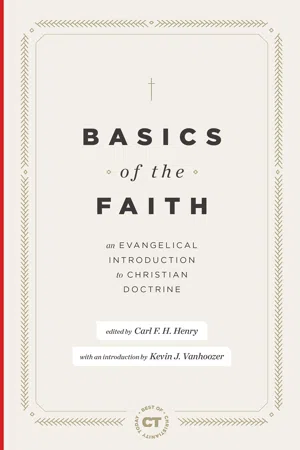
eBook - ePub
Basics of the Faith (Best of Christianity Today)
An Evangelical Introduction to Christian Doctrine
- 384 pages
- English
- ePUB (mobile friendly)
- Available on iOS & Android
eBook - ePub
Basics of the Faith (Best of Christianity Today)
An Evangelical Introduction to Christian Doctrine
About this book
Information
Topic
Theology & ReligionSubtopic
Christian TheologyChapter 1
GENERAL REVELATION AND SPECIAL REVELATION
ADDISON H. LEITCH
Addison H. Leitch (1908–1973) was a Presbyterian theologian who earned a PhD from Cambridge University and taught at Pittsburgh-Xenia Theological Seminary, Tarkio College (Tarkio, MO), and Gordon-Conwell Theological Seminary (South Hamilton, MA). He is the author of Interpreting Basic Theology (1961) and A Layman’s Guide to Presbyterian Beliefs (1967).
It is the psalmist who sings “The Heavens declare the glory of God; and the firmament showeth his handiwork. Day unto day uttereth speech, and night unto night showeth knowledge. There is no speech nor language, their voice is not heard.” Men have known these things for generations. They have gloried in the glory of a God who manifests himself in his wonderous works. No speech nor language is spoken, it is not in the words of Greek or Hebrew or German or English; yet every day speaks and every night shows knowledge. The apostle adds in a later day “the invisible things of him from the creation of the world are clearly seen, being understood by the things that are made, even his eternal power and godhead; so that they are without excuse …” Psalmist and apostle declare what no man can deny, that there is a God who can be known through his works and when we refuse to see him there, we are without excuse.
Such knowledge of God forced on us by the world around us has been recognized and accepted by believers in every generation. In some fashion it is the approach of Plato as he moves level upon level to his supreme Idea, an idea, which according to Plato’s thinking, necessarily has moral qualities which can be defined as an Ideal. In some fashion it is the approach of Aristotle as his system carries us from utter matter to perfect form or from the inanimate world to the high reaches of the Unmoved Mover. More specifically, in the Christian tradition, men have discovered in the world around them “proofs” for God, reasons for faith, necessities for believing, and, at least, in the direction of their thinking, they have been forced toward some knowledge of God. Arguments for the existence of God and in support of the nature of God are very old ones. They have been subjected to much criticism and therefore to considerable refinement in the history of thought. In spite of such criticism, however, they keep cropping up in one form or another, one argument, or one way of stating the argument, appealing to one generation more than to another; but none of the arguments ever quite disappears. That these arguments keep reviving is probably a reason for their fundamental strength; men feel under some duress to define what they know must be true about God from the evidence of the external world.
FROM EFFECTS TO THEIR CAUSE
Keeping in mind that these arguments say something about God’s attributes as well as giving reasons for his existence, we are justified in using them as supports in natural theology for our knowledge of God. In general, the arguments move under at least four titles: the Cosmological, the Teleological, the Anthropological, and the Ontological. These arguments all allow somewhat the same scheme, namely that an effect must have a cause equal to or greater than the effect itself. In the general scheme of things you cannot get something from nothing and, surely, one can observe a great deal of something in the world of nature; the question is, therefore, what is “the source, the support, and the end” of all these things about us? What is the explanation of their existence?
The easiest argument is The Cosmological. It argues from the existence of the Cosmos, the universe, what C. S. Lewis calls “the whole show.” Man does not need to be either clever or subtle merely to wonder about the world around him. How can one account for all these things he sees and experiences—the birds, the rocks, the trees, and the stars in their courses. This first argument in “natural” theology finds us unable to escape the belief that back of all this cosmos there is some thing or some one equal to bringing into existence (by what method we need not argue here) the universe within us, around us, and above us.
The Teleological argument is more reflective regarding the universe. Here our interest is focused on design and purpose as we discover the amazing intricacy with which all things are interlocked as if united in some grand mutual interdependancy, some basic design. These interlocked designs and purposes point to a designer, some intelligence with creative purpose. There are no isolated data, there is no item so small that it is not somehow interrelated with every possible other thing. Nothing ever “just happens.” You can never really say of anything that “it doesn’t really matter.” Butler in his Analogy, Paley in his Evidences, and in these latter days F. R. Tennant in his Philosophical Theology found this argument from design almost conclusive for the existence and the nature of God.
In his master work, Nature, Man and God, William Temple sets himself to examine the world of nature only to discover that nature includes man and that nature and man together point us to God. In some such fashion The Anthropological argument grows out of the Teleological argument, for nothing points more clearly to intelligence and design than the fact of man himself, man who is able to understand the design and to appreciate the designer. But beyond this is man as person. Man as a person has what we call personality. Will anyone seriously argue that personality can arise from some impersonal source? Will anyone seriously support accidents or material or both as sufficient to account for all the wonders in man? Since man is so creative himself, was the ground of his existence uncreative? Thus the argument runs. We cannot get something from nothing; we have something personal in man; we cannot believe that this personal end-product comes from impersonal sources.
The Ontological argument points to perfection or more exactly to the idea of perfection which we find inescapable in our ways of thought. To use our thinking about God as an example, how is it possible for us to talk about the perfections of God without some idea of perfection as a point of reference. Yet we are imperfect ourselves, we think imperfectly, we are surrounded by a world of imperfections. Since, once again, we cannot get something from nothing and since assuredly we have ideas of perfection which cannot be accounted for in the immediacies of our surroundings, the conclusion suggests itself that this idea of perfection must come directly from the perfect source, namely, from God himself.
It would appear from this brief treatment that we have at least four reasons for believing in God. (Some add the moral argument, that is, the inescapable sense of “oughtness” common to all men, Kant’s catagorical imperative. We believe that the moral argument which we have not here expanded can find a natural place in the Anthropological argument.) These tell us some very definite things about God’s nature—he is mighty enough to account for the universe itself, he is intelligent enough to satisfy its design, he is personal enough to account for man as person, and he is the ground of all our understanding and perfection. If we add creativity and morality as necessary to man as person, we may presume to have found as necessary a God who is almighty, intelligent, personal, creative, moral, and perfect. We are not far from the kingdom!
FROM NECESSARY PRESUPPOSITIONS
What has been said thus far usually comes under the heading of a posteriori reasoning, that is, reaching our conclusions inductively. There are others who prefer the a priori approach; this is, as a matter of fact, the approach of much of the theology of our day. Knowledge of God with this approach is not so much the result of our thinking as it is the starting place of our thinking. The starting place is always there, described sometimes as a first truth, and it is only in personal intellectual maturity or perhaps in the maturity of the race that man gets around to analyzing the nature of his starting place. Living as we do in an age dominated by scientific method, it is difficult for us to accept the fact that we operate even in science, even in our “proofs,” from the foundation of various presuppositions. For many, the fact of God is one of the necessary presuppositions.
All of us must accept some first truths about ourselves from the outset. We are alive and awake and sane; such truths about ourselves which we cannot prove objectively; we merely accept them as starting places. On a deeper level we base our thinking on the assumption that there are certain foundations of Truth and Reason from which we operate and to which we constantly return. We believe that truth has an interrelatedness in a universe (which is a single organizational principle of truth).
All serious thinking, especially the most objective scientific research, upholds the necessity of absolute honesty in methods and in findings, appealing therefore to a moral ground built into the structure of reality. In other directions our words betray us: “it stands to reason” or “that doesn’t make sense.” Thus we are insisting that our thinking, as well as our experimenting, demands a frame of reference that is sensible. Moreover, we appeal to one another on the grounds of a common acceptance of these necessary fundamentals. Notice the presupposition of this paragraph recently published in the Science section of Time magazine where the discussion has to do with the possibility of interplanetary conversations: “But what message would aliens send that could be understood by earthlings? Dr. Drake suggests a familiar series of numbers, such as 1, 2, 3, 4. Professor Purcell believes that a simple on-off signal would be more logical as a starter. After that the messages could progress to Mathematical relationships, which are surely the same in all planetary systems …”1 Note how normal it is for scientists to assume an underlying rational system.
FROM SPECIAL REVELATION
From this a priori approach it is interesting to note that we are talking again about a Reality at the source of things showing attributes of Truth, Reason, and Morality. We are being pressed to the conclusion again, namely, that in what is called Natural Theology there are strong reasons for knowing that there is a God and knowing something of his attributes. But, “can a man by searching find out God?” Only is this possible when God is pleased to reveal himself and to answer finally and authoritatively man’s deepest questions. This is not Natural Revelation but Special Revelation. This is the Bible record of God’s mighty acts and his authoritative Word about the revelatory acts and about himself. This is the climax and fulfillment of God’s Word to us in the Living Word even Jesus Christ. Natural revelation gives us direction and confidence in our search for God; God’s Special Revelation gives us final authority and assurance regarding his own nature and his will for man. As Calvin suggests, in the Bible we have the “divine spectacles” which bring the truths of natural theology into focus.
BIBLIOGRAPHY
In addition to classic systematic theologies by C. Hodge, A. H. Strong, L. Berkhof, and others, we suggest:
R. Flint, Evangelical Theism (an old standard work)
J. Gerstner, Reasons for Faith (popular and sound)
S. M. Thompson, A Modern Philosophy of Religion
H. Heppe, Reformed Dogmatics
K. Barth, Church Dogmatics (dialectical)
F. R. Tennant, Philosophical Theology (liberal but surprisingly firm in its objective approach)
Chapter 2
THE SAVING ACTS OF GOD
GEORGE E. LADD
George Eldon Ladd (1911–1982) was a Baptist New Testament scholar who earned a PhD from Harvard University and taught at Fuller Theological Seminary (Pasadena, CA). He is the author of numerous books, including The Gospel of the Kingdom (1959) and A Theology of the New Testament (1974).
The uniqueness and the scandal of the Christian religion rest in the mediation of revelation through historical events. The Hebrew-Christian faith stands apart from the religions of its environment because it is a historical faith whereas they were religions rooted in mythology or the cycle of nature. The God of Israel was the God of history, or the Geschichtsgott, as German theologians so vividly put it. The Hebrew-Christian faith did not grow out of lofty philosophical speculation or profound mystical experiences. It arose out of the historical experiences of Israel, old and new, in which God made himself known. This fact imparts to the Christian faith a specific content and objectivity which sets it apart from others.
At the same time, this very historical character of revelation raises an acute problem for many thinking men. Plato viewed the realm of time and space as one of flux and change. History by definition involves relativity, particularity, caprice, arbitrariness, whereas revelation must convey the universal, the absolute, the ultimate. History has been called “an abyss in which Christianity has been swallowed up quite against its will.”
REVELATORY HISTORY
How can the Infinite be known in the finite, the Eternal in the temporal, the Absolute in the relativities of history? From a purely human perspective, this is impossible; but at precisely this point is found perhaps the greatest miracle in the biblical faith. God is the living God, and he, the eternal, the unchangeable, has communicated knowledge of himself through the ebb and flow of historical experience.
The problem is well nigh insoluble for the man who takes his world view from modern philosophies rather than from the Bible. Yet there can be no doubt about the Bible’s claim for the historical character of revelation. This can be seen in the historical character of the Bible itself. From one point of view, the Bible is not so much a book of religion as a book of history. The Bibile is not primarily a collection of the religious ideas of a series of great thinkers. It is not first of all a system of theological concepts, much less of philosophical speculations. Nowhere, for instance, does the Bible try to prove the existence of God; God simply is. His existence is everywhere assumed. Nowhere does the New Testament reflect on the deity of Christ. Christ is God, and yet God is more than Christ. The Father is God, Christ is God, the Holy Spirit is God; and yet God is one, not three. The New Testament does not try to synthesize these diverse elements into a theological whole. This is the legitimate and necessary task of systematic theology.
Neither is the Bible primarily the description of deep mystical experiences of religious geniuses, a...
Table of contents
- Cover
- Title Page
- Copyright
- Contents
- Introduction: The “Greatest Generation” and Its Legacy for the Future of Evangelical Theology (Kevin J. Vanhoozer)
- Chapter 1: General Revelation and Special Revelation (Addison H. Leitch)
- Chapter 2: The Saving Acts of God (George E. Ladd)
- Chapter 3: The Inspiration of the Bible (Philip E. Hughes)
- Chapter 4: The Incommunicable Attributes of the Triune God (Fred H. Klooster)
- Chapter 5: The Communicable Attributes of God (Anthony A. Hoekema)
- Chapter 6: The Holy Trinity (J. Kenneth Grider)
- Chapter 7: The Decrees of God (Geoffrey W. Bromiley)
- Chapter 8: Predestination (William Childs Robinson)
- Chapter 9: Creation (Harold B. Kuhn)
- Chapter 10: Angels (Bernard Ramm)
- Chapter 11: Satan and the Demons (G. C. Berkouwer)
- Chapter 12: Providence (Andrew K. Rule)
- Chapter 13: Miracles (Henry Stob)
- Chapter 14: The Origin and Nature of Man (John H. Gerstner)
- Chapter 15: The Covenant of Works (Oswald T. Allis)
- Chapter 16: The Nature and Origin of Sin (J. Oliver Buswell, Jr.)
- Chapter 17: Original Sin, Imputation, and Inability (Cornelius Van Til)
- Chapter 18: The Covenant of Grace (Herbert M. Carson)
- Chapter 19: The Person of Christ: Incarnation and Virgin Birth (F. F. Bruce)
- Chapter 20: The Person of Christ: The Kenotic Theory (Wayne E. Ward)
- Chapter 21: The Person of Christ: Death, Resurrection, Ascension (Ralph Earle)
- Chapter 22: Jesus Christ: Prophet, Priest, and King (Samuel J. Mikolaski)
- Chapter 23: The Atonement (Leon Morris)
- Chapter 24: The Intercessory Work of Christ (Robert Paul Roth)
- Chapter 25: The Work of the Holy Spirit (John F. Walvoord)
- Chapter 26: Common Grace (M. Eugene Osterhaven)
- Chapter 27: Effectual Calling (J. Norval Geldenhuys)
- Chapter 28: Regeneration (Otto Michel)
- Chapter 29: Repentance and Conversion (Julius R. Mantey)
- Chapter 30: Faith (Calvin D. Linton)
- Chapter 31: The Mystical Union (William A. Mueller)
- Chapter 32: Justification by Faith (H. D. McDonald)
- Chapter 33: Adoption (J. Theodore Mueller)
- Chapter 34: Sanctification (John Murray)
- Chapter 35: The Perseverance of the Saints (W. Boyd Hunt)
- Chapter 36: The Nature of the Church (James I. Packer)
- Chapter 37: The Government of the Church (Edward John Carnell)
- Chapter 38: Baptism and the Lord’s Supper (Merrill C. Tenney)
- Chapter 39: Other Means of Grace (Frank E. Gaebelein)
- Chapter 40: Death and Immortality (J. G. S. S. Thomson)
- Chapter 41: The Second Coming: Millennial Views (William M. Arnett)
- Chapter 42: The Resurrection of the Dead and Final Judgment (Walter W. Wessel)
- Chapter 43: The Final State: Heaven and Hell (J. A. Motyer)
- Subject Index
- Scripture Index
- Old Testament
Trusted by 375,005 students
Access to over 1.5 million titles for a fair monthly price.
Study more efficiently using our study tools.
Frequently asked questions
Yes, you can cancel anytime from the Subscription tab in your account settings on the Perlego website. Your subscription will stay active until the end of your current billing period. Learn how to cancel your subscription
No, books cannot be downloaded as external files, such as PDFs, for use outside of Perlego. However, you can download books within the Perlego app for offline reading on mobile or tablet. Learn how to download books offline
Perlego offers two plans: Essential and Complete
- Essential is ideal for learners and professionals who enjoy exploring a wide range of subjects. Access the Essential Library with 800,000+ trusted titles and best-sellers across business, personal growth, and the humanities. Includes unlimited reading time and Standard Read Aloud voice.
- Complete: Perfect for advanced learners and researchers needing full, unrestricted access. Unlock 1.5M+ books across hundreds of subjects, including academic and specialized titles. The Complete Plan also includes advanced features like Premium Read Aloud and Research Assistant.
We are an online textbook subscription service, where you can get access to an entire online library for less than the price of a single book per month. With over 1.5 million books across 990+ topics, we’ve got you covered! Learn about our mission
Look out for the read-aloud symbol on your next book to see if you can listen to it. The read-aloud tool reads text aloud for you, highlighting the text as it is being read. You can pause it, speed it up and slow it down. Learn more about Read Aloud
Yes! You can use the Perlego app on both iOS and Android devices to read anytime, anywhere — even offline. Perfect for commutes or when you’re on the go.
Please note we cannot support devices running on iOS 13 and Android 7 or earlier. Learn more about using the app
Please note we cannot support devices running on iOS 13 and Android 7 or earlier. Learn more about using the app
Yes, you can access Basics of the Faith (Best of Christianity Today) by Carl F. H. Henry in PDF and/or ePUB format, as well as other popular books in Theology & Religion & Christian Theology. We have over 1.5 million books available in our catalogue for you to explore.