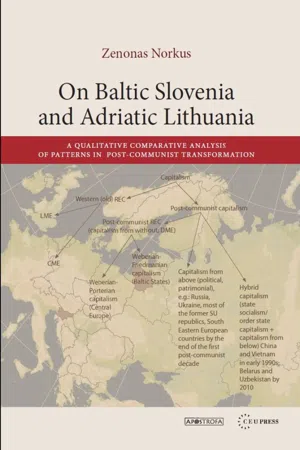
A unique application of social science software to generate typology and ranklist of transition models of twenty-nine countries in Europe and Asia, ranging from Estonia to Vietnam, Norkus provides a highly innovative internationally comparative causal analysis of the variation in political and economic outcomes after the first decade of post-communist transformations, using multi-value Qualitative Comparative Analysis and Tosmana programme. The analysis includes a critical revision of received dichotomies (e.g. on gradualism versus "shock therapy"), and contributes to current debates on the varieties of post-communist capitalism.This conceptual framework is applied in national case studies, searching for reasons behind successes and failures, with special consideration given to the possibility of alternatives to the Lithuanian way, and the challenges of populism in this country's politics.
eBook - PDF
On Baltic Slovenia and Adriatic Lithuania
A Qualitative Comparative Analysis of Patterns in Post-Communist Transformation
- 377 pages
- English
- PDF
- Available on iOS & Android
eBook - PDF
On Baltic Slovenia and Adriatic Lithuania
A Qualitative Comparative Analysis of Patterns in Post-Communist Transformation
About this book
Information
Table of contents
- Cover
- Title page
- Copyright page
- Contents
- List of Figures
- List of Tables
- Introduction
- Part I . Patterns of Post -Communist Transformation
- Chapter 1. The Concept of Post-Communist Transformation
- 1.1. What Was Communism?
- 1.2. The Concept of the Exit from Communism
- 1.3. Conceptual Foundations of the Typology of Paths of Post-Communist Transformation
- Chapter 2. Orientations and Modes of Post-Communist Transformation
- 2.1. Orientations of the Exit from Communism: Concepts and Cases
- 2.2. Economic Modes of the Exit from Communism: Concepts and Cases
- 2.3. Political Modes of the Exit from Communism: Concepts and Cases
- Chapter 3. Economic and Political Outcomesof Post-Communist Transformation
- 3.1. Change and Diversity of Capitalismin the Comparative Economic Sociology and Political Economy
- 3.2. Rational Entrepreneurial Capitalism in the Post-Communist World
- 3.3. Political Oligarchic and State Capitalismin the Post-Communist World
- 3.4. Democracy, Authoritarianism, and Their Adjectives:Outcomes of Political Transformation
- Chapter 4. Pathways and Patterns of Post-Communist Transformation
- 4.1. Comparative Qualitative Analysis as a Method of Theory Building
- 4.2. From Empirically Observed to Counterfactual Waysof Post-Communist Transformation
- 4.3. All Ways of Post-Communist Transformation
- Part I I . Capitalism and Democracy in Post -CommunistLithuania : Deepening Comparative Contexts
- Chapter 5. Why Lithuania “Lagged” Behind Estonia?
- 5.1. A North-South Gap in the Post-Communist Transformationof the Baltic States as a Problem of Explanation
- 5.2. An Economic Explanation of Lithuania’s Falling Back
- 5.3. A Political-Economic Explanation:Does the Blame Lay on Lithuanian Ex-Communists?
- 5.4. A Culturalist Explanation: “Weber’s Thesis” for the Baltic Countries?
- 5.5. Latvia and Other Difficulties of the Culturalist Explanationof the Estonia’s Success: Towards Resolution
- Chapter 6. Between Estonia and Slovenia: Post-Communist Capitalism in Lithuania and Its Prospects
- 6.1. Baltic States and Slovenia as Extremitiesof Post-Communist Rational Entrepreneurial Capitalism
- 6.2. Baltic Capitalism(s) – New Liberal Market EconomiesBetween the Core and Periphery?
- 6.3. Could Lithuania Have Become the “Baltic Slovenia”?
- 6.4. How Slovenia Could Have Become the “Adriatic Lithuania”
- Chapter 7. The Presidential Impeachment as the Stress Testof the Liberal Democracy in Lithuania
- 7.1. Populism and Perils of Semi-Presidentialismin the Baltics and Central Europe
- 7.2. Paksasgate Story: Staging, Casting, and Plots about Plots
- 7.3. Did the Successful Impeachment of Rolandas Paksas Save Liberal Democracy in Lithuania from Breakdown?
- 7.4. Was it All Sound and Fury, Signifying Nothing, or Why ImpeachmentDid Not Enhance the Quality of Democracy in Lithuania?
- Concluding Clarifications and Invitations
- References
- Name Index
- Subject Index
Trusted by 375,005 students
Access to over 1.5 million titles for a fair monthly price.
Study more efficiently using our study tools.
Frequently asked questions
Yes, you can cancel anytime from the Subscription tab in your account settings on the Perlego website. Your subscription will stay active until the end of your current billing period. Learn how to cancel your subscription
No, books cannot be downloaded as external files, such as PDFs, for use outside of Perlego. However, you can download books within the Perlego app for offline reading on mobile or tablet. Learn how to download books offline
Perlego offers two plans: Essential and Complete
- Essential is ideal for learners and professionals who enjoy exploring a wide range of subjects. Access the Essential Library with 800,000+ trusted titles and best-sellers across business, personal growth, and the humanities. Includes unlimited reading time and Standard Read Aloud voice.
- Complete: Perfect for advanced learners and researchers needing full, unrestricted access. Unlock 1.5M+ books across hundreds of subjects, including academic and specialized titles. The Complete Plan also includes advanced features like Premium Read Aloud and Research Assistant.
We are an online textbook subscription service, where you can get access to an entire online library for less than the price of a single book per month. With over 1.5 million books across 990+ topics, we’ve got you covered! Learn about our mission
Look out for the read-aloud symbol on your next book to see if you can listen to it. The read-aloud tool reads text aloud for you, highlighting the text as it is being read. You can pause it, speed it up and slow it down. Learn more about Read Aloud
Yes! You can use the Perlego app on both iOS and Android devices to read anytime, anywhere — even offline. Perfect for commutes or when you’re on the go.
Please note we cannot support devices running on iOS 13 and Android 7 or earlier. Learn more about using the app
Please note we cannot support devices running on iOS 13 and Android 7 or earlier. Learn more about using the app
Yes, you can access On Baltic Slovenia and Adriatic Lithuania by Zenonas Norkus in PDF and/or ePUB format, as well as other popular books in History & Baltic History. We have over 1.5 million books available in our catalogue for you to explore.