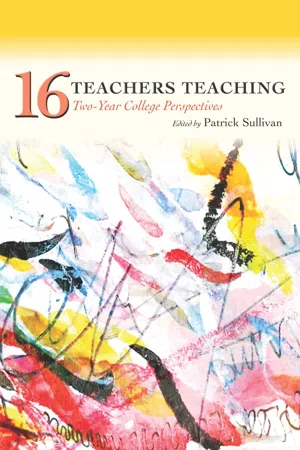
Sixteen Teachers Teaching is a warmly personal, full-access tour into the classrooms and teaching practices of sixteen distinguished two-year college English professors. Approximately half of all basic writing and first-year composition classes are now taught at two-year colleges, so the perspectives of English faculty who teach at these institutions are particularly valuable for our profession. This book shows us how a group of acclaimed teachers put together their classes, design reading and writing assignments, and theorize their work as writing instructors.
All of these teachers have spent their careers teaching multiple sections of writing classes each semester or term, so this book presents readers with an impressive—and perhaps unprecedented—abundance of pedagogical expertise, teaching knowledge, and classroom experience. Sixteen Teachers Teaching is a book filled with joyfulness, wisdom, and pragmatic advice. It has been designed to be a source of inspiration for high school and college English teachers as they go about their daily work in the classroom.
Contributors: Peter Adams, Jeff Andelora, Helane Adams Androne, Taiyon J. Coleman, Renee DeLong, Kathleen Sheerin DeVore, Jamey Gallagher, Shannon Gibney, Joanne Baird Giordano, Brett Griffiths, Holly Hassel, Darin Jensen, Jeff Klausman, Michael C. Kuhne, Hope Parisi, and Howard Tinberg
- English
- ePUB (mobile friendly)
- Available on iOS & Android
eBook - ePub
About this book
Information
Part I
An Introduction to Teaching Writing at the Two-Year College

1
Dispatches from Bartertown
Building Pedagogy in the Exigent Moment
Darin L. Jensen
Abstract: This essay explores the challenge of engaging in authentic critical literacy work while being positioned as contingent labor in the neoliberal community college. The author offers a set of principles that help him engage in literacy work while negotiating the significant systemic and ideological challenges faced in the twenty-first-century writing classroom.
“There is no such thing as a single-issue struggle because we do not live single-issue lives.”
—Audre Lorde (n.p.)
The Landscape and Some Questions
This volume’s call to examine teaching writing in the two-year college is an important one. Nearly half of all first-year writing courses are taught at the two-year college, and I imagine that a high percentage of the two million students who take developmental education classes annually do so at a community college (Lovas 2002, Saxon et. al. 2005). What’s more, the two-year college engages students who are the least visible and most often relegated to the sidelines. In fact, a quick look at the American Association of Community Colleges’ Fast Facts reveals that two-year colleges teach a diverse body of students, including 40 percent of first-time freshmen, a majority of Hispanic and Native American students, and a significant numbers of black and Asian students (AACC 2018). The two-year college is inarguably one of the most important sites for education in the United States. If we are going to examine teaching writing in the community college, there are three broad sites of inquiry in which to aim our work:
- 1. What does it mean to teach in the community college in the twenty-first century?
- 2. What does it mean to teach a writing course in the twenty-first century? How do we undertake the task well? What are the best practices?
- 3. What does it mean to teach as an adjunct in the community college in this moment? This last question is crucial because over three-fourths of postsecondary teachers are contingent faculty (Curtis 2014).
The Twenty-First Century Community College
I confess that I love the community college. At its best, it is an agile institution that meets the needs of a community and helps prepare citizens to make those communities better. But we must be honest; The community college has always had tension in its mission. The tension is complex. Part of it sits in the space between work for transfer and work for vocation. Part of it sits in the notion of the purpose of the community college. What is it for? At this moment, the answer is that the community college is largely an institution guided by neoliberal ideology—the notion that everything is a market and that all education is job preparation (see Caplan 2018). Students are customers. Colleges partner with businesses to train employees to enter the market. We are either creating students who can immediately enter the workplace with a vocation or we are creating students who will transfer to a university to receive more training to be a technocrat and then enter the economy. We talk about competition and marketability rather than the public good and community.
But is that all that the two-year college is for? The short answer for me is: I hope not. Community colleges have a long association with the democratization of education with open access and being able to represent students who are not traditionally represented in post-secondary education. However, as Barry Alford mentions in “Composition in the New Gilded Age,” it seems almost quaint to hear education and democracy in the same sentence (Alford 2017). Recently, Patrick Sullivan wrote an entire book on neoliberalism in the community college that examines this tension (see Sullivan’s Economic Inequality 2017), and Nancy Welch and Tony Scott recently edited the collection Composition in the Age of Austerity (2016), which examines the influences of neoliberalism on education. These works point to our political moment wherein ideological and budgetary forces seemingly are aligned against affordable and accessible education and seem to be headed toward crisis. Decades of neoliberal ideology have undermined faith in public institutions and the institutions themselves. Sadly, arguments about the public good of education belong in the same quaint club Alford describes.
The moment the community college finds itself in is one where state legislatures demand evidence of persistence and completion, where developmental education is under attack as a barrier to success, more than three-fourths of the instructional workforce is contingent, and funding for community colleges has decreased by nearly 40 percent over the last three decades (Harbour 2014). It’s tough. Even so, students are still coming through the doors and they want to learn and they still believe in the power of education in some fashion. Working with those students, who have wildly different levels of preparation and who live under the exigent conditions of austerity and the pernicious ideology of neoliberalism, is what’s on the table. High stakes indeed.
These exigent circumstances have led me to think of the community college, and educational institutions in general, as Bartertown, the fictional town in Mad Max: Beyond Thunderdome. Bartertown is out in the wasteland and its primary purpose is trade and income generation. Bartertown is the raw market—everything is a market without any of the shiny varnish we have in our world. Anything can be had for a price. And under Bartertown is the Underworld, which provides power to Bartertown through methane generation—literally pig shit. The Underworld is staffed by those who “ask” for work. No one would want to ask for work there, but it is all some can get. It’s not too much of a stretch to see Bartertown and the Underworld as symbols for the neoliberal community college—devoted to economic output with a vast underworld of exploited adjunct laborers keeping it functioning.
Teaching Writing in the Twenty-First Century
Considering our notion of Bartertown, what does it mean to be a writing teacher, especially in the two-year college? I always think of Mike Rose’s Lives on the Boundary when I start to think about what it means to teach writing. Early in his book, Rose takes on the notion of literacy crises. He gives a succinct account of how before World War II, most students read at a fourth-grade level, and then we needed more as a society (Rose 1990, 6). He tells us that compulsory high school education wasn’t demanded until the late 1970s (1990, 6). His point is that rather than a literacy crisis or series of literacy crises, what we’ve really had occurring in the United States is an opening up of literacy and the opportunity to become literate. The last three US presidents (Clinton, Bush, and Obama) all called for post-secondary education on a much wider scale. Of course, they couched it in neoliberal terms: We are preparing human resources for the market, we are working to be more competitive, etc. But the fact remains that we are teaching more people—and more people who would not otherwise be included in education than we ever have before in the United States, and the community college is a major facilitator of that labor. Neoliberal or not, the community college has been an influence for the public good. What, then, is the role of the language teacher?
For me, what it means to be a writing/language teacher in the two-year college is a need to be true to an ideology and practice of education that prepares students in ways that will help them employ literacy for their own benefit and for the benefit of their community. The driving ideological framework I use comes from critical pedagogy—scholars and teachers like bell hooks, Audre Lorde, Patrick Finn, Paolo Friere, and Carmen Kynard. hooks encapsulates this idea when she calls for “teaching that enables transgressions—a movement against and beyond boundaries” so that “education is a practice of freedom” (hooks 2014, 12). I envision an education that benefits students and their local communities as they define that benefit. Importantly, I consider local contexts just as essential for teaching in the community college. I contrast this localism with the drive for fitting out students as technocrats and cogs in a globalized service economy. This ideological orientation in the classroom is an enormous commitment. I take seriously hooks’ notion that teaching is sacred in the sense that it is work that is set apart and dedicated to one purpose. Unfortunately, being part of those local contexts and being able to dedicate oneself to the work is made more difficult without a permanent position and work.
What Does It Mean to Be an Adjunct? An Examination of the Hustle
The most important thing in understanding my current life as an adjunct is to understand the difference between the Work and the Hustle. I earnestly listen to the advice of Carmen Kynard’s mentor, who reminded her: “do not confuse work with the job” (Kynard 2017). The Work is that of critical literacy; helping students critically engage with language to empower themselves and experience education that liberates and ennobles. This Work is what the Truman Commission described in 1947: the democratization of higher education for broader equality. It is also the work of those who see language teaching as being able to build powerful literacy (see Finn 2009), being able to transgress and challenge systems and leading to conscientization—the Frierian process of developing critical awareness in social reality through reflection and engagement. I teach to do the Work. The Work can happen in community literacy centers, activist organizations, within religious organizations, and more, but I have learned to do the Work in the classroom.
The Hustle refers to the actions I have to take to keep my life going. In the fall of 2017, the Hustle was teaching five sections of composition at two different campuses for $13,500 before taxes. The Hustle is learning where the copy machine is and when I can make copies in order to get around the requirement of sending everything to the copy center for tracking purposes. The Hustle is finding an empty room where I can meet with students because I don’t have an office. The Hustle is submitting to redundant training on technology or Title IX training that might be construed as more about creating a shield for the institution than making sure things are equal. The Hustle is all of these things and a thousand more that we learn to do and put up with so we can do the Work.
Let me be clear: full-timers do the Hustle too, but they do it with benefits, a retirement match, and guaranteed income. If you are on the tenure track, there’s a Hustle with all of that, too (see Kynard 2017). But the Hustle a contingent faculty member does is raw and near the edge of collapse and ruin—financial, mental, emotional, spiritual. Many educators have read the recent stories of adjuncts and sex work or adjuncts living in cars (Gee 2017). All of this is the Hustle in the neoliberal community college landscape where funding has been cut for decades and the majority of instructional staff are part of the “just-in-time” gig economy, and it is part of devaluing those who do the Work. If you are lucky like me, you have a spouse who has a job with benefits and you aren’t likely to miss a meal or essential health care. But if you don’t have that, it’s bleak out there. It’s easy to feel Marc Bousquet’s assertion in How the University Works that PhDs are the waste product of the university (Bousquet 2008).
The situation is dire. Carmen Kynard is right that academia is a hustle, just as Bousquet is right that PhD students are the waste product of a broken system. To return to my metaphor, they are what powers Bartertown. Alford is right that composition has entered a New Gilded Age, and Shor is right, on some level, when he asserts that mass education has failed (Shor, Teacher-Scholar-Activist comment 2018). But Rose is also right that two-year colleges are great second-chance institutions, and Sullivan is right that we need to attend to the democratic vision espoused in the Truman condition (Sullivan 2017). Duffy is also right that first-year writing classes are a site of development for democratic citizens (Duffy 2012). These thinkers are right, but it’s hard to live in Bartertown on the edge of civilization and do the Work of teaching literacy and focusing education on democratic principles when you know you’re working in a broken system that doesn’t value your work or worth. This tension of two competing realities and ideologies is what adjuncts who teach first-year writing and are interested in the Work of democratic critical education must navigate every day of their lives.
The Principles of Teaching the Work
All of that being said, and my position within the Education Industrial Complex accounted for, I still love the Work and believe there are principles for enacting it in a writing classroom in the two-year college. In this section, I lay out some principles that I follow in teaching that I believe get at the notion of powerful literacy.
Inquiry-Based Writing Classrooms
I have found that many of my students do not know why they are at a community college or that they know in a tangential way. They might know that they want to be a nurse or get some classes under their belt to transfer on to a four-year school or take enough courses to get a job as a welder, but many more do not know what they want to do. And because two-year colleges have many first-generation students enrolled, it may be that they haven’t had discussions about the purpose of education in their homes or communities. I was a first-generation student and my parents didn’t talk to me about college; they talked to me about getting to work after high school. What this means in my classroom is that my students have not thought about the purpose of education very often. If I ask, they often talk about the economic capital to be gained from a college education—they have been indoctrinated into neoliberal logics of market-based education and competition almost totally. They haven’t ever talked about becoming a better person through education. And only rarely have they said they want to get an education to give back to their community. I find this alarming. And that alarm has shaped my pedagogy in the writing classroom.
I want my students to begin to think about why they are in college and what the point of an education is. To do this work, I begin many of my classes with a definition essay; students should define education. What does it mean for them? For their community? What is the etymology of education? Of student? We then have a conversation. To help facilitate that thinking and discussion, I have been using John Duffy’s short essay “Virtuous Arguments” on the purpose of first-yea...
Table of contents
- Cover
- Title Page
- Copyright Page
- Dedication
- Contents
- Introduction: Democracy’s Unfinished Business
- Part I: An Introduction to Teaching Writing at the Two-Year College
- Part II: Teaching Informed by Compassion and Theory
- Part III: Equity and Social Justice at the Two-Year College
- Part IV: New Approaches to Teaching Developmental Reading and Writing
- Part V: Conclusion
- Acknowledgments
- About the Authors
- About the Editor
- Index
Trusted by 375,005 students
Access to over 1.5 million titles for a fair monthly price.
Study more efficiently using our study tools.
Frequently asked questions
Yes, you can cancel anytime from the Subscription tab in your account settings on the Perlego website. Your subscription will stay active until the end of your current billing period. Learn how to cancel your subscription
No, books cannot be downloaded as external files, such as PDFs, for use outside of Perlego. However, you can download books within the Perlego app for offline reading on mobile or tablet. Learn how to download books offline
Perlego offers two plans: Essential and Complete
- Essential is ideal for learners and professionals who enjoy exploring a wide range of subjects. Access the Essential Library with 800,000+ trusted titles and best-sellers across business, personal growth, and the humanities. Includes unlimited reading time and Standard Read Aloud voice.
- Complete: Perfect for advanced learners and researchers needing full, unrestricted access. Unlock 1.5M+ books across hundreds of subjects, including academic and specialized titles. The Complete Plan also includes advanced features like Premium Read Aloud and Research Assistant.
We are an online textbook subscription service, where you can get access to an entire online library for less than the price of a single book per month. With over 1.5 million books across 990+ topics, we’ve got you covered! Learn about our mission
Look out for the read-aloud symbol on your next book to see if you can listen to it. The read-aloud tool reads text aloud for you, highlighting the text as it is being read. You can pause it, speed it up and slow it down. Learn more about Read Aloud
Yes! You can use the Perlego app on both iOS and Android devices to read anytime, anywhere — even offline. Perfect for commutes or when you’re on the go.
Please note we cannot support devices running on iOS 13 and Android 7 or earlier. Learn more about using the app
Please note we cannot support devices running on iOS 13 and Android 7 or earlier. Learn more about using the app
Yes, you can access Sixteen Teachers Teaching by Patrick Sullivan in PDF and/or ePUB format, as well as other popular books in Languages & Linguistics & Linguistics. We have over 1.5 million books available in our catalogue for you to explore.