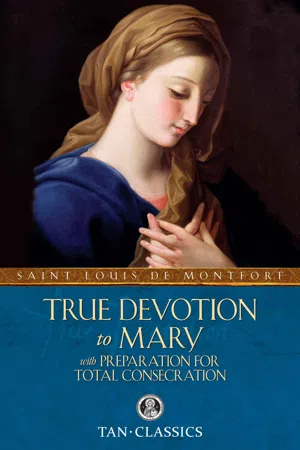
Considered by many to be the greatest single book of Marian spirituality ever written, True Devotion to Mary is St Louis de Montfort's classic statement on the spiritual way to Jesus Christ though the Blessed Virgin Mary. Beloved by countless souls, this book sums up the entire Christian life, showing a way of holiness that is short, easy, secure, and perfect—a way of life chosen by Our Lord Himself. In this beautiful and sublimely inspiring book, de Montfort explains the wonderful spiritual effects which true devotion to Mary brings about in a person's life. This new edition in the TAN Classic format includes an expanded Preparation for Total Consecration with readings and prayers. There is no better way to advance quickly in holiness, no better way to please God, and no better way to guarantee one's present sanctity and eternal salvation than the true devotion to Mary.
All rights reserved. With the exception of short excerpts used in articles and critical reviews, no part of this work may be reproduced, transmitted, or stored in any form whatsoever, printed or electronic, without the prior written permission of the publisher.
Published with the assistance of The Livingstone Corporation. Cover and interior design by Mark Wainright, The Livingstone Corporation. Typeset by Saint Benedict Press, TAN Books.
Cover Image: The Virgin Annunciate by Pompeo Girolamo Batoni (1708-87) (after), Private Collection. Photo: Bonhams, London, UK/The Bridgeman Art Library.
“The more we honor the Blessed Virgin, the more we honor Jesus Christ, because we honor Mary only that we may the more perfectly honor Jesus, since we go to her only as the way by which we are to find the end we are seeking, which is Jesus.” —St. Louis De Montfort
FROM THE POPES
Pope Pius IX declared that St. Louis De Montfort’s devotion to Mary was the best and most acceptable form of devotion to Our Lady.
Pope Leo XIII granted a plenary indulgence to those who make St. Louis De Montfort’s act of consecration to the Blessed Virgin. On his deathbed he renewed the act himself and invoked the heavenly aid of St. Louis De Montfort, whom he had beatified in 1888.
Pope St. Pius X: “I heartily recommend True Devotion to The Blessed Virgin, so admirably written by Blessed De Montfort, and to all who read it grant the Apostolic Benediction.”
Pope Benedict XV: “A book of high authority and unction.”
Pope Pius XI: “I have practiced this devotion ever since my youth.”
Pope Pius XII: “The greatest force behind all his [St. Louis De Montfort’s] apostolic ministry and his great secret for attracting and winning souls for Jesus was his devotion to Mary.” (From Canonization address, July 20, 1947).
Pope Paul VI: “We are convinced without any doubt that devotion to Our Lady is essentially joined with devotion to Christ, that it assures a firmness of conviction to faith in Him and in His Church, a vital adherence to Him and to His Church which, without devotion to Mary, would be impoverished and compromised.”
Pope John Paul II: “The reading of this book was a decisive turning-point in my life. I say ‘turning-point,’ but in fact it was a long inner journey…. This ‘perfect devotion’ is indispensable to anyone who means to give himself without reserve to Christ and to the work of redemption.” “It is from Montfort that I have taken my motto: ‘Totus tuus’ (‘I am all thine’). Someday I’ll have to tell you Montfortians how I discovered De Montfort’s Treatise on True Devotion to Mary, and how often I had to reread it to understand it.”
Vatican Council II: “The maternal duty of Mary toward men in no way obscures or diminishes this unique mediation of Christ, but rather shows its power. All her saving influence on men originates not from some inner necessity, but from the divine pleasure. It flows forth from the superabundance of the merits of Christ, rests on His mediation, depends entirely on it and draws all its power from it.” “… the practices and exercises of devotion to her recommended by the Church in the course of the centuries [are to] be treasured….” (Lumen Gentium: 60, 67).
CONTENTS
ABOUT ST. LOUIS DE MONTFORT
ABOUT TRUE DEVOTION TO MARY
PREFACE BY CARDINAL O’CONNELL
FATHER FABER’S PREFACE
PART ONE
Devotion to the Blessed Virgin Mary
PRELIMINARY REMARKS BY ST. LOUIS DE MONTFORT
CHAPTER ONE
Necessity of the Blessed Virgin and of Devotion to Her
CHAPTER TWO
Fundamental Truths of Devotion to the Blessed Virgin
CHAPTER THREE
Choice of True Devotion to the Blessed Virgin
PART TWO
Perfect Devotion to the Blessed Virgin Mary or Perfect Consecration to Jesus Christ
CHAPTER ONE
Nature of Perfect Devotion to the Blessed Virgin, or Perfect Consecration to Jesus Christ
CHAPTER TWO
Motives of This Perfect Devotion
CHAPTER THREE
Wonderful Effects of This Devotion
CHAPTER FOUR
Particular Practices of This Devotion
SUPPLEMENT
PREPARATION FOR CONSECRATION TO JESUS THROUGH MARY
THE CONSECRATION
The Day of Consecration
The Act of Consecration
THE LITTLE CROWN OF THE BLESSED VIRGIN MARY
THE HOLY ROSARY ACCORDING TO THE METHOD OF ST. LOUIS DE MONTFORT
THE CONFRATERNITY OF MARY, QUEEN OF ALL HEARTS
ABOUT ST. LOUIS DE MONTFORT
St. Louis Marie Grignion de la Bacheleraie, who abandoned his family name for that of his birthplace, was born on January 31, 1673 in the little town of Montfort-la-Canne, which is located in Brittany, France. He studied for the priesthood at St. Sulpice in Paris, having made the 200-mile journey there on foot. He was ordained a priest in 1700, at the age of 27.
St. Louis De Montfort had wanted to become a missionary in Canada, but he was advised to remain in France. There he traveled around the western part of the country, from diocese to diocese and from parish to parish, instructing the people, preaching, helping the poor, hearing confessions, giving retreats, opening schools and rebuilding church buildings. His labors were almost miraculously fruitful. He stated that never did a sinner resist after being touched by him with a Rosary.
But because he encountered great opposition from religious authorities—in particular, being forbidden by the Bishop of Poitiers to preach in his diocese—he decided to travel to Rome to ask the Holy Father if he was doing God’s Will and whether he should continue as before. St. Louis De Montfort walked to Rome—a thousand miles—and put his case to Pope Clement XI. The Pope told him to continue his traveling missionary work, and named him Missionary Apostolic, but told him always to be sure to work under obedience to the diocesan authorities.
One of St. Louis De Montfort’s greatest problems was the opposition he encountered from propagators of the Jansenist heresy, which was then very active in France. The Jansenists spread an atmosphere of harshness and moral rigorism, claiming that human nature was radically corrupted by Original Sin (as opposed to the Catholic teaching that human nature is still essentially good, though fallen, and although it has suffered a darkening of the intellect and weakening of the will). The Jansenists denied that God’s mercy is available to all, and they allowed only infrequent reception of the Sacraments of Penance and the Holy Eucharist, and only after long and severe preparation—with Holy Communion being looked upon as a reward rather than a remedy. Also, they taught that God should always be addressed with fear and trembling. These tenets resembled those of Calvinism. Although Jansenism had been condemned by the Church twice even before St. Louis De Montfort’s birth, its teachings continued to spread and to influence people for a century. In contrast, St. Louis De Montfort preached confidence in Mary and union with her Divine Son.
St. Louis De Montfort founded two religious orders: the Daughters of Wisdom, begun in 1703 from a number of poor and afflicted girls at the Hospital of Poitiers, where he was temporary chaplain, and the Missionaries of the Company of Mary (Montfort Fathers and Brothers), founded in 1715. The Brothers of St. Gabriel, a teaching order, also claim St. Louis De Montfort as their spiritual father.
St. Louis De Montfort left several writings, the most famous being The Secret of the Rosary, True Devotion to Mary, and The Secret of Mary. These books were based on sermons he had given when traveling around France. By spreading devotion to the Blessed Virgin Mary, St. Louis De Montfort was teaching souls to love the devil’s great enemy. (In True Devotion to Mary, he states that the devil fears Mary more than all angels and men, and in a sense more than God Himself—see no. 52). At the Saint’s beatification investigation, many witnesses testified that during his life they had heard struggles between him and the devil, including the sound of fist blows and the swish of whips.
St. Louis De Montfort exhausted his great physical strength by his apostolic labors. On his deathbed in Sainte-Laurent-sur-Sèvre, at age 43, he kissed the crucifix and a statue of the Blessed Mother. Apparently speaking to the devil, he exclaimed: “In vain do you attack me; I am between Jesus and Mary! I have finished my course: All is over. I shall sin no more!” Then he died peacefully on April 28, 1716. His feast day is April 28, the day of his birth in Heaven. St. Louis De Montfort’s writings were examined by the Holy See, which pronounced that there was nothing in them to hinder his beatification and canonization. He was canonized a Saint in 1947.
ABOUT TRUE DEVOTION TO MARY
St. Louis De Montfort himself prophesied regarding True Devotion to Mary: “I clearly foresee that raging beasts shall come in fury to tear with their diabolical teeth this little writing and him whom the Holy Ghost has made use of to write it—or at least to smother it in the darkness and silence of a coffer, that it may not appear. They shall even attack and persecute those who shall read it and carry it out in practice.” (T.D., no. 114). This prediction was fulfilled to the letter. Throughout the whole 18th century, the spiritual sons of St. Louis De Montfort were persecuted by the Jansenists for their zeal in spreading this devotion; the precious manuscript of De Montfort remained hidden during the troubled times of the French Revolution and was brought to light only in the year 1842, when it was found in a chest of old books by a Montfort Father.
The title page from True Devotion was missing, and the book has been variously known as True Devotion to the Blessed Virgin, Treatise on True Devotion to Mary, and True Devotion to Mary—the phrase “true devotion” being drawn from chapter III of Part 1, wherein St. Louis De Montfort distinguishes between true devotion and false devotion to Mary. Over the years, however, the phrase “true devotion” has come to be used in reference to the Perfect Devotion to Mary which is expounded on in Part 2 of the book.
St. Louis De Montfort was the one to whom it was given to explain thoroughly the path “to Jesus through Mary” and to shape it into a definite method of spiritual life. He does not propose some special or “extra” prayers, but rather, a devotion which essentially consists of one single act which, under various forms and conditions, we apply to our whole life, both interior and exterior. This devotion leads to a permanent disposition of living and acting habitually in dependence on Mary; it embraces one’s entire life, not just one’s prayer times or specifically religious acts.
St. Louis De Montfort knew that Mary is the pathway to her Son, leading souls quickly and securely to Jesus Christ, the Eternal Wisdom.
Inflamed with holy love St. Louis De Montfort wrote many poems to the Divine Wisdom, including the following fervent lines:
Divine Wisdom, I love Thee unto folly. I am Thy lover. Thou alone in this world I seek, Thou alone I desire. I am a man gone mad with love, Forever chasing Thee.
Tell me who Thou art, For I am half blind. I can discern only That Thou art a secret I must fathom. Show Thyself fully to my soul Which dies for love of Thee.
Where dost Thou live, Wisdom Divine? Must ...
Table of contents
TRUE DEVOTION to MARY
Trusted by 375,005 students
Access to over 1.5 million titles for a fair monthly price.
Study more efficiently using our study tools.
Frequently asked questions
Yes, you can cancel anytime from the Subscription tab in your account settings on the Perlego website. Your subscription will stay active until the end of your current billing period. Learn how to cancel your subscription
No, books cannot be downloaded as external files, such as PDFs, for use outside of Perlego. However, you can download books within the Perlego app for offline reading on mobile or tablet. Learn how to download books offline
Perlego offers two plans: Essential and Complete
Essential is ideal for learners and professionals who enjoy exploring a wide range of subjects. Access the Essential Library with 800,000+ trusted titles and best-sellers across business, personal growth, and the humanities. Includes unlimited reading time and Standard Read Aloud voice.
Complete: Perfect for advanced learners and researchers needing full, unrestricted access. Unlock 1.5M+ books across hundreds of subjects, including academic and specialized titles. The Complete Plan also includes advanced features like Premium Read Aloud and Research Assistant.
Both plans are available with monthly, semester, or annual billing cycles.
We are an online textbook subscription service, where you can get access to an entire online library for less than the price of a single book per month. With over 1.5 million books across 990+ topics, we’ve got you covered! Learn about our mission
Look out for the read-aloud symbol on your next book to see if you can listen to it. The read-aloud tool reads text aloud for you, highlighting the text as it is being read. You can pause it, speed it up and slow it down. Learn more about Read Aloud
Yes! You can use the Perlego app on both iOS and Android devices to read anytime, anywhere — even offline. Perfect for commutes or when you’re on the go. Please note we cannot support devices running on iOS 13 and Android 7 or earlier. Learn more about using the app
Yes, you can access True Devotion to Mary by in PDF and/or ePUB format, as well as other popular books in Theology & Religion & Christian Denominations. We have over 1.5 million books available in our catalogue for you to explore.