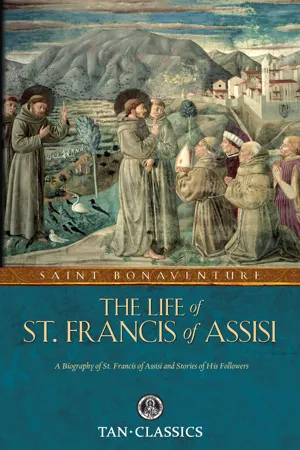
"Francis, go and build up My house, which thou seest, is falling into ruin." To fulfill this command of Our Lord, St Francis of Assisi (1181-1226) began by restoring physical churches and continued by building up the spiritual Church in souls. Francis' humility, purity, and true joy inspired many to conversion and a deeper faith. Never ordained a priest, St. Francis nonetheless was a preacher and a miracle-worker of the first order - curing, prophesying, casting out devils, turning water into wine, and raising people frmo the dead. The Life of St Francis of Assisi by St Bonaventure conveys a picture of the Saint that renders an indelible impression of a man totally transformed by God. This is the original TAN edition now with updated typesetting, fresh new cover, new size and quality binding, and the same trusted content.
- 184 pages
- English
- ePUB (mobile friendly)
- Available on iOS & Android
eBook - ePub
About this book
Information
Topic
Theology & ReligionSubtopic
Religious BiographiesCHAPTER ONE
Of the Manner of Life of St. Francis
Whilst He Yet Wore the Secular Habit
Whilst He Yet Wore the Secular Habit

IN THE city of Assisi there dwelt a man named Francis, whose memory is in benediction; for God in His mercy, preventing him with His divine blessing, vouchsafed to deliver him from the perils of this present life and filled him abundantly with the gifts of His heavenly grace. For although he was brought up in his youth among the vain children of worldly men in the vanities of the world, and was employed by his father, as soon as he had acquired some knowledge of letters, in the pursuit of worldly gain; yet, by the continual present help of God, he never suffered himself to be carried away, like the lawless youths around him, by sensual pleasure, albeit he was of a gay and joyous spirit; nor, although dwelling among covetous traders, was he intent upon gain, nor did he set his heart and hopes on money. For in the soul of this young man there dwelt, by the gift of God, a certain innate and natural love of the poor of Christ, which, growing up with him from his earliest childhood, filled his heart with such benignity that, in obedience to the words of the Gospel, he resolved within himself to give to everyone who should ask of him, and especially if the petitions were made in the Name of God. Now it happened one day, when Francis was wholly engrossed by the tumult of worldly business, that a poor man asked an alms of him; contrary to his usual custom he passed him unheeded, and went on his way. But speedily recollecting himself, he ran after the poor man, charitably relieved his wants, and made a solemn promise to God that, from that day forth, he would never refuse an alms to any that should ask it of him for the love of God. And this promise he faithfully kept till the day of his death, meriting thereby an abundant increase of the grace and love of God. So that he was wont to say, after he had perfectly put on Christ, that even while he still wore the secular habit, he could never hear words expressing the love of God without his heart being deeply moved and affected. And certain it is, that in the sweetness and mildness of his bearing, the gentleness of his manners, his patience and docility—far beyond the ordinary custom of men, the munificence of his bounty, exceeding even the extent of his means—in all these things shone forth the beauty of this young man’s soul, clearly betokening the abundant outpouring of the divine blessing reserved for him in days to come.
A certain man of great simplicity dwelt in those days at Assisi, who, by virtue of knowledge divinely infused, whenever he met Francis in the street, would take of his mantle, and spread it upon the ground before him, declaring that he did so because he was a man worthy of all honor and reverence, who should shortly perform great works and marvellous deeds, and was, therefore, to be highly honored and praised by all faithful Christians.
But Francis as yet knew not, neither understood, the great purposes of God towards him; for being by the will of his father engrossed by external affairs, and also by reason of the original corruption of our nature drawn down and depressed by earthly things, he had not learned to contemplate heavenly mysteries, neither did he yet know the sweetness of divine consolation. And, forasmuch as the Lord is wont, by affictions and tribulations, to open the ears of the spirit, so, by the right hand of the Most High, he was suddenly changed, his body being afficted with long and severe sufferings, that so his soul might be prepared to receive the unction of the Holy Ghost. Now, when he had recovered his bodily health, going forth one day, as was his wont, in apparel suited to his state, he met a certain soldier of honor and courage, but poor and vilely clad; of whose poverty, feeling a tender and sorrowful compassion, he took of his new clothes and gave them to the poor man-at-arms, thus at once fulfilling two offices of piety, by covering the shame of a noble cavalier and relieving a poor man’s penury.
On the following night, when he was asleep, the divine mercy showed him a spacious and beautiful palace filled with arms and military ensigns, all marked with the Cross of Christ, to make known to him that his charitable deed done to the poor soldier for the love of the great King of Heaven should receive an unspeakable reward. And when he asked for whom all these things were reserved, a divine voice answered him that they were for him and for his soldiers.
When Francis awoke, early in the morning, not being yet accustomed to understand and interpret divine mysteries, nor through visible signs to ascend to in visible truths, he thought that this strange vision betokened some great earthly prosperity. Therefore, being still ignorant of the Divine Will, he determined to go into Apulia, there to enter the household of a certain Count of great magnificence and liberality, who dwelt in that country, hoping in his service to acquire military honor and renown, according to what he sup posed to be the meaning of the vision. When he had travelled for some days together, he came to a certain city, when the Lord spoke to him in the night with the familiar voice of a friend, saying, “Francis, who can do most for thee—the Lord or the servant, the rich man or the poor?” And when Francis replied that the Lord and the rich man could do more for him than the poor, “Wherefore, then,” said the voice, “dost thou leave the Lord for the servant, and the God of infinite riches for a poor mortal?” Then said Francis, “Lord, what wilt Thou have me to do?” And the Lord answered: “Return home; for the vision which thou hast seen prefigured a spiritual work which thou shalt bring to pass, not by human counsel, but by divine disposition.” So, when the day dawned, Francis set forth in great haste towards Assisi, full of joy and confidence; and from that time he awaited in obedience the revelation of the Will of God, and withdrawing from the tumult of worldly affairs, he most devoutly besought the divine clemency to vouchsafe to make manifest to him all that he was to do. And so, by the practice of frequent prayer, the vehement fame of heavenly desires increased daily within him, and already, for the love of his celestial country, he despised all earthly things, as if they existed not; for he knew that he had found the hidden treasure, and like a prudent merchant he considered within himself how to sell all that he had to make it his own. But he knew not yet how he was to purchase it, nor what he was to give for it; only it seemed to be made known to him that the spiritual merchant must begin with the contempt of the world, and that the soldier of Christ must begin by victory over himself.
Now, as he was riding one day over the plain of Assisi he met a leper, whose sudden appearance filled him with fear and horror; but forthwith calling to mind the resolution which he had made to follow after perfection, and remembering that if he would be a soldier of Christ he must first overcome himself, he dismounted from his horse and went to meet the leper, that he might embrace him: and when the poor man stretched out his hand to receive an alms, he kissed it and filled it with money. Having again mounted his horse, he looked around him over the wide and open plain, but nowhere could he see the leper; upon which, being filled with wonder and joy, he began devoutly to give thanks to God, purposing within himself to proceed to still greater things than this.
He sought continually for wild and solitary places, where, with tears and unutterable groans, he poured forth long and fervent prayers, until at last our Lord was pleased to hear him; for being one day engaged in fervent prayer, according to his custom, in a lonely place, he became wholly absorbed in God, when Jesus Christ appeared to him under the form of a Crucifix, at which sight his whole soul seemed to melt away; and so deeply was the memory of Christ’s Passion impressed on his heart, that it pierced even to the marrow of his bones. From that hour, whenever he thought upon the Passion of Christ, he could scarcely restrain his tears and sighs; for he then understood (as he made known to some of his familiar friends not long before his death) that these words of the Gospel were addressed to him: “If thou wilt come after Me, deny thyself, and take up thy cross and follow Me.” And from that day forth he clothed himself with the spirit of poverty, the sense of humility, and the affection of interior piety. And inasmuch as heretofore he had greatly abhorred the company of lepers, and could not endure even the distant sight of them, now—for the love of Christ crucifed, who, according to the Prophet’s words, was despised as a leper—he, in contempt of himself, sought out and served lepers with great humility and piety, and aided them in all their necessities. For he often visited them in their houses, giving them bountiful alms, and with affectionate compassion he would kiss their hands and their faces; and he desired to bestow upon poor beggars not only his money, but even himself; often times taking of his own clothes to cover them, tearing or cutting them in pieces for them when he had nothing else to give. With the greatest reverence and piety he was wont to supply the necessities of poor priests, especially by providing them with ornaments for the altar, that so he might at the same time bear his part in the divine worship and provide for the needs of the ministers of God. About this time, he was visiting with great reverence and devotion the holy temple of St. Peter, at Rome; he saw a great multitude of poor surrounding the church door; and partly induced by the love of poverty, partly by the delight which he took in the exercise of works of mercy, he gave his own clothes to the one who seemed most destitute; and putting on the poor man’s rags, he remained there all day amidst these poor people, in marvellous joy and gladness of heart, that so despising the glory of the world he might attain to evangelical perfection. He labored with all diligence at the mortification of the flesh, that thus the Cross of Christ, which he bore inwardly in his heart, might be impressed also outwardly on his body. And all these things were done by Francis, this servant of God, before he had taken the religious habit, or separated himself from the conversation of the world.
CHAPTER TWO
Perfect Conversion of St. Francis to God;
He Rebuilds Tree Churches
He Rebuilds Tree Churches
THROUGHOUT all the time of which we have hitherto spoken, this great servant of God had neither master nor teacher to guide or instruct him, save only Christ our Lord, who, in addition to the gifts already bestowed upon him, was pleased now to visit him with the sweet consolations of His divine grace. For having gone one day into the fields, the better to contemplate and meditate upon heavenly things, he came to the church of St. Damian, which, from its great antiquity, was fast falling into decay, and, by the inspiration of the Spirit of God, he went in thither to pray. As he lay prostrate before a Crucifx he was flled with great spiritual consolation, and gazing with tearful eyes upon the holy Cross of the Lord, he heard with his bodily ears a voice from the Crucifx, which said thrice to him: “Francis, go and build up My house, which, as thou seest, is falling into ruin.” Then Francis, trembling, and full of fear, being in the church alone, wondered at the sound of that marvellous voice, and as his heart received the meaning and power of the divine words he fell into a great ecstasy. When he had recovered his senses, and came to himself, he prepared to obey, and set himself at once to fulfill the command which he had received to repair the material church, although the principal intention of these words referred to that Church which Christ has purchased and built up with His precious Blood, as the Holy Spirit afterwards revealed to him, and as he afterwards made known to the friars.
He arose, therefore, and fortifying himself with the Sign of the Cross, he took out of his house a number of pieces of cloth, with which he went in all haste to the city of Foligno, where he sold all the merchandise which he had brought with him, and the horse also which had carried it, and so the happy merchant returned to Assisi, and reverently entering the church which had been committed to his care, he found there a poor priest, to whom, with due reverence, he offered all his goods for the repair of that church, and for the necessities and use of the poor, humbly beseeching him to suffer him to dwell with him there for awhile.
The priest was well content that he should remain there, but for fear of his father and mother he refused the proffered money. Francis, however, who cared not for anything that might befall him, threw down all the money on a ledge of a window, as if it had been so much dust, and so left it in contempt.
Now when the servant of God had dwelt some days with this priest, his father, coming to hear of it, hastened in great anger to the church. Francis being yet a novice in the service of Christ, hearing the loud threats of his persecutors, and expecting their approach, resolved to give place to wrath, and hid himself for some days in a very secret place, beseeching the Lord continually, with many tears, to deliver his soul from the hands of those who persecuted him, that so he might accomplish the pious design with which He had inspired him. Then, being filled with exceeding joy, he began to reproach himself with his fearfulness and faintness of heart, and leaving his retreat, and casting away all fear, he made his way to Assisi, where, when the citizens saw him, pale and meagre in countenance, and changed in mind and character, many of them judged that he was out of his senses, and began to throw stones and mud at him and to cry after him as a madman. But the good servant of God, unmoved by all these insults, went on his way as if he heard them not. These cries soon reached the ears of his father, who ran to the spot, not to deliver him, but rather to oppress him more cruelly: for seizing him without mercy, he dragged him to his house, reproaching and tormenting him with words, blows and bonds. But he who had now become more prompt and valiant in the service of his Lord, called to mind those words of the Gospel: “Blessed are they who are persecuted for justice’sake, for theirs is the kingdom of heaven.”
Not long afterwards his father was compelled by the affairs of his merchandise to leave Assisi, when his mother, disapproving her husband’s treatment of Francis, and seeing that there was no hope of shaking the invincible constancy of her son, freed him from his bonds and gave him liberty to go whithersoever he would. And so, returning thanks to Almighty God, he returned to St. Damian’s.
When his father came home and found that he was gone, he severely reproved his wife, and went in great anger to seek him, being minded, if he could not bring him home, to drive him altogether out of the country. But Francis, in the strength of God, went forth of his own accord to meet his furious father, declaring that he feared neither his blows nor his chains, and protesting that he was ready to bear every suffering which might await him for the Name of Christ.
The father, seeing that his son could not be moved from his purpose, turned his thoughts next to the recovery of his money. Having found this at last lying, as has been said, on a window-sill, his anger was in some measure appeased by the recovery of the money, which satisfied the thirst of his avarice.
And now his father according to the flesh, having despoiled him of his money, brought this son (no longer his, but the child of divine grace) before the Bishop of Assisi, to compel him to renounce in his hands all his inheritance, and whatsoever he had received from him, which this true lover of poverty was most ready and willing to do. As soon, therefore, as he came into the Bishop’s presence, without a moment’s delay, neither waiting for his father’s demand nor uttering a word himself, he laid aside all his clothes, and gave them back to his father. Then it was seen, that under his fair and costly garments the holy man wore a hard and rough hair-shirt. With marvellous fervor he then turned to his father, and spoke thus to him in the presence of all: “Until this hour I have called thee my father on earth; from henceforth, I may say confidently, my Father Who art in Heaven,in Whose hands I have laid up all my treasures, all my trust, and all my hope.”
When the Bishop, who was a man of great virtue and piety, heard this, he marvelled at the exceeding fervor of the holy man of God, and rising from his seat, he embraced him with many tears, covering him with his mantle, and he commanded his servants to bring some garment wherewith to clothe him. There was brought to him a poor mantle, belonging to a certain laborer of the Bishop, which Francis received with exceeding joy; and with a piece of chalk, which he found lying there, he made the Sign of the Cross upon it, as a garment well befitting a poor half-naked man, crucified to the world.
And thus did this most faithful servant of the great King of Heaven and earth strip himself of all things, that so he might follow the Lord, Whom he so truly loved, Who died naked on the Cross for him; and thus did he arm himself with the Sign of the Cross, committing his soul to that sacred wood of our salvation, to escape thereby from the fearful shipwreck of the world.
From that day forth this great despiser of the world, being freed from all the bonds of worldly cupidity, went forth from the city to a secret and solitary place, where, alone and in silence, he waited the revelation of the Divine Will.
Now it came to pass, that as Francis, the servant of God, was singing the praises of the Lord with great joy and gladness, certain robbers fell upon him and fiercely questioned him, asking him who he was. And when he answered them in truly prophetic words: “I am the herald of the great King of Heaven,” the robbers fell upon him with great fury, and having loaded him with blows, they cast him into a ditch filled with snow, saying: “Lie there, thou herald of nothing, who callest thyself the herald of God.” When they had departed, Francis arose, and, full of exceeding joy, went through the forest, singing with a loud voice the praises of his Creator; and having come to a neighboring monastery, he there asked an alms as a poor man, and as such he received it, for it was given to him as to a vile and un known person.
From thence he came to Gubbio, where he was recognized by one of his own friends, who received him into his house, and gave him a poor old tunic, with which he clothed himself, as in deed and in truth the poor servant of God.
Afterwards, in his deep love of humility, he went among the lepers and remained with them, serving them diligently for the love of God. He washed their feet, bound up their wounds, pressing out the corrupt matter, and then washing and cleansing them. And having done this he kissed their wounds with great and marvellous devotion, as one who in brief space was to become an evangelical physician, and true healer of s...
Table of contents
- Cover Page
- Halftitle Page
- Title Page
- Copyright Page
- Preface
- Prologue
- Contents
- Chapter One: Of the Manner of Life of St. Francis Whilst He Yet Wore the Secular Habit
- Chapter Two: Perfect Conversion of St. Francis to God; He Rebuilds Three Churches
- Chapter Three: Of the Institution of the Order, and the Approbation of the Rule of St. Francis
- Chapter Four: Of the Increase of His Order, and of the Confirmation of the Rule Already Approved
- Chapter Five: Of the Austerity of His Life, and How All Creatures Gave Him Joy and Consolation
- Chapter Six: Of His Humility and Obedience, and How the Divine Majesty Granted All His Prayers
- Chapter Seven: Of His Love of Poverty, and the Wonderful Provision Made For All His Wants By God
- Chapter Eight: Of His Tender Piety, and How Even Creatures Devoid of Reason Were Obedient To His Will
- Chapter Nine: Of the Fervor of His Charity, and of His Desire of Martyrdom
- Chapter Ten: Of His Fervor and Diligence In Prayer
- Chapter Eleven: Of His Knowledge of Holy Scripture, and of His Spirit of Prophecy
- Chapter Twelve: Of the Efficacy of His Preaching, and of His Gift of Healing
- Chapter Thirteen: Of the Sacred Stigmata
- Chapter Fourteen: Of His Patience, and of His Death
- Chapter Fifteen: Of His Canonization and Translation
- Chapter Sixteen: Of Certain Miracles Wrought After His Death
Trusted by 375,005 students
Access to over 1.5 million titles for a fair monthly price.
Study more efficiently using our study tools.
Frequently asked questions
Yes, you can cancel anytime from the Subscription tab in your account settings on the Perlego website. Your subscription will stay active until the end of your current billing period. Learn how to cancel your subscription
No, books cannot be downloaded as external files, such as PDFs, for use outside of Perlego. However, you can download books within the Perlego app for offline reading on mobile or tablet. Learn how to download books offline
Perlego offers two plans: Essential and Complete
- Essential is ideal for learners and professionals who enjoy exploring a wide range of subjects. Access the Essential Library with 800,000+ trusted titles and best-sellers across business, personal growth, and the humanities. Includes unlimited reading time and Standard Read Aloud voice.
- Complete: Perfect for advanced learners and researchers needing full, unrestricted access. Unlock 1.5M+ books across hundreds of subjects, including academic and specialized titles. The Complete Plan also includes advanced features like Premium Read Aloud and Research Assistant.
We are an online textbook subscription service, where you can get access to an entire online library for less than the price of a single book per month. With over 1.5 million books across 990+ topics, we’ve got you covered! Learn about our mission
Look out for the read-aloud symbol on your next book to see if you can listen to it. The read-aloud tool reads text aloud for you, highlighting the text as it is being read. You can pause it, speed it up and slow it down. Learn more about Read Aloud
Yes! You can use the Perlego app on both iOS and Android devices to read anytime, anywhere — even offline. Perfect for commutes or when you’re on the go.
Please note we cannot support devices running on iOS 13 and Android 7 or earlier. Learn more about using the app
Please note we cannot support devices running on iOS 13 and Android 7 or earlier. Learn more about using the app
Yes, you can access The Life of St. Francis of Assisi by in PDF and/or ePUB format, as well as other popular books in Theology & Religion & Religious Biographies. We have over 1.5 million books available in our catalogue for you to explore.