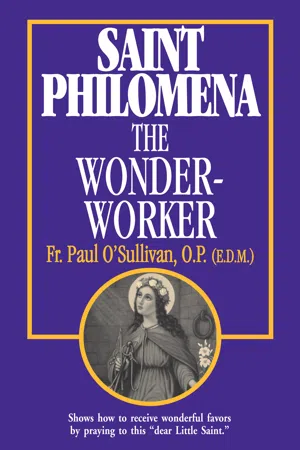
Though nothing historical is known of her, she was declared a Saint in 1837, only 35 years after discovery of her relics. Here is the whole incredible story, plus many accounts of her tremendous favors and miracles. Another St. Jude to call on in our desperate needs. Impr. 192 pgs,
- 192 pages
- English
- ePUB (mobile friendly)
- Available on iOS & Android
eBook - ePub
St. Philomena the Wonder-Worker
About this book
Information
Topic
Teologia e religioneSubtopic
Denominazioni cristiane Chapter 1
THE CATACOMBS
Who has not heard of the Catacombs of Rome— those wonderful, hidden passages and corridors, those subterranean chambers dug out in the bowels of the earth and forming, as it were, a belt of underground fortresses around and in the close vicinity of the Eternal City. After St. Peter’s and a visit to the Holy Father, the Catacombs, with their hallowed memories, are the great sight of Rome. Here venerable Pontiffs, saintly Bishops, spotless Virgins, fearless Martyrs, gathered together in secret to celebrate the Divine Mysteries. Here too, tender youths and venerable old men, proud patricians and humble plebeians, nay princes even and slaves, knelt at the same altar, adored the same God, and participated in the same Divine Food.
Here they met in the evening at the feet of the venerable Pontiff; a few short hours after, they were fighting with lions in the arena, and when the darkness of the night again overshadowed the earth, their mangled remains were borne back for the last benediction to the feet of Christ’s Vicar on earth. Then they were reverently enclosed in crypts hollowed out in the tufa granolare or soft stone, where, side by side, the living dwelt with the dead—these resting after their labors, those awaiting their summons to the battlefield.
The meaning of the word “Catacomb” is not evident at first sight. It would seem to mean a depression or hollow in the ground, and we find it applied for the first time to a neighborhood in the Appian Way, close by the tomb of Cecilia Metellus, under which lay the cemetery of St. Sebastian. The name Catacomb, given to this cemetery, was then gradually applied to the others around Rome. The word thus came to mean a subterranean burial place dug out in the soft stone or tufa by the early Christians.
THE ORIGIN OF THE CATACOMBS HAS NOW BEEN THOROUGHLY INVESTIGATED
For many years it was commonly believed that they had been sand-pits from which, as the sand was extracted for building purposes, long passages and corridors were formed, which in the early ages of Christianity, the faithful used as places of refuge.
This opinion is no longer tenable. The great number of Catacombs are not dug out in the sandy soil, but hollowed out in the strata of soft stone common about Rome.
Moreover, sand-pits must of a necessity have been near the surface of the earth and they must have been so fashioned that the sand could be easily removed from them.
The Catacombs, on the other hand, are sunk deep in the earth—30, 40, or even 50 feet below the surface—and are reached by a steep stairway. They consist of long, narrow passages and corridors opening out into crypts and chambers. These passages intersect each other at different angles, and the corridors so formed present a perfect labyrinth of ways and byways, shooting off for long distances and again branching off into a new maze of streets and cross streets. At intervals, shafts go down from the first set of chambers deeper into the ground and open into new and lower galleries, and others again, from these into still lower depths, so that two, three, and even more tiers of passages and chambers lie, one under the other, forming a very extensive underground city. It is not, therefore, conceivable that these should have originally served as sand-pits, as it would have been well-nigh impossible to extract sand from them in the large quantities required by Roman builders. The truth is that an entrance to the Catacombs was sometimes made through one of the sand-pits so as to avoid detection and to cover the retreat of those who entered. It is also possible that the sand-pits proper might have in the very first days of persecution furnished hiding places for the persecuted Christians, before they had time to prepare a refuge for themselves, as they did shortly afterwards.
The Catacombs, therefore, as we know them, were bored in the soft stone by the early Christians as places of burial for their dead, and for the living as places of refuge in time of persecution.
That they served admirably for these purposes is evident. Firstly, the entrance was carefully concealed. If this were discovered or its position made known by some traitor, the approach of an enemy was speedily discovered and frustrated by the faithful, who fled at the first alarm into the more hidden recesses, where pursuit was out of the question. For it needed not only a perfect knowledge of the corridors, but the greatest circumspection to avoid being lost in the bewildering network of those dark passages, so closely resembling each other. Moreover, the corridors were so narrow that an excavator could in a few minutes throw up a barrier of sand and block them up effectually, thus rendering a chase absolutely impossible. As a final resource, some at least of the Catacombs were joined one with another by secret passages through which the fugitives could escape in an extreme necessity.
THE EXACT DATE OF THE FIRST CATACOMB IS NOT KNOWN
The pagans usually cremated their dead. This custom seems to have been abhorrent at all times to the Christians. Like the Jews, they preferred to bury their dead, according to the custom prevalent in Palestine, that is, in vaults cut out in the rock, such as we read of regarding the burial place of Lazarus. The Sepulchre which Joseph of Arimathea ceded for the burial of Our Lord was also hewn out of rock.
Since, however, the persecution started in the reign of Nero (A.D. 54-68), and the Christians could not safely perform the burial services in the presence of their heathen enemies above ground, it is clear that from a very early date indeed they must have begun to hollow out these subterranean cemeteries. We have proofs of the existence of the Catacombs certainly as early as the reign of Domitian, A.D. 96.
It is not easy to divine where the Christians who died in Rome before this date were buried. No traces of such burial places are to be found, but it is surmised that they were buried either in the Jewish cemetery, less abhorrent to them than pagan burial grounds, or that Roman converts who had private mausoleums allowed their new brethren to have a resting place in the immediate proximity of their own.
THE EXTENT OF THE CATACOMBS
The Catacombs are enormous in extent, and it is calculated that, if instead of being grouped around Rome they were stretched out in one direction, they should reach to a length of several hundred miles. Grave authorities tell us that six million Christians were buried in the Catacombs. The number is not excessive if we calculate that these cemeteries were in use upwards of 300 years and that in these 300 years 10 bloody persecutions were waged against the helpless Christians. Though the 60 Catacombs in the vicinity of Rome are the most famous, there are others scattered over different parts of Italy, France, Greece, Illyria, Africa and Asia Minor, all of which possess many notable archeological treasures.
WHY THE CATACOMBS WERE ABANDONED
The Catacombs were naturally abandoned when Constantine gave lasting peace to the Catholic Church. Hiding places were no longer required, and there was no further need for subterranean burial places. They were venerated however, and most justly so, as places of pilgrimage, for they were the hallowed resting places of the heroes and heroines whose names were in every mouth, whose memories were revered, whose combats and triumphs were the glory and consolation of the Church and whose help was invoked in every need.
Thus they continued until Rome fell prey to the Goths and Lombards. These barbarous invaders, believing that vast treasures were hidden in the underground vaults, invaded the sacred precincts, broke open the tombs of the martyrs and scattered their dust on the ground.
The next phase in the history of the Catacombs was marked by the transference of the relics of the more famous martyrs to the great Basilicas and other Sanctuaries especially erected for them by the Roman Patricians. The Popes, desirous of depositing these precious remains in places more worthy of them and anxious to put before the eyes of the people the examples of those heroes and heroines of the Faith, proceeded to transfer thousands1 of the bodies to above-ground churches, where they would be more accessible to the veneration of the faithful.
The Catacombs, thus despoiled of their richest treasures, became gradually less and less frequented and at last were entirely abandoned. Dirt and debris so blocked the entrances that in a short time all knowledge of their whereabouts was lost to the world, and it was only in the year 1578 that they were casually re-discovered. The Roman Pontiffs now became thoroughly alive to the vast importance of safeguarding them and appointed trustworthy custodians to watch over the treasures still enclosed in them.
The present procedure is as follows: Expert workmen, directed by learned ecclesiastics, are appointed to make excavations. When a new discovery is made, work ceases until the competent authority arrives, and then a minute examination commences under the direction of specialists. Everything on the exterior of the sarcophagus is first carefully noted, after which the sarcophagus is opened for the examination of what may be found inside.
Satisfied that they are in the presence of the relics of a holy Martyr, those present fall on their knees and recite the prescribed prayers. Then follows diligent investigation, and every sign or emblem discovered is described in writing for the better elucidation of the history of the martyr.
1In the cemetery of St. Callixtus, 174,000 martyrs and 45 saintly bishops were buried. Pope Pascal I alone is said to have translated to the Church of St. Praxedes 2,000 bodies!
Chapter 2
THE FINDING OF THE BODY OF ST. PHILOMENA
It was on May 24, 1802 that the excavators came on a loculus that had never been violated. Everything pointed to the fact that the chamber was exactly as it had been when the precious remains were enclosed there long centuries before. The discovery was looked upon from the first as something remarkable, and the opening of the sarcophagus was marked for the very next day, May 25.
On arriving at the spot, the learned custodian noted that the vault was walled up with three terra cotta slabs on which were depicted in red the symbols of martyrdom. They bore the following inscription:
LUMENA—PAX TE—CUM Fl
It would seem that the slabs had been misplaced, as happened so often in the necessary haste of burial. The first slab should have been placed in the third place and when this is done the inscription becomes at once clear:
PAX TE CUM Fl LUMENA PEACE [BE] WITH YOU, PHILOMENA
This “loculus” [tomb] is considered an excellent specimen of its kind and is rendered exceedingly valuable by the inscription on it of the very name of the Martyr whose remains were therein enclosed, a fact of rare occurrence.
In addition to this inscription, there were various emblems painted on the slabs.
First, there was an anchor which, from its resemblance to the Cross, was looked on as an emblem of hope. It is also at times a sign of martyrdom, as anchors were fastened to the neck of some of the confessors when they were thrown into the sea. Some think that St. Philomena was cast into the river Tiber.
Second, there were two arrows, one pointing upwards and the other downwards. These, too, might betoken the kind of death which the martyrs suffered, as some were shot to death with arrows.
Third, there was a lance, which might have had a similar significance.
Fourth, there was a palm—the emblem of the martyr’s triumph.
Fifth, and lastly, there was a lily, an emblem of purity.
Upon the opening of the tomb, the relics of a Virgin Martyr were found, with a glass vase containing a portion of her blood in a dried form.
The dried blood found in vials close to the martyrs’ resting places have been subjected at various times to chemical tests and proved to be blood.1 In the case of the blood of St. Philomena we have a far higher guarantee of its genuineness than any given by such process. The wonders wrought daily in and by this precious relic, and witnessed by countless pilgrims, as well as by keen ecclesiastical experts, furnish us with a supernatural proof of the authenticity of the relic.
The bones, the ashes and the blood of the Saint were carefully placed in a wooden case, which was closed and sealed in three places. This was borne above ground, where it was again opened and minutely examined by experts, among whom were doctors, surgeons and theologians.
The skull was found to have been fractured. The bones were apparently those of a girl, and the doctors surmised that she was twelve or thirteen years of age.
ST. PHILOMENA GOES TO NAPLES
Little indeed is known historically of our Saint previous to her glorious Martyrdom. Her real history commences when her blessed remains were found in May of 1802 after having rested in the obscurity of the Catacomb of St. Priscilla for upwards of 1,700 years.
After the final examination of the relics, a document was made out and placed in the case containing the remains. This was once more closed and sealed and deposited in the chapel or treasury where the bodies of saints and martyrs were kept, awaiting the Holy Father’s orders for bestowal on some church. Three years later, namely, in 1805, the Bishop of Potenza arrived in Rome, accompanied by a humble priest from Mugnano del Cardinale, a village not far from Naples, in the diocese of Nola. During his stay in the Eternal City this good priest, Don Francisco di Lucia, did all in his power to achieve the great ambition of his life, namely, to secure the body of some Virgin Martyr for his church. To this end, he obtained permission to visit the Treasury of Relics, where at first he was perfectly unmoved. As he approached, however, the spot where the relics of St. Philomena were deposited, an indescribable emotion took possession of him, and he felt all at once a burning desire to obtain these precious remains.
Insurmountable difficulties arose. It was against the custom to bestow such treasures on a simple priest. His petition was absolutely and irrevocably refused. An intimate friend of his, seeing his distress, succeeded by personal influence in getting for him the body of another Saint, which he reluctantly accepted, in lieu of what he so earnestly craved for. During the negotiations for the relics, Don Francisco was consumed with fever, lost all appetite, and fell seriously ill. The Bishop of Potenza became seriously alarmed for his life.
One evening, while the good priest was brooding over his disappointment, a sudden inspiration came on him: He promised to take St. Philomena as his special patron and to take her to Mugnano, if only he could get possession of her relics. He was instantaneously cured. Both he and the Bishop were convinced that the cure was a miracle of the Saint. Shortly after, the apparently insuperable difficulties were removed and Don Francisco became the happy possessor of the ashes, the bones, and the blood of St. Philomena.
From this moment forward began an uninterrupted series of miracles and wonders, the like of which have been rarely or perhaps never seen in the history of the Church. The sick were healed, the dying restored to health, sinners were converted, and evil-minded men punished. Prodigies the most extraordinary, graces the most abundant, blessings the most copious were the daily fruits of the Little Saint’s intercession.
The Bishop and Don Francisco, deeply grateful for the latter’s wonderful cure, promised to take the holy relics in their own carriage and give them the place of honor. The day of departure arrived. The bustle and fuss of preparation drove the promise out of the heads of the travellers. One thing, however, they made perfectly sure of and that was that the relics were safe. They were placed under the seat occupied by the Bishop and securely fastened. Scarcely, however, had His Lordship taken his place in the carriage when he felt sharp blows on his legs. He was forced to get out, and gave orders to the coachman to fasten the box more securely. It was, however, perfectly clear to all present that the case was as secure as it could possibly be. Nothing could displace it. Very much surprised, His Lordship resumed his seat, but the blows became again so violent that he was once more forced to relinquish his place and leave the carriage. This gave occasion to new discussions and further examination. All now saw for themselves that the case was so well fastened that not even the violent jolting of the carriage could move it, yet the carriage had not move...
Table of contents
- St Philomena the Wonder-Worker
- Title Page
- Copyright Page
- Byline
- Contents
- Publishers’ Note
- Letters of Cardinals and Bishops
- Foreword: A Priest and a Soldier
- 1. The Catacombs
- 2. The Finding of the Body of St. Philomena
- 3. The Marvels of Mugnano
- 4. The Great Miracle of Mugnano
- 5. A Visit to Mugnano
- 6. The Curé of Ars and St. Philomena
- 7. Other Favored Sanctuaries
- 8. The Sovereign Pontiffs and St. Philomena
- 9. The Intercession of the Saints
- 10. Who Was St. Philomena?
- 11. How to Honor St. Philomena
- 12. What the Thaumaturga Does for Schools
- 13. Answers to Prayer
- Supplement No. 1
- Supplement No. 2
- Appendix
- Other Books
Trusted by 375,005 students
Access to over 1.5 million titles for a fair monthly price.
Study more efficiently using our study tools.
Frequently asked questions
Yes, you can cancel anytime from the Subscription tab in your account settings on the Perlego website. Your subscription will stay active until the end of your current billing period. Learn how to cancel your subscription
No, books cannot be downloaded as external files, such as PDFs, for use outside of Perlego. However, you can download books within the Perlego app for offline reading on mobile or tablet. Learn how to download books offline
Perlego offers two plans: Essential and Complete
- Essential is ideal for learners and professionals who enjoy exploring a wide range of subjects. Access the Essential Library with 800,000+ trusted titles and best-sellers across business, personal growth, and the humanities. Includes unlimited reading time and Standard Read Aloud voice.
- Complete: Perfect for advanced learners and researchers needing full, unrestricted access. Unlock 1.5M+ books across hundreds of subjects, including academic and specialized titles. The Complete Plan also includes advanced features like Premium Read Aloud and Research Assistant.
We are an online textbook subscription service, where you can get access to an entire online library for less than the price of a single book per month. With over 1.5 million books across 990+ topics, we’ve got you covered! Learn about our mission
Look out for the read-aloud symbol on your next book to see if you can listen to it. The read-aloud tool reads text aloud for you, highlighting the text as it is being read. You can pause it, speed it up and slow it down. Learn more about Read Aloud
Yes! You can use the Perlego app on both iOS and Android devices to read anytime, anywhere — even offline. Perfect for commutes or when you’re on the go.
Please note we cannot support devices running on iOS 13 and Android 7 or earlier. Learn more about using the app
Please note we cannot support devices running on iOS 13 and Android 7 or earlier. Learn more about using the app
Yes, you can access St. Philomena the Wonder-Worker by Rev. Fr. Paul O'Sullivan, O.P. in PDF and/or ePUB format, as well as other popular books in Teologia e religione & Denominazioni cristiane. We have over 1.5 million books available in our catalogue for you to explore.