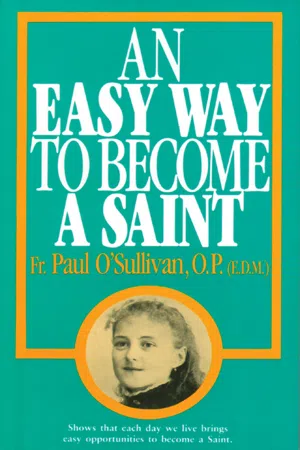
A very optimistic book showing how an "ordinary" Catholic can become a great saint without ever doing anything "extraordinary"--just by using the many opportunities for holiness that to most people lie hidden in each day. Written with an assurance of success that is totally convincing and infectious. Many easy but infallible means of reaching great sanctity.
- 120 pages
- English
- ePUB (mobile friendly)
- Available on iOS & Android
eBook - ePub
An Easy Way to Become a Saint
About this book
Information
Topic
Theology & ReligionSubtopic
Christian DenominationsChapter 1
TWO KINDS OF SAINTS
There are saints and saints. Some we may call "extraordinary saints" and some "ordinary saints."
Extraordinary saints are raised up by God for some extraordinary mission, and to these God gives extraordinary means to carry out that mission.
Such were, for instance, St. Dominic, St. Francis of Assisi, St. Ignatius Loyola and a host of others.
St. Dominic was raised up by God to defend the Church against the Albigensian heretics, who taught the vilest doctrines and perpetrated the most hideous crimes. Kings sent armies against them, the Pope sent holy men to check them, but all in vain.
God then raised up St. Dominic who, by the holiness of his life and his earnest preaching, converted 100,000 of these hardened sinners in a remarkably short time.
Notwithstanding his austere life and incessant labors, there was no one more joyful, more lovable than St. Dominic. He was sad only when he heard of the sorrows of others or of offenses committed against his dear Lord.
The Saint founded three religious orders, which have given to the Church notable saints, missionaries, martyrs, bishops and popes.
What especially endears him to us is the fact that it was he who gave us the Rosary, which God's Holy Mother had given to him.
Who has not heard of the seraphic St. Francis of Assisi, so famous for his profound humility, his extreme poverty and his burning love of God, as a reward of which he received on his hands and feet and in his side the Sacred Stigmata, the marks of Christ's five wounds.
He, too, founded three religious orders, which have given many and great saints to the Church, people such as St. Bonaventure, St. Anthony of Padua, St. Clare and many others, saints who shine as bright stars in the firmament of Heaven.
St. Ignatius of Loyola is another example of an extraordinary saint. He began life as a soldier in the army of Spain, but God called him to be a great soldier of Holy Church.
To him was given the mission to battle against the pseudo-reformers, as to St. Dominic had been given the task of converting the Albigenses.
His glorious order, the Society of Jesus, has done and is ever doing a mighty work for the glory of God and for the welfare of the world at large. His sons are ever in the vanguard of the battle, fighting valiantly against the enemies of Christ.
Now these extraordinary saints, inspired by God, used extraordinary means to achieve their great ends. They labored incessantly, spent long hours in prayer, fasted rigorously and did severe penance. God favored them with supernatural visions and revelations and gave them the power of working miracles.
Ordinary Christians are not called upon to do such mighty deeds, nor are they asked or advised to imitate the long prayers, the rigorous fasts of these extraordinary saints.
ORDINARY SAINTS
There is, however, a second class of saints, ordinary saints. Bear in mind that these saints are no less saints than the others; they are true saints and have reached exalted heights of sanctity, though in a different way.
They lead humble, simple lives, performing their daily duties well and using the ordinary but abundant means of sanctity given by God to all Christians.
These means we too can use, and by them we can attain a high degree of holiness.
Here is a good example of the ordinary saint.
THE TWO LADIES
The great St. Antony, the abbot who had spent long years in the desert, passing whole nights in prayer and performing severe penances, aware of how important the virtue of humility is in the spiritual life, asked God to make him profoundly humble.
In answer to his prayer, the Almighty directed him to visit two ladies in the neighboring city, who though simple and unpretentious in their manner of life, were, so God told Antony, holier than he who had spent long years in the practice of rigorous penance and unceasing prayer.
On entering their home, the Saint sought to discover the secret of such remarkable holiness; he asked them many questions as to the fasts they made, the length of their prayers, their austerities and the like, so that he might imitate them.
He was not a little surprised to learn that they did nothing exceptional. They observed the fasts of the Church; they said their prayers devoutly; they gave what little alms they could afford; they frequented the Sacraments, heard daily Mass and practiced the ordinary Christian virtues.
What impressed the Saint most was that they loved God very simply but very sincerely. God was the great reality in their lives. They did all their actions for love of Him. They performed their daily duties, seeing God in all they did. They accepted what happened to them, joys as well as sorrows, as coming directly from His hand.
That was all, but it sufficed to explain to the Saint the secret of their wonderful sanctity, viz., they performed their duties well and they loved God.
There are thousands of such hidden, ordinary saints in the Church now, as there have been at all times.
SAINT THERESE OF LISIEUX
We have a striking example in our own days of a canonized saint who was actually given to us as an example of how to become holy, by what she herself tells us is the easy, the "little way" to Heaven.
St. Therese of Lisieux never worked a miracle, never enjoyed heavenly visions, never did anything extraordinary, but she did well all that she did. She tells us that she went to Heaven in an elevator (a lift).
In the Carmelite convent in which she lived, none of the sisters remarked anything wonderful in her conduct. She was sweet and joyful and was the sunshine of the community. Possibly some of the other sisters prayed longer and did more rigorous penances than she did.
An incident which took place before her death shows how simple and unpretentious was her life.
It was the custom in the convent for the prioress to write a short account of the life of each sister after that sister's death. During the illness of St. Therese, two sisters were heard speaking of this. One said to the other, "Poor Mother Prioress, whatever will she find to write about poor little Sister Therese?"
Yet this dear little saint began to work so many wonders after her death and obtain so many favors for those who had recourse to her that the whole world rang with her praises. She was solemnly canonized after a remarkably short time.
What a consolation she offers to those who wish to be holy! Hers was the little, the easy way, the elevator (lift) by which we, too, no matter how weak we are, can go to Heaven.
BENIGNA CONSOLATA
A second example that will encourage the humblest of us is the story of Benigna Consolata. Her life, her conduct were so ordinary that those who were most intimate with her had not the faintest idea that she was a saint.
She did not spend her nights in prayer, nor did she fast more rigorously than the others; she never worked miracles, yet her pure, humble life attracted the love of Our Lord, who frequently appeared to her and treated her with the most loving intimacy.
When speaking to her, He addressed her by her pet name, "Nina Mia." Her name was Benigna Philomena Consolata. He revealed to her the most consoling doctrines and said to her, "My dear little Secretary, write all I tell you, that others may know it."
The sisters who lived with her were utterly surprised when they learned after her death of her wonderful sanctity.
We ourselves may be surprised when we enter Heaven to see on high thrones those whom we knew on Earth but whose sanctity we did not suspect.
THE CHILDREN OF FATIMA
What happened more recently at Our Lady's sanctuary in Fatima will serve as another lesson on how to reach great holiness by simple means.
The Angel Guardian of Portugal came to prepare the three chosen children who were later on destined to see Our Blessed Lady.
Three things the Angel bade them do, viz., to pray devoutly, to hate sin and to offer to God with patience the sufferings the Almighty would be pleased to send them, this for His greater glory and for the salvation of souls. God's Holy Mother herself, when she came, taught them the same lessons, which enabled these poor ignorant little children to become worthy of their glorious mission.
Can we not do what three poor, unlettered children did?
We ourselves from time to time meet with simple souls whose extraordinary virtue is made evident by a single act.
A dear old woman run over by a carriage in Dublin and horribly crushed was rushed to a hospital.
One of the Mercy Nuns who became her nurse tried with infinite delicacy to comfort and console her.
What was not the nun's surprise when the patient opened her eyes and said, "Sister dear, are you telling me to be resigned to God's holy will? Let me tell you that God's holy will has been always to me as welcome as the fruit to the tree."
Poor, with many sorrows and needs during her long life, she now, in the throes of agony, manifested her perfect union with the will of God.
Monsignor Robert Hugh Benson, the convert son of the Protestant Archbishop of Canterbury, while still a priest, went for a short visit to Catholic Ireland, of which he had heard so much.
At his request, a friend took him to visit some of the poor sick in their little homes.
He saw what he called "wonders." These dear sufferers amazed the young convert by their faith, patience and perfect resignation to the will of God.
One old man was suffering from an awful cancer, already in an advanced stage, which was eating away his breast.
Father Benson, full of compassion, tried to say some words of comfort to him.
"Oh my, Father, it's nothing," replied the old man. "Sure in a few days I will be with God in Heaven. Didn't He suffer much more for me?"
On his return to England, Father Benson wrote a touching article on the heroic patience and faith of these poor people. "They seem to see God," he said.
Owing to political troubles, an unfortunate man slew his enemy, a crown official.
Denounced by a perfidious friend of his own, he was arrested and condemned to death. He repented sincerely of his crime, but could not pardon his base accuser. The chaplain of the prison used his utmost efforts to induce him to go to Confession. "This I cannot do," he said, "because, though sorry for my crime, I cannot pardon my false friend. Thus my Confession would be bad."
A good Sister of Mercy won his heart by her "infinite" kindness and delicacy. She too tried to induce him to confess. In vain.
On the eve of his execution, she made a last, supreme effort. "Do you know who I am?" she asked him. "Yes, Sister, you are an Angel from Heaven."
"No, I am no Angel from Heaven, but I am the sister of the man whom you killed. I have pardoned you, I have fasted and prayed and done all I could to save your soul."
Amazed, the poor man fell on his knees and, in a flood of tears, kissed her feet.
"Yes, yes, Angel of God, for you are, indeed, an Angel. I forgive with all my heart my enemy, oh forgive me you."
Hers, indeed, was heroic forgiveness.
A single act, as we have said, reveals at times heroic sanctity.
The widow's alms won Our Lord's high approbation. "She has given more," He said, "than all the rest." She had given only a mite, but she gave it with all her heart.
The Good Thief's plea for mercy on the cross obtained plenary pardon for all his crimes.
The Publican's short prayer: "O God, have mercy on me, a sinner" made his soul as white as snow.
Chapter 2
HOW TO LOVE GOD
Now let us see what we can do to become saints.
The first, the easiest and the most certain of all means to become a saint is to love God. We cannot possibly do anything holier, anything more pleasing to Him or anything more meritorious for ourselves.
We must learn all about the Love of God, for nothing is more important and more nec...
Table of contents
- Cover Page
- Copyright Page
- Publisher's Note
- CONTENTS
- Foreword: An Easy Way to Become a Saint
- 1. Two Kinds of Saints
- 2. How to Love God
- 3. The Wonderful Things God Has Done for Us
- 4. God's Greatest Proof of Love
- 5. The Passion
- 6. After His Ascension
- 7. We Must Do Everything for the Love of God
- 8. The Principal Duties of the Day
- 9. Reading
- 10. Meditation
- How to Go to Confession
- The Twelve Promises of the Sacred Heart
Trusted by 375,005 students
Access to over 1.5 million titles for a fair monthly price.
Study more efficiently using our study tools.
Frequently asked questions
Yes, you can cancel anytime from the Subscription tab in your account settings on the Perlego website. Your subscription will stay active until the end of your current billing period. Learn how to cancel your subscription
No, books cannot be downloaded as external files, such as PDFs, for use outside of Perlego. However, you can download books within the Perlego app for offline reading on mobile or tablet. Learn how to download books offline
Perlego offers two plans: Essential and Complete
- Essential is ideal for learners and professionals who enjoy exploring a wide range of subjects. Access the Essential Library with 800,000+ trusted titles and best-sellers across business, personal growth, and the humanities. Includes unlimited reading time and Standard Read Aloud voice.
- Complete: Perfect for advanced learners and researchers needing full, unrestricted access. Unlock 1.5M+ books across hundreds of subjects, including academic and specialized titles. The Complete Plan also includes advanced features like Premium Read Aloud and Research Assistant.
We are an online textbook subscription service, where you can get access to an entire online library for less than the price of a single book per month. With over 1.5 million books across 990+ topics, we’ve got you covered! Learn about our mission
Look out for the read-aloud symbol on your next book to see if you can listen to it. The read-aloud tool reads text aloud for you, highlighting the text as it is being read. You can pause it, speed it up and slow it down. Learn more about Read Aloud
Yes! You can use the Perlego app on both iOS and Android devices to read anytime, anywhere — even offline. Perfect for commutes or when you’re on the go.
Please note we cannot support devices running on iOS 13 and Android 7 or earlier. Learn more about using the app
Please note we cannot support devices running on iOS 13 and Android 7 or earlier. Learn more about using the app
Yes, you can access An Easy Way to Become a Saint by Rev. Fr. Paul O'Sullivan, O.P. in PDF and/or ePUB format, as well as other popular books in Theology & Religion & Christian Denominations. We have over 1.5 million books available in our catalogue for you to explore.