Numerous beautiful, true stories about canonized Saints who saw and spoke with the Blessed Mother, e.g., St. Gertrude the Great, St. Francis, St. Bridget, St. Catherine of Siena, St. Teresa of Avila, St. John of the Cross, etc.--17 in all. Imparts a profound realization about the loving role of Mary in the lives of the faithful. One of the most enlightening, enjoyable and inspiring books a person will ever encounter! Impr. 155 pgs,
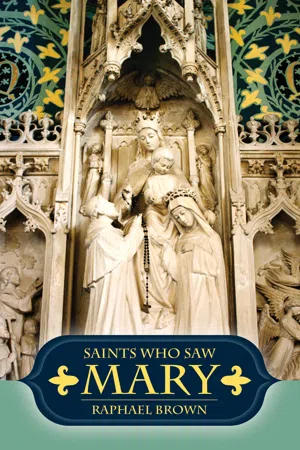
- 155 pages
- English
- ePUB (mobile friendly)
- Available on iOS & Android
eBook - ePub
Saints Who Saw Mary
About this book
Information
Topic
Theology & ReligionSubtopic
Christian DenominationsCHAPTER ONE
ST. GREGORY
THE WONDERWORKER
THE WONDERWORKER
(c. 213-268)
IN THE TOWN of Neocaesarea in Asia Minor during the third century after Christ, there lived a rich and prominent family of pagans whose son, Gregory, was a brilliant and promising young law student. He possessed a keen and inquiring mind, and he relentlessly pursued the truth no matter where it might lead him. Now while he was on a trip to Palestine, Divine Providence, as Gregory himself tells us, led him to meet the fiery Christian philosopher Origen. And when this inspiring teacher had proved to Gregory the necessary limitations of human reason in the most important of all fields of knowledge, namely religion, the young man opened his mind to the light of God's grace and became a fervent and convinced apostle of Christ.
After seven years of study under Origen in the Holy Land, Gregory returned to his home in Neocaesarea. No doubt his friends were shocked to find that this distinguished young man had become a devout, reserved, and humble convert to a mystical other-worldly sect. Certainly Gregory must have been shocked to learn that in all this great and prosperous city, which was steeped in vice and idolatry, there were exactly seventeen Christians.
But he was even more disturbed when he heard that the archbishop of the province was planning not only to ordain him a priest, but also to make him a bishop. In his humility Gregory fled into the desert to think over this unexpected summons. Finally he came to realize that God Himself was calling him to share with his pagan neighbors the grace of conversion which God had given him. So he made an agreement with the archbishop that, after a period of spiritual preparation in the solitude of the desert, he would come to be ordained and consecrated.
Now he set about purifying his mind and soul. But he was sorely troubled by one problem. At that time the most bitter controversy was raging over the exact nature of the Holy Trinity, for the language of theology was not so precise then as it has since become. And Gregory also knew that some of the teachings of Origen were not considered orthodox. Consequently, knowing that as a shepherd of souls he would soon have to teach the truth on these difficult subjects, he turned to God and sought divine light in fervent and continuous prayer.
One night he fell asleep while still meditating. Then, all of a sudden, a venerable old man with an air of almost superhuman dignity and beauty was standing before him. Gregory jumped to his feet in amazement and asked the stranger, "Who are you? What do you want?"
The old man replied quietly and soothingly, "Calm yourself, my son. I have come to help you."
Somehow Gregory immediately felt reassured, and the other continued in his gentle voice: "God has sent me to enlighten you, to solve the problems that are troubling you, and to teach you the truth you are seeking."
As Gregory was beginning to feel new hope and joy, the stranger raised his hand and pointed to one side.
Looking in that direction, Gregory perceived a dazzling light, in the midst of which was a woman whose beauty, grace, and majesty were utterly godlike. As he lowered his eyes before this marvelous being, he heard the lovely woman tell the old man, whom she called John the Evangelist, to explain to Gregory the mystery of the Divine Trinity.
Then St. John said, "I will gladly comply with the wish of the Mother of God." And he proceeded to give Gregory an exact and masterful description of the nature of the three Persons who form the Trinity, ending with these words:
"There is therefore nothing created, nothing greater or less in the Trinity, nothing superadded . . . The Father has never been without the Son, nor the Son without the Spirit; and this same Trinity is immutable and forever unalterable."
In a flash all Gregory's questions were perfectly answered, and he was filled with an inspiring new insight into the deepest mysteries of the Divinity. But now, to his intense sorrow, both the gracious Virgin and St. John vanished from his sight. However, with a prayer of thanks in his heart, he immediately set down in writing the exact words which he had just heard.
And henceforth, as Cardinal Newman writes, he "preached in the Church according to that form, and bequeathed to posterity, as an inheritance, that heavenly teaching." Moreover, Gregory's life was marked by an abundance of miracles. As a result, when Gregory died about thirty years later, he had richly earned his title of St. Gregory "the Wonderworker"–that is, St. Gregory "Thaumaturgus"–and in all the city of Neocaesarea there were exactly seventeen non-Christians.
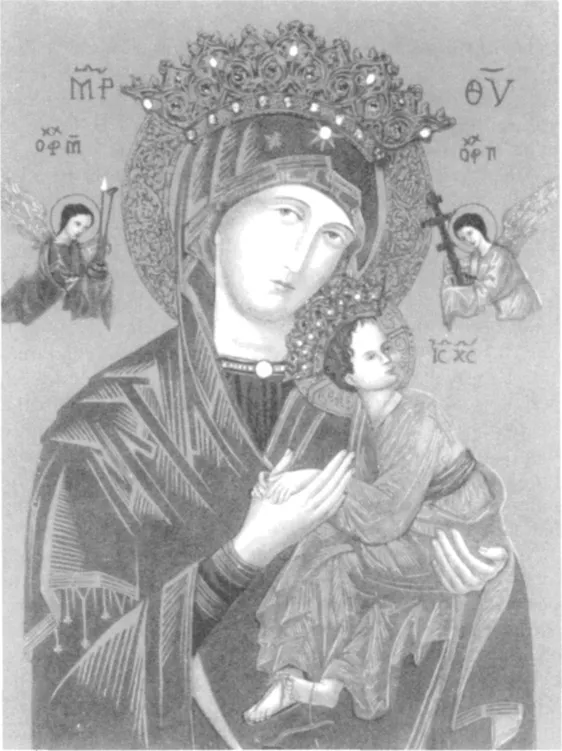
OUR MOTHER OF PERPETUAL HELP. The Mother of God can never be outdone in loving generosity. She appeared to St. Gregory the Wonderworker (c. 213-268), accompanied by St. John the Evangelist, and instructed St. John to explain to Gregory the mystery of the Divine Trinity. In a flash, all of St. Gregory's questions were answered. With thanks in his heart, the Saint wrote down the exact words he had been told.
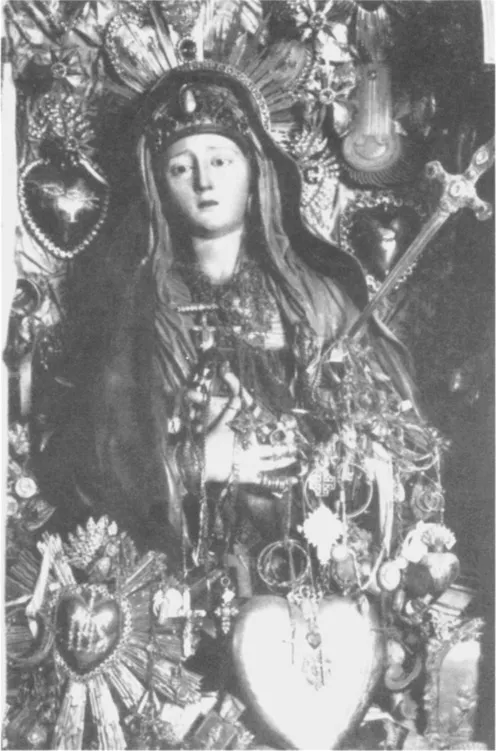
WITH DIVINE ASSISTANCE, St. Gregory earned the title, St. Gregory "Thaumaturgus," or "The Wonderworker." The Saint is credited with an abundance of miracles. The Blessed Virgin Mary, pictured above as the Sorrowful Mother, inspired St. Gregory to heavenly teaching on the mystery of the Holy Trinity.
CHAPTER TWO
ST. MEINRAD (d.861) and ST. CONRAD OF CONSTANCE
(d. 975)
EARLY IN THE ninth century, a saintly, quiet-loving young Benedictine monk named Meinrad, while passing through the city of Zurich on his way to become a teacher at the small monastery of Bollingen, was deeply thrilled when the Abbess-Princess Hildegarde gave him a lovely three-foot wooden statue of the Mother of God holding the Child Jesus in her arms.
Very often during his several years at Bollingen, young Father Meinrad used to gaze out of the window of his cell with ever-increasing longing at a forest-clad mountain on the other side of the lake, for he wished more than anything else to become a hermit and to live a life of prayer, penance and meditation all alone in those woods, like the great hermit-saints of old. Having at last obtained his superiors' permission, one day in the year 828 he took up in his arms his cherished statue of Mary and set out in a wide flat-bottomed boat to cross the lake and become a hermit in the Dark Wood on the slopes of Mount Etzel.
Soon after settling in a solitary retreat he found a nest with two young ravens, which he gladly adopted and tamed, perhaps because the Child Jesus of his statue held a small bird in one hand. Meinrad spent seven years on this mountain, and he was a happy young hermit except for one thing: more and more pilgrims were coming to visit him, attracted by his growing reputation as a saint.
Therefore he fled from his tiny cell, taking his statue and his two friends, the ravens, with him. He went still farther into the depths of the Dark Wood until one day he found, in the midst of the lofty pine trees on a small table-land surrounded by hills on three sides, a bubbling spring giving forth sparkling, fresh mountain water. Here he built himself a little log hut and a chapel, in which he reverently placed Our Lady's statue. His faithful ravens often perched on either side of a crucifix on the gable and watched the holy hermit as he worked and prayed. He was completely happy in this solitude.
But one day a woodcutter discovered Meinrad's retreat, and soon pilgrims were again flocking to receive his blessing and advice. Once some of his Brothers in religion came to visit him, and during the night one of them saw and heard Meinrad reciting his Office with a beautiful seven-year-old boy all dressed in white, who approached the astonished monk and secretly foretold many events which later occurred.
After more than twenty years of prayer and penance, while he was saying Mass in his little chapel on the morning of January 21, 861, the Feast of the Martyr St. Agnes, Meinrad learned by a divine revelation that this was to be his last Mass. With perfect resignation to the will of God, he devoutly received Holy Communion as if it were Holy Viaticum. Then with tears of love in his eyes, the old hermit looked up at his beautiful statue of Mary and begged Our Lady to strengthen him, asking her to offer to her Son the death which he was about to suffer for His glory.
During all the years which Meinrad had spent alone in the Dark Wood, he had never been harmed by the mountain bears or wolves or other wild animals who dwelt there. Now, however, two human beasts of prey, two hardened criminals, hearing that people made pilgrimages to the hermit, were tempted by the idea that he must have precious gifts and rich treasure hidden away in his lonely hermitage. And so this cold winter night they made their way through the deep snow to his retreat in the forest.
Meinrad was just finishing his Mass as they approached, and he now heard the shrill screams of warning of his faithful ravens. With a smile of heavenly joy on his lips, he went out and welcomed the two men with loving kindness and hospitality, setting before them some bread and wine. When they roughly demanded that he show them his hidden treasure, he humbly led them into the little chapel, and pointing to the plain wooden statue above the altar, he said, "I have no other treasure."
Then, with a last loving look at Mary, he folded his hands on his chest, bowed his head, and added calmly, "That for which you have come, do . . ."
In a mad rage the two robbers seized and brutally beat the saintly old hermit to death with a heavy club, while his two ravens flew wildly about, screaming and trying in vain to help their good friend by pecking at the murderers' foreheads.
Then the criminals dragged the Saint's body to his couch of dry leaves in his hut and were about to begin their search for the supposedly hidden treasure when all of a sudden they noticed that a strange yet delicious odor pervaded the place. When they perceived that two candles standing by the hermit's bed had somehow just been lighted without human hand, the two assassins fled in terror all the way to Zurich. But like the accusing finger of God, Meinrad's two ravens persistently followed and attacked the murderers until they were arrested and had confessed the crime.
The body of the holy martyr was taken by his Brothers to the great Abbey of Reichenau near Constance, in which he had entered the Order and been ordained priest.
In the years that followed, pilgrims kept coming to the abandoned little chapel in the Dark Wood, and a few hermit-monks settled there. In the year 906, St. Benno of Strasbourg began to restore and add to the old structures. And in 934, St. Eberhard, also from Strasbourg, arrived and set about building a large monastery and church, the latter enclosing and protecting Meinrad's holy little chapel, which was only eight and a half yards long by six yards wide. When this work was completed in the summer of 948, Eberhard, having become the first Abbot of Einsiedeln, invited St. Conrad, the Bishop of Constance, to consecrate and dedicate the Chapel of Our Lady of the Hermits.
Conrad's party, which included the Bishop of Augsburg and many princes and knights of the Empire, arrived at the hermitage in the Dark Wood on September 13 in the year 948, on the eve of the Feast of the Exaltation of the Holy Cross. And that night there occurred at the Shrine of Our Lady in Einsiedeln one of the most glorious events in all the history of the Catholic Church.
The holy Bishop of Constance retired to his room early in the evening in order to rest after the trip. However, despite his fatigue, he did not fail to get up, as was his custom, before midnight and to go with several religious to pray in the chapel which he was due to consecrate the next morning. While he was fervently beseeching the Blessed Virgin to accept this holy shrine and to make it henceforth a center of pilgrimages where for centuries and centuries she would heal and help her suffering children, suddenly, at exactly midnight, St. Conrad and those with him began to hear the sound of many harmonious voices chanting a melody of heavenly beauty. Looking up, he saw with amazement that the sanctuary of the chapel was filled with a brilliant light that made everything clearer than the brightest noonday sun, and that the altar was completely illuminated as for a solemn festival. Then he saw coming down from Heaven a magnificent procession of angels under the leadership of St. Michael the Archangel. Some of them formed the choir and were chanting celestial psalms, while others bearing swinging golden censers took their places before the altar.
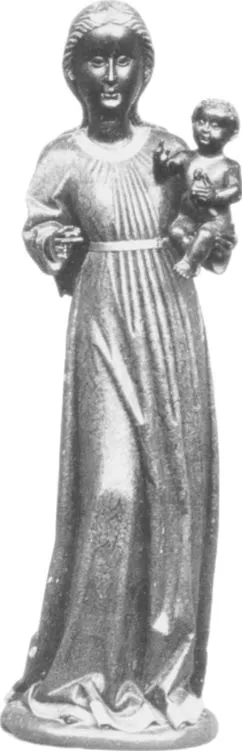
THIS PRECIOUS STATUE of Our Lady of Einsiedeln was placed over the altar of St. Meinrad's simple chapel in the year 828. The Saint had cherished the fond hope of leading a hermit's life, but his solitude was frequently interrupted by visitors who were attracted by his reputation as a saint.
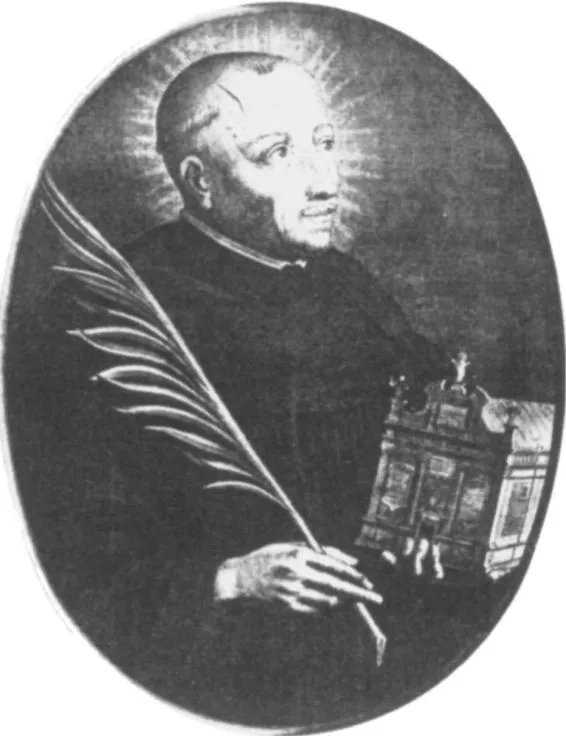
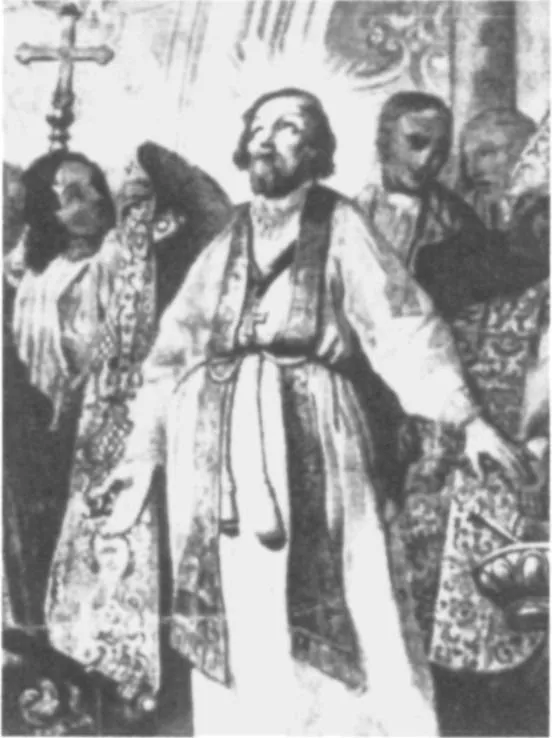
ST. MEINRAD (d. 861), pictured above, and St. Conrad of Constance (d. 975), shown in the fresco below, were both integral to the history of the famous chapel at Einsiedeln, Switzerland. Miraculously dedicated by Our Lord Himself in the year 948, the shrine at Einsiedeln is one of the most popular pilgrimage sites in the world and is visited annually by up to 200,000 pilgrims.
After the angels came St. Peter with a crozier in his hand, followed by St. Matthew, St. Mark, St. Luke and St. John, who preceded three great Doctors of the Church, St. Gregory, St. Augustine and St. Ambrose. Then came, vested as deacon and subdeacon, the Martyr Saints Lawrence and Stephen. And finally, as High Priest, arrayed in pontifical vestments and wearing a violet chasuble, there appeared in all the splendor of His Divinity, Our Lord and Saviour Jesus Christ. Then, as a breathtaking climax, just before God the Son began the Mass that was to consecrate this holy shrine forever to His Immaculate Mother, Mary herself took h...
Table of contents
- Cover Page
- Copyright Page
- CONTENTS
- Foreword
- 1. St. Gregory the Wonderworker
- 2. St. Meinrad and St. Conrad of Constance
- 3. St. Bernard of Clairvaux
- 4. St. Francis of Assisi
- 5. The Seven Servite Saints
- 6. St. Simon Stock
- 7. St. Mechtilde
- 8. St. Gertrude
- 9. St. Bridget of Sweden
- 10. St. Catherine of Siena
- 11. St. Bernardine of Siena
- 12. St. Frances of Rome
- 13. St. Nicholas of Flue
- 14. St. Ignatius of Loyola
- 15. St. Teresa of Avila
- 16. St. John of the Cross
- 17. St.Catherine Labouré
Trusted by 375,005 students
Access to over 1.5 million titles for a fair monthly price.
Study more efficiently using our study tools.
Frequently asked questions
Yes, you can cancel anytime from the Subscription tab in your account settings on the Perlego website. Your subscription will stay active until the end of your current billing period. Learn how to cancel your subscription
No, books cannot be downloaded as external files, such as PDFs, for use outside of Perlego. However, you can download books within the Perlego app for offline reading on mobile or tablet. Learn how to download books offline
Perlego offers two plans: Essential and Complete
- Essential is ideal for learners and professionals who enjoy exploring a wide range of subjects. Access the Essential Library with 800,000+ trusted titles and best-sellers across business, personal growth, and the humanities. Includes unlimited reading time and Standard Read Aloud voice.
- Complete: Perfect for advanced learners and researchers needing full, unrestricted access. Unlock 1.5M+ books across hundreds of subjects, including academic and specialized titles. The Complete Plan also includes advanced features like Premium Read Aloud and Research Assistant.
We are an online textbook subscription service, where you can get access to an entire online library for less than the price of a single book per month. With over 1.5 million books across 990+ topics, we’ve got you covered! Learn about our mission
Look out for the read-aloud symbol on your next book to see if you can listen to it. The read-aloud tool reads text aloud for you, highlighting the text as it is being read. You can pause it, speed it up and slow it down. Learn more about Read Aloud
Yes! You can use the Perlego app on both iOS and Android devices to read anytime, anywhere — even offline. Perfect for commutes or when you’re on the go.
Please note we cannot support devices running on iOS 13 and Android 7 or earlier. Learn more about using the app
Please note we cannot support devices running on iOS 13 and Android 7 or earlier. Learn more about using the app
Yes, you can access Saints Who Saw Mary by Raphael Brown in PDF and/or ePUB format, as well as other popular books in Theology & Religion & Christian Denominations. We have over 1.5 million books available in our catalogue for you to explore.