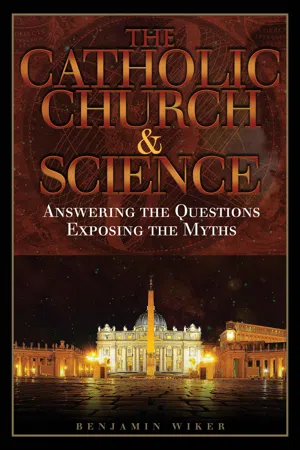
Were the Middle Ages dark for science? Did the pope say Darwin was right? From the Big Bang to Galileo, from the origins of life on Earth to the existence of life on other planets, The Catholic Church and Science clears away the fog of falsehood and misunderstanding to reveal a faith whose doctrines do not contradict the facts of science, but harmonize with them and a universe whose uncanny order and precision point not to chance assemblage by random forces, but to the purpose-built design of an intelligent creator.Author Ben Wiker (The Darwin Myth, A Meaningful World) takes on the most common errors that modern materialistic thinkers, convinced that faith and science must be mortal enemies, have foisted into popular culture. With great learning, clarity, and wit he tackles stubborn confusions many people have about the relationship between Christianity especially Catholicism and the empirical sciences, and separates truth from lies, the factual from the fanciful.
eBook - ePub
The Catholic Church & Science
Answering the Questions, Exposing the Myths
- 192 pages
- English
- ePUB (mobile friendly)
- Available on iOS & Android
eBook - ePub
About this book
Trusted by 375,005 students
Access to over 1.5 million titles for a fair monthly price.
Study more efficiently using our study tools.
Information
Topic
Theology & ReligionSubtopic
Christian DenominationsNotes
Introduction
1. G. K. Chesterton, Orthodoxy (New York: Doubleday, 1959), 100–101.
2. J. L. Heilbron, The Sun in the Church: Cathedrals as Solar Observatories (Cambridge, MA: Harvard University Press, 1999), 3.
3. See Neil Baldwin, Edison: Inventing the Century (Chicago: University of Chicago Press, 2001), especially chapter 10.
First of all, he was not the first to work on the problem of electric luminescence. Humphry Davy (1778–1829) seems to have been the first, and a long list of partially successful inventors and scientists follow leading up to Edison’s triumph in 1879. Edison himself had his own personal struggles in life before becoming an inventor, including being considered a bit slow in school and also gradually losing his hearing from an early age. In regard to the problem of creating a viable electric light, the main difficulty was figuring out what the glowing filament should be made of, and it cost Edison more than a lot of sweat. He fell ill with “neuralgia,” he accidentally burned the side of his face (which caused his eyes to water constantly), and in the midst of his labors, his wife went into labor. On top of all this, Edison, a bit of a showman, had “announced” prematurely to the public that he was on the cusp of victory, and so he was constantly badgered by reporters about his too-slow progress.
Chapter 1
1. For an up-to-date assessment of Draper’s thesis and its long reverberation down through a seemingly endless number of textbooks and popular science books, see Ronald Numbers, ed., Galileo Goes to Jail, and Other Myths about Science and Religion (Cambridge, MA: Harvard University Press, 2009). See also David Lindberg and Ronald Numbers, eds., God and Nature: Historical Essays on the Encounter between Christianity and Science (Berkeley, CA: University of California Press, 1986), introduction; and Lindberg and Numbers, “Beyond War and Peace: A Reappraisal of the Encounter between Christianity and Science,” Perspectives on Science and Christian Faith 39, no. 3: 140–49. (Happily, this last essay is also available on the web at http://www.asa3.org/ASA/PSCF/1987/PSCF9-87Lindberg.html.)
2. From the introduction to Andrew Dickson White, A History of the Warfare of Science with Theology in Christendom (New York: Appleton, 1896). White’s book is available on the web at http://englishatheist.org/white/contents.html. White had published a shorter, earlier version of his two volume argument in 1876, entitled, more economically, The Warfare of Science.
3. There are few screeds against the Church as lively and literary as Part IV of Hobbes’s Leviathan (1651), titled “Of the Kingdom of Darkness.”
4. Henri Thierry Baron d’Holbach, The System of Nature, vol. I (Middlesex, England: The Echo Library, 2006), 7.
5. Baron d’Holbach, The System of Nature, vol. 1, 10.
6. John Paul II, Fides et Ratio (Boston, MA: Pauline Books, 1998), p. 7.
7. John Paul II, Fides et Ratio (Boston, MA: Pauline Books, 1998), Chapter V, Section 49, pp. 66–67.
8. John Paul II, Fides et Ratio, Chapter V, Section 50, p. 67.
9. John Paul II, Fides et Ratio, Chapter V, Sections 52–56, pp. 68–76.
10. Noah Efron, “That Christianity Gave Birth to Modern Science,” in Ronald Numbers, ed., Galileo Goes To Jail, and Other Myths about Science and Religion, p. 79.
11. Alfred North Whitehead, Science and the Modern World (New York: Macmillan, 1967), 12. Whitehead’s book was originally published in 1925.
12. For up-to-date accounts, see John Hedley Brooke, ed., Science and Religion: Some Historical Perspectives (Cambridge: Cambridge University Press, 1991); David Lindberg, The Beginnings of Western Science: The European Scientific Tradition in Philosophical, Religious, and Institutional Context, Prehistory to A.D. 1450 (Chicago: University of Chicago Press, 1992); Edward Grant, The Foundations of Modern Science in the Middle Ages: Their Religious, Institutional and Intellectual Contexts (Cambridge: Cambridge University Press, 1996); Gary Ferngren, Science and Religion: A Historical Introduction (Baltimore, MD: Johns Hopkins University Press, 2002); and James Hannam, God’s Philosophers: How the Medieval World Laid the Foundations of Modern Science (London: Icon, 2009); as well as Numbers, Galileo Goes to Jail; and Lindberg and Numbers, God and Nature.
13. As an introduction see Syed Nomanul Haq, “That Medieval Islamic Culture Was Inhospitable to Science,” in Ronald Numbers, ed., Galileo Goes To Jail, chapter 4; for more detailed analyses see George Saliba, Islamic Science and the Making of the European Renaissance (Cambridge, MA: MIT Press, 2007); Mark Graham, How Islam Created the Modern World (Beltsville, MD: Amana Publications, 2006); and Jonathan Lyons, The House of Wisdom: How the Arabs Transformed Western Civilization (New York: Bloomsbury Press, 2009).
14. See my Moral Darwinism: How We Became Hedonists (Downers Grove, IL: InterVarsity Press, 2002); Peter Gay, The Enlightenment, An Interpretation: The Rise of Modern Paganism (New York: Norton, 1966); Catherine Wilson, Epicureanism at the Origins of Modernity (Oxford: Oxford University Press, 2008); and Jonathan Israel, Radical Enlightenment: Philosophy and the Making of Modernity, 1650–1750 (Oxford: Oxford University Press, 2001).
15. See Charles Webster, From Paracelsus to Newton: Magic and the Making of Modern Science (Cambridge: Cambridge University Press, 1982); William Eamon, Science and the Secrets of Nature (Princeton: Princeton University Press, 1996); D. P. Walker, Spiritual and Demonic Magic: From Ficino to Campanella (London: University of London, 1958); Frances Yates, Giordano Bruno and the Hermetic Tradition (Chicago: University of Chicago Press, 1964).
16. On the connections in regard to alchemy and chemistry see my Mystery of the Periodic Table (Bathgate, ND: Bethlehem Books, 2003), which is an introduction to the history of chemistry for young people, but is quite serviceable as a general introduction; and on a more sophisticated level, my Meaningful World: How the Arts and Sciences Reveal the Genius of Nature (Downers Gr...
Table of contents
- Title Page
- Copyright
- Contents
- A Short but Very Important Introduction
- The First Confusion: “The Catholic Church Is at War with Science (and Faith Is at War with Reason)”
- The Second Confusion: “The Middle Ages Were a Time of Scientific Darkness”
- The Third Confusion: “The Anti-science Catholic Church Persecuted Copernicus and Galileo”
- The Fourth Confusion: “The Church Accepts Darwinism” or “The Church Rejects Evolution”
- The Fifth Confusion: “The Big Bang Is a Scientific Alternative to Belief in a Creator God”
- The Sixth Confusion: “The Origin of Life Was One Big Happy Accident”
- The Seventh Confusion: “The Vastness of the Universe Means Extraterrestrial Life Must Exist”
- Appendix: More Evidence against a Visit by Aliens
- Conclusion
- Notes
Frequently asked questions
Yes, you can cancel anytime from the Subscription tab in your account settings on the Perlego website. Your subscription will stay active until the end of your current billing period. Learn how to cancel your subscription
No, books cannot be downloaded as external files, such as PDFs, for use outside of Perlego. However, you can download books within the Perlego app for offline reading on mobile or tablet. Learn how to download books offline
Perlego offers two plans: Essential and Complete
- Essential is ideal for learners and professionals who enjoy exploring a wide range of subjects. Access the Essential Library with 800,000+ trusted titles and best-sellers across business, personal growth, and the humanities. Includes unlimited reading time and Standard Read Aloud voice.
- Complete: Perfect for advanced learners and researchers needing full, unrestricted access. Unlock 1.5M+ books across hundreds of subjects, including academic and specialized titles. The Complete Plan also includes advanced features like Premium Read Aloud and Research Assistant.
We are an online textbook subscription service, where you can get access to an entire online library for less than the price of a single book per month. With over 1.5 million books across 990+ topics, we’ve got you covered! Learn about our mission
Look out for the read-aloud symbol on your next book to see if you can listen to it. The read-aloud tool reads text aloud for you, highlighting the text as it is being read. You can pause it, speed it up and slow it down. Learn more about Read Aloud
Yes! You can use the Perlego app on both iOS and Android devices to read anytime, anywhere — even offline. Perfect for commutes or when you’re on the go.
Please note we cannot support devices running on iOS 13 and Android 7 or earlier. Learn more about using the app
Please note we cannot support devices running on iOS 13 and Android 7 or earlier. Learn more about using the app
Yes, you can access The Catholic Church & Science by Benjamin Wiker, Ph.D. in PDF and/or ePUB format, as well as other popular books in Theology & Religion & Christian Denominations. We have over 1.5 million books available in our catalogue for you to explore.