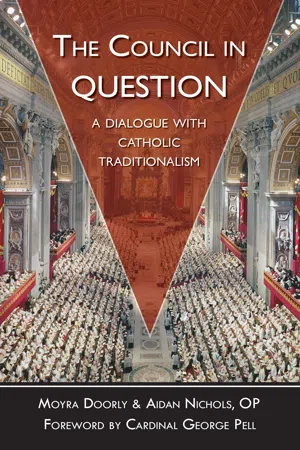
The ideal TAN book! The resurgence of tradition is rekindling devotion, zeal and, we pray, sanctity. But do some place traditionalism before Mother Church herself? This is the issue of our time a unique time, 50 years after Vatican II when much (though not all) of the misapplication of the Council s teaching and the liturgical aberrations have settled. In The Council in Question: A Dialogue With Catholic Traditionalism, journalist Moyra Doorly, an SSPX attendee and Dominican Aidan Nichols engage in a vibrant and enlightening discussion on the health and future of the Roman Catholic Church. Doorly takes up the arguments of the Society of Saint Pius X, while Nichols picks up the mantel of the post-Vatican II Church. This fascinating exchange is more than just a dialogue between two factions of the Church, it is a sign and defense of the genuine continuity and development across the millennia in doctrine, liturgy, and church law. A must-read for lovers of Tradition. US and CA distribution only.
- 140 pages
- English
- ePUB (mobile friendly)
- Available on iOS & Android
eBook - ePub
About this book
Information
Topic
Teologia e religioneSubtopic
Denominazioni cristianeA FINAL BUT NOT NECESSARILY CONCLUSIVE REPLY
Dear Moyra,
WE AGREED that we should each write a Conclusion to this “Dialogue with Catholic Traditionalism,” and you have chosen to make yours a renewed plea for the Traditionalist concept of human dignity, and the limitations that hedge round that dignity after the Fall of Man. You have settled on this point because you take it to be (if I understand you) the key to all Mgr. Lefebvre’s criticisms of the Second Vatican Council, its “letter” as well as its “spirit.” For if human dignity cannot be lost, and the rights it confers remain enduringly intact, where, one might ask, does this leave the radical need for salvation which has always been the foundation of the Church’s claims? If, in some quite fundamental sense, humanity is “all right,” then what is the requirement for a Redeemer? How can we continue to commend the role of the Catholic Church as Mother and Mistress of the nations? Why must the Mass, her central act of worship, be a Sacrifice of supplication and propitiation for miserable offenders, rather than, in all simplicity, an act of praise and thanksgiving for benefits received?
Let me begin by saying I have no difficulty with Archbishop Lefebvre’s distinction between “ontological” and “operative” dignity as such. To my mind, that distinction points precisely to a dignity that can never be lost, since in one of its modes dignity follows from the very being—the “ontology”—of the human person herself. The tragedy of sin is that we betray that dignity. We are princes who drag our noble robes through muck. Our inherent nobility as images of God doesn’t reduce the opprobrium we deserve when we make the Fall our own. On the contrary, that nobility increases our guiltiness. It renders monstrous the evil we do. There is no shred of dignity at work in sinful deeds, no “operative” dignity to be found there at all. Rather do we demean our high calling—I mean, just as human beings, I am not yet talking of our supernatural vocation—in a way no mere animal could ever do. I am reminded of a former prior of Blackfriars Cambridge, Father Thomas Gilby, who, rather in the spirit of the medieval bestiaries, used to remind the congregation here, “Kingfishers are beautiful birds. But they foul their nests.”
So humanity is definitely not “all right.” It needs what the theologians call gratia sanans, the “healing grace” of the God-Man. It needs the wisdom by which Holy Mother Church can interpret the natural law, the law of creation. It needs the Fountain of mercy that stays ever open in the Sacrifice of the altar. And what humanity is offered by Christ and the Church goes beyond even that. His grace is gratia elevans, our movement into the life of God; it is intended as divinization, theosis. The Church’s Eucharist brings not only graces of repentance and conversion, it also brings about, for those who cooperate fully with the mystery, intimate hidden union with God.
I have no objection, Moyra, to your robust doctrine of sin. After the Fall, the phrase “human depravity” is not too strong, and what it denotes comes, as you say, from the weakness of the will in its pursuit of the good and the darkening of the human mind as the orientation towards truth falters. Those negative factors can reach the point when, in a well-ordered society, the civil authority will intervene to inhibit the action of the religiously committed individual—despite the “ontological” dignity of the person—as Dignitatis humanae itself somewhat laconically observes. (para. 2). The Council scarcely expects civil society to follow up the “Declaration on Religious Liberty” by accepting “Thuggee”: the ritualized murder, as an offering to the goddess Kali, which recurs from time to time in rural India even today. Likewise, for any criminally recognized breach of the moral law, whatever its motivation, there is, in a properly functioning society, a price to be paid. If due self-determination implies a right to choose, within reasonable limits, how, where, and with whom one will spend one’s life, then a term of imprisonment is, surely, an infringement of human rights—and, where good law is well administered, a praiseworthy infringement at that.
The trouble with the language of “rights” is it is a wax nose one can press into any shape one likes. As I read recent Church history, the new prominence of rights discourse in the public speech of hierarchs is the work not so much of the Council as of the post-Conciliar popes. In Britain today we have good reason to know it can be both an incubus and a help. At stake in the matter of abortion, is there a woman’s right to choose what to do with the reproductive capacity of her own body? Or is that a pseudo-right, the genuine right being the right to life of the infant she conceived? And in any case, where will the mushrooming of asserted rights end, devaluing as it does the very word on whose moral capital it depends? But before we move to eliminate it from our vocabulary we need to understand what a pope like John Paul II thought he was doing when he adopted rights language so vociferously. He was attacking in the East the Communist system whose philosophy of dialectical materialism had no room for “human nature” and thus for “natural rights.” And similarly he was attacking in the West the legal positivism for which a human right is merely what this or that national legislature happens to say it is. Neither of those errors is compatible with the anthropology of the Church. Natural human rights, when correctly identified, tell us what is justly due to the image of God in man.
Some critics of Traditionalism will say that Mgr. Lefebvre’s systematic hostility to the language of rights merely places him as a particular kind of Frenchman for whom any mention of the “rights of man and the citizen” summons up the specter of the despised Revolution of 1789. As is well known, the Archbishop considered the Council to be the arrival of the French Revolution in the sphere of the Church, the abomination of desolation set up, blasphemously, in the midst of the holy place. No one who is not French can fully understand, perhaps, the power of the counter-revolutionary tradition—the heroic resistance of the Vendée to a godless regime, the hopes placed on the Restoration of the monarchy in 1815, the seizing of the opportunity, at Vichy in 1940, to replace the hated “Liberty, Equality, Fraternity” of the Republic with a new motto more in keeping with Catholic sensibility: “Family, Fatherland, Work.” I note that Bishop Tissier de Mallerais, the Archbishop’s biographer, is, in his own words, the grandson of a “disciple and companion” of Charles Maurras, the chief philosopher of the radical Right in France, condemned by Pius XI but contumaciously followed by a number of Catholics (including the said grandfather) until his (partial) rehabilitation by Pius XII. That is not necessarily a criticism of Traditionalism (after all, most of those who attend the churches and chapels of the Society of St. Pius X are not even French), but it is nonetheless a fact. Before we rush to judgment on its basis, we should reflect that England has never known a revolution of a comparable order. Though we once killed a king in favor of (eventually) a “Lord Protector” and replaced an Anglican settlement with first a Presbyterian and then a Congregationalist one, we soon came to our senses (in 1660). So long as we retain our monarchy and the established Church, our ancien régime continues, at any rate as a legal form and, however weakened, a cultural force.
We can surely recognize the way the French Revolution—which, not without cause, historians often call “The Great Revolution of the West,” for its influence spread far beyond France—was profoundly subversive of historic Christendom. Writing as an apologist for both the Church and modern France, Hilaire Belloc sought to defend the Revolution as naturally Christian in spirit and only anti-Catholic by accident. I tend to agree with the English historian of culture Christopher Dawson: its hostility to the Church was fundamental. The Revolution embodied, wrote Dawson, a religion of human salvation. And he went on to add, in words which, no doubt, Mgr. Lefebvre could echo: the Tree of Liberty replaced the Cross, the Reason of Man substituted for the Grace of God, and the Revolution itself took the place of Redemption.
I think contemporary Churchmen have made a great mistake whenever they have sought to dismantle what the Anglo-Catholic theologian John Milbank calls the “remnants of Christendom.” In the Great Commission at the end of St. Matthew’s Gospel, our Lord asked his apostles to convert the nations, and that cannot be done by targeting individuals on an Alpha Course or even the Rite of the Christian Initiation of Adults. It assumes the steady drip, drip, drip, of the water of Revelation throughout culture in a society where custom and education, art and literature, thought and the laws in vigor, insinuate the faith at all levels. I explain that in my attempted manifesto of plenary Catholicism Christendom Awake, and seek to apply it to our situation at home in a little book called The Realm.
Although what some authors are now calling “Theo-politics” renders me (in appropriate circumstances) sympathetic to the Traditionalist view of the Catholic State (though the Christendom society is far more than its State form), the primary consideration is not, however, the public law of the Church. It is the proper description of the Church in her continuous, self-identical, believing and worshipping existence. That is why I cannot, Moyra, say to Traditionalists, come and join forces with us (orthodox official Catholics) at any price you may set. The price of rejecting the Council en bloc is too high for me to pay. And indeed we can hardly hope to persuade repr sentatives of the civil order of the merits of Catholic truth if at the same time we call into question the coherence of that truth—the internal coherence of the pre- and post-Conciliar tradition considered as a unity.
The weaknesses I have conceded in the Conciliar documents do not, I believe, outweigh their strengths. True, an occasional text is so bland as to be almost nugatory (Inter mirifica, the “Decree on the Instruments of Social Communication,” comes to mind), and set a sad fashion for bureaucratese in Pastoral Letters. Nonetheless, the accents of the great doctors are audible in much that is non-controversial in this corpus of teaching while what is controversial (between official Catholics and Traditionalists, I mean) is also of importance. It is important, I hold, for meeting the trio of imperatives which, so I suggested in my “Introduction” to The Council in Question, lay behind Pope John’s initiative from the beginning. Encouraging the Church to speak more powerfully to the contemporary world; hastening the reunion of separated Christians; recovering more fully the riches of the ancient tradition: these remain legitimate objectives however inept the ways in which some people—many people, alas—have sought to attain them or further them.
This is the tragedy of the post-Conciliar era, that an instrument of Catholic renaissance has been made into a stone of stumbling. But we believe in the divine ability to bring Easter out of Good Friday. The passion of the Church we have lived through, and still experience, must be for some saving good.
Until we meet again, Moyra,
I am yours very sincerely,
I am yours very sincerely,
Fr. Aidan

Saint Benedict Press, founded in 2006, is the parent compa-ny for a variety of imprints including TAN Books, Catholic Courses, Benedict Bibles, Benedict Books, and Labora Books. The company’s name pays homage to the guiding influence of the Rule of Saint Benedict and the Benedictine monks of Belmont Abbey, North Carolina, just a short distance from the company’s headquarters in Charlotte, NC.
Saint Benedict Press is now a multi-media company. Its mis-sion is to publish and distribute products reflective of the Catholic intellectual tradition and to present these products in an attractive and accessible manner.

TAN Books was founded in 1967, in response to the rapid decline of faith and morals in society and the Church. Since its founding, TAN Books has been committed to the preserva-tion and promotion of the spiritual, theological and liturgical traditions of the Catholic Church. In 2008, TAN Books was acquired by Saint Benedict Press. Since then, TAN has expe-rienced positive growth and diversification while fulfilling its mission to a new generation of readers.
TAN Books publishes over 500 titles on Thomistic theology, traditional devotions, Church doctrine, history, lives of the saints, educational resources, and booklets.
For a free catalog from Saint Benedict Press
or TAN Books, visit us online at
saintbenedictpress.com • tanbooks.com
or call us toll-free at
(800) 437-5876
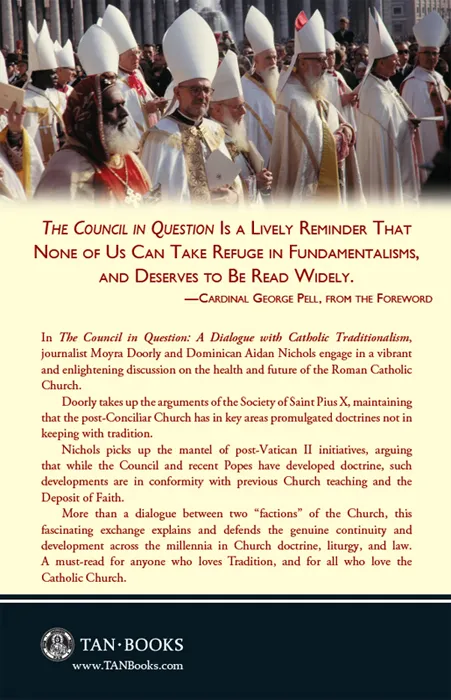
Table of contents
- Front Cover
- Title Page
- Copyright Page
- Contents
- Foreword
- The Making of a Debate: A View from the Official Church
- The Coming of the Controversy: The Society’s Perspective
- First Letter from a Confused Catholic: On the Reform of the Roman Liturgy
- A First Reply to a Confused Catholic
- Second Letter from a Confused Catholic: On the Eucharistic Doctrine of the Missal of Pope Paul VI
- A Second Reply to a Confused Catholic
- Third Letter from a Confused Catholic: On the Idea of Tradition
- A Third Reply to a Confused Catholic
- Fourth Letter from a Confused Catholic: On the Continuity with Tradition of the Second Vatican Council
- A Fourth Reply to a Confused Catholic
- Fifth Letter from a Confused Catholic: On Ecumenism
- A Fifth Reply to a Confused Catholic
- Sixth Letter from a Confused Catholic: On Inter-Religious Dialogue
- A Sixth Reply to a Confused Catholic
- Seventh Letter from a Confused Catholic: On Religious Liberty
- A Seventh Reply to a Confused Catholic
- One Last Letter from a Confused Catholic
- A Final but Not Necessarily Conclusive Reply
- Back Cover
Trusted by 375,005 students
Access to over 1.5 million titles for a fair monthly price.
Study more efficiently using our study tools.
Frequently asked questions
Yes, you can cancel anytime from the Subscription tab in your account settings on the Perlego website. Your subscription will stay active until the end of your current billing period. Learn how to cancel your subscription
No, books cannot be downloaded as external files, such as PDFs, for use outside of Perlego. However, you can download books within the Perlego app for offline reading on mobile or tablet. Learn how to download books offline
Perlego offers two plans: Essential and Complete
- Essential is ideal for learners and professionals who enjoy exploring a wide range of subjects. Access the Essential Library with 800,000+ trusted titles and best-sellers across business, personal growth, and the humanities. Includes unlimited reading time and Standard Read Aloud voice.
- Complete: Perfect for advanced learners and researchers needing full, unrestricted access. Unlock 1.5M+ books across hundreds of subjects, including academic and specialized titles. The Complete Plan also includes advanced features like Premium Read Aloud and Research Assistant.
We are an online textbook subscription service, where you can get access to an entire online library for less than the price of a single book per month. With over 1.5 million books across 990+ topics, we’ve got you covered! Learn about our mission
Look out for the read-aloud symbol on your next book to see if you can listen to it. The read-aloud tool reads text aloud for you, highlighting the text as it is being read. You can pause it, speed it up and slow it down. Learn more about Read Aloud
Yes! You can use the Perlego app on both iOS and Android devices to read anytime, anywhere — even offline. Perfect for commutes or when you’re on the go.
Please note we cannot support devices running on iOS 13 and Android 7 or earlier. Learn more about using the app
Please note we cannot support devices running on iOS 13 and Android 7 or earlier. Learn more about using the app
Yes, you can access The Council in Question by Aidan Nichols, O.P. in PDF and/or ePUB format, as well as other popular books in Teologia e religione & Denominazioni cristiane. We have over 1.5 million books available in our catalogue for you to explore.