On many occasions throughout the history of the Catholic Church, God has provided visible proof of the invisible reality of the Real Presence of Jesus Christ in the Holy Eucharist. In her book, Eucharistic Miracles, Joan Carroll Cruz documents 36 such miracles which occurred from 800 AD to the present day. This book tells of consecrated Hosts which have visibly turned to human flesh, have bled, levitated, and which have become hard as flint when received by a person in mortal sin. It details the official investigations that have been made into these miracles by scientists throughout the world, and where some can still be venerated today. Eucharistic Miracles also recounts miraculous Eucharistic phenomena in the lives of saints: saints who lived with only the Eucharist for sustenance, received Communication miraculously, or experienced raptures, ecstasies, levitations, visions, locutions, and more. Pictures and photographs of the miracles, the churches they took place in, and the people involved are also included, adding the final touch to a comprehensive, detailed, and extraordinary overview of these miraculous happenings.Eucharistic Miracles is a superb compilation of God's visible testimony of the truth of the Catholic Faith, proving the reality of one of its loftiest mysteries — the Real Presence of Jesus Christ in the Holy Eucharist. (352 pgs., .)
eBook - ePub
Eucharistic Miracles
And Eucharistic Phenomenon in the Lives of the Saints
- 353 pages
- English
- ePUB (mobile friendly)
- Available on iOS & Android
eBook - ePub
About this book
Information
Topic
Theology & ReligionSubtopic
Christian Denominations— PART ONE —
EUCHARISTIC MIRACLES
CHAPTER 1
THE MIRACLE OF LANCIANO, ITALY
8th Century
In about the 700th year of Our Lord, in a monastery then named for St. Longinus, the Roman centurion who pierced the side of Christ with a lance, a priest-monk of the Order of St. Basil was celebrating the Holy Sacrifice of the Mass according to the Latin Rite. Although his name is unknown, it is reported in an ancient document that he was “… versed in the sciences of the world, but ignorant in that of God.” Having suffered from recurrent doubts regarding transubstantiation (the change of the bread and wine into the Body and Blood of Christ), he had just spoken the solemn words of Consecration when the host was suddenly changed into a circle of flesh, and the wine was transformed into visible blood.
Bewildered at first by the prodigy which he had witnessed, he eventually regained his composure, and while weeping joyously, he spoke to the congregation: “O fortunate witnesses, to whom the Blessed God, to confound my unbelief, has wished to reveal Himself visible to our eyes! Come, brethren, and marvel at our God, so close to us. Behold the flesh and blood of our Most Beloved Christ.”
The congregation rushed to the altar, marveled at the sight, and went forth to spread the news to other townspeople who, in turn, came to the church to witness the Eucharistic miracle for themselves.
The flesh remained intact, but the blood in the chalice soon divided into five pellets of unequal sizes and irregular shapes. The monks decided to weigh the nuggets. On a scale obtained from the Archbishop, it was discovered that one nugget weighed the same as all five together, two as much as any three, and the smallest as much as the largest.
The Host and the five pellets were placed in a reliquary of artistic ivory. Over the years they have been in the keeping of three different religious orders. At the time of the miracle, the Church of St. Longinus was staffed by Basilian monks, but it was abandoned by them at the close of the 12th century. The property passed quickly to the Benedictines, and then to the Franciscans—who had to demolish the old church because of damage incurred during earthquakes. The new church that was built on the site was named after their founder, St. Francis of Assisi.
History records that after the miracle was certified, a document telling the details of the miracle was written on parchment in both Greek and Latin and was safeguarded by the monks between two tablets. We are told that in the first years of the 16th century, when the monastery was in the possession of the Franciscans, the document was shown to two visiting monks of the Order of St. Basil. Wishing, perhaps, to save their order the disgrace of having the weak faith of one of its members live on in history, they left with the document during the night; and despite many investigations, the Franciscans “… have never been able to find out whither the two fugitives had fled.”
The ivory reliquary was replaced in 1713 by the one which now exhibits the two relics. This is a monstrance of finely sculptured silver and crystal. The flesh is enclosed in the way a Host is usually enclosed in a monstrance, and the nuggets of blood are held in a chalice of artistically etched crystal, which some believe might be the actual chalice in which the miraculous change occurred.
In 1887 Archbishop Petrarca of Lanciano obtained from Pope Leo XIII a plenary indulgence in perpetuity for those who visit the Church of the Miracle during the eight days preceding the annual feast day, the last Sunday of October.
In February of 1574, Monsignor Rodrigues verified in the presence of reputable witnesses that the combined weight of the five pellets of congealed blood was equal to the individual weight of any of them, a fact that was later memoralized by being chiseled on a marble tablet, dated 1636, which is still located in the church. During subsequent authentications of the blood, however, this prodigy was not repeated.
A number of these authentications have been performed throughout the centuries, but the last verification, in 1970, is the most scientifically complete, and it is that examination which we will now consider.
Performed under strict scientific criteria, the task was assigned to Professor Doctor Odoardo Linoli, university professor-at-large in anatomy and pathological histology, and in chemistry and clinical microscopy, head physician of the united hospitals of Arezzo. Professor Linoli availed himself of the services of Doctor Ruggero Bertelli, a professor emeritus of normal human anatomy at the University of Siena. Dr. Bertelli not only concurred with all of Professor Linoli’s conclusions, but also presented an official document to that effect.
Assembled in the sacristy of the Church of St. Francis on November 18, 1970 were the Archbishop of Lanciano, the Bishop of Ortona, the Provincial of the Friars Minor Conventual, the chancellor of the archdiocese, the reverend secretary of the Archbishop and the entire community of the monastery, together with Professor Linoli.
On examining the ostensorium, it was observed that the lunette containing the flesh was not hermetically sealed and that the particles of “unleavened bread” in the center of the flesh, that had remained for many years, had by then entirely disappeared. The flesh was described as being yellow-brown in color, irregular and roundish in shape, thicker and wrinkled along the periphery, becoming gradually thinner as it reached the central area where the tissue was frayed, with small extensions protruding toward the empty space in the middle. A small sample was taken from a thicker part for examination in the laboratory of the hospital in Arezzo.
On examining the five pellets of blood, it was noted that the prodigy regarding the weight of the pellets was no longer evident, as it was last noted in 1574. The five pellets were found to be quite irregular in form, finely wrinkled, compact, homogeneous and hard in consistency, being a yellow-chestnut color and having the appearance of chalk. A small sample was taken from the central part of one pellet for microscopic examination and scientific study. Later, after all the studies were completed, the fragments of both relics were returned to the church.
The conclusions reached by Professor Linoli were presented on March 4, 1971 in detailed medical and scientific terminology to a prestigious assembly, including ecclesiastical officials, the provincials and superiors of the Friars Minor Conventual, and representatives of religious houses in the city as well as civil, judicial, political and military authorities, representatives of the medical staffs of the city hospitals, various religious of the city and a number of the city’s residents.
The professor’s conclusions were later discussed by the Very Rev. Father Bruno Luciani and Professor Urbano, the chief analyst of the city hospital of Lanciano and a professor at the University of Florence. A copy of the detailed report and the minutes of the meeting and discussions are kept in the archives of the monastery. Authentic copies were sent to various officials of the Catholic Church and to superiors of the Order, while another was delivered to His Holiness Pope Paul VI during a private audience.
As a result of the histological (microscopic) studies, the following facts were ascertained and documented: The flesh was identified as striated muscular tissue of the myocardium (heart wall), having no trace whatsoever of any materials or agents used for the preservation of flesh. Both the flesh and the sample of blood were found to be of human origin, emphatically excluding the possibility that it was from an animal species. The blood and the flesh were found to belong to the same blood type, AB. The blood of the Eucharistic miracle was found to contain the following minerals: chlorides, phosphorus, magnesium, potassium, sodium in a lesser degree, and a greater quantity of calcium. Proteins in the clotted blood were found to be normally fractionated, with the same percentage ratio as those found in normal fresh blood.
Professor Linoli further noted that the blood, had it been taken from a cadaver, would have altered rapidly through spoilage and decay. His findings conclusively exclude the possibility of a fraud perpetrated centuries ago. In fact, he maintained that only a hand experienced in anatomic dissection could have obtained from a hollow internal organ, the heart, such an expert cut, made tangentially—that is, a round cut, thick on the outer edges and lessening gradually and uniformly into nothingness in the central area. The doctor ended his report by stating that while the flesh and blood were conserved in receptacles not hermetically sealed, they were not damaged, although they had been exposed to the influences of physical, atmospheric and biological agents.
The ostensorium containing the relics was previously kept to the side of the altar in the Church of St. Francis, but it is now situated in a tabernacle atop the main tabernacle of the high altar. A stairway at the back of the altar enables the visitor to approach very close to the tabernacle, which is open in the back, so that he can clearly see the reliquary containing the flesh and blood.
The visitor will notice that the Host appears rosy in color when it is backlighted. As he gazes, he must undoubtedly reflect upon the countless numbers of others who have looked upon this awesome miracle during its more than 1200 years of existence.
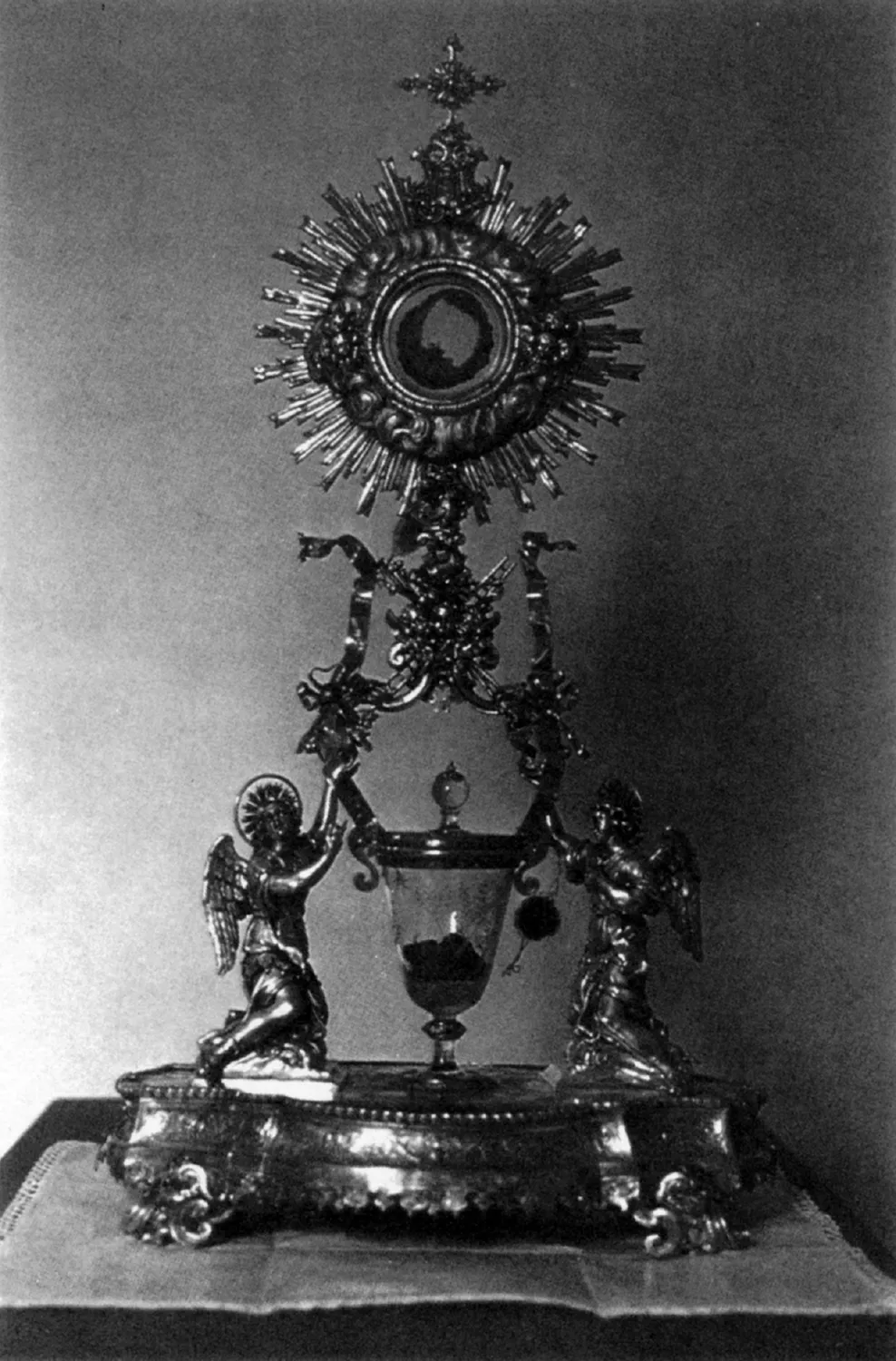
Ostensorium with the miraculous Eucharist of Lanciano—the Host which turned to flesh and the wine which turned to visible blood in the eighth century. A wax seal can be seen to the right of the crystal chalice. This reliquary dates back to 1713, although the chalice itself is thought by some to be the very one in which the miraculous change occurred.

The flesh of the Eucharistic miracle of Lanciano. The circle of flesh appeared around the Host. Over the centuries the “unleavened bread” of the Host has pulverized and disappeared, but the flesh remains intact. At scientific examinations made in 1971 the flesh was found to be human striated muscular tissue of the myocardium (heart wall), type AB, and to be absolutely free of any agents used for preserving flesh.

The blood of the Eucharistic miracle of Lanciano; this blood has divided into five irregularly shaped pellets. At ...
Table of contents
- Front Cover
- Eucharistic Miracles
- Title Page
- Copyright Page
- Dedication
- Contents
- Author’s Preface
- Introduction: The Catholic Teaching on the Holy Eucharist
- Acknowledgements
- Glossary
- Part One: Eucharistic Miracles
- Part Two: Eucharistic Phenomena in the Lives of the Saints
- Selected Bibliography
- About the Author
- Back Cover
Trusted by 375,005 students
Access to over 1.5 million titles for a fair monthly price.
Study more efficiently using our study tools.
Frequently asked questions
Yes, you can cancel anytime from the Subscription tab in your account settings on the Perlego website. Your subscription will stay active until the end of your current billing period. Learn how to cancel your subscription
No, books cannot be downloaded as external files, such as PDFs, for use outside of Perlego. However, you can download books within the Perlego app for offline reading on mobile or tablet. Learn how to download books offline
Perlego offers two plans: Essential and Complete
- Essential is ideal for learners and professionals who enjoy exploring a wide range of subjects. Access the Essential Library with 800,000+ trusted titles and best-sellers across business, personal growth, and the humanities. Includes unlimited reading time and Standard Read Aloud voice.
- Complete: Perfect for advanced learners and researchers needing full, unrestricted access. Unlock 1.5M+ books across hundreds of subjects, including academic and specialized titles. The Complete Plan also includes advanced features like Premium Read Aloud and Research Assistant.
We are an online textbook subscription service, where you can get access to an entire online library for less than the price of a single book per month. With over 1.5 million books across 990+ topics, we’ve got you covered! Learn about our mission
Look out for the read-aloud symbol on your next book to see if you can listen to it. The read-aloud tool reads text aloud for you, highlighting the text as it is being read. You can pause it, speed it up and slow it down. Learn more about Read Aloud
Yes! You can use the Perlego app on both iOS and Android devices to read anytime, anywhere — even offline. Perfect for commutes or when you’re on the go.
Please note we cannot support devices running on iOS 13 and Android 7 or earlier. Learn more about using the app
Please note we cannot support devices running on iOS 13 and Android 7 or earlier. Learn more about using the app
Yes, you can access Eucharistic Miracles by Joan Carroll Cruz in PDF and/or ePUB format, as well as other popular books in Theology & Religion & Christian Denominations. We have over 1.5 million books available in our catalogue for you to explore.