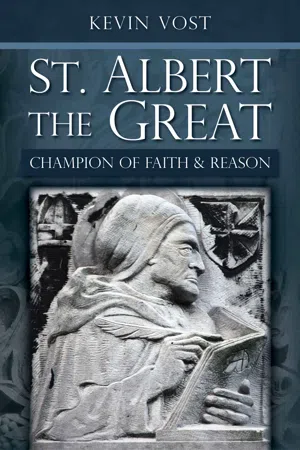
Even while he was still alive, Dominican friar Albert of Cologne was widely called Magnus the Great. His contemporaries said St. Albert simply knew all there was to know; he was a scientist, theologian, and philosopher; a teacher, preacher, and negotiator; a shrewd shepherd and an unflinching defender of the Faith. The time has come to re-discover St. Albert's greatness, and to profit from his prodigious wisdom and virtue as did his famous student, St. Thomas Aquinas. Author Kevin Vost presents St. Albert's brilliant scholarly career at the height of the Church's intellectual renewal in the thirteenth century. St. Albert was tireless (and courageous) in his leadership and works of reform as a Dominican provincial and diocesan bishop. Desperate popes pressed him into diplomatic missions, hoping that Magnus might succeed in making peace where lesser men had failed. These pages not only tell St. Albert's story they share his lessons. Each chapter uses Albertine teachings, and the witness of the saint's life, to instruct, edify, and inspire us to greater holiness and more ardent love. Read St. Albert and see why the greatest man of his age has great things to offer our age as well.
- 208 pages
- English
- ePUB (mobile friendly)
- Available on iOS & Android
eBook - ePub
About this book
Information
Topic
Theology & ReligionSubtopic
Christian DenominationsChapter 1
Saintly Scientist
The first [cause], God—the most true, most sweet, most powerful from eternity forever and ever and reigning through boundless ages—can be known in another way, that is, through his effects.
—St. Albert the Great1
I recommend to you particularly the virtues of courage, which defends science in a world marked by doubt, alienated from truth, and in need of meaning; and humility, through which we recognize the finiteness of reason before Truth which transcends it. These are the virtues of Albert the Great.
—Pope John Paul II2
Perhaps you’ve heard the tale from history books about how Europe was cast in darkness after the fall of Rome. About how it then endured centuries of “dark ages” and only slightly brighter “middle ages” until the bold humanists of the Renaissance cast off the mental shackles of the Catholic Church; rediscovered the wisdom of the ancient pagans; and brought a rebirth of vitality, science, and intelligence to all the Western world.
Well, I’d like to tell two little stories of my own, the first from one of those very Renaissance men, Francis Bacon (1561-1626).
In the year 1432, a group of scholars had been tirelessly and fiercely debating a question of grave importance for a period of nearly two weeks. They had consulted a vast array of ancient learned texts (no doubt the esteemed works of Aristotle and the Church Fathers among them) but could find no answer to their dilemma. The mystery itself was that of “the number of teeth in a horse’s mouth,” but alas, none of the ancient wise men had addressed it and thus arose their stalemate.
Well, on the 14th day, a young friar in their company (I suspect a Dominican) asked if he might make a suggestion, which was to go out into the barn and look into the open mouth of a horse and count the teeth. The scholars were “sore vexed” at such a ludicrous suggestion “in a manner so coarse and unheard-of.” Thereupon, they fell upon the young man, “smote him hip and thigh,” and kicked him out. When they had calmed down and regained their composure many days later, one of them declared the problem an “ever-lasting mystery,” since none of the great theologians had ever addressed it, and “so ordered the same writ down.”3
That’s some funny stuff—and told so well in Bacon’s own words. But before I make any comment, let’s consider the other story.
On a cold Christmas Eve, 13 centuries after the birth of Our Lord, two young German brothers stole from their beds and trod stealthily toward the family barn, hoping to avoid notice of the watchman pacing upon the stone walls. In a land of many tales, the boys had been told that on the eve of Christ’s birth, the animals of the stable spoke as humans did. The older brother speculated that the ox might say, “‘O-o-o-omnes’—that means ‘all’—‘Come all ye faithful.’” The younger brother, only seven, had feared that the animals might speak in Latin, in which case his big brother would have to translate for him. In any event, as they sunk down in the hay and began to observe the ox, the younger brother sneezed; a groomsman heard it, found the boys, and brought them back inside. The younger brother apologized for the sneeze but assured his brilliant older brother that he was so smart that undoubtedly that ox would have spoken just as he thought, since “you’re always right about those things!” But the big brother shook his head and said, “I want to know for sure…I want to hear them—and then we’ll know. You can’t always go by what people say.”4
I came across Bacon’s story of the medieval scholars in a history of psychology class I took in 1993, and it has never failed to amuse me; but as my own knowledge of history and psychology grew, it began to annoy me a bit as well. Bacon presents quite the caricature, portraying the learned doctors of the Middle Ages as unfamiliar with—and flat out opposed to—knowledge of the natural world. That was certainly not always the case, most especially among the friars who wore the habit of St. Dominic!
The second story, the one about the little boys, I came across in Master Albert, Sister Dorcy’s children’s book on St. Albert the Great. The big brother who insisted that he wanted to know for sure would one day be known as the consummate medieval scholar: Albertus Magnus, Albert the Great! The events of that tale, by the way, would have taken place more than 200 years before Bacon’s little fantasy.
Even if both tales are fictional, one thing we’ll learn from the life and lessons of St. Albert is that long before the Renaissance, learned men of God had turned the light of their intellects to the natural world as well, and, like God Himself, they declared it good, very good!
On Albert’s Nature
Albert was a consummate naturalist. He was enamored of created things, from the literal birds and bees to flowers, spiders, lizards, dogs, mountains, stones, and stars, from a very early age. But as immersed as he was in the cultural and spiritual milieu of the medieval age, he knew the things of nature were not complete ends in themselves. He saw nature as the handwork of God that also mirrored, though imperfectly, the nature of its Creator.
One of the myriad natural subjects to interest St. Albert was that of individual differences. What makes each one of us unique? He sought answers in the ancient science of physiognomy, which sought to examine traits of human character, especially as revealed in facial features. Let’s imagine, if you will, the faces of three great saints, and see what they might tell us.
St. Albert was a member and a leader of the Dominican order, whose preacher-friars traveled great distances by foot throughout all of Europe. If we could look upon the face of St. Dominic himself as he walked along, we might well find him looking down or straight ahead, immersed in prayer or conversing about God with his religious brothers. St. Thomas Aquinas, another saintly Dominican, was famous for his professorial absent-mindedness, unaware of his physical surroundings as he pondered the deepest philosophical and theological mysteries. We’d likely see a far-away stare in his eyes. But St. Albert we would probably see walking with his eyes wide open, looking all around him at the wonders of creation. In fact, it’s said that young Albert was so distracted from his spiritual studies by his love of nature that the Virgin Mary, the “Seat of Wisdom” herself, had to come to him to set him straight.
Albert on Nature
St. Albert wrote extensively on the natural world, with books specifically addressing plants, animals, minerals, and more. I’ve seen only snippets of most of them, but I’ve been able to acquire a new English translation of his Questions Concerning Aristotle’s On Animals.5 Here, in 19 “books,” or what we would call chapters, Albert addresses a total of 442 questions on an amazing (and sometimes amusing) diversity of subject matters. Here is a small sample of questions, to give you but a taste of the breadth of his concerns. Some of these may seem rather odd and archaic today and some, perhaps, surprisingly timely:
- Book One, Question 19: Why some animals have feet and some do not.
- Book One, Question 26: Why eyebrows that are straight indicate femininity and pliability whereas ones arched toward the nose indicate discretion and intellect.
- Book One, Question 43: Why a human has such a large brain size in proportion to his body size.
- Book Two, Question 3: Whether the right foot is more unfettered and better suited for motion than the left.
- Book Two, Question 27: Whether the human ought to lack a tail naturally.
- Book Three, Question 27: Whether the marrow is necessary for the bone’s nourishment.
- Book Four, Question 6: Whether fish have hearing.
- Book Four, Question 21: Why some people who eat more are thin, whereas others who eat only a little are fat.
- Book Seven, Question 32: Whether pestilential disease arises from an infection of the air.
Here Albert seeks to know the nature and workings of all varieties of animals and of man himself, both inside and out. He seeks to understand the anatomy and habits of fish, birds, camels, and horses, as well as the mysteries of human conception, growth, development, and aging. He ponders the quirky anomalies of the human mind, covering issues as far-ranging as why “madmen” have such great physical strength to why wise men seem prone to having frivolous children. Albert’s fascination with and love for all of creation burst forth from every page.
Here is a morsel of special significance to me, because on many a day I have sat in a little swivel rocker, swilling coffee, reading books about St. Albert while one of these little guys peered quizzically at me, just feet away, from his perch on a little tree just outside my picture window. “The pirolus is an extremely lively little animal; it nests in the tops of trees, has a long bushy tail, and swings itself from tree to tree, in doing so it uses its tail as a rudder. When on the move it drags its tail behind it, but when sitting it carries it erect up on its back. When taking food it holds it as do the other rodents in its hands, so to speak, and places it in its mouth. Its food consists of nuts and fruit and such-like things.”6 He goes on to describe how its coloring varies in Germany (black when young), in Poland (reddish gray), and in Russia (gray). I’d call the ones in my own neighborhood reddish brown, though there are lots of little gray ones in a park just two miles away.
Perhaps you have identified the “pirolus.” I always associate them with that other great saint of nature, St. Francis of Assisi. For me, this may be partly due to that little statue right outside the same window. One rests at Francis’s shoulder while a deer and a rabbit flank his sides. Now though, whenever I see a busy little squirrel, I think of both a great Franciscan and a great Dominican saint!
Albert was a wonderful observer and describer of nature. Observation and description are the key elements to a scientific approach to the world, after all. When I taught college psychology, I told my students that the three key goals of psychological research were (1) to describe the domain of observational research, (2) to explain the domain of experimental research, and (3) to optimize the domain of practical application. I’m going to attempt to show in the pages ahead how, though rare for the 13th century, Master Albert was a master of all three.
Albertus Magnus, Scientist
Some in Albert’s own time considered him a dangerous innovator, potentially drawing pious souls toward philosophy and science and thereby, they reasoned, away from God. Others in his day and in centuries since have considered him a magician, so vast was his knowledge of nature, mechanics, and medicine. Still others, however, in the centuries after his death, and up to the present day, have considered Albert too little the scientist, chastising him for his ostensible gullibility and his close dependence on Aristotle and other ancients. This last is the kind of thing we saw in the tale of Francis Bacon that began this chapter.
Which is it? If the scientist’s goal is to find the truth, based on the evidence, then to find the truth on St. Albert’s role as a scientist we need to go to the evidence available to us: St. Albert’s own writings and achievements.
Some critics have charged that St. Albert followed Aristotle—who made many errors in his writings on science and nature—too uncritically. But Albert himself pointed out that Aristotle was human and prone to errors. For one example, Aristotle had written that the lunar rainbow occurred only once every 50 years, but Albert reported that Aristotle was in error because he had seen two in the same year himself! And in another instance, where Aristotle had noted that eels feed on nothing but slime, Albert corrects him by noting that he had seen for himself eels feasting on the likes of frogs, worms, and fish. Albert also corrected Aristotle on the number of human ribs and other things.
In reading St. Albert’s purely scientific writings, we likewise find errors and gaps in knowledge common to the greatest minds of his day. Sometimes his sources were responsible for the errors (Albert would often qualify in his writings if certain events had only been reported to him rather than be observed with his own eyes). But often he would set about to verify or correct those very sources with his own experiments. It had been reported, for example, that ostriches ate iron pellets, so he tested this and found an ostrich had no taste for them. He had heard that cicadas continued to produce their noise after they’d lost their heads, which he tested and found to be true. In these and other simple experiments and comments, he showed that he did indeed display a true scientific mindset—one guided by evidence, by observation, and where possible, by experiment.
Indeed, should a modern scientist consider St. Albert’s understanding of the nature and spirit of the scientific mindset lacking, I would direct him, for a start, to Book 11 of the aforementioned Questions Concerning Aristotle’s On Animals. The very first question is “Whether there is a double mode of proceeding in science.”7 By “double mode” he refers to two of the same major goals of science I explained to my college students more than 700 years after St. Albert: “one descriptive, and the other assigning causes,” that is, to describe and to explain the provinces of observational and experimental research.
But St. Albert does far more than name them. In his analysis of science as proposed by Aristotle, Albert examines deeply the very nature of observation and of experimentation, noting how observation serves as a necessary starting point to show us the “whats” of nature, while experiment can lead us to the “whys” as well. He analyzes the four great classes of causes (material, formal, efficient, and final), the nature of scientific classification, including the use of genus and species, and so much more, showing true depth of understanding. He also displays something too often lacking in modern scientists: science’s own dependence on philosophy. Philosophy defines the laws of logical reasoning that we apply to scientific observations and experimental findings, both to find truths about the material world and to help us understand the limitations of those findings.8
Though many of his findings have been superseded by modern science, with its instruments and technologies far exceeding those of seven centuries ago, Albert helped end a scientific standstill that had lasted about three centuries before his time, and his grasp of the very heart of science remains illuminating even today.
Below is a small sample of a few of Albert’s specific scientific contributions with regard to observation, classification, and predictive theory:
- He isolated arsenic.
- He provided the first description of the spinach plant in Western writing.
- He did early work in the theory of protective coloration of animals—including the prediction that animals in the extreme north would have white coloring.
- He determined that the Milky Way is a huge assemblage of stars.
- He determined that the figures visible on the moon were not reflections of earth’s mountains and seas but features of the moon’s own surface.
- He predicted land masses at the earth’s poles.
- He predicted a large land mass to the west of Europe.
- He determined, with the use of mathematical formulae, that the earth was spherical.9
Courage and Humility
There is no doubt that Albert was a scientist, and in his day a great one. But the true greatness of the saintly scientist today shines forth in his saintliness. For him, science served as a means to understand God through His creation, to deepen our awareness of His majesty in the glorious wonders of the universe that is His handiwork. Saints, of course, are models of virtue, and two virtues ascribed to St. Albert by another man whom people have begun to call “the Great,” Pope John Paul II, are the virtues of ...
Table of contents
- Contents
- Acknowledgments
- Author’s Preface: A Great Man for All Seasons
- Introduction: The Least Shall Be the Greatest
- Chapter 1: Saintly Scientist
- Chapter 2: Studious Student
- Chapter 3: Talented Teacher
- Chapter 4: Foundational Philosopher
- Chapter 5: Memory Master
- Chapter 6: Docile Dominican
- Chapter 7: Prudent Preacher
- Chapter 8: Providential Provincial
- Chapter 9: Booted Bishop
- Chapter 10: Coped Crusader
- Chapter 11: Pontifical Peacemaker
- Chapter 12: Mary’s Minstrel
- Chapter 13: Lady Lover
- Chapter 14: Thorough Theologian
- Chapter 15: Charging Champion
- Chapter 16: Cherished Child
- Conclusion: The Undisputed Universal Doctor
- Appendix 1: The Life and Times of St. Albert the Great
- Appendix 2: Prayer of Albert the Great to End a Sermon
- Notes
Trusted by 375,005 students
Access to over 1.5 million titles for a fair monthly price.
Study more efficiently using our study tools.
Frequently asked questions
Yes, you can cancel anytime from the Subscription tab in your account settings on the Perlego website. Your subscription will stay active until the end of your current billing period. Learn how to cancel your subscription
No, books cannot be downloaded as external files, such as PDFs, for use outside of Perlego. However, you can download books within the Perlego app for offline reading on mobile or tablet. Learn how to download books offline
Perlego offers two plans: Essential and Complete
- Essential is ideal for learners and professionals who enjoy exploring a wide range of subjects. Access the Essential Library with 800,000+ trusted titles and best-sellers across business, personal growth, and the humanities. Includes unlimited reading time and Standard Read Aloud voice.
- Complete: Perfect for advanced learners and researchers needing full, unrestricted access. Unlock 1.5M+ books across hundreds of subjects, including academic and specialized titles. The Complete Plan also includes advanced features like Premium Read Aloud and Research Assistant.
We are an online textbook subscription service, where you can get access to an entire online library for less than the price of a single book per month. With over 1.5 million books across 990+ topics, we’ve got you covered! Learn about our mission
Look out for the read-aloud symbol on your next book to see if you can listen to it. The read-aloud tool reads text aloud for you, highlighting the text as it is being read. You can pause it, speed it up and slow it down. Learn more about Read Aloud
Yes! You can use the Perlego app on both iOS and Android devices to read anytime, anywhere — even offline. Perfect for commutes or when you’re on the go.
Please note we cannot support devices running on iOS 13 and Android 7 or earlier. Learn more about using the app
Please note we cannot support devices running on iOS 13 and Android 7 or earlier. Learn more about using the app
Yes, you can access St. Albert the Great by Kevin Vost in PDF and/or ePUB format, as well as other popular books in Theology & Religion & Christian Denominations. We have over 1.5 million books available in our catalogue for you to explore.